Kirjojen hintavertailu. Mukana 11 627 428 kirjaa ja 12 kauppaa.

Kirjahaku

Etsi kirjoja tekijän nimen, kirjan nimen tai ISBN:n perusteella.

1000 tulosta hakusanalla Richard Edwards

The Works of Richard Edwards

The Works of Richard Edwards

Manchester University Press
2009
nidottu
The heart of this book is its fully annotated, critical editions of the surviving work of Richard Edwards, one of the most influential poets and dramatists writing in England before Shakespeare. Ros King's extensive introduction, identifying the holes in the documentary evidence that might accommodate this important but now little known writer, rewrites the history of pre-Shakespearean drama, illustrates new approaches to sixteenth-century prosody and to the modernisation of dramatic poetry, and re-evaluates the public role of theatre and poetry during a particularly turbulent period in English history.While it will be essential reading for specialist scholars, it will also be of much wider interest. The introduction is highly accessible which makes it an appropriate text-book for students in a field where few textbooks are available. It will appeal to the current appetite among the reading public for biography, while the play, poems and songs are themselves very appealing.
Edwards's Great West and her Commercial Metropolis, embracing a general view of the West, and a complete history of St. Louis ... With portraits and biographies of ... old settlers, etc.
Title: Edwards's Great West and her Commercial Metropolis, embracing a general view of the West, and a complete history of St. Louis ... With portraits and biographies of ... old settlers, etc.Publisher: British Library, Historical Print EditionsThe British Library is the national library of the United Kingdom. It is one of the world's largest research libraries holding over 150 million items in all known languages and formats: books, journals, newspapers, sound recordings, patents, maps, stamps, prints and much more. Its collections include around 14 million books, along with substantial additional collections of manuscripts and historical items dating back as far as 300 BC.The GENERAL HISTORICAL collection includes books from the British Library digitised by Microsoft. This varied collection includes material that gives readers a 19th century view of the world. Topics include health, education, economics, agriculture, environment, technology, culture, politics, labour and industry, mining, penal policy, and social order. ++++The below data was compiled from various identification fields in the bibliographic record of this title. This data is provided as an additional tool in helping to insure edition identification: ++++ British Library Edwards, Richard; 1860. 8 . 10412.g.5.
Edwards's great West and her commercial metropolis

Edwards's great West and her commercial metropolis

Richard Edwards; M Hopewell

Alpha Edition
2020
pokkari
This book has been considered by academicians and scholars of great significance and value to literature. This forms a part of the knowledge base for future generations. So that the book is never forgotten we have represented this book in a print format as the same form as it was originally first published. Hence any marks or annotations seen are left intentionally to preserve its true nature.
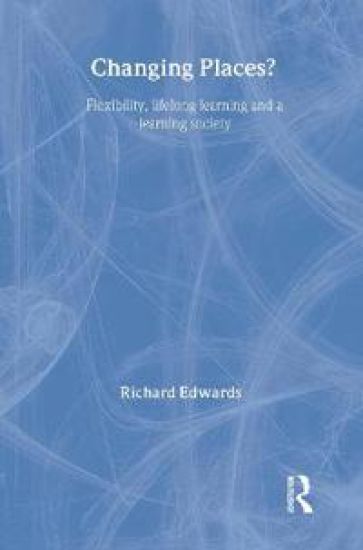
Changing Places?

Changing Places?

Richard Edwards

Routledge
1997
sidottu
Flexibility has become a central concept in much policy and academic debate. Individuals, organizations and societies are all required to become more flexible so that they can participate in the ongoing processes of change involved in lifelong learning. This book explores how the notion of a learning society has developed over recent years: the changes that have given rise to the requirement for flexibility, and the changed discourses and practices that have emerged in the education and training of adults. With the growth in interest in adults as learners, (primarily to support economic competitiveness), the closed field of adult education has now been displaced by a more open discourse of lifelong learning. This involves not only changing practices such as moving towards open and distance-based learning, but also changing workplace identities. Learning settings are therefore changing places in a number of senses: they are places in which people change; they are subject to change; and they are changing to include the home and workplace as well as more formal settings. This book takes an unusually critical standpoint: it challenges contemporary trends, explores the uncertainties and ambivalences of the processes of change, and is suggestive of different forms of engagement with them. It will prove an important text for policy makers, workplace trainers and those working in the field of adult, further and higher education. Richard Edwards is currently a Senior Lecturer in post compulsory education at the Open University.
Changing Places?

Changing Places?

Richard Edwards

Routledge
1997
nidottu
Flexibility has become a central concept in much policy and academic debate. Individuals, organizations and societies are all required to become more flexible so that they can participate in the ongoing processes of change involved in lifelong learning. This book explores how the notion of a learning society has developed over recent years: the changes that have given rise to the requirement for flexibility, and the changed discourses and practices that have emerged in the education and training of adults. With the growth in interest in adults as learners, (primarily to support economic competitiveness), the closed field of adult education has now been displaced by a more open discourse of lifelong learning. This involves not only changing practices such as moving towards open and distance-based learning, but also changing workplace identities. Learning settings are therefore changing places in a number of senses: they are places in which people change; they are subject to change; and they are changing to include the home and workplace as well as more formal settings. This book takes an unusually critical standpoint: it challenges contemporary trends, explores the uncertainties and ambivalences of the processes of change, and is suggestive of different forms of engagement with them. It will prove an important text for policy makers, workplace trainers and those working in the field of adult, further and higher education. Richard Edwards is currently a Senior Lecturer in post compulsory education at the Open University.
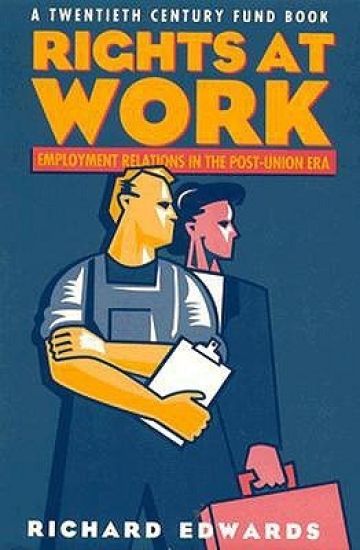
Rights at Work

Rights at Work

Richard Edwards

Brookings Institution
1994
nidottu
"With growing international competition, American firms have been gaced with increasing pressures to produce better products, cut costs, and improve efficiency. As a result, American employers have changed many of their long-standing labor priorities. Work-force stability has become less important; long-term commitments have become less attractive; and labor costs, especially fringe benefits, have come under increased scrutiny. With this large reorganization of work forces and priorities, Americans are again faced with the significant questions of what rights workers have—and should have—in the workplace.In the current environment, employers have a greater need for highly motivated, hard-working, skilled employees, and have often developed innovated forms of management to enlist these worker's support. So too, national legislation has granted workers new rights in recent years, such as mandatory early notification of plant closings, greater rights for workers with disabilities, and increased protection for older workers. State legislators have also enacted expanded protection for workers, and state courts have been rewriting basic legal doctrines governing workers' rights in ways that favor employees.In this book, Richard Edwards explores workers' rights and the institutions that have defined and are now enforcing them. He looks closely at the decline of American unions and its effect on traditional rights. As unions have been transformed from major institutional players in the American economy to much more marginal brokers enrolling only a small minority of American workers, political support for workers' rights has diminished. Edwards also traces the American state courts' and the ongoing revision of the legal interpretations of employment contracts and employers' promises, a development which he believes may revolutionize traditional employment law. Rights at Work cuts through the debate between employers' groups and workers' advocates to find a new common ground. Edwards argues that a new system of employment relations offers a ""win-win"" opportunity, and he proposes some innovative public policy strategies that could protect workers' rights while enhancing employers' ability to succeed in a highly competitive global market."
The World around the Chinese Artist

The World around the Chinese Artist

Richard Edwards

Centre for Chinese Studies Publications
2000
nidottu
In Chinese painting there is no clear desire to separate the subjective world and the objective world. Rather, there is a constant, conscious play between the physical reality of the world and the subjective vision of the artist. The artist is continually imitating the world—sometimes more, sometimes less—but he never denies its appearance to the point of total abstraction; nor, in the other extreme, does he claim for the physical world an existence independent of his own involvement. The World around the Chinese Artist explores this special relationship between the self and the landscape in Chinese art through studies of painters Hsia Kuei (12th–13th centuries), Shen Chou (15th–16th centuries), and Shih-t’ao (17th–18th centuries). Each of these three was important in his own time and deemed a master by later critics. Hsia Kuei was Painter-in-attendance in the Academy of Painting during the reign of Emperor Ning-tsung, and he was concerned with presenting a directly observable view of a physically believable landscape. Shen Chou can be described as the inheritor of Yüan ideals and the recipient of traditional training, yet he developed his own style and sensitivity characterized by walking the hair-line between involvement in and detachment from the world he observed. Shih-t’ao was a Buddhist priest and Confucian who viewed narrow adherence to the past as unacceptable slavery and countered it with conscoius rebellion, painting with special notions of style, independence, and individuality that included freedom and abstraction.