
Kirjahaku
Etsi kirjoja tekijän nimen, kirjan nimen tai ISBN:n perusteella.
1000 tulosta hakusanalla Roberto Calasso
The Review of Contemporary Fiction: Roberto Calasso Issue
Dalkey Archive Press
2019
pokkari
La Memoria, La Storia E La Forma. Percorsi Autobiografici Di Roberto Calasso Autore-Editore
Marco de Cristofaro
Peter Lang AG, Internationaler Verlag der Wissenschaften
2023
nidottu
La ricezione della storia di Adelphi ha risentito a lungo dell'influenza di una delle sue figure pi autorevoli: Roberto Calasso. Quest'ultimo ha dedicato una parte della sua produzione a un discorso sulla figura dell'editore a cui si intrecciano percorsi autobiografici riguardanti la sua attivit nella casa editrice milanese. Attraverso il filtro delle sue memorie editoriali si venuto formando cos un preciso immaginario adelphiano. Il saggio indaga le opere di Calasso che rientrano in questo filone memorialistico. Partendo da un'indagine sulle tecniche narrative utilizzate, la ricerca arriva a delineare il rapporto tra la storia di Adelphi e la sua resa creativa all'interno del racconto dell'editore. Grazie a una prospettiva interdisciplinare che considera la critica letteraria relativa alla scrittura del s , la sociologia della letteratura e le ricerche in campo editoriale, il lavoro vuole proporre un approccio nuovo alla storia culturale in cui lo studio della memoria intellettuale arricchisce e amplia l'indagine storica.

A sparkling new translation of the classic work on violence and revolution as seen through mythology and artThe Ruin of Kasch takes up two subjects: "the first is Talleyrand, and the second is everything else," wrote Italo Calvino when the book first appeared in 1983. Hailed as one of those rare books that persuade us to see our entire civilization in a new light, its guide is the French statesman Charles-Maurice de Talleyrand, who knew the secrets of the ancien régime and all that came after, and was able to adapt the notion of "legitimacy" to the modern age. Roberto Calasso follows him through a vast gallery of scenes set immediately before and after the French Revolution, making occasional forays backward and forward in time, from Vedic India to the porticoes of the Palais-Royal and to the killing fields of Pol Pot, with appearances by Goethe and Marie Antoinette, Napoleon and Marx, Walter Benjamin and Chateaubriand. At the centre stands the story of the ruin of Kasch, a legendary kingdom based on the ritual killing of the king and emblematic of the ruin of ancient and modern regimes.'Startling, puzzling, profound . . . a work charged with intelligence and literary seduction' The New York Times'Unique, idiosyncratic and vaultingly ambitious... essential reading' Independent'A great fat jewel-box of a book, gleaming with obscure treasures' John Banville

All the books published by a certain publisher could be seen as links in a single chain. In this book, the author meditates on the art of book publishing. It looks at the publishing industry as a whole, from the essential importance of graphics, jackets and cover flaps to the consequences of universal digitization.

Tourists, terrorists, secularists, hackers, fundamentalists, transhumanists, algorithmicians: in this book Roberto Calasso considers the tribes that inhabit and inform the world today. A world that feels more elusive than ever before.This book, the ninth part of a work in progress, is a meditation on the obscure and ubiquitous process of transformation happening in societies today, where distant echoes of Auden's The Age of Anxiety give way to something altogether more unsettling.

'Beautiful, intellectually thrilling . . . unlike anything else' TelegraphPromise and separation. Grace and guilt. The chosen and the damned. Roberto Calasso's captivating retelling of key stories from the bible evokes the dramatic world of the Old Testament and casts one of the founding texts of Western civilization in an astonishing - and disquieting - new light. The Book of All Books is the culmination of a lifetime's work and the tenth part of a series that began with The Ruin of Kasch.'Engaging . . . enlightening' Financial Times'Surprising . . . vivid' Spectator

An immersive and mesmerizing narrative that reimagines the Mesopotamian myth of the Great FloodA long time ago, the gods grew tired of humans and decided to send a flood to destroy them. But Ea, the god of fresh underground water, didn't agree. He advised one of his devotees, Utnapishtim, to build a quadrangular boat to house humans and animals, and saved these living creatures from the Flood.Rather than punish Utnapishtim for his disobedience, Enlil, King of the gods, granted the mortal eternal life and banished him to the island of Dilmun. Thousands of years later, when Sinbad the Sailor is shipwrecked and arrives on that very same island, the two begin a conversation about courage, loss, salvation and sacrifice.

'It will be read and re-read not as a treatise but as a story: one of the most extraordinary that has ever been written of the origins of Western self-consciousness' Simon SchamaThe marriage of Cadmus and Harmony was the last time the gods of Olympus feasted alongside mortals. What happened in the distant ages preceding it, and in the generations that followed, form the timeless tales of ancient Greek mythology. In this masterful retelling of the myths we think we know, Roberto Calasso illuminates the deepest questions of our existence.'The kind of book one comes across only once or twice in one's lifetime' Joseph Brodsky'A perfect work like no other' Gore Vidal

'To read Ka is to experience a giddy invasion of stories - brilliant, enigmatic, troubling, outrageous, erotic, beautiful' The New York Times'Who?' - or 'ka' - is the question that runs through Roberto Calasso's retelling of the stories of the minds and gods of India; the primordial question that continues to haunt human existence. From the Rigveda to the Upanishads, the Mahabharata to the life of Buddha, this book delves into the corpus of classical Sanskrit literature to re-imagine the ancient Indian myths and how they resonate through space and time.'The very best book about Hindu mythology that anyone has ever written' Wendy Doniger'Dazzling, complex, utterly original ... Ka is his masterpiece' Sunday Times

'Tiepolo: the last breath of happiness in Europe'The eighteenth-century Venetian painter Giambattista Tiepolo spent his life creating frescoes that are among the glories of Western art, yet he remains shrouded in mystery. Who was he? And what was the significance of the dark, bizarre etchings depicting sacrifice and magic, which he created alongside his heavenly works? Roberto Calasso explores Tiepolo as the last artist of the ancien régime and at the same time the first example of the "painter of modern life" evoked by Baudelaire. He was the incarnation of that peculiar Italian virtue sprezzatura: the art of not seeming artful.Translated by Alastair McEwen'A brilliant, eccentric, provocative . . . and thoroughly splendid celebration of a great painter' John Banville, The New Republic'Calasso is a myth-maker ... a book that treats paintings as a kind of sorcery' Peter Conrad, Observer

What are Kafka's stories about? Are they dreams? Allegories? Symbols? Things that happen every day? But where and when?In this remarkable book, Roberto Calasso sets out not to dispel the mystery but to let it be illuminated by its own light. With his unique vision, imagination, and intellectual acumen, Calasso attempts to enter the flow, the tortuous movement, the physiology of the stories to discover what they are meant to signify and to delve into the most basic question: Who is K.?

Roberto Calasso is one of the most original and acclaimed of writers on literature, art, culture and mythology. In Baudelaire's Folly, Calasso turns his attention to the poets and writers of Paris in the nineteenth century who created what was later called 'the Modern.' His protagonist is Charles Baudelaire: poet of nerves, art lover, pioneering critic, man about Paris, whose groundbreaking works on modern culture described the ephemeral, fleeting nature of life in the metropolis - and the artist's role in capturing this - as no other writer had done. With Baudelaire's critical intelligence as his inspiration, Calasso ranges through his life and work, focusing on two painters - Ingres and Delacroix - about whom Baudelaire wrote acutely, and then turns to Degas and Manet, who followed in the tracks Baudelaire laid down in his great essay The Painter of Modern Life. In a mosaic of stories, insights, dreams, close readings of poems and commentaries on paintings, Paris in Baudelaire's years comes to life. In the eighteenth century, a 'folie' was a garden pavilion set aside for people of leisure, a place of delight and fantasy. Here Calasso has created a brilliant and dramatic 'Folie Baudelaire': a place where the reader can encounter Baudelaire, his peers, his city, his extraordinary likes and dislikes, and his world, finally discovering that it is nothing less than the land of 'absolute literature'.Born in Florence, Roberto Calasso lives in Milan, where he is publisher of Adelphi. He is the author of Tiepolo Pink, The Ruin of Kasch, The Marriage of Cadmus and Harmony, winner of the Prix Veillon and the Prix du Meilleur Livre Etranger, Literature and the Gods, Ka and K.
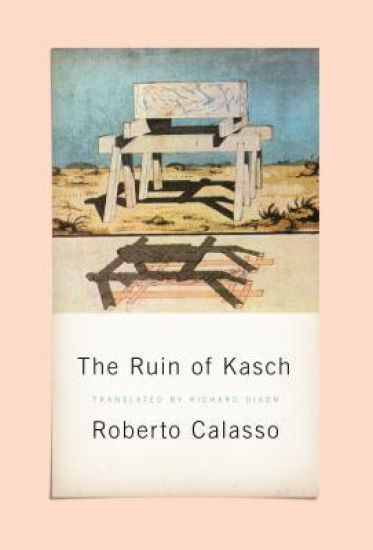
A brilliant new translation of a classic work on violence and revolution as seen through mythology and artThe Ruin of Kasch takes up two subjects--"the first is Talleyrand, and the second is everything else," wrote Italo Calvino when the book first appeared in 1983. Hailed as one of those rare books that persuade us to see our entire civilization in a new light, its guide is the French statesman Charles-Maurice de Talleyrand, who knew the secrets of the ancien r gime and all that came after, and was able to adapt the notion of "legitimacy" to the modern age. Roberto Calasso follows him through a vast gallery of scenes set immediately before and after the French Revolution, making occasional forays backward and forward in time, from Vedic India to the porticoes of the Palais-Royal and to the killing fields of Pol Pot, with appearances by Goethe and Marie Antoinette, Napoleon and Marx, Walter Benjamin and Chateaubriand. At the center stands the story of the ruin of Kasch, a legendary kingdom based on the ritual killing of the king and emblematic of the ruin of ancient and modern regimes. Offered here in a new translation by Richard Dixon, The Ruin of Kasch is, as John Banville wrote, "a great fat jewel-box of a book, gleaming with obscure treasures."
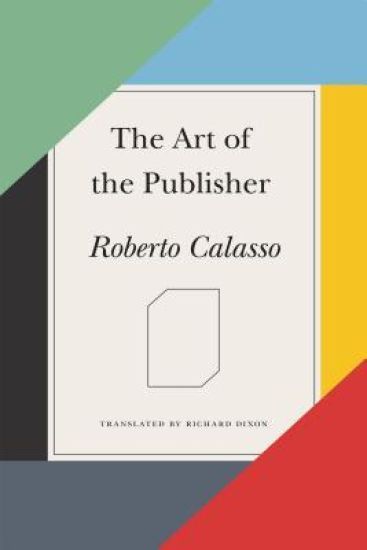
An interior look at Roberto Calasso's work as a publisher and his reflections on the art of book publishing In this illuminating volume, Roberto Calasso reflects on more than half a century of distinguished literary publishing at Adelphi Edizioni in Milan. "Part merchant, part circus impresario, the publisher has always been considered with a certain mistrust, like a clever huckster," Calasso writes, and yet "publisher" may also be one of the most prestigious titles around. Recalling the beginnings of Adelphi in the 1960s, Calasso touches on the house's defining qualities and its strategy of publishing a wide range of authors of high literary quality. Stepping back, he then considers the publishing industry as a whole, bringing his signature erudition and grasp of literary history to bear on various aspects of the enterprise. From the vital importance of jackets, design, and cover flaps to the consequences of universal digitization, Calasso offers a penetrating study of the industry and an essential survey of twentieth-century literature. A daring defense of an industry in flux and an ode to publishers who devote themselves to "good books," The Art of the Publisher makes an insider's case for publishing as a singular artistic form. An essential collection for writers, readers, and editors, it is a tribute to the age-old art of making books.

A book that begins before Adam and ends after us. In this magisterial work by the Italian intellectual superstar Roberto Calasso, figures of the Bible and its whole outline emerge in a new light: one that is often astonishing and disquieting, as indeed--more than any other--is the book from which they originate Roberto Calasso's The Book of All Books is a narration that moves through the Bible as if through a forest, where every branch--every verse--may offer some revelation. Where a man named Saul becomes the first king of a people because his father sent him off to search for some donkeys that had gone astray. Where, in answer to an invitation from Jerusalem's king, the queen of a remote African realm spends three years leading a long caravan of young men, girls dressed in purple, and animals, and with large quantities of spices, to ask the king certain questions. And where a man named Abraham hears these words from a divine voice: "Go away from your land, from your country and from the house of your father toward the land that I will show you"--words that reverberate throughout the Bible, a story about a separation and a promise followed by many other separations and promises. The Book of All Books, the tenth part of a series, parallels in many ways the second part, The Marriage of Cadmus and Harmony. There, gods and heroes of the Greek myths revealed new physiognomies, whereas here many figures of the Bible and its whole outline emerge in a new light: one that is often astonishing and disquieting, as indeed is the book--more so than any other--from which they originate.

Brilliant, inspired, and gloriously erudite, Literature and the Gods is the culmination of Roberto Calasso's lifelong study of the gods in the human imagination. By uncovering the divine whisper that lies behind the best poetry and prose from across the centuries, Calasso gives us a renewed sense of the mystery and enchantment of great literature. From the banishment of the classical divinities during the Age of Reason to their emancipation by the Romantics and their place in the literature of our own time, the history of the gods can also be read as a ciphered and splendid history of literary inspiration. Rewriting that story, Calasso carves out a sacred space for literature where the presence of the gods is discernible. His inquiry into the nature of "absolute literature" transports us to the realms of Dionysus and Orpheus, Baudelaire and Mallarm , and prompts a lucid and impassioned defense of poetic form, even when apparently severed from any social function. Lyrical and assured, Literature and the Gods is an intensely engaging work of literary affirmation that deserves to be read alongside the masterpieces it celebrates.

In "the very best book about Hindu mythology that anyone has ever written" (The New Republic) Calasso plunges Western readers into the mind of ancient India. He begins with a mystery: Why is the most important god in the Rg Veda, the oldest of India's sacred texts, known by a secret name--"Ka," or Who? What ensues is not an explanation, but an unveiling. Here are the stories of the creation of mind and matter; of the origin of Death, of the first sexual union and the first parricide. We learn why Siva must carry his father's skull, why snakes have forked tongues, and why, as part of a certain sacrifice, the king's wife must copulate with a dead horse. A tour de force of scholarship and seduction, Ka is irresistible.

A decisive key to help grasp some of the essential points of what is happening around us. The ninth part of Roberto Calasso's masterwork, The Unnamable Present, is closely connected with themes of the first book, The Ruin of Kasch (originally published in 1983, and reissued by FSG in a new translation). But while Kasch is an enlightened exploration of modernity, The Unnamable Present propels us into the twenty first century. Tourists, terrorists, secularists, fundamentalists, hackers, transhumanists, algorithmicians: these are all tribes that inhabit the unnamable present and act on its nervous system. This is a world that seems to have no living past, but was foreshadowed in the period between 1933 and 1945, when everything appeared bent on self-annihilation. The Unnamable Present is a meditation on the obscure and ubiquitous process of transformation happening today in all societies, which makes so many previous names either inadequate or misleading or a parody of what they used to mean. Translated with sensitivity by Calasso's longtime translator, Richard Dixon, The Unnamable Present is a strikingly original and provocative vision of our times, from the writer The Paris Review called "a literary institution of one."