Kirjojen hintavertailu. Mukana 11 244 527 kirjaa ja 12 kauppaa.

Kirjahaku

Etsi kirjoja tekijän nimen, kirjan nimen tai ISBN:n perusteella.

1000 tulosta hakusanalla Rodney Foster

The Real 'Dad's Army'

The Real 'Dad's Army'

Rodney Foster

Penguin Books Ltd
2012
pokkari
Rodney Foster's The Real Dad's Army is the true-life account of Britain's Home Guard and now the subject of the new film Dad's Army (Feb 2016).'Who do you think you are kidding Mr Hitler?' Not Colonel Rodney Foster, a platoon commander of the Kent Home Guard. Dad's Army, the iconic comedy series is as well-known today as it was forty years ago. But the reality of life in the Home Guard was often very different. Here, for the first time, is the full inside story of the Home Guard, the ragtag volunteer army that defended the coast of Britain from German invasion during the Second World War. Colonel Rodney Foster, who retired to Hythe in the south of England after a military career in British India, joined the Home Guard in 1940 and kept a diary every day - a highly illegal act at the time - and in it meticulously chronicled his service in the real Dad's Army. He records with a unique wit and wisdom the everyday details of family life during the war: the domestic routine dogged by air raid warnings, the antics of soldiers stationed nearby taking every chance to improve their lot, the quiet strength of a small community faced with great adversity.'It's magical' Dan Snow, The One Show'If you lament the demise of the stiff upper lip, this is the book for you' Dominic Sandbrook,Evening StandardShaun Sewell is an avid antique dealer and social historian. Shaun lives and works in Northumberland. Rodney Foster was born in India in 1882 and spent his career in the Indian Army. In his retirement he went with his wife and daughter to live in Saltwood, near Hythe on the Kent coastline. Here in 1940 he enrolled in the Home Guard. He died in 1962.

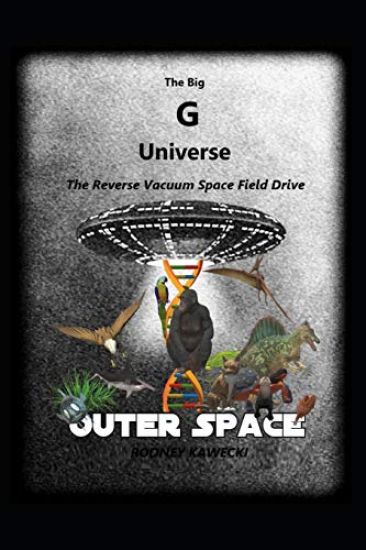
The Big G Universe: Receding Reverse Vacuum Faster Than Light Space Field Drive
The Reverse Vacuum Space Field Drive is a new technology that relies on the mainframe fabric of space itself that's gravity force allows for faster than light space travel solely based on the mainframe of the space fabric itself. Earlier scientists believed all gravitation had a formal limitation anything of mass can travel through space. Isaac Newton's ideas about planet gravity the little 'g' works differently than in space. His theories showed a big 'G' gravity force symbol explaining the action of gravitation in space. It is through these avenues Rodney Kawecki has imported in his new theory. According to Kawecki the outer space mainframe works pushing repulsive energy in all directions inside an Idle space field. Unlike Alcubierre Warp Drive Kawecki's "Reverse Vacuum Space Field Drive" works by principles of its own by fulfilling the strength of a repulsive expansion force that is guided by the expansion of the universe. A bubble as some physicists call it or inflating a balloon that is pushing universe matter made up of stars, planets, and galaxies widely apart. It is this same force that acts in a repulsive manner that allows moving objects in 'Idle space' to accelerate way beyond their instrument. It is not only the reason why vessels traveling in space are able to travel at extreme velocities but it is also what allows faster than light space travel all based on a common standard model. Faster than light space travel is recognized on the foundation that space unlike planet gravity is repulsive and not attracted. Instead of attracting a moving mass space pushes moving masses away from its present. It allows greater acceleration which illustrates how a vessel with the ability to travel at close to light velocity will actually travel 2.7c. That's more than twice light speed. The rest is history. The Expansion Warp Drive known as Reverse Vacuum Space Drive is measured and weighed on the way the universe expands and with it, the equations shown illustrate how the universe works and why this new technique allows a ship in space to travel way beyond what physics illustrates in today's science models.
Rodney Graham: British Weathervanes

Rodney Graham: British Weathervanes

Iwona Blazwick

Christine Burgin/Donald Young
2011
sidottu
Early plans for the Whitechapel Library included provision for an unrealised weathervane. Over a century later this original intention has been achieved through Rodney Graham's Erasmus Weathervane - a glittering addition to the London skyline. This publication celebrates the inauguration of Graham's weathervane on the cupola of the Whitechapel Gallery's roof. Rodney Graham was born in 1949 in Canada and lives and works in Vancouver. He has continually worked across different mediums including photography, sculpture and installation as well as music, film, performance and writing and his work has taken the form of architectural models, books, camera obscuras, wallpaper and musical scores.
Rodney McMillian

Rodney McMillian

Aspen Art Museum,US
2015
sidottu
This monograph, published on the occasion of the Aspen Art Museum exhibition of Rodney McMillian, showcases a comprehensive survey of the artist's paintings, a section of his practice also encompassing sculpture, installation and performance. Incorporating and challenging the notion of art as social and historical critique, the works, essays and interview in this publication examine issues of race, identity and commerce in contemporary society. The book contains images of almost every painting produced by McMillian since, and including, his graduate thesis exhibition, demonstrating a fuller comprehension of the impetus of his work and an insight into the development of the artist's practice. It also features texts by Thomas Lax and Rodney McMillian as well as an interview between the artist and Heidi Zuckerman. Born in 1969 in Columbia, South Carolina, and currently living in Los Angeles, Rodney McMillian received his BA in Foreign Affairs from the University of Virginia and went on to study art at the School of the Art Institute of Chicago, the Skowhegan School of Painting and Sculpture, and received an MFA from the California Institute of the Arts in 2002. McMillian's work has been exhibited at the UCLA Hammer Museum and the Museum of Contemporary Art, Los Angeles, the Studio Museum in Harlem and the Whitney Museum of American Art, New York, the Herning Art Museum in Denmark, the Royal Academy in London and Boston's Institute of Contemporary Art.
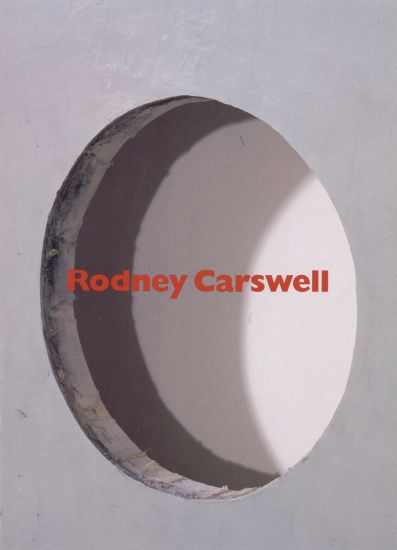
Rodney Carswell – Selected Works, 1975–1993

Rodney Carswell – Selected Works, 1975–1993

David Pagel

Renaissance Society at the University of Chicago
1993
nidottu
This catalogue was produced in conjunction with the Renaissance Society's 1993 mid-career survey of this influential painter and teacher, who has worked primarily in Chicago since 1973. The sensuous surfaces and revealing construction methods of Carswell's work expand and explore the component parts of painting--surface, structural support, pigment--in order to better communicate their distinctions and interdependence. Carswell merges his structural analysis with the sheer beauty of his surfaces to create synthesized painting/objects. A must-read for anyone interested in the continued relevance of painting as a beautiful and critical art form.
Rodney McMillian

Rodney McMillian

Studio Museum in Harlem,US
2017
sidottu
For more than a decade, Los Angeles–based artist Rodney McMillian (born 1969) has worked in sculpture, painting, video and performance to explore the intersections of race, class, gender and socioeconomic policy. Copublished by the Institute of Contemporary Art, University of Pennsylvania and The Studio Museum in Harlem on the occasion of Rodney McMillian: The Black Show and Rodney McMillian: Views of Main Street, this volume offers an in-depth examination of McMillian’s varied practice and his meditations on social systems, art history, science fiction and public policy. In addition to contributions by Elms and Keith, McMillian’s radical use of postconsumer objects, video and painting is addressed in essays by leading figures including Charles Gaines, Rita Gonzalez, Dave McKenzie and Steven Nelson.