Kirjojen hintavertailu. Mukana 11 342 296 kirjaa ja 12 kauppaa.

Kirjahaku

Etsi kirjoja tekijän nimen, kirjan nimen tai ISBN:n perusteella.

812 tulosta hakusanalla Rp Edwards

RP-HPLC Method for the Simultaneous Estimation of Ampicillin and Cloxa

RP-HPLC Method for the Simultaneous Estimation of Ampicillin and Cloxa

Shireesha Battula

LAP Lambert Academic Publishing
2019
pokkari
Pharmaceutical analysis simply means analysis of pharmaceuticals. Webster' dictionary defines a pharmaceutical is a medical drug. A more appropriate term for a pharmaceutical is active pharmaceutical ingredient (API) or active ingredient to distinguish it from a formulated product or drug product is prepared by formulating a drug substance with inert ingredient (excipient) to prepare a drug product that is suitable for administration to patients. Research and development (R&D) play a very comprehensive role in new drug development and follow up activities to ensure that a new drug product meets the established standards is stable and continue to approved by regulatory authorities, assuring that all batches of drugproduct are made to the specific standards utilization of approved ingredients and production method becomes the responsibility of pharmaceutical analysts in the quality control (QC) or quality assurance department . The methods are generally developed in an analytical R&Ddepartment and transferred to QC or other departments as needed. At times they are transferred to other divisions.
RP-HPLC estimation of Salsalate, Irbesartan, Levodopa and Enoxaparin

RP-HPLC estimation of Salsalate, Irbesartan, Levodopa and Enoxaparin

Nekuri Bujji Babu; Rudraraju Ramesh Raju
LAP Lambert Academic Publishing
2021
pokkari
The pharmaceutical industry develops, produces and markets drugs licensed for use as medications.A drug may be defined as a substance meant for diagnosis, cure, mitigation and prevention, treatment of diseases in human beings or animals, for altering in structure or function of the body of human beings or animals. In pharmaceutical industry the chemical composition of raw material, intermediates and finished products quality and need to be monitored to ensure satisfactory consistency. Pharmaceutical chemistry is a science that makes use of general laws of chemistry to study drugs and their preparation, chemical nature, composition, structure, influence on an organism, the methods of quality control and the conditions of their storage etc. Quality control is a concept, which strives to produce a perfect product by series of measures designed to prevent and eliminate errors at different stages of production. Pharmaceutical analysis provides information on theidentity, purity, content and stability of starting materials, excipients and active pharmaceutical ingredients (APIs).
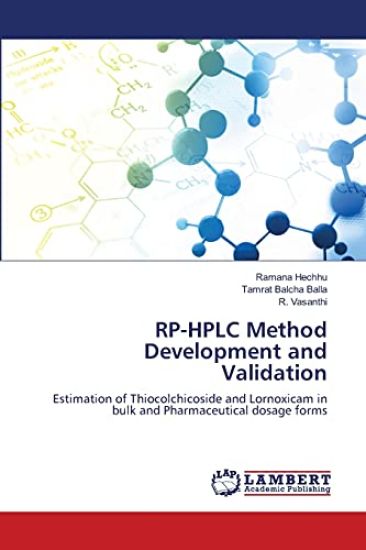
RP-HPLC Method Development and Validation

RP-HPLC Method Development and Validation

Ramana Hechhu; Tamrat Balcha Balla; R Vasanthi

Lap Lambert Academic Publishing
2021
pokkari
High performance liquid chromatography is at present one of the most sophisticated tool of the analysis. The estimation of Thiocolchicoside and Lornoxicam was done by RP-HPLC. The Phosphate buffer was pH 3.0 and the mobile phase was optimized with consists of Methanol: Phosphate buffer mixed in the ratio of 70:30 % v/ v. Inertsil C18 column C18 (4.6 x 150mm, 5μm) or equivalent chemically bonded to porous silica particles was used as stationary phase. The detection was carried out using UV detector at 260 nm. The solutions were chromatographed at a constant flow rate of 0.8 ml/min. the linearity range of Thiocolchicoside and Lornoxicam were found to be from 100-500 μg/ml of Thiocolchicoside and 1-5μg/ml of Lornoxicam . Linear regression coefficient was not more than 0.999.The values of % RSD are less than 2% indicating accuracy and precision of the method. The percentage recovery varies from 98-102% of Thiocolchicoside and Lornoxicam . LOD and LOQ were found to be within limit.The results obtained on the validation parameters met ICH and USP requirements .it inferred the method found to be simple, accurate, precise and linear. The method was found to be having suitable application.
RP- HPLC Study Of Rebamipide

RP- HPLC Study Of Rebamipide

Biswajit Samantaray; Amulyaratna Behera; Lipsa Samal

LAP Lambert Academic Publishing
2021
pokkari
The aim of the present work was to develop and validate a simple RP-HPLC method for the determination of Rebamipide. Chromatographic separation of Rebamipide was achieved by using a C18 column. A Mobile phase containing a mixture of methanol: water (70:30 v/v) was pumped at the flow rate of 1 ml/min. Detection was performed at 231 nm. Validation parameters were evaluated according to the International Conference on Harmonization (ICH) Q2R1 guidelines. The calibration curve was linear in the concentration range 2- 10μg/ml for the Rebamipide with regression coefficient 0.999. The method was found to be accurate with 0.66 % RSD. RSD values were found to be 0.94 % in the case of intra-day precision studies, whereas0.76% in the case of inter-day precision the limits of detection and quantification were found to be 0.6, 1.98μg/ml, respectively. The results obtained from the stress testing reveals that Rebamipide drug substance is particularly stable under acidic, neutral and thermal degradation conditions. From the stability point of view, care should be taken in the manufacturing process and storage of this product