This work has been selected by scholars as being culturally important and is part of the knowledge base of civilization as we know it.This work is in the public domain in the United States of America, and possibly other nations. Within the United States, you may freely copy and distribute this work, as no entity (individual or corporate) has a copyright on the body of the work.Scholars believe, and we concur, that this work is important enough to be preserved, reproduced, and made generally available to the public. To ensure a quality reading experience, this work has been proofread and republished using a format that seamlessly blends the original graphical elements with text in an easy-to-read typeface.We appreciate your support of the preservation process, and thank you for being an important part of keeping this knowledge alive and relevant.
This work has been selected by scholars as being culturally important and is part of the knowledge base of civilization as we know it.This work is in the public domain in the United States of America, and possibly other nations. Within the United States, you may freely copy and distribute this work, as no entity (individual or corporate) has a copyright on the body of the work.Scholars believe, and we concur, that this work is important enough to be preserved, reproduced, and made generally available to the public. To ensure a quality reading experience, this work has been proofread and republished using a format that seamlessly blends the original graphical elements with text in an easy-to-read typeface.We appreciate your support of the preservation process, and thank you for being an important part of keeping this knowledge alive and relevant.
This work has been selected by scholars as being culturally important and is part of the knowledge base of civilization as we know it.This work is in the public domain in the United States of America, and possibly other nations. Within the United States, you may freely copy and distribute this work, as no entity (individual or corporate) has a copyright on the body of the work.Scholars believe, and we concur, that this work is important enough to be preserved, reproduced, and made generally available to the public. To ensure a quality reading experience, this work has been proofread and republished using a format that seamlessly blends the original graphical elements with text in an easy-to-read typeface.We appreciate your support of the preservation process, and thank you for being an important part of keeping this knowledge alive and relevant.
Originally published in 1948, this book presents a concise discussion regarding various aspects of the life and works of the novelist Samuel Butler, author of Erehwon (1872). The text is an amended version of Furbank's 1946 Le Bas Prize winning essay. This book will be of value to anyone with an interest in Samuel Butler and nineteenth-century literature.
This work has been selected by scholars as being culturally important and is part of the knowledge base of civilization as we know it.This work is in the public domain in the United States of America, and possibly other nations. Within the United States, you may freely copy and distribute this work, as no entity (individual or corporate) has a copyright on the body of the work.Scholars believe, and we concur, that this work is important enough to be preserved, reproduced, and made generally available to the public. To ensure a quality reading experience, this work has been proofread and republished using a format that seamlessly blends the original graphical elements with text in an easy-to-read typeface.We appreciate your support of the preservation process, and thank you for being an important part of keeping this knowledge alive and relevant.
This work has been selected by scholars as being culturally important and is part of the knowledge base of civilization as we know it.This work is in the public domain in the United States of America, and possibly other nations. Within the United States, you may freely copy and distribute this work, as no entity (individual or corporate) has a copyright on the body of the work.Scholars believe, and we concur, that this work is important enough to be preserved, reproduced, and made generally available to the public. To ensure a quality reading experience, this work has been proofread and republished using a format that seamlessly blends the original graphical elements with text in an easy-to-read typeface.We appreciate your support of the preservation process, and thank you for being an important part of keeping this knowledge alive and relevant.
This work has been selected by scholars as being culturally important and is part of the knowledge base of civilization as we know it.This work is in the public domain in the United States of America, and possibly other nations. Within the United States, you may freely copy and distribute this work, as no entity (individual or corporate) has a copyright on the body of the work.Scholars believe, and we concur, that this work is important enough to be preserved, reproduced, and made generally available to the public. To ensure a quality reading experience, this work has been proofread and republished using a format that seamlessly blends the original graphical elements with text in an easy-to-read typeface.We appreciate your support of the preservation process, and thank you for being an important part of keeping this knowledge alive and relevant.
This work has been selected by scholars as being culturally important and is part of the knowledge base of civilization as we know it.This work is in the public domain in the United States of America, and possibly other nations. Within the United States, you may freely copy and distribute this work, as no entity (individual or corporate) has a copyright on the body of the work.Scholars believe, and we concur, that this work is important enough to be preserved, reproduced, and made generally available to the public. To ensure a quality reading experience, this work has been proofread and republished using a format that seamlessly blends the original graphical elements with text in an easy-to-read typeface.We appreciate your support of the preservation process, and thank you for being an important part of keeping this knowledge alive and relevant.
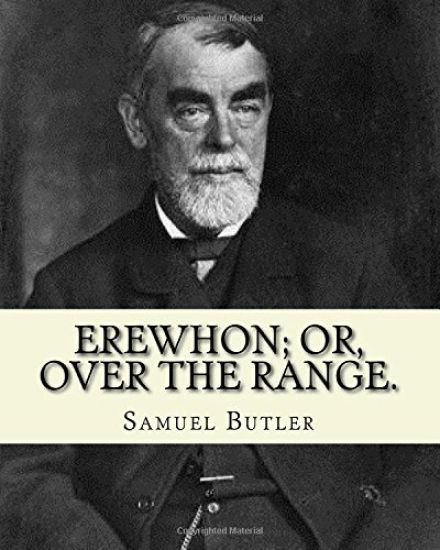
Erewhon: or, Over the Range ( is a novel by Samuel Butler which was first published anonymously in 1872.The title is also the name of a country, supposedly discovered by the protagonist. In the novel, it is not revealed where Erewhon is, but it is clear that it is a fictional country. Butler meant the title to be read as "nowhere" backwards even though the letters "h" and "w" are transposed, as it would have been pronounced in his day (and still is in some dialects of English). The book is a satire on Victorian society. The first few chapters of the novel dealing with the discovery of Erewhon are in fact based on Butler's own experiences in New Zealand where, as a young man, he worked as a sheep farmer on Mesopotamia Station for about four years (1860-64), and explored parts of the interior of the South Island and which he wrote about in his A First Year in Canterbury Settlement (1863).The greater part of the book consists of a description of Erewhon. The nature of this nation is intended to be ambiguous. At first glance, Erewhon appears to be a Utopia, yet it soon becomes clear that this is far from the case. Yet for all the failings of Erewhon, it is also clearly not a dystopia, such as that depicted in George Orwell's Nineteen Eighty-Four. As a satirical utopia, Erewhon has sometimes been compared to Gulliver's Travels (1726), a classic novel by Jonathan Swift; the image of Utopia in this latter case also bears strong parallels with the self-view of the British Empire at the time. It can also be compared to the William Morris novel, News from Nowhere. Erewhon satirises various aspects of Victorian society, including criminal punishment, religion and anthropocentrism. For example, according to Erewhonian law, offenders are treated as if they were ill, whereas ill people are looked upon as criminals. Another feature of Erewhon is the absence of machines; this is due to the widely shared perception by the Erewhonians that they are potentially dangerous. This last aspect of Erewhon reveals the influence of Charles Darwin's evolution theory; Butler had read On the Origin of Species soon after it was published in 1859..... Samuel Butler (4 December 1835 - 18 June 1902) was an iconoclastic Victorian-era English author who published a variety of works. Two of his most famous pieces are the Utopian satire Erewhon and a semi-autobiographical novel published posthumously, The Way of All Flesh. He is also known for examining Christian orthodoxy, substantive studies of evolutionary thought, studies of Italian art, and works of literary history and criticism. Butler made prose translations of the Iliad and Odyssey, which remain in use to this day.Butler was born on 4 December 1835 at the rectory in the village of Langar, near Bingham, Nottinghamshire, England, to the Rev. Thomas Butler, son of Dr. Samuel Butler, then headmaster of Shrewsbury School and later Bishop of Lichfield. Dr Butler was the son of a tradesman and descended from a line of yeomen, but his scholarly aptitude being recognised at young age, was sent to Rugby and Cambridge, where he distinguished himself and launched his successful career. His only son Thomas wished to go into the Navy, but succumbed to paternal pressure and entered the Church, in which he led a wholly undistinguished career, all the more so in contrast with his father's. It has been suggested that this family dynamic had some impact on Samuel, insofar as it created the oppressive home environment (chronicled in The Way of All Flesh) which formed his approach to the world. Thomas Butler, states one critic, "to make up for having been a servile son, became a bullying father."..............
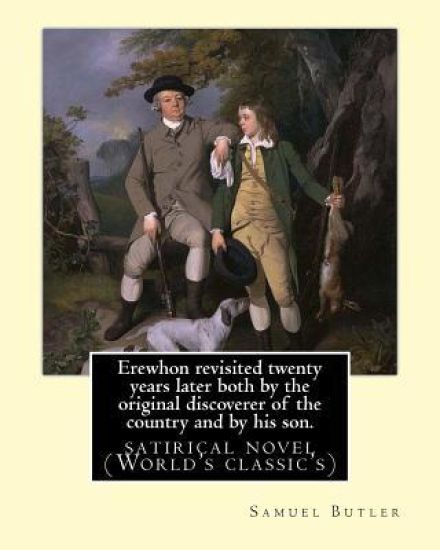
Erewhon Revisited Twenty Years Later, Both by the Original Discoverer of the Country and by His Son (1901) is a satirical novel by Samuel Butler, forming a belated sequel to his Erewhon (1872).The Cambridge History of English and American Literature judges that it "has less of the free imaginative play of its predecessor...but, in sharp brilliance of wit and criticism, in intellectual unity and coherence, it surpasses Erewhon". Erewhon, set in a thinly disguised New Zealand, ended with the escape of its unnamed protagonist from the native Erewhonians by balloon. In the sequel, narrated by his son John, we are told that our hero's name is Higgs. Higgs returns to Erewhon and meets his former lover Yram, who is now the mother of his son George. He discovers that he is now worshipped as "the Sunchild", his escape having been interpreted as an ascension into heaven, and that a church of Sunchildism has sprung up. He finds himself in danger from the villainous Professors Hanky and Panky, who are determined to protect Sunchildism from him. With George's help Higgs escapes from their clutches and returns to England. The Swiftian device of setting his satire in a fictional culture enabled Butler, as the critic Elinor Shaffer has written, "to analyse the phenomena of religion from their point of genesis, while disclaiming all responsibility for their uncanny parallels to certain known religions." It did not however make the road to publication any easier. When Butler submitted the manuscript to the respectable and long-established house of Longman, who had in recent years become his regular publishers, they rejected it for fear of offending their High Church clientele, even when Butler offered to pay the costs himself. On March 24, 1901 he wrote to George Bernard Shaw, conceding that the book was "far more wicked than Erewhon", and asking for his advice.Shaw replied recommending his own publisher, Grant Richards, and lost no time introducing Butler to him. The book duly came out under the Grant Richards imprint................ Samuel Butler (4 December 1835 - 18 June 1902) was an iconoclastic Victorian-era English author who published a variety of works. Two of his most famous pieces are the Utopian satire Erewhon and a semi-autobiographical novel published posthumously, The Way of All Flesh. He is also known for examining Christian orthodoxy, substantive studies of evolutionary thought, studies of Italian art, and works of literary history and criticism. Butler made prose translations of the Iliad and Odyssey, which remain in use to this day.Butler was born on 4 December 1835 at the rectory in the village of Langar, near Bingham, Nottinghamshire, England, to the Rev. Thomas Butler, son of Dr. Samuel Butler, then headmaster of Shrewsbury School and later Bishop of Lichfield. Dr Butler was the son of a tradesman and descended from a line of yeomen, but his scholarly aptitude being recognised at young age, was sent to Rugby and Cambridge, where he distinguished himself and launched his successful career. His only son Thomas wished to go into the Navy, but succumbed to paternal pressure and entered the Church, in which he led a wholly undistinguished career, all the more so in contrast with his father's. It has been suggested that this family dynamic had some impact on Samuel, insofar as it created the oppressive home environment (chronicled in The Way of All Flesh) which formed his approach to the world. Thomas Butler, states one critic, "to make up for having been a servile son, became a bullying father." In any event, Samuel Butler's relationship with his parents, and especially with his father, was largely antagonistic. His education began at home and included frequent beatings, as was not uncommon at the time. Samuel, however, found his parents particularly "brutal and stupid by nature,"and their relationship to him never progressed beyond the adversarial...............
Samuel Clemens' lifetime was what the development of America was all about: trade and life on the Mississippi; the gold rush days in the west; the development of publishing and industry in the east. It also goes in depth about Clemens' life abroad where he was the toast of society where ever he went. But the heart and soul of Clemens lie in his family and his days in Hartford, CT and Elmira, NY. He is a true genius, documenting the "real" America and through it's people and place in the world. Albert B Paine is an excellent writer commenting directly on most of the last years of Twain's life when he became his personal biographer/companion. Paine is truly in awe of Clemens, but not above presenting the human side of Mark Twain in the process of painstaking creation of this massive and greatly detailed biography.