Kirjahaku
Etsi kirjoja tekijän nimen, kirjan nimen tai ISBN:n perusteella.
948 tulosta hakusanalla Shanthi
This book contains the most secretive aspects of the ancient religion of Hinduism not so far revealed in any manner to the world outside India. This book is resplendent in Jnaana. Whosoever can read and assimilate its contents is sure to live the most comfortable life besides attaining Nirvaana. While this is not a beginner's guide on Hindu spirituality, all the averments of advanced concepts are explained using regular and simple words used every day by ordinary people. Philosophy is a tough to crack subject and Hindu spiritual philosophy is even tougher subject. Simply stated, this book is a "Hindu philosophy made-simple". While this is one of the eighteen books of Maha Bhaaratha, this book is the largest among all and is completely independent. It does not depend on the previous book to understand the context or there is something in the next book that needs to be read to get a complete picture. This book contains three section - the first one details the matters connected with ruling the kingdom which are surprisingly similar to modern management precepts. The second section is about living righteously in adverse conditions like the present times. The third is about the attainment of Nirvana. The original was authored by Veda Vyaasa in the ancient times of about 5000 years ago in Sanskrit. This is but a rare book that is not easy to find in a language other than Sanskrit. It is also one book that is dreaded by others even to explain, leave alone translating it. I, even for a second think that I translated it. It was the act of God Almighty who used my hand to type out the text. One that can read this fully would be blessed by Lord Krishna Himself.

Critically acclaimed author Shanthi Sekaran makes her middle grade debut with this timely and stunning novel in which a young boy and his friends must rescue his grandmother from a relocation camp after their country’s descent into xenophobia. Perfect for fans of The Night Diary and Front Desk.Before his grandmother moved from India to the island of Mariposa, Muki Krishnan’s life was good. But now? He has to share his bedroom with Paati, his grandmother, who snores like a bulldozer and wakes him up at dawn to do yoga.Paati’s arrival coincides with even bigger changes in Mariposa. The president divides citizens into Butterflies—families who have lived in Mariposa for three generations—and Moths, who, like Muki’s family, are more recent immigrants. The changes are small at first. But then Muki and his friends find a camp being built to imprison Moths before sending them away. Soon after, his Paati is captured and taken there.While devising Paati’s escape, Muki discovers that a secret rebellion is underway, and as he digs deeper, he realizes that rescuing Paati will be the fight of his life.* Bank Street Best Children's Books of the Year *
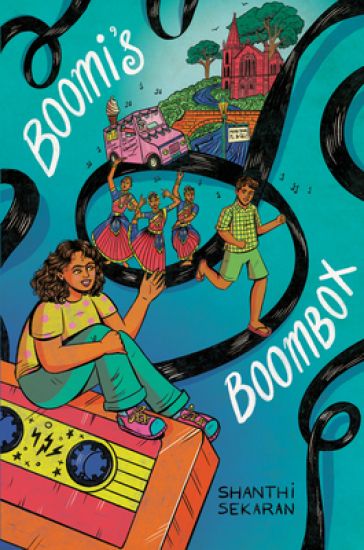
Acclaimed author Shanthi Sekaran delivers a powerful story about grief, family, dance, and friendship that follows a young girl who accidentally travels back in time to meet her dad as a child that will change her life forever. Perfect for fans of The Thing About Jellyfish and The Ethan I Was Before. A Junior Library Guild Selection When Boomi's dad dies of Covid, the rest of her life topples like a row of dominoes. First her best friend, Bebe, stops talking to her. Then she gets kicked out of her ballet academy. Her mom becomes hyper focused on her weight. Her grandmother sinks further into the shadows of her mind.Then Boomi is given one last gift from her dad: his old boombox. Inside it, she finds a mix tape and a note: You can change your life. When she presses play on the boombox, her life really does change: she's magically transported to Thumpton-on-Soar, England, 1986. And her dad's there But he doesn't know he's her dad--he's twelve, just like Boomi. Boomi starts to see what being twelve was like for her dad, growing up Indian in a town that wanted to silence people like him. She starts to understand why he never went back. But why is Boomi sent back to Thumpton? Is she supposed to save her dad? Or change her life?
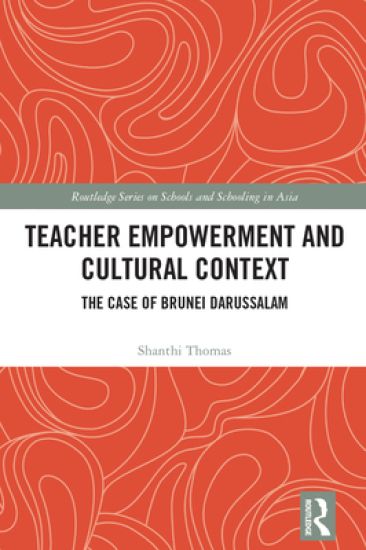
Teacher empowerment is a psychological and socio-structural motivational process that enhances teacher performance and self-expression. The current conceptualisations of Teacher Empowerment, available in extant literature, have been constructed in an Anglo-Saxon, western cultural context. There have been attempts to transfer the concept to Asian countries, but these attempts were faced with major obstacles since the underlying cultural assumptions are not the same across countries. This book treads new ground by redefining Teacher Empowerment in the cultural context of South East Asia. Using the case of Brunei Darussalam which has a unique socio-cultural make-up as a melting pot of Malay, Chinese and other Asian cultures, the book offers a unique insight how the Teacher Empowerment dynamics is played out in this context. Covering more than just empowering leadership in schools, the author explores how colleagues, parents, and students empower teachers, and how teachers empower themselves. This book is a valuable guide for educators and educational leaders and researchers in Southeast Asia and beyond, who are committed to the empowerment of teachers, and the qualitative enhancement of the field of education as a whole.
High Frequency Continuous Time Filters in Digital CMOS Processes
Shanthi Pavan; Yannis Tsividis
Springer
2000
sidottu
There is an ever increasing trend towards putting entire systems on a single chip. This means that analog circuits will have to coexist on the same substrate along with massive digital systems. Since technologies are optimized with these digital systems in mind, designers will have to make do with standard CMOS processes in the years to come. We address analog filter design from this perspective. Filters form important blocks in applications ranging from computer disc-drive chips to radio transceivers. In this book, we develop the theory and techniques necessary for the implementation of high frequency (hundreds of megahertz) programmable continuous time filters in standard CMOS processes. Since high density poly-poly capacitors are not available in these technologies, alternative capacitor structures have to be found. Met- metal capacitors have low specific capacitance. An alternative is to use the (inherently nonlinear) capacitance formed by MOSFET gates. In Chapter 2, we focus on the use of MOS capacitors as integrating elements. A physics-based model which predicts distortion accurately is presented for a two-terminal MOS structure in accumulation. Distortion in these capacitors as a function of signal swing and bias voltage is computed. Chapter 3 reviews continuous-time filter architectures in the light of bias-dependent integrating capacitors. We also discuss the merits and demerits of various CMOS transconductance elements. The problems encountered in designing high frequency programmable filters are discussed in detail.
Media development seeks to support and promote a pluralistic, editorially independent and financially sustainable media sector. An independent media sector buttresses key governance goals such as voice, accountability, and transparency – not through dissemination of messages about these issues, but through its very existence. This handbook is the result of a multi-year effort, the first stage of which Public Sentinel: News Media and Governance Reform. That book explored key issues surrounding the media and governance, including: the ideal role of the media system in strengthening democratic governance, the conditions under which media systems fulfill their objectives, and the policy interventions most effective at helping the news media live up to its democratic potential. The second stage of this effort, presented here, is meant to bridge the gap between theory and practice. A survey reveals that very few governance advisors understand the concept of media development and how such programs could play a key role in advancing good governance. Ultimately, this handbook is designed for those who may be interested in media development programs, but are unclear about the whys, hows, and whens. It will introduce the fundamentals of media development, provide ways to conceptualize and analyze the sector, and help guide programming based on political economy analysis as well as individual country context. It also includes ideas on monitoring and evaluation of media development programs, plus links to further resources.
Expectations About Civilian Labor Markets and Army Officer Retention
Shanthi Nataraj; Michael L. Hansen
RAND
2011
pokkari
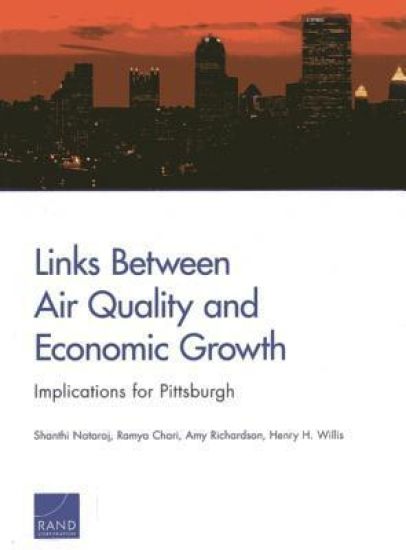
Links Between Air Quality and Economic Growth
Shanthi Nataraj; Ramya Chari; Amy Richardson; Henry Willis
RAND
2014
pokkari
This report assesses the evidence that exists for the ways in which local air quality could influence local economic growth through health and workforce issues, quality-of-life issues, or air-quality regulations and business operations. It then extrapolates some of the existing results to the Pittsburgh region.
The Future of the Army's Civilian Workforce
Shanthi Nataraj; Lawrence M. Hanser; Frank Camm; Jessica Yeats
RAND
2014
pokkari
The DoD is planning to scale back its civilian workforce in the next few years. To help the Army participate in this reduction, the authors examined how the Army might manage supply to meet changes in demand for civilians, and projected where cuts and growth are likely to occur. For projected requirements based on the FY 2014 President s Budget, nominal costs will remain stable, with expected civilian pay raises offsetting workforce reductions."
Options for Department of Defense Total Workforce Supply and Demand Analysis
Shanthi Nataraj; Christopher Guo; Philip Hall-Partyka; Susan M. Gates; Douglas Yeung
RAND
2014
pokkari
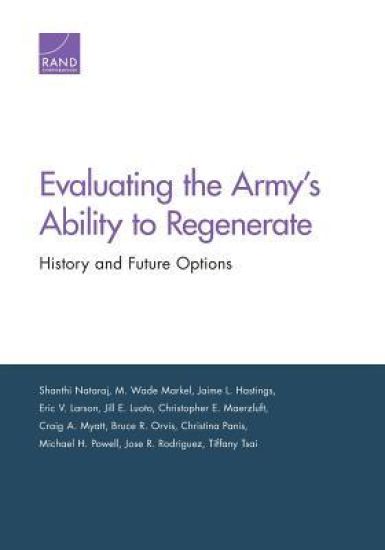
Evaluating the Army's Ability to Regenerate
Shanthi Nataraj; M Wade Markel; Jaime L Hastings
RAND
2017
nidottu
This analysis modeled the Army's ability to increase ("regenerate") its active component (AC) end strength over a five-year period in two scenarios--starting from a Total Army of 980,000 (450,000 AC) and starting from a Total Army of 920,000 (420,000 AC)--so that the Army could provide the number of deployable troops available at the end of the last conflict in 2010.
This report examines what the career of a "typical" Army civilian looks like. Using a statistical clustering technique to group career trajectories together by length of service, promotion frequency and timing, and transfers between the Army and other Department of Defense components, the researchers identified common career patterns among individuals who entered the Army civilian workforce between 1981 and 2000 as General Schedule employees.
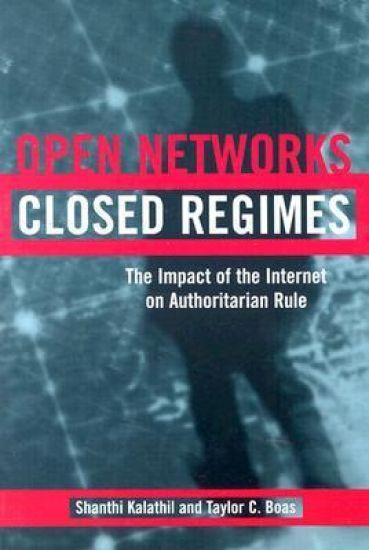
Open Networks, Closed Regimes
Shanthi Kalathil; Taylor C Boas
Carnegie Endowment for International Peace
2002
nidottu
As the Internet diffuses across the globe, many have come to believe that the technology poses an insurmountable threat to authoritarian rule. Grounded in the Internet's early libertarian culture and predicated on anecdotes pulled from diverse political climates, this conventional wisdom has informed the views of policymakers, business leaders, and media pundits alike. Yet few studies have sought to systematically analyze the exact ways in which Internet use may lay the basis for political change. In Open Networks, Closed Regimes, the authors take a comprehensive look at how a broad range of societal and political actors in eight authoritarian and semi-authoritarian countries employ the Internet. Based on methodical assessment of evidence from these cases —China, Cuba, Singapore, Vietnam, Burma, the United Arab Emirates, Saudi Arabia, and Egypt —the study contends that the Internet is not necessarily a threat to authoritarian regimes.
The story of an undocumented Mexican woman, her pregnancy, and an Indian-American wife desperate for a child, Lucky Boy is an emotional journey that will leave you certain of the redemptive beauty of this world. When Solimar makes it across the border into America, pregnant and full of hope, she wasn't prepared to be detained and have her son taken away from her. Likewise, Kavya didn't expect to wrap her heart around someone else's child. The reality of their separate situations is moving and revelatory. A heart-wrenching story taken from real life and applied to fiction.
A succinct yet comprehensive overview of respiratory medicine, written for students and professionals Essential Respiratory Medicine is an indispensable text offering an understanding of respiratory conditions and their clinical management within evidence-based guidelines. Containing information on taking a medical history, performing examinations and investigations, diagnosis and the management of respiratory conditions, this comprehensive text was put together by a noted expert in the field. Written in an accessible manner, Essential Respiratory Medicine contains the foundational science associated with respiratory medicine, a wide-variety of practical procedures, helpful diagrams, and self-assessments designed to enhance understanding of the material presented. The text covers a variety of conditions as well as providing suggestions for engaging with patients at different stages of care. This important resource: Demonstrates an effective approach to patients presenting with common respiratory symptoms Includes a description of all key practical procedures with diagramsDiscusses acute management of important respiratory emergenciesCovers both acute and chronic diseaseContains a companion website containing a range of learning materials, including downloadable management summaries and algorithms, an image bank, videos of patient examination, example respiratory sounds and multiple-choice questions Essential Respiratory Medicine is an essential resource for anyone on a clinical placement, rotation, or training programme in respiratory medicine.
Understanding Delta-Sigma Data Converters
Shanthi Pavan; Richard Schreier; Gabor C. Temes
Wiley-Blackwell
2017
sidottu
This new edition introduces operation and design techniques for Sigma-Delta converters in physical and conceptual terms, and includes chapters which explore developments in the field over the last decade Includes information on MASH architectures, digital-to-analog converter (DAC) mismatch and mismatch shapingInvestigates new topics including continuous-time ?S analog-to-digital converters (ADCs) principles and designs, circuit design for both continuous-time and discrete-time ?S ADCs, decimation and interpolation filters, and incremental ADCsProvides emphasis on practical design issues for industry professionals
International students are often engaged not just in education, but in high stakes towards gaining permanent migration status. This book unpacks the consequences of this education-migration nexus, analyzing migration policies and providing a vivid picture of student-migrants' lived experiences.
Teacher empowerment is a psychological and socio-structural motivational process that enhances teacher performance and self-expression. The current conceptualisations of Teacher Empowerment, available in extant literature, have been constructed in an Anglo-Saxon, western cultural context. There have been attempts to transfer the concept to Asian countries, but these attempts were faced with major obstacles since the underlying cultural assumptions are not the same across countries. This book treads new ground by redefining Teacher Empowerment in the cultural context of South East Asia. Using the case of Brunei Darussalam which has a unique socio-cultural make-up as a melting pot of Malay, Chinese and other Asian cultures, the book offers a unique insight how the Teacher Empowerment dynamics is played out in this context. Covering more than just empowering leadership in schools, the author explores how colleagues, parents, and students empower teachers, and how teachers empower themselves. This book is a valuable guide for educators and educational leaders and researchers in Southeast Asia and beyond, who are committed to the empowerment of teachers, and the qualitative enhancement of the field of education as a whole.