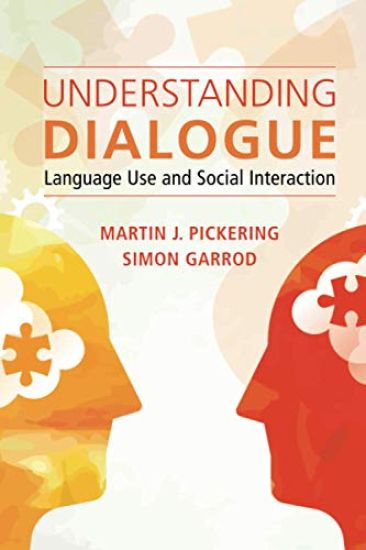
Linguistic interaction between two people is the fundamental form of communication, yet almost all research in language use focuses on isolated speakers and listeners. In this innovative work, Garrod and Pickering extend the scope of psycholinguistics beyond individuals by introducing communication as a social activity. Drawing on psychological, linguistic, philosophical and sociological research, they expand their theory that alignment across individuals is the basis of communication, through the model of a 'shared workspace account'. In this workspace, interlocutors are actors who jointly manipulate and control the interaction and develop similar representations of both language and social context, in order to achieve communicative success. The book also explores dialogue within groups, technologies, as well as the role of culture more generally. Providing a new understanding of cognitive representation, this trailblazing work will be highly influential in the fields of linguistics, psychology and cognitive linguistics.
Linguistic interaction between two people is the fundamental form of communication, yet almost all research in language use focuses on isolated speakers and listeners. In this innovative work, Garrod and Pickering extend the scope of psycholinguistics beyond individuals by introducing communication as a social activity. Drawing on psychological, linguistic, philosophical and sociological research, they expand their theory that alignment across individuals is the basis of communication, through the model of a 'shared workspace account'. In this workspace, interlocutors are actors who jointly manipulate and control the interaction and develop similar representations of both language and social context, in order to achieve communicative success. The book also explores dialogue within groups, technologies, as well as the role of culture more generally. Providing a new understanding of cognitive representation, this trailblazing work will be highly influential in the fields of linguistics, psychology and cognitive linguistics.
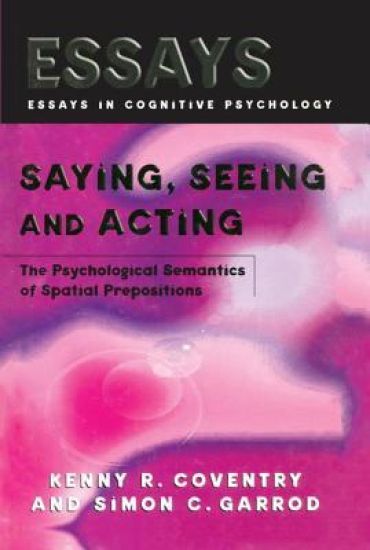
Our use of spatial prepositions carries an implicit understanding of the functional relationships both between objects themselves and human interaction with those objects.This is the thesis rigorously explicated in Saying, Seeing and Acting. It aims to account not only for our theoretical comprehension of spatial relations but our ability to intercede with efficacy in the world of spatially related objects. Only the phenomenon of functionality can adequately account for what even the simplest of everyday experiences show to be the technically problematic, but still meaningful status of expressions of spatial location in contentious cases.The terms of the debate are established and contextualised in Part One. In the Second Section, systematic experimental evidence is drawn upon to demonstrate specific covariances between spatial world and spatial language. The authors go on to give an original account of the functional and geometric constraints on which comprehension and human action among spatially related objects is based. Part Three looks at the interaction of these constraints to create a truly dynamic functional geometric framework for the meaningful use of spatial prepositions.Fascinating to anyone whose work touches on psycholinguistics, this book represents a thorough and incisive contribution to debates in the cognitive psychology of language.
Our use of spatial prepositions carries an implicit understanding of the functional relationships both between objects themselves and human interaction with those objects.This is the thesis rigorously explicated in Saying, Seeing and Acting. It aims to account not only for our theoretical comprehension of spatial relations but our ability to intercede with efficacy in the world of spatially related objects. Only the phenomenon of functionality can adequately account for what even the simplest of everyday experiences show to be the technically problematic, but still meaningful status of expressions of spatial location in contentious cases.The terms of the debate are established and contextualised in Part One. In the Second Section, systematic experimental evidence is drawn upon to demonstrate specific covariances between spatial world and spatial language. The authors go on to give an original account of the functional and geometric constraints on which comprehension and human action among spatially related objects is based. Part Three looks at the interaction of these constraints to create a truly dynamic functional geometric framework for the meaningful use of spatial prepositions.Fascinating to anyone whose work touches on psycholinguistics, this book represents a thorough and incisive contribution to debates in the cognitive psychology of language.
A fictional story about a young South African boy who tries to fulfill his Father's dream of overcoming the problem of poaching of Wild Animals. It is a story of determination and dedication with a happy ending
The shock of being diagnosed with a terminal disease- one of the cruelest in medical annals, is made even more confusing and ironic by a fantastic gift that accompanies it...You will laugh. You will cry. And you will enjoy one of the most moving love stories ever written...You will never forget the "man-child", Simon, with his unparalleled joys and his unimaginable sorrows. And you are sure to be exhilarated by its gripping and astonishing conclusion.