Kirjahaku
Etsi kirjoja tekijän nimen, kirjan nimen tai ISBN:n perusteella.
1000 tulosta hakusanalla Stephen Pell



The evolution of religion An anthropological study (Edition1)
Stephen H P Pell
Alpha Editions
2025
nidottu

Minstrel of the Mist is the story of achieving one's potential, of learning about love and acceptance. Travis Hazzard is a forty-year-old singer/songwriter who has unused talents and no ambition to change. That is until he gets an offer that is literally out of this world. The question is, does he have a ghost of a chance at success?

The UK Music Artist: A Practical Guide to Starting in Business
Stephen J. Pell
Createspace Independent Publishing Platform
2015
nidottu

This book is a major reinterpretation of the Iran-Iraq War and is a source for reexamining the U.S. involvement in the Gulf. Pelletiere demonstrates that the war was not a standoff in which Iraq finally won a grinding war of attrition through luck, persistence, and the use of poison gas. Instead, Iraq planned the last campaign almost two years prior to its unfolding. [The Iraqis] trained extensively and expended enormous sums of money to make their effort succeed. What won for them was their superior fignting prowess and greater commitment. Gas--if it was used at all--played only a minor part in the victory.' Pelletiere concludes that the key to understanding the war is the Extraordinary Congress of the Ba'th Party held in July 1986. It was there that the initial planning for the final campaign was done, and this campaign is what decided the fate of the conflict. The study centers around the last Iraqi campaign, which Pelletiere argues was based upon World War II blitzkrieg tactics, but he also treats the background, the politics, and the history of the conflict, and analyzes the significance of the war to the Middle East and to the position of the United States there.

Ten years after the end of the Gulf War, the conflict continues with unresolved questions about economic sanctions and Iraq's participation in the oil export system. A specialist in Middle Eastern politics and an intelligence officer, Pelletiére covered the Iran-Iraq War as well as the subsequent Gulf conflict. He argues that Iraq's victory over Iran in 1988 gave the nation the capability of becoming a regional superpower with a strong say in how the Gulf's oil reserves were managed. Because the United States could not tolerate an ultranationalist state with the potential to destabilize the world's economy, war then became inevitable.This study examines the rise of the international oil system from the 1920s when the great cartel was formed. Comprised of seven companies, it was designed to ensure their continued control over the world's oil supplies. When the companies lost control with the OPEC revolution in 1973, the United States moved into the realm of Gulf politics with the goal of protecting the world economy. Pelletire details how Saddam Hussein unwillingly precipitated the Gulf crisis and why the conflict is not likely to be resolved soon-or peacefully.
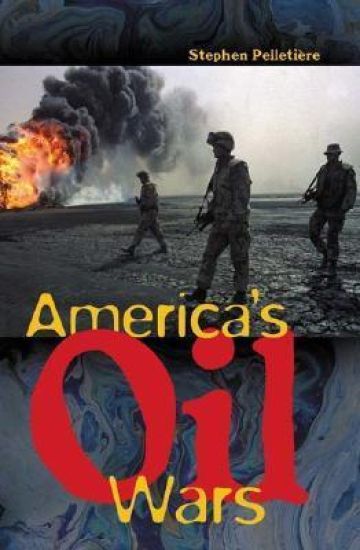
Why has the United States become involved in so many wars in the Middle East, and why just now? What explains the extraordinary disconnect between pre-war statements by the Bush Administration and the post-war reality? How much of U.S. intelligence was wrong, and why? Why did the Bush Administration ignore warnings by senior military commanders about the difficulties they would confront in trying to occupy Iraq? Why was there virtually no pre-war planning for administering Iraq once the war was successfully concluded? Pelletiere argues that, in going to war twice against Iraq and once against Afghanistan, the United States was seeking to put a lock on its future energy supplies. In neglecting diplomacy for so long in dealing with the Gulf States, Washington was practically compelled to use force to get what it wanted. Pelletiere explores the context of events that produced the attacks of September 11, 2001, the pretext for the United States' military move into the region. He debunks the Bush Administration's claim that the United States was beset by Islamic terrorists bent on destroying western civilization and set the stage for an examination of other possible motives. Next, he details the history of U.S. involvement in the region, beginning with the discovery of oil and the pioneering efforts of American and British companies to open the region to exploration. After the OPEC Revolution, he argues, the United States would allow itself to be drawn into an arms-supplying relationship with the Shah of Iran and the military-industrial complex would become hooked on subsidies from the Gulf monarchs. Finally, after discussing the First Gulf War and recent events in Afghanistan, Pelletiere contends that these conflicts and the current war in Iraq are really part of a greater struggle between North and South, a struggle that will have significant consequences for the future of the United States.
According to the Bush administration, the war in Iraq ended in May 2003 when the president pronounced mission accomplished from the deck of the USS Abraham Lincoln. Yet, fighting, resistance, and American casualties continue. Stephen Pelletière argues that it is Iraqi suspicion of the Americans' motive—the belief that the United States is out to tear the state apart—that is fueling the current rebellion. Resistance in Iraq has become a national struggle, tied to the mood of Iraqis generally, as well as to anger fed by experiences of the whole people over the course of the last quarter century. Americans see Iraq as a failed state because they lack knowledge of those experiences and of Iraqi history. That is what Pelletière has set out to remedy. In doing so, he relates American behavior in Iraq to the wider sphere of U.S. interests in the Persian Gulf specifically and the Middle East overall, positioning the war as part of a larger geo-political struggle that encompasses not just the Iraqis or the Iranians, but the Israelis and all of the other client states of the United States in the Middle East.
A former CIA analyst looks at nearly three decades of U.S. Middle East policy to examine the pervasive and too-often disastrous influence of Israel's right wing Likud party. In this revelatory volume, Stephen Pelletière, the CIA's Iraq analyst in the 1980s, argues that not only did Rumsfeld's plan for a quick, decisive military victory in Iraq reflect the ideas of Israel's right-wing party, but that it exemplifies Lukid's profound, little-understood, and at times disatrous influence on the United States' Middle East policy for nearly three decades. Israel in the Second Iraq War: The Influence of Likud describes U.S.-Israeli relations from the fall of the Shah—when President Reagan anointed the Israel as America's surrogate in the Middle East—through a string of Mid-East policy fiascos, including the 1982 invasion of Lebanon, the Iran-Contra arms-for-hostages scandal, and the ill-fated second Iraq War, which Likudniks in the Pentagon promoted and which produced the ongoing Iraqi resistance. The book also chronicles the growth of resistance movements including Hamas and Hezbollah, arguing that these are not part of a vast jihadi conspiracy, but are instead Arab attempts to stop land seizures by the Israelis and the Americans.

Lessons Learned: The Iran-Iraq War, Vol. I
Stephen C. Pelletiere; Douglas V. Johnson II; Department Of the Na U. S. Marine Corps
Createspace Independent Publishing Platform
1990
nidottu
Oil and the Kurdish Question critiques the conventional narrative of the Iran-Iraq War and the associated Anfal campaign. This narrative claims that in the last two years (1987-88) of the Iran-Iraq War the Ba’thists dominated the fighting using gas attacks. According to this narrative, the Ba’thists also used gas in a fearsome campaign of extermination against the Kurds of northern Iraq. This book argues that, contrary to conventional wisdom, the Iraqis trained hard to turn the tables on Iran in the last months of the war and won by superior generalship without the use of gas. Further, it was only when the Iranians conceded defeat that the Iraqi army went north and—in the space of nine days, using conventional arms—suppressed pockets of Kurdish insurgent unrest. The book also examines how publicists exploited the myth of the Kurdish holocaust as justification for America to declare war on Iraq. It exposes a scheme laid out before the war that aimed to defeat Iraq, deconstruct it, and create an autonomous Kurdish Regional Government which would then let lucrative oil concessions to interests mainly in the west. The intrigue accomplished two things: it subverted Iraq’s oil nationalization law which forbade granting concessions to foreigners, and it ended Iraq’s existence as a sovereign nation-state.

In a modern world where technology is taking over our lives, could we lead an essential, simple life without electricity? How can we get by without computers, power tools, phones, or even basics such as electric lights and appliances? The answers lie in Amish communities and other Old Order groups in the United States, Canada, and Mexico that have been living lives off the grid while still affording to be self-sufficient for countless years.Living Without Electricity examines the Amish response to technology and shows us why and how they live without inventions other people take for granted. Taking lessons from the Amish, learn how to light a room without electricity, keep warm without centralized heating, get around without a car, communicate without a phone, and others. In addition, take Amish instruction on how to cook and store food, pump water, wash clothes, and even run farms and businesses, all while off the electric grid. Reconsider the basic necessities of your life, and you might decide to orientate yourself toward a self-sufficient life without electricity.

Cardinal Martini approaches the figure of Stephen, the first martyr, by beginning with what is described in Chapters 6-8 of the Acts of the Apostles, 'an impressive document of a man's retrospective view in the face of death, of himself, the history of salvation, of what Christ has meant for him and the future to which he has been called.' Reflection on the figure of Stephen is important for the entire community of believers; in fact with Stephen 'the Church feels the seriousness of being both witness and servant: It understands that abandoning oneself to God does not save one from death, but it does allow one to pass through death, contemplating the glory of God; it recognises what it is that God saves us and does not save us from and what he prepares us for.'The richness of these meditations lies in this summary of things. It lies in the experience of a man who is approaching the revelation of the proximity of a transcendent and immanent God and at the same time arrives 'at the culmination of his mission as servant witness, ' experiencing the mystery that he proclaims, contemplates and adores, in his very own body.