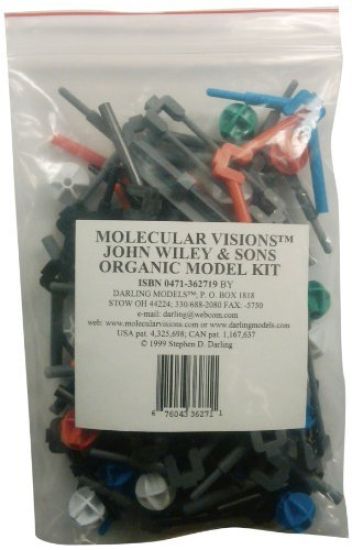
Manipulating models and building molecules in 3-dimensional space is the very best way for students to develop their spatial skills (one of the key issues in organic courses) and to get a real sense of how molecules are put together. To that end, we have done everything we could to make a model set available for students at a price they can afford. The model kit is particularly customized to the Solomons Fryhle text, but can be used with any of Wiley's organic texts. Manufactured by Darling Model Kits, this custom kit was designed by T.W.Graham Solomons. The kit consists of Darling's basic Molecular Vision kit with a few additional pieces, so that p orbitals could be shown in molecules like acetylene. This customized kit also has pieces that allow linear geometry for the sigma bonds of alkynes while also having orthogonal connections at each atom for the associated p orbitals. By attaching balls of the right colors it is possible to show the lobes of the p orbitals that make up the pi bonds in an alkyne. Ball colors can be matched symmetrically to show in-phase orbital overlap, or antisymmetrically to show an antibonding state. Use of colored balls with the appropriate framework geometry is a very nice feature of the Darling model set. Pieces from Darling's inorganic model set and are used for octahedral geometry.
The 12th edition of Organic Chemistry continues Solomons, Fryhle & Snyder's tradition of excellence in teaching and preparing students for success in the organic classroom and beyond. A central theme of the authors' approach to organic chemistry is to emphasize the relationship between structure and reactivity. To accomplish this, the content is organized in a way that combines the most useful features of a functional group approach with one largely based on reaction mechanisms. The authors' philosophy is to emphasize mechanisms and their common aspects as often as possible, and at the same time, use the unifying features of functional groups as the basis for most chapters. The structural aspects of the authors' approach show students what organic chemistry is. Mechanistic aspects of their approach show students how it works. And wherever an opportunity arises, the authors' show students what it does in living systems and the physical world around us.
Organic Chemistry 13th Edition continues Solomons, Fryle, and Snyder's tradition of excellence in teaching and preparing students for success in both the classroom and beyond. Central to the authors is their approach in emphasizing organic chemistry's relationship between structure and reactivity. To accomplish this, the content is organized in a way that combines the most useful features of a functional group approach with one largely based on reaction mechanisms. The authors' philosophy is to emphasize mechanisms and their common aspects as often as possible, and at the same time, use the unifying features of functional groups as the basis for most chapters. The structural aspects of the authors' approach show students what organic chemistry is. Mechanistic aspects of their approach show students how it works. And wherever an opportunity arises, the authors show students what it does in living systems and the physical world around us.
Organic Chemistry, 13th edition provides a comprehensive, yet accessible, treatment of all the essential organic chemistry concepts, with emphasis on relationship between structure and reactivity in the subject. The textbook includes all the concepts covered in a typical organic chemistry textbook but is unique in its skill-development approach to the subject. Numerous hands-on activities and real-world examples are integrated throughout the text to help students understand both the "why" and the "how" behind organic chemistry. This International Adaptation offers new and updated content with improved presentation of all course material. It offers new material on several topics, including the relevance of intermolecular forces in the immune response and vaccines like those for Covid-19, the chemistry of breathing (carbonic anhydrase), how conjugation and complexation affect the color of lobsters, and how biodegradable polymers are used to stabilize vaccines and pharmaceuticals. Content is revised to reflect the current understanding of chemical processes, and improved depictions of longstanding mechanisms. This edition builds on the ongoing pedagogical strength of the book with the inclusion of additional worked and end-of-chapter problems and an engaging set of new problems entitled "Chemical Consultant Needed". These draw from the primary chemical literature and give students experience of working with more complex, polyfunctional structures, and areas where key transformations take place.
For 150 years, Corning Incorporated has repeatedly succeeded in their quest to create new products for an ever-changing marketplace. Corning and the Craft of Innovation is the story of the extraordinary research and development strategy that propelled this company to its leadership position in leading-edge technologies for the new world economy. Since its founding in the mid-nineteenth century, Corning has placed a premium on research and development in tandem with an unending spirit of innovation. Corning's innovations made possible such essential items as light bulbs, television, Pyrex, catalytic converters for cars, and high-speed telecommunications through fiber optics. Most impressive is Corning's evolution into a highly innovative producer of specialty materials. In its early days, Corning developed specialty glass for use in railroad signal lenses that had to withstand the rigors of high and low temperatures; and developed its high speed Ribbon Machine - still used today - to produce glass envelopes for light bulbs more quickly and efficiently than anyone else. Today Corning leads the world in fibre optics and is a premier provider of cable and photonic products. In 1999 Wired magazine nominated Corning for its coveted Wired Index, confirming Corning's astonishing staying power as a leading-edge company. Corning and the Craft of Innovation examines how Corning fostered a culture of innovation while showing extraordinary patience in backing long-term projects. The book illustrates how a pattern of deliberate, regular, and profitable innovation begun 150 years ago has put Corning at the vanguard of leading-edge technologies for the fastest-growing markets of the global marketplace. It will be essential reading for anyone interested in strategic management, innovation, science and technology or knowledge management.
Incorporating a variety of styles and formats and photographs from around the world, T(w)o Bits is a poetic exploration of life's themes and threads. From friendship to romance, from love to loss, heartache, and more.
Title: An Elegy on the death of A. M. Toplady. By T. W ilkins].Publisher: British Library, Historical Print EditionsThe British Library is the national library of the United Kingdom. It is one of the world's largest research libraries holding over 150 million items in all known languages and formats: books, journals, newspapers, sound recordings, patents, maps, stamps, prints and much more. Its collections include around 14 million books, along with substantial additional collections of manuscripts and historical items dating back as far as 300 BC.The FICTION & PROSE LITERATURE collection includes books from the British Library digitised by Microsoft. The collection provides readers with a perspective of the world from some of the 18th and 19th century's most talented writers. Written for a range of audiences, these works are a treasure for any curious reader looking to see the world through the eyes of ages past. Beyond the main body of works the collection also includes song-books, comedy, and works of satire. ++++The below data was compiled from various identification fields in the bibliographic record of this title. This data is provided as an additional tool in helping to insure edition identification: ++++ British Library W., T; Toplady, Augustus; 1778. 8 . 11641.bb.58.
God is that You? Are these whispers Yours or mine? Can we really talk with the Great I AM? Is there an eternal presence of all that is, was, or ever will be within us? Can we come to know the "truth"? Help us seek your presence within us. Help us make the choice to visit, while still in this life's moment. The authors prefer to remain anonymous and hope the book will help the readers find their own internal spiritual "Author".




![The Female Patriot; An Epistle from C-T-E M-C-Y to the Rev. Dr W-L-N [wilson] on Her Late Marriage; With Critical ... Notes, Etc. [a Satire on Catherine Macaulay.]](/covers/9781241014889.jpg)






![An Elegy on the Death of A. M. Toplady. by T. W[ilkins].](/covers/9781241594947.jpg)