The Bibliotheca Teubneriana, established in 1849, has evolved into the world's most venerable and extensive series of editions of Greek and Latin literature, ranging from classical to Neo-Latin texts. Some 4-5 new editions are published every year. A team of renowned scholars in the field of Classical Philology acts as advisory board: Gian Biagio Conte (Scuola Normale Superiore di Pisa)Marcus Deufert (Universitat Leipzig)James Diggle (University of Cambridge)Donald J. Mastronarde (University of California, Berkeley)Franco Montanari (Universita di Genova)Heinz-Gunther Nesselrath (Georg-August-Universitat Goettingen)Dirk Obbink (University of Oxford)Oliver Primavesi (Ludwig-Maximilians Universitat Munchen)Michael D. Reeve (University of Cambridge)Richard J. Tarrant (Harvard University) Formerly out-of-print editions are offered as print-on-demand reprints. Furthermore, all new books in the Bibliotheca Teubneriana series are published as eBooks. The older volumes of the series are being successively digitized and made available as eBooks.If you are interested in ordering an out-of-print edition, which hasn't been yet made available as print-on-demand reprint, please contact us: [email protected] editions of Latin texts published in the Bibliotheca Teubneriana are collected in the online database BTL Online.
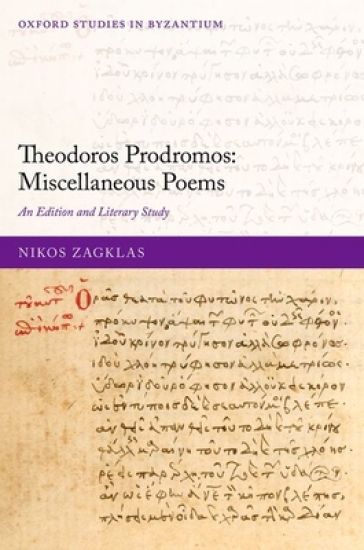
In twelfth-century Byzantium, poetry played a key part in various contexts of textual production and consumption. One of the leading poets of this period was Theodoros Prodromos, whose surviving corpus comprises approximately 17,000 verses. Even though most of his poetry has been presented in modern critical editions, a group of his works has been overlooked by modern philologists and literary scholars alike. The selected corpus--conventionally designated as Miscellaneous Poems--consists of texts on various themes and in a wide range of genres, ranging from cycles of religious and secular epigrams to riddles, ethopoiiai, and works of a self-referential and essayistic nature. This book includes the first critical edition and study of these poems, accompanied by English translations and commentaries. Their study contributes to a more nuanced picture of Prodromos' intellectual profile, expanding his image as the 'poet laureate' of the Komnenian court and providing entirely new insights into his activity in the different settings of Constantinopolitan intellectual life. The book also sheds new light on the complex relationship between patronage and other aspects of literary activity and the circulation of the same text in different performative contexts.
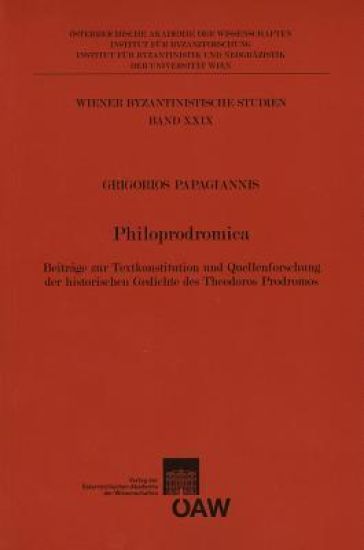
I. Textkonstitution: Die Forschung verfugt uber mehrere mittelalterliche Handschriften und Editionen, sogar uber eine moderne kritische Gesamtausgabe der Historischen Gedichte des Theodoros Prodromos. Allerdings gibt es immer noch Stellen in diesen Texten, die zu hinterfragen sind (z. T. schon erkannt, z. T. ungefragt akzeptiert). Manche davon werden auch nach der vorliegenden Behandlung - vorlaufig? - korrupt bleiben, andere liessen sich deutlich verbessern bzw. besser verstehen, viele wurden geheilt. Letzteres erfolgte auf zwei Wege: Entweder fuhrte die systematische Anwendung von philologischen Methoden und Mitteln (Nachkollation, Grammatik, Syntax, Metrik, Stilkenntnis, vergleichendes Lesen, lexikographische Forschung usw.) auf einen uberzeugenden Korrekturvorschlag (emendatio) hin oder, umgekehrt, eine gluckliche Eingebung (divinatio) liess sich (nachtraglich) durch die erwahnten Mitteln bestatigen bzw. untermauern. II. Quellenforschung bedeutet in diesem Fall die Suche nach dem Gedankenweg des Dichters, den Versuch alle seinen Andeutungen aufzufangen. Dies geschieht auf zwei Wege: Entweder spricht der Text direkt die aLesungen des Lesers an oder dieser erkennt nur unbestimmt eine gewisse Nachahmung-Reminiszenz usw., die sich dann oft mit Hilfe der Technologie oder traditioneller Methoden genauer bestimmen lasst.
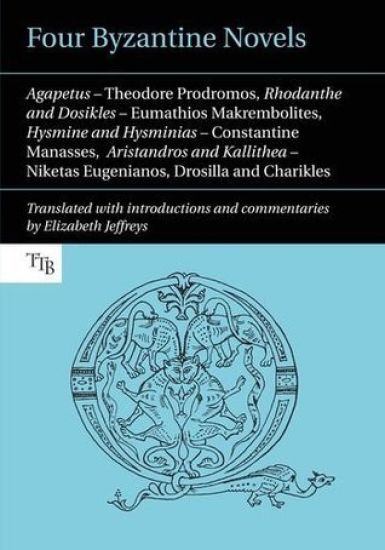
Constantinople in the mid-twelfth century saw the composition of the first sustained fictional narratives in the European world – novels – since late antiquity. Four members of the Byzantine intelligentsia produced for the entertainment of their colleagues, their aristocratic patrons, and not least themselves, pastiches in verse and prose of the romantic tales of Achilles Tatius and Heliodorus. These novels are perhaps the most attractive, as well as the most unexpected, literary products of the Byzantine millennium. More than one of the four novels translated here was well known in Renaissance Europe, but all have been largely neglected by later generations of readers and scholars as insipid and derivative eroticism. This is regrettable since they antedate by several decades the works of Chrétien de Troyes, the French father of the European novel. This Byzantine phase in the history of the genre, though not part of its central development, deserves exploration. Building on recent work which has begun to rehabilitate these texts, this book marks the first English translation of all four texts in one volume, placing them and their writers in their literary and historical contexts and opening up their world to all those interested in the novel and in European medieval literature. LUP gratefully acknowledges the generous support of Dr Costas Kaplanis, alumnus of King’s College London, who suggested the idea of the series to Professor Herrin and has underwritten the initial expenses.
Constantinople in the mid-twelfth century saw the composition of the first sustained fictional narratives in the European world – novels – since late antiquity. Four members of the Byzantine intelligentsia produced for the entertainment of their colleagues, their aristocratic patrons, and not least themselves, pastiches in verse and prose of the romantic tales of Achilles Tatius and Heliodorus. These novels are perhaps the most attractive, as well as the most unexpected, literary products of the Byzantine millennium. More than one of the four novels translated here was well known in Renaissance Europe, but all have been largely neglected by later generations of readers and scholars as insipid and derivative eroticism. This is regrettable since they antedate by several decades the works of Chrétien de Troyes, the French father of the European novel. This Byzantine phase in the history of the genre, though not part of its central development, deserves exploration. Building on recent work which has begun to rehabilitate these texts, this book marks the first English translation of all four texts in one volume, placing them and their writers in their literary and historical contexts and opening up their world to all those interested in the novel and in European medieval literature. LUP gratefully acknowledges the generous support of Dr Costas Kaplanis, alumnus of King’s College London, who suggested the idea of the series to Professor Herrin and has underwritten the initial expenses.
Prodrome of a monograph of the Pinnipedes is an unchanged, high-quality reprint of the original edition of 1866. Hansebooks is editor of the literature on different topic areas such as research and science, travel and expeditions, cooking and nutrition, medicine, and other genres. As a publisher we focus on the preservation of historical literature. Many works of historical writers and scientists are available today as antiques only. Hansebooks newly publishes these books and contributes to the preservation of literature which has become rare and historical knowledge for the future.
Observera att förlaget som ger ut denna produkt baserar innehållet i sina produkter på fria källor som Wikipedia. Boken är med stor sannolikhet endast ett utdrag ur dessa informationskällor, alltså inte en vanlig bok i den bemärkelsen.