Kirjojen hintavertailu. Mukana 11 342 296 kirjaa ja 12 kauppaa.

Kirjahaku

Etsi kirjoja tekijän nimen, kirjan nimen tai ISBN:n perusteella.

1000 tulosta hakusanalla Tim Milnes

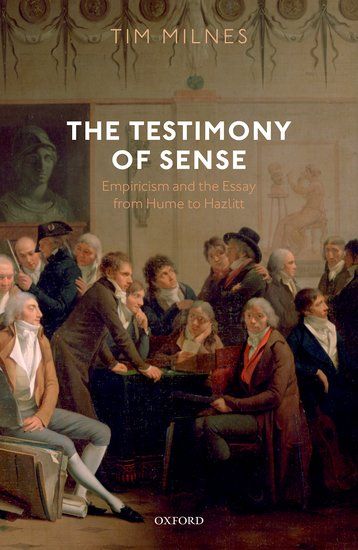
The Testimony of Sense

The Testimony of Sense

Tim Milnes

Oxford University Press
2019
sidottu
The Testimony of Sense attempts to answer a neglected but important question: what became of epistemology in the late eighteenth century, in the period between Hume's scepticism and Romantic idealism? It finds that two factors in particular reshaped the nature of 'empiricism': the socialisation of experience by Scottish Enlightenment thinkers and the impact upon philosophical discourse of the belletrism of periodical culture. The book aims to correct the still widely-held assumption that Hume effectively silenced epistemological inquiry in Britain for over half a century. Instead, it argues that Hume encouraged the abandonment of subject-centred reason in favour of models of rationality based upon the performance of trusting actions within society. Of particular interest here is the way in which, after Hume, fundamental ideas like the self, truth, and meaning are conceived less in terms of introspection, correspondence, and reference, and more in terms of community, coherence, and communication. By tracing the idea of intersubjectivity through the issues of trust, testimony, virtue and language, the study offers new perspectives on the relationships between philosophy and literature, empiricism and transcendentalism, and Enlightenment and Romanticism. As philosophy grew more conversational, the familiar essay became a powerful metaphor for new forms of communication. The book explores what is epistemologically at stake in the familiar essay genre as it develops through the writings of Joseph Addison, David Hume, Samuel Johnson, Charles Lamb, and William Hazlitt. It also offers readings of philosophical texts, such as Hume's Treatise, Thomas Reid's Inquiry, and Adam Smith's Theory of Moral Sentiments, as literary performances.

William Wordsworth - The Prelude

William Wordsworth - The Prelude

Tim Milnes

Red Globe Press
2009
sidottu
The Prelude is now seen as a central text in the Wordsworth corpus. This Guide identifies and gathers significant critical perspectives, interpretations and debates connected with the poem, contextualising and explaining criticism from the Victorian period right through to the present day.
William Wordsworth - The Prelude

William Wordsworth - The Prelude

Tim Milnes

Red Globe Press
2009
nidottu
The Prelude is now seen as a central text in the Wordsworth corpus. This Guide identifies and gathers significant critical perspectives, interpretations and debates connected with the poem, contextualising and explaining criticism from the Victorian period right through to the present day.
Knowledge and Indifference in English Romantic Prose

Knowledge and Indifference in English Romantic Prose

Tim Milnes

Cambridge University Press
2007
pokkari
This 2003 study sheds light on the way in which the English Romantics dealt with the basic problems of knowledge, particularly as they inherited them from the philosopher David Hume. Kant complained that the failure of philosophy in the eighteenth century to answer empirical scepticism had produced a culture of 'indifferentism'. Tim Milnes explores the way in which Romantic writers extended this epistemic indifference through their resistance to argumentation, and finds that it exists in a perpetual state of tension with a compulsion to know. This tension is most clearly evident in the prose writing of the period, in works such as Wordsworth's Preface to Lyrical Ballads, Hazlitt's Essay on the Principles of Human Action and Coleridge's Biographia Literaria. Milnes argues that it is in their oscillation between knowledge and indifference that the Romantics prefigure the ambivalent negotiations of modern post-analytic philosophy.
The Truth about Romanticism

The Truth about Romanticism

Tim Milnes

Cambridge University Press
2010
sidottu
How have our conceptions of truth been shaped by romantic literature? This question lies at the heart of this examination of the concept of truth both in romantic writing and in modern criticism. The romantic idea of truth has long been depicted as aesthetic, imaginative and ideal. Tim Milnes challenges this picture, demonstrating a pragmatic strain in the writing of Keats, Shelley and Coleridge in particular, that bears a close resemblance to the theories of modern pragmatist thinkers such as Donald Davidson and Jürgen Habermas. Romantic pragmatism, Milnes argues, was in turn influenced by recent developments within linguistic empiricism. This book will be of interest to readers of romantic literature, but also to philosophers, literary theorists, and intellectual historians.
Knowledge and Indifference in English Romantic Prose

Knowledge and Indifference in English Romantic Prose

Tim Milnes

Cambridge University Press
2003
sidottu
This 2003 study sheds light on the way in which the English Romantics dealt with the basic problems of knowledge, particularly as they inherited them from the philosopher David Hume. Kant complained that the failure of philosophy in the eighteenth century to answer empirical scepticism had produced a culture of 'indifferentism'. Tim Milnes explores the way in which Romantic writers extended this epistemic indifference through their resistance to argumentation, and finds that it exists in a perpetual state of tension with a compulsion to know. This tension is most clearly evident in the prose writing of the period, in works such as Wordsworth's Preface to Lyrical Ballads, Hazlitt's Essay on the Principles of Human Action and Coleridge's Biographia Literaria. Milnes argues that it is in their oscillation between knowledge and indifference that the Romantics prefigure the ambivalent negotiations of modern post-analytic philosophy.
The Truth about Romanticism

The Truth about Romanticism

Tim Milnes

Cambridge University Press
2013
pokkari
How have our conceptions of truth been shaped by romantic literature? This question lies at the heart of this examination of the concept of truth both in romantic writing and in modern criticism. The romantic idea of truth has long been depicted as aesthetic, imaginative and ideal. Tim Milnes challenges this picture, demonstrating a pragmatic strain in the writing of Keats, Shelley and Coleridge in particular, that bears a close resemblance to the theories of modern pragmatist thinkers such as Donald Davidson and Jürgen Habermas. Romantic pragmatism, Milnes argues, was in turn influenced by recent developments within linguistic empiricism. This book will be of interest to readers of romantic literature, but also to philosophers, literary theorists, and intellectual historians.
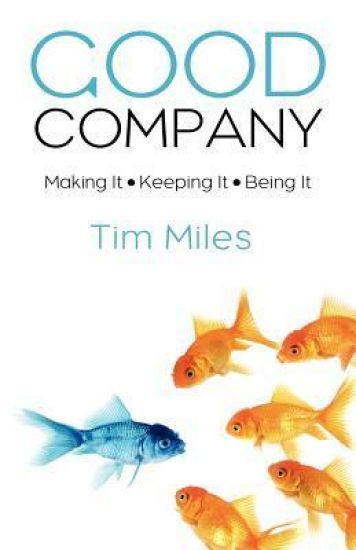
Good Company: Making It - Keeping It - Being It
Fish don't know they're in water. We've been like that, too. Tried-and-trusted methods of communication no longer ring true in today's marketplace. What's more (or less, as the case may be), the systems you relied upon are failing ... maybe. If you want to not only survive but thrive in this century, you're going to need to reorient yourself to a new way of thinking. Inside this book, you'll find three sections devoted to case studies, lessons learned, and stories of business growth, customer delight, and personal development. In Part I - "Making Good Company" - you'll learn about strategy and about what matters and what doesn't to consumers today. You'll learn to critically and objectively analyze what you're trying to make happen, and what's in your way. In Part II - "Keeping Good Company" - you'll learn some of the secrets that have helped my words win customers in seven countries. You'll see and - through a complementary private website - hear actual examples of copywriting and customer service success stories to help you win new customers and delight the ones you already have. In Part III - "Being Good Company" - you'll learn some techniques for separating the truly important from the merely urgent. You'll take a look inside the Miles family - where Dee and I have learned to look at the world a little differently since our son was diagnosed with autism. A book filled with heart, humor and historical success, Good Company will help you live, work and play a little better, a little truer, and a little stronger. If you're looking for a quick fix, you're going to come away disappointed. This book is the diet and exercise of marketing and communication and persuasion. If you're looking for a bag of magic beans, I wish you the best of luck. But don't worry - I'm sure some social media expert will be by in a few minutes.
Stand-Up Comedy

Stand-Up Comedy

Tim Miles

Routledge
2026
sidottu
This book sets out a fresh approach to stand-up comedy. By constructing a theoretical framework using laughter theory, phenomenology and contemporary performance theory, it provides not only a new analytical tool for this genre of performance, but also a means by which it can be understood, discussed and taught. Tim Miles combines empirical research into the 'lived experience' of live stand-up with a strong theoretical model to explore the importance of performance expectations; perceptions of space; sensory perceptions; liveness; the lived experience; inter-subjectivity; memory; interactions; collectively; and perceptions of truth and trust.
Stand-Up Comedy

Stand-Up Comedy

Tim Miles

Routledge
2026
nidottu
This book sets out a fresh approach to stand-up comedy. By constructing a theoretical framework using laughter theory, phenomenology and contemporary performance theory, it provides not only a new analytical tool for this genre of performance, but also a means by which it can be understood, discussed and taught. Tim Miles combines empirical research into the 'lived experience' of live stand-up with a strong theoretical model to explore the importance of performance expectations; perceptions of space; sensory perceptions; liveness; the lived experience; inter-subjectivity; memory; interactions; collectively; and perceptions of truth and trust.
Why We Give

Why We Give

Tim Milner

Createspace Independent Publishing Platform
2014
pokkari
This will change the way you see money forever. What if Jesus told you how to use your money? Here's the thing, Jesus talked about money more than almost any other topic. Jesus knows that where your money is, there your heart will be also. He has a plan for you and one part of that plan is getting you to honor Him with your money. Why We Give was written to challenge people to be both generous and strategic with their money.Jesus challenges each of us to give, and this book will tell you why.
...och 20 år har gått...

...och 20 år har gått...

Tim Malnes

Recito Förlag AB
2010
nidottu
«Rotade på vinden och fann lite dikter jag skrev för många år sedan. Satte mig ner och läste igenom. Mina innersta tankar. 20 år gamla. Jag frågade mig själv: Har jag förändrats? Inte mycket. Kanske blivit mer luttrad. Konstaterade att det där är jag även idag.» Tim Malnes 2009
Brand Your Own Business: A Step-by-Step Guide to Being Known, Liked, and Trusted in the Age of Rapid Distraction
Small business branding questions? You're not alone There are nearly eight million family businesses in the U.S. and Canada and nearly that many marketing options to choose from. Good companies don't know which direction to turn. Good people are drowning in noise, choice, and the droning voice of self-appointed thought leaders on every virtual street corner. When you BYOB: - You will know how to translate your deepest values into daily actions. - You will know how to get your team on the same page with the same purpose... YOUR purpose. - You will know how to consistently deliver a more delightful experience than you promise. - You will know how to tell the right, true story about your business, so that people know, like, and trust you. Create a marketing plan from the inside out in an intuitive, step-by-step way that will make sense and feel good to you and your team. You'll have a strong foundation to weather any storm, because you'll always be able to Brand Your Own Business.
Five miles a pint! Walking the South West Coast Path
Other South West Coast Path walkers usually seem to start, rather sensibly, at the beginning, progress to the middle and finish at the end. Often the challenge seems to be tackled in one 'hit', which is fine if you can spare the eight weeks needed to do it that way. But our story is not like that. Snatching time off from work when we could, the sections of path we attempted depended upon the availability of out of season public transport. Wainwright's Coast to Coast walk, it's Alternative cousin and our own Hare-Brained Hike were duly conquered, but the "Path" still resisted. Whatever the terrain, whatever the weather, the presence of 'killer steps' or otherwise and regardless of whether or not we stopped at lunchtime, we always seemed to average two miles per hour over each trip. And as we went, we recorded both our adventures and our 'fuel' economy...
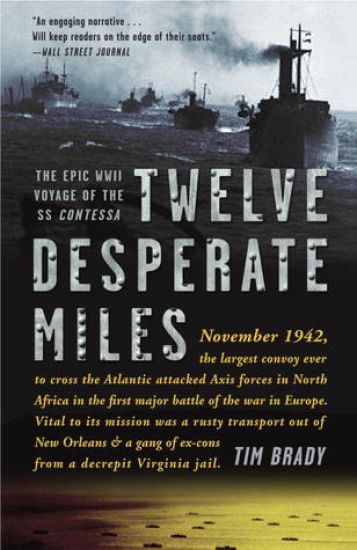
Twelve Desperate Miles: The Epic World War II Voyage of the SS Contessa
The true story of how a rusty New Orleans banana boat staffed with a most unlikely and diverse crew was drafted into service in WWII--and heroically succeeded in setting the stage for Patton's epic invasion of North Africa.The largest amphibious invasion force ever to cross the Atlantic Ocean set sail from Virginia in November 1942 with the aim of capturing Casablanca and a crucial airfield northeast of the city. Unfortunately, the airfield was located a dozen miles up a twisting Morrocan river, too shallow for any ship in the entire Allied fleet. As the invasion neared, the War Department turned up the Contessa, a salt-caked Honduran-registered civilian freighter that had spent most of her career hauling bananas and honeymooners. This unremarkable ship, crewed by seamen from twenty-six different nations, eighteen sailors pulled from the Norfolk County jail, and a French harbor pilot spirited out of Morroco by OSS agents, became the focus of the opening salvo of World War II. Too late to join the massive convoy sailing for Africa, the Contessa set out on her own through the U-boat-infested waters of the Atlantic to the shores of Morocco, where she faced her most daunting challenge: the twelve-mile voyage up the well-defended Sebou River, carrying an explosive cocktail of airplane fuel and nine hundred tons of bombs in her holds. Twelve Desperate Miles is a surprising and entertaining account of one of the great untold stories of the war.
Milestones of Flight

Milestones of Flight

Tim Grove

ABRAMS
2016
sidottu
Milestones of Flight takes readers soaring through the high points of American aviation: from the Wright brothers and their competitors to the military pilots who first circumnavigated the globe, from the initial space rocket to the moon walk, from the earliest manmade satellite to today’s spy drones. The book also describes what inventions—such as rocket propulsion, the wind tunnel, and the silicon chip—helped move flight upward and beyond. Profusely illustrated with objects from the Smithsonian’s collection, Milestones of Flight provides an inspiring look at America’s contributions to aviation. The book includes a bibliography, author’s note, and index.
Milestones in Archaeology

Milestones in Archaeology

Tim Murray

ABC-CLIO
2007
sidottu
This engaging work uses key discoveries, events, people, techniques, and controversies to give the general reader a rich history of archaeology from its beginnings in the 16th century to the present.The history of archaeology leads from the musty collections of dilettante antiquarians to high-tech science. The book identifies three major developmental periods—Birth of Archaeology (16th–18th centuries), Archaeology of Origins and Empires (19th century), and World Archaeology (20th century). An introductory essay acquaints the reader with the essence of the science for each period. The short entries comprising the balance of the book expand on the themes introduced in the essays.Organized around personalities, techniques, controversies, and conflicts, the encyclopedia brings to life the history of archaeology. It broadens the general reader's knowledge by detailing the professional significance of widely known discoveries while introducing to wider knowledge obscure but important moments in archaeology. Archaeology is replete with the visionaries and swashbucklers of popular myth; it is also filled with careful and dedicated scientists.200 entries present chronological milestones in the history of archaeologyIncludes 70 photographs and drawings of people, sites, and artifactsThree maps locate sites mentioned throughout the textIncludes an extensive bibliography for introductory essays and each entry