This volume forms a collection of papers tracking the emergence of the history of archaeology from a subject of marginal status in the 1980s to the mainstream subject which it is today. Professor Timothy Murrays essays have been widely cited and track over 20 years in the development of the subject. The papers are accompanied by a new introduction which surveys the development of the subject over the last 25 years as well as a reflection of what this means for the philosophy of archaeology and theoretical archaeology. This volume spans Tims successful career as an academic at the forefront of the study of the history of archaeology, both in Australia and internationally. During his career he has held posts in Britain and Europe as well as Australia, most notably at the University of Cambridge, The Institute of Archaeology at UCL, Leiden University and the University of Paris. He now edits The Bulletin of the History of Archaeology.
This engaging work uses key discoveries, events, people, techniques, and controversies to give the general reader a rich history of archaeology from its beginnings in the 16th century to the present.The history of archaeology leads from the musty collections of dilettante antiquarians to high-tech science. The book identifies three major developmental periods—Birth of Archaeology (16th–18th centuries), Archaeology of Origins and Empires (19th century), and World Archaeology (20th century). An introductory essay acquaints the reader with the essence of the science for each period. The short entries comprising the balance of the book expand on the themes introduced in the essays.Organized around personalities, techniques, controversies, and conflicts, the encyclopedia brings to life the history of archaeology. It broadens the general reader's knowledge by detailing the professional significance of widely known discoveries while introducing to wider knowledge obscure but important moments in archaeology. Archaeology is replete with the visionaries and swashbucklers of popular myth; it is also filled with careful and dedicated scientists.200 entries present chronological milestones in the history of archaeologyIncludes 70 photographs and drawings of people, sites, and artifactsThree maps locate sites mentioned throughout the textIncludes an extensive bibliography for introductory essays and each entry
The WoWs pack a punch, bringing insights from a person who successfully climbed the corporate ladder from Accounting Clerk to CEO. The WoWs provide the reader the opportunity to learn from the best classroom, the real world. The author brings unique stories from his career that deliver practical everyday advice. The world has drastically changed as a result of the COVID pandemic, now more than ever the WoWs can be leveraged to accelerate your career. Whether you are a CEO or a college student the WoWs deliver results.
Since time immemorial, Inuit drum dancing songs have been used throughout the Arctic to reaffirm kinship ties, decompress from the rigors of hunting and gathering, and redirect competitive behavior. The Effects of Inuit Drum Dancing on Psychosocial Well-Being and Resilience: Productivity and Cultural Competence in an Inuit Settlement explores the sociocultural context surrounding two forms of traditional Inuit drum dancing in Ulukhaktok, an Inuit settlement in the Canadian Northwest Territories. Tim Murray uses case studies and social script analysis to argue that drum dance participation has emerged in this community as a way of supporting the psychosocial well-being of the settlement’s younger population and to explore how in the wake of colonization, drum dancing has resolidified in Ulukhaktok. Specifically, chapters examine the impacts of generational isolation and its downstream effects on the lives of settlement youth and young adults, the deployment of drum dancing as a tactical resource for modulating emotional access with elders, and its reemergence within the Ulukhaktok taskscape as a platform for reinterpreting local understandings of productivity and cultural competence.
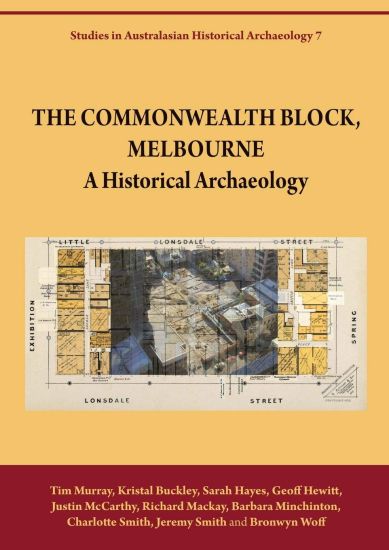
Tim Murray; Kristal Buckley; Sarah Hayes; Geoff Hewitt; Justin McCarthy; Richard Mackay; Barbara Minchinton; Charlotte Smith; Jeremy Smith; Bronwyn Woff
For much of the 19th and 20th centuries, Melbourne’s Little Lonsdale Street – locally known as ‘Little Lon’ – was notorious as a foul slum and brothel district, occupied by the itinerant and the criminal. The stereotype of ‘slumdom’ defined ‘Little Lon’ in the minds of Melbournians, and became entrenched in Australian literature and popular culture.The Commonwealth Block, Melbourne tells a different story. This groundbreaking book reports on almost three decades of excavations conducted on the Commonwealth Block – the area of central Melbourne bordered by Little Lonsdale, Lonsdale, Exhibition and Spring streets. Since the 1980s, archaeologists and historians have pieced together the rich and complex history of this area, revealing a working-class and immigrant community that was much more than just a slum. The Commonwealth Block, Melbourne delves into the complex social, cultural and economic history of this forgotten community.
This book presents research into the urban archaeology of 19th-century Australia. It focuses on the detailed archaeology of 20 cesspits in The Rocks area of Sydney and the Commonwealth Block site in Melbourne. It also includes discussions of a significant site in Sydney – First Government House. The book is anchored around a detailed comparison of contents of 20 cesspits created during the 19th century, and examines patterns of similarity and dissimilarity, presenting analyses that work towards an integration of historical and archaeological data and perspectives. The book also outlines a transnational framework of comparison that assists in the larger context related to building a truly global archaeology of the modern city. This framework is directly related a multi-scalar approach to urban archaeology. Historical archaeologists have been advocating the need to explore the archaeology of the modern city using several different scales or frames of reference. The most popular (and most basic) of these has been the household. However, it has also been acknowledged that interpreting the archaeology of households beyond the notion that every household and associated archaeological assemblage is unique requires archaeologists and historians to compare and contrast, and to establish patterns. These comparisons frequently occur at the level of the area or district in the same city, where archaeologists seek to derive patterns that might be explained as being the result of status, class, ethnicity, or ideology. Other less frequent comparisons occur at larger scales, for example between cities or countries, acknowledging that the archaeology of the modern western city is also the archaeology of modern global forces of production, consumption, trade, immigration and ideology formation. This book makes a contribution to that general literature
This book presents research into the urban archaeology of 19th-century Australia. It focuses on the detailed archaeology of 20 cesspits in The Rocks area of Sydney and the Commonwealth Block site in Melbourne. It also includes discussions of a significant site in Sydney – First Government House. The book is anchored around a detailed comparison of contents of 20 cesspits created during the 19th century, and examines patterns of similarity and dissimilarity, presenting analyses that work towards an integration of historical and archaeological data and perspectives. The book also outlines a transnational framework of comparison that assists in the larger context related to building a truly global archaeology of the modern city. This framework is directly related a multi-scalar approach to urban archaeology. Historical archaeologists have been advocating the need to explore the archaeology of the modern city using several different scales or frames of reference. The most popular (and most basic) of these has been the household. However, it has also been acknowledged that interpreting the archaeology of households beyond the notion that every household and associated archaeological assemblage is unique requires archaeologists and historians to compare and contrast, and to establish patterns. These comparisons frequently occur at the level of the area or district in the same city, where archaeologists seek to derive patterns that might be explained as being the result of status, class, ethnicity, or ideology. Other less frequent comparisons occur at larger scales, for example between cities or countries, acknowledging that the archaeology of the modern western city is also the archaeology of modern global forces of production, consumption, trade, immigration and ideology formation. This book makes a contribution to that general literature
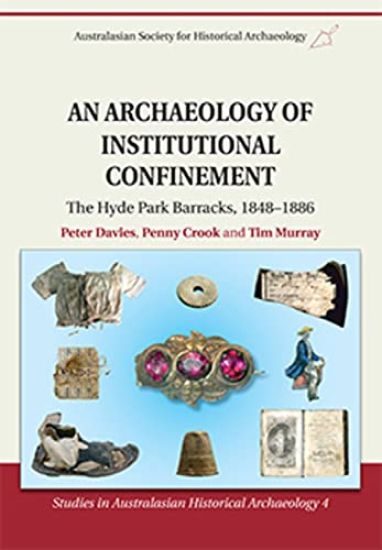
The archaeological assemblage from the Hyde Park Barracks is one of the largest, most comprehensive and best preserved collections of artefacts from any 19th-century institution in the world. Concealed for up to 160 years in the cavities between floorboards and ceilings, the assemblage is a unique archaeological record of institutional confinement, especially of women.The underfloor assemblage dates to the period 1848 to 1886, during which a female Immigration Depot and a Government Asylum for Infirm and Destitute Women occupied the second and third floors of the Barracks. Over the years the women discarded and swept beneath the floor thousands of clothing and textile fragments, tobacco pipes, religious items, sewing equipment, paper scraps and numerous other objects, many of which rarely occur in typical archaeological deposits. These items are presented in detail in this book, and provide unique insight into the private lives of young female migrants and elderly destitute women, most of whom will never be known from historical records.
Critical Games is about the games we play (whether we know it or not), the ways we play them (for fun, but also to win, and to gain approval from others), and what happens when they get out of hand. The book interrogates the theory of play and gaming, with a particular focus on the games played by literary authors and literary critics. Drawing on (often self-critical) autobiography, as well as readings in texts across a range of languages, Tim Beasley-Murray plays with academic conventions to highlight what is at stake in them, turning to the Game of Literature, from Kafka to Carrère, to seek models and warnings of the outcomes of taking games too seriously, or not taking them seriously enough.
A narrative account of the survey of almost 1,000 professional historians on what constitutes a successful performance in the presidency, this survey tells us almost as much about the thinking and biases of historians as it does about the nature of the American presidency. Besides comparing past presidential polls and constructing a ranking list of the nation’s chief executives, this study examines why historians rate presidents the way they do, and it analyzes those qualities and traits historians look for in a successful president. It also delimits what constitutes a failing performance in the White House and marks the major pitfalls that almost assuredly lead to an adverse historical verdict. In the process, the study demonstrates that there is not always a close correlation between what historians say a president should do and what historians obviously feel when actually ranking the performances of the presidents of the United States. This study should prove enlightening not only to the historical profession but to the general public, political pundits, newscasters, public officials, and all presidential aspirants, and even to past and present occupants of the White House and their staffs.
Thinking Systematics (TSS) is conceived as a “toolkit for the mind” — designed to improve how we think about the world, analyze information and pursue our goals. Smith and Hayslip make a compelling argument that individual thinking and collective decision making are being systematically constrained within limits imposed by outmoded forms of cognition and the determination of privileged elites to perpetuate an unsustainable status quo. The dialectical reasoning advocated in this wide-ranging book aims to overcome those limits and to allow a much more profound understanding of the human condition in the 21st century. Mainstream problem-solving focuses almost exclusively on scientific/technological fixes on one side and moral/cultural remedies on the other. But to comprehend our world adequately far more serious attention must be given to the specifically social, economic and political arrangements shaping our lives. Once embraced by growing numbers of people, TSS strategies, methods and habits of thought can contribute significantly to a “new common sense” — one adequate to meeting the immense challenges facing humanity in our era.
A natural remedies guide to preventing and treating cancer lists foods, supplements, and tips on how to assess personal risk, stop cancer growth, and deal with both conventional and alternative treatments, in a three-part handbook that covers prevention, treatment, and coping with the side effects of treatment. Reprint.
Mark Sheerin; Coco Khan; Susan Murray; Mark Edward; Penny Pepper; Paul Quinn; Hayley Foster Da Silva; Ellen Cheshire; Dr K. Charlie Oughton; Simon Smith; Jack Bright; Ben Graham; Em Ayson; Tim Burrows; Dr Tim Garrett; Bella Qvist
What is Counterculture? – It’s an alternative lifestyle... – The ideas that spark a revolution... – A movement that changes the world... This new collection of essays celebrates the incredible originality of British post-war culture. British art, film, theatre, dance, literature and music have attracted international recognition, from the Angry Young Men to the Sex Pistols to Grayson Perry. Now gaming, the internet and social media enable creative communities to flourish and either fight for social justice – or just be entertained. Can we find the creative inspiration to succeed in a postcapitalist future?
James Bradley; Kim Scott; Helen Garner; Herb Wharton; Tom Cho; Barry Cooper; Delia Falconer; Sonya Hartnett; Catherine Ford; David Malouf; Carmel Bird; Brian Castro; Brenda Walker; Gail Jones; Murray Bail; Gerald Murnane; Tim Richards; Gillian Mears; Alexis Wright
De flesta svenskar, också de hyggligt belästa, får lätt något panikslaget i blicken om de ombeds nämna en enda australiensisk författare, skriver Jan Arnald i förordet till Australien berättar som är en antologi med ett brett urval av samtidsförfattare från denna ofta förbisedda kontinent. Den aboriginska urbefolkningen har den längsta obrutna kulturhistorien av jordklotets alla folkslag, men ur ett västerländskt perspektiv är den australiensiska litteraturen i stort sätt nyfödd. I denna antologi finns såväl aboriginska som icke-aboriginska författare representerade. På olika sätt förhåller de sig till det australiska; dess samhälle såväl som dess säregna mytologi. Inte minst bearbetar flera av författarna på olika sätt sin egen historia. Först i februari 2008 bad den australiensiska staten officiellt om ursäkt för sin förtryckarpolitik gentemot aboriginerna. Australien berättar fyller en lucka i den bokliga allmänbildningen i Sverige, genom att ge läsare möjligheten att bekanta sig med noveller som sträcker sig från det komiska till det tragiska, från det underhållande till det reflekterande mer sällan än inte på en och samma gång. Australien berättar utkommer i Tranans uppskattade berättarserie, som presenterar framstående novellistik från hela världen, inte sällan av författare som aldrig tidigare kommit ut på svenska. Hittills har tretton volymer utkommit, senast med noveller från Lettland och Egypten.