Kirjahaku
Etsi kirjoja tekijän nimen, kirjan nimen tai ISBN:n perusteella.
1000 tulosta hakusanalla Timothy H. Edgar
Safeguarding Our Privacy and Our Values in an Age of Mass SurveillanceAmerica’s mass surveillance programs, once secret, can no longer be ignored. While Edward Snowden began the process in 2013 with his leaks of top secret documents, the Obama administration’s own reforms have also helped bring the National Security Agency and its programs of signals intelligence collection out of the shadows. The real question is: What should we do about mass surveillance?Timothy Edgar, a long-time civil liberties activist who worked inside the intelligence community for six years during the Bush and Obama administrations, believes that the NSA’s programs are profound threat to the privacy of everyone in the world. At the same time, he argues that mass surveillance programs can be made consistent with democratic values, if we make the hard choices needed to bring transparency, accountability, privacy, and human rights protections into complex programs of intelligence collection. Although the NSA and other agencies already comply with rules intended to prevent them from spying on Americans, Edgar argues that the rules?most of which date from the 1970s?are inadequate for this century. Reforms adopted during the Obama administration are a good first step but, in his view, do not go nearly far enough.Edgar argues that our communications today?and the national security threats we face?are both global and digital. In the twenty first century, the only way to protect our privacy as Americans is to do a better job of protecting everyone’s privacy. Beyond Surveillance: Privacy, Mass Surveillance, and the Struggle to Reform the NSA explains both why and how we can do this, without sacrificing the vital intelligence capabilities we need to keep ourselves and our allies safe. If we do, we set a positive example for other nations that must confront challenges like terrorism while preserving human rights. The United States already leads the world in mass surveillance. It can lead the world in mass surveillance reform.
Biographical Sketch Of Timothy Bloomfield Edgar And His Wife
Frances H Edgar Rice
Hansebooks
2016
pokkari
A Guide to the Birds of the Philippines
Robert Kennedy; Pedro C. Gonzales; Edward Dickinson; Hector C. Miranda; Timothy H. Fisher
Oxford University Press
2000
nidottu
A Guide to the Birds of the Philippines is the first and only guide that covers all 572 species of birds known to occur within the 7,100 islands that make up the Philippines. The Philippine avifauna includes some 170 endemics - species that are not found anywhere else in the world - and is thus of interest to avid birders around the world. Many of these species are also endangered, due to the high levels of habitat destruction in the Philippine forest, and this book is also urgently needed by conservation workers in the region. The Guide is illustrated by 72 specially painted colour plates that show all but the three vagrant species recently recorded there. Its text gives detailed information about the plumage, voice, range, distribution, status, habitat, life history and behaviour of the birds and is accompanied by distribution maps for all the species described. The expert team of authors and artists includes two prominent Philippine ornithologists, and has combined field experience summing to over 100 years. This book clearly will be the standard for Philippine Ornithology for many years to come.
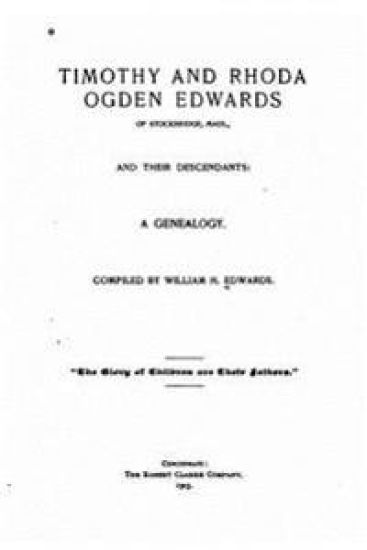
Timothy and Rhoda Ogden Edwards of Stockbridge
William H. Edwards
Createspace Independent Publishing Platform
2016
nidottu
Strategies to Mitigate the Risk to the National Critical Functions Generated by Climate Change
Andrew Lauland; Liam Regan; Susan A Resetar; Joie D Acosta; Rahim Ali; Edward W Chan; Richard H Donohue; Liisa Ecola; Timothy R Gulden; Chelsea Kolb; Kristin J Leuschner; Michelle E Miro; Tobias Sytsma; Patricia A Stapleton; Michael T Wilson; Chandler Sachs
RAND Corporation
2024
pokkari
This report examines climate adaptation strategies for 25 National Critical Functions (NCFs) at risk of disruption from climate change. The focus is on impact pathways, each of which is a combination of climate drivers (such as drought and flooding) and impact mechanisms (such as physical damage and workforce shortages) affecting a given NCF. The emphasis is on strategies that owner-operators of critical functions might implement.
Clarence King's Survey, undertaken between 1867 and 1872, covered a vast swath of terrain, from the border of California eastward to the edge of the Great Plains. It was the first survey to include a full-time photographer—Timothy O'Sullivan—who produced about 450 finished photographs in large-format and smaller-format stereographs. O'Sullivan's images convey a distinct individual quality of perception, at once direct and laconic, as well as a perfect union of objective fact and personal interpretation. As such, O'Sullivan remains the most admired, studied, and debated photographer who worked on the great western surveys of the 19th century. This handsome and enlightening book aims to enrich and enlarge our understanding of O'Sullivan's pivotal body of western photographs by emphasizing the idea of context. This ambition encompasses several frames of reference: O'Sullivan's best-known images in relation to his larger body of survey work; the function his photographs served in relation to the survey's overall goals and methodologies; and the King Survey itself as a logical part of a complex and prolonged expeditionary endeavor. The volume also includes an essential catalogue raisonné of O'Sullivan's King Survey work. Distributed for The Nelson-Atkins Museum of Art Exhibition Schedule: Art Institute of Chicago(10/22/11-01/15/12) Nelson-Atkins Museum of Art(04/14/12-08/26/12)
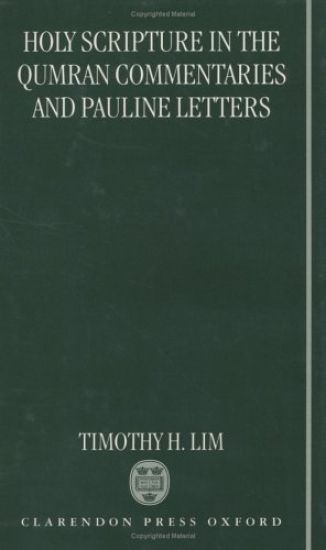
Holy Scripture in the Qumran Commentaries and Pauline Letters
Timothy H. Lim
Clarendon Press
1997
sidottu
What was the ancient exegetes' attitude to the biblical texts? Did they consider them `sacred' in the sense that the words were the inviolable utterances of God? Or did they when necessary modify and adapt holy writ for their own purposes? This book examines the question of exegetical modifications from the post-Qumran perspective of textual pluriformity of literalism that runs through ancient exegeses and translations. The Qumran Commentators and Paul complemented their fulfilment-exegeses by paying close attention to the verbal formations of the biblical texts. The hermeneutical principles underlying their exegeses involved a multiplex of competing forces that at the same time sought to make scripture relevant while guarding it from changes. In so far as the label 'post-biblical exegesis' describes a clear separation between the written, authoritative texts and its interpretation, the distinction is overdrawn, for the ancients were not merely commentators, but also in some sense authors of the biblical texts.
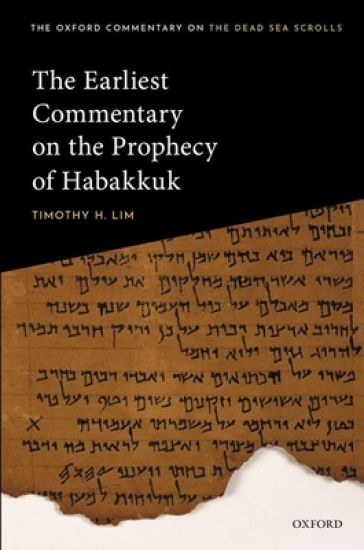
The Earliest Commentary on the Prophecy of Habakkuk
Timothy H. Lim
Oxford University Press
2020
sidottu
This is the first major commentary in English on Pesher Habakkuk for forty years. It elucidates the nature of 1QpHab as the earliest commentary on the prophecy of Habakkuk by a detailed study of the biblical quotation and sectarian interpretation. This commentary provides a new edition of the scroll, including new readings, and detailed palaeographical, philological, exegetical and historical notes and discussion. It shows that the pesherist imitates the allusive style of the oracles of Habakkuk and also draws on lexemes, phrases, and themes from other biblical texts and Jewish sources. It shows that the pesherist identified the Kittim with the Romans who conquered Judaea in 63 BCE, and suggests that the scroll refers to several righteous and wicked figures, including the last Hasmonean high priests.
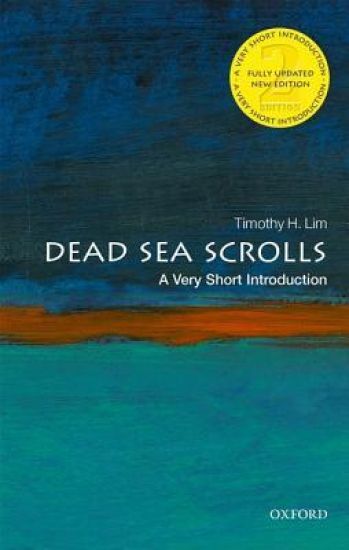
Since their discovery in 1947, the Dead Sea Scrolls have become an icon in popular culture that transcends their status as ancient Jewish manuscripts. Everyone has heard of the Scrolls, but amidst the conspiracies, the politics, and the sensational claims, it can be difficult to separate the myths from the reality. In this Very Short introductions, Timothy Lim discusses the cultural significance of the finds, and the religious, political and legal controversies during the seventy years of study since the discovery. He also looks at the contribution the Scrolls have made to our understanding of the Old Testament or Hebrew Bible, and the origins of early Christianity. Exploring the most recent scholarly discussions on the archaeology of Khirbet Qumran, and the study of the biblical texts, the canon, and the history of the Second Temple Period, he considers what the scrolls reveal about sectarianism in early Judaism. Was the archaeological site of Qumran a centre of monastic life, a fortress, a villa, or a pottery factory? Why were some of their biblical texts so different from the ones that we read today? Did they have 'a Bible'? Who were the Essenes and why did they think that humanity is to be divided between 'the sons of light' and those in darkness? And, finally, do the Scrolls reflect the teachings of the earliest followers of Jesus? ABOUT THE SERIES: The Very Short Introductions series from Oxford University Press contains hundreds of titles in almost every subject area. These pocket-sized books are the perfect way to get ahead in a new subject quickly. Our expert authors combine facts, analysis, perspective, new ideas, and enthusiasm to make interesting and challenging topics highly readable.
The first volume of its kind to analyze the impact that theories and practices of imaging have had on a variety of fields. It draws on an impressive range of philosophical approaches, from analytic, to pragmatic, to phenomenological - concluding that imaging is developing a social and cultural impact comparable to language.
The discovery of the Dead Sea Scrolls provides unprecedented insight into the nature of the Hebrew Bible or Old Testament before its fixation. Timothy Lim here presents a complete account of the formation of the canon in Ancient Judaism from the emergence of the Torah in the Persian period to the final acceptance of the list of twenty-two/twenty-four books in the Rabbinic period.Using the Hebrew Bible, the Scrolls, the Apocrypha, the Letter of Aristeas, the writings of Philo, Josephus, the New Testament, and Rabbinic literature as primary evidence he argues that throughout the post-exilic period up to around 100 CE there was not one official “canon” accepted by all Jews; rather, there existed a plurality of collections of scriptures that were authoritative for different communities. Examining the literary sources and historical circumstances that led to the emergence of authoritative scriptures in ancient Judaism, Lim proposes a theory of the majority canon that posits that the Pharisaic canon became the canon of Rabbinic Judaism in the centuries after the destruction of the Jerusalem Temple.
Over much of the past century, the law governing third-party importation of non-counterfeit, genuine goods has been obscured by conceptual uncertainty. In recent years, the debate over the gray market has centered on the fundamental reasons for trademark protection, and has raised the possibility of conflict between the two traditionally recognized purposes of trademark law--protecting consumers from deception and protecting trademark owners from lost sales.Hiebert discusses the evolution of the universality and territoriality principles of trademark law, and develops a new understanding of the role of goodwill in resolving trademark infringement issues. Beginning with a review of the earliest days of trademark law, Hiebert traces the development of the twofold purpose and territoriality doctrines in the United States, and examines in detail the cases, statutes, and regulations governing parallel imports. Unlike other recent treatments of the subject, this work benefits from the availability of important archival materials, and devotes considerable attention to the nineteenth-century antecedents of modern parallel importation doctrine, and to the evolution of trademark doctrine within the broader context of American legal realism.
The 1964 Army Mutinies and the Making of Modern East Africa
Timothy H. Parsons
Heinemann Educational Books,U.S.
2003
sidottu
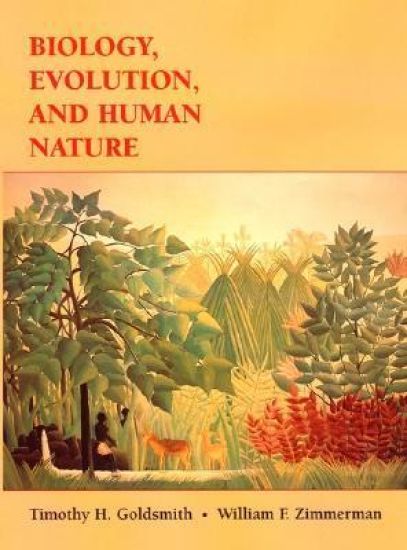
Biology, Evolution, and Human Nature
Timothy H. Goldsmith; William F. Zimmerman
John Wiley Sons Inc
2000
sidottu
This book uses evolution as the unifying theme to trace the connections between levels of biological complexity from genes through nervous systems, animal societies, and human cultures. It examines the history of evolutionary theory from Darwin to the present, including: the impact of molecular biology and the emergence of evolutionary social theory.
The National Veterinary Medical Series (NVMS) is an effective, economical system for learning and review. Basic and clinical veterinary sciences are outlined in a practical format that enables you to master large amounts of information in a limited amount of time. The books in the NVMS help you prepare for the National Boards and the Clinical Competency Test and are excellent resources for problem-based learning.
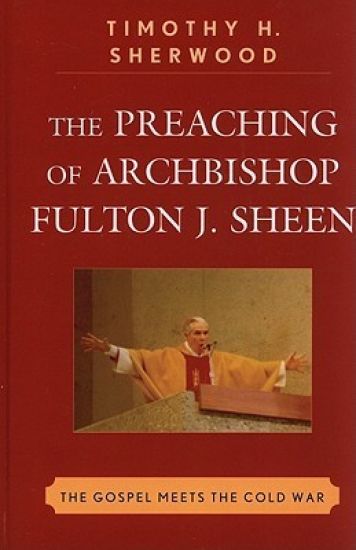
The greatness of America's most influential preachers of the twentieth century came from their significant contributions to both religious and secular society. Some names, like Martin Luther King, Jr. and Billy Graham, are universally recognized and typically thought of first by people today. Assorted reviews have also listed other notable names from various Christian denominations, but little recognition has been given to the Catholic contribution to preaching in the twentieth century. Archbishop Fulton J. Sheen is at least one Catholic name whose contributions belong with the top most influential American preachers of that era. Though many associate Sheen with his five years on primetime television in the 1950s, it was the decades he spent preaching that wrought a religious tone to the Cold War and led the way in a national renewal of religion. An epic battle was set between the forces of good and evil in Sheen's preaching, particularly in his Good Friday sermons. This rhetorical study seeks to understand how and why his preaching was so persuasive to the people of his day.
The greatness of America's most influential preachers of the twentieth century came from their significant contributions to both religious and secular society. Some names, like Martin Luther King, Jr. and Billy Graham, are universally recognized and typically thought of first by people today. Assorted reviews have also listed other notable names from various Christian denominations, but little recognition has been given to the Catholic contribution to preaching in the twentieth century. Archbishop Fulton J. Sheen is at least one Catholic name whose contributions belong with the top most influential American preachers of that era. Though many associate Sheen with his five years on prime time television in the 1950s, it was the decades he spent preaching that wrought a religious tone to the Cold War and led the way in a national renewal of religion. An epic battle was set between the forces of good and evil in Sheen's preaching, particularly in his Good Friday sermons. This rhetorical study seeks to understand how and why his preaching was so persuasive to the people of his day.
The Rhetorical Leadership of Fulton J. Sheen, Norman Vincent Peale, and Billy Graham in the Age of Extremes
Timothy H. Sherwood
Lexington Books
2013
sidottu
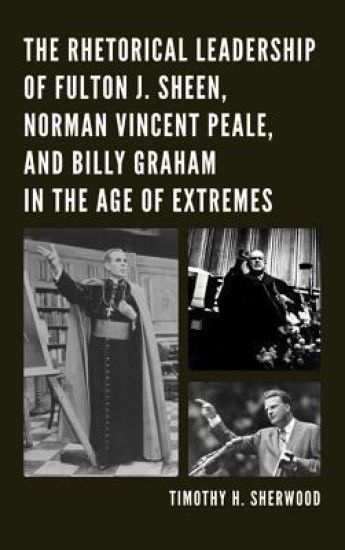
Fulton J. Sheen, Norman Vincent Peale, and Billy Graham were America’s most popular religious leaders during the mid-twentieth century period known as the golden years of the Age of Extremes. It was part of an era that encompassed polemic contrasts of good and evil on the world stage in political philosophies and international relations. The 1950s and early 1960s, in particular, were years of high anxiety, competing ideologies, and hero/villain mania in America. Sheen was the voice of reason who spoke against those conflicting ideologies which were hostile to religious faith and democracy; Peale preached the gospel of reassurance, self-assurance, and success despite ominous global threats; and Graham was the heroic model of faith whose message of conversion provided Americans an identity and direction opposite to atheistic communism. This study looks at how and why their rhetorical leadership, both separately and together, contributed to the climate of an extreme era and influenced a national religious revival.