

Kirjahaku
Etsi kirjoja tekijän nimen, kirjan nimen tai ISBN:n perusteella.
1000 tulosta hakusanalla Traci


The moving, gripping, and tell-all autobiography of Traci Elizabeth Lords, a former child porn queen, electronica maven, and cult movie and TV star. At 14, Nora Kuzma ran away from home and ended up on the dirty streets of Hollywood. She fell in with a fast crowd, and her dreams of modelling soon landed her a spectacular centrefold in Penthouse Magazine, where at 15 she became internationally known as TRACI LORDS. From there she appeared in numerous adult films and magazines, denying her past and battling a deep addiction to cocaine and men. Three years later she got out. This is her memoir-a tale of loss, redemption, and ultimate survival as Traci Elizabeth Lords takes you into her secretive past, faces her demons, and shares her extraordinary journey of personal growth.



Traci: Revenge of the Hell Bitch
Paul B. Jenkins
Createspace Independent Publishing Platform
2013
nidottu

One Step At A Time: Walking in the Heels of A Trendsetter: The Memoir of Traci J
Traci Jefferson
Createspace Independent Publishing Platform
2016
nidottu
"One Step At A Time: Walking in the Heels of A Trendsetter, The Memoir of Traci J", is a breathtakingly candid journey through the life of Traci "Traci J" Jefferson. She shares her story of a loving childhood that seemed to spiral out of control to teen motherhood and a turbulent era during her twenties that included violence and insecurity... but that ultimately led to a spiritual awakening of self-love, the love of her Boaz, and the promises of God's bountiful blessings that include her "love affair with hair and fashion", community service and activism, and incredibly close and supporting love of family and real friends. Traci J gives a first-hand account of her life "no holds barred", to how she became The Trendsetter and the person she is today. She shares her precious God Inspired Meditations (or GIMS) on how she overcame the adversities life placed in her way, as well as the lessons she learned that will help you overcome your own trials. So grab your heels and get ready to stride down memory lane with the Trendsetter herself Ms. Traci J. She promises you will walk away from this book with a new, fresh view of life as a woman with purpose.

Traci's Pocket Posh Journal, Chevron
Andrews McMeel Publishing
2016
pokkari

Traci's Pocket Posh Journal, Mum
Andrews McMeel Publishing
2016
pokkari

Traci's Pocket Posh Journal, Polka Dot
Andrews McMeel Publishing
2016
pokkari

Traci's Pocket Posh Journal, Tulip
Andrews McMeel Publishing
2016
pokkari

Traci and Gary meet on a cruise and start a whirlwind romance and killer adventure. Their initial attraction overwhelms them, and they separate. After they accept their attraction and love, they must survive a near death experience, betrayal, stalking, attempted murder, murder and kidnapping. After having had their lives nearly destroyed emotionally and physically, they must try and rebuild their trust, emotional bond and marriage. So much has happened, will they be able to recover? Or is their destiny together over?

After a long and forced separation, Traci and Gary are again confronted with evil when Traci is attacked and the public mayhem that ensues afterwards. Then a past hurt rears its ugly head and causes more tension to the couple's marriage and family. Can they survive the continual tests to their love? Or have they had more than they can bare?

Traci's Bio Present The Pink Sister Chronicles 3
Traci Smith
Createspace Independent Publishing Platform
2017
nidottu

Tracing Pathogens in the Food Chain
Woodhead Publishing Ltd
2016
nidottu
Successful methods for the detection and investigation of outbreaks of foodborne disease are essential for ensuring consumer safety. Increased understanding of the transmission of pathogens in food chains will also assist efforts to safeguard public health. Tracing pathogens in the food chain reviews key aspects of the surveillance, analysis and spread of foodborne pathogens at different stages of industrial food production and processing. Part one provides an introduction to foodborne pathogen surveillance, outbreak investigation and control. Part two concentrates on subtyping of foodborne pathogens, with chapters on phenoytypic subtyping and pulsed-field gel electrophoresis, as well as emerging methods. The vital topics of method validation and quality assurance are also covered. The focus in Part three is on particular techniques for the surveillance and study of pathogens, such as protein-based analysis, ribotyping and comparative genomics. Finally, Part four focuses on tracing pathogens in specific food chains, such as red meat and game, dairy, fish and shellfish. With its distinguished editors and international team of contributors, Tracing pathogens in the food chain is a standard reference for researchers, public health experts and food industry professionals concerned with the study and control of foodborne disease.
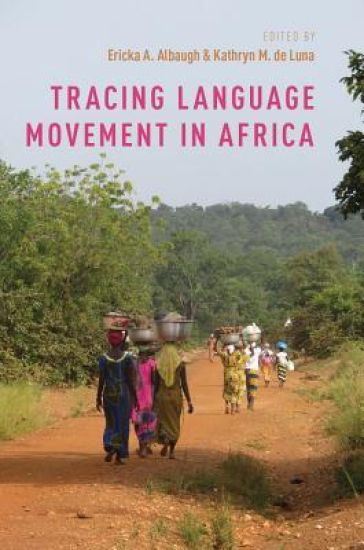
Tracing Language Movement in Africa
Oxford University Press Inc
2018
sidottu
The great diversity of ethnicities and languages in Africa encourages a vision of Africa as a fragmented continent, with language maps only perpetuating this vision by drawing discrete language groups. In reality, however, most people can communicate with most others within and across linguistic boundaries, even if not in languages taught or learned in schools. Many disciplines have looked carefully at language movement and change on the continent, but their lack of interaction has prevented the emergence of a cohesive picture of African languages. Tracing Language Movement in Africa gathers eighteen scholars together to offer a truly multidisciplinary representation of language in Africa, combining insights from history, archaeology, religion, linguistics, political science, and philosophy. The resulting volume illuminates commonalities and distinctions in these disciplines' understanding of language change and movement in Africa. The volume is empirical -- aiming to represent language more accurately on the continent -- as well as theoretical. It identifies the theories that each discipline uses to make sense of language movement in Africa in plain terms and highlights the themes that cut across all disciplines: how scholars use data, understand boundaries, represent change, and conceptualize power. The volume is organized to reflect differing conceptions of language that arise from its discipline-specific contributions: that is, tendencies to study changes that consolidate language or those that splinter it, viewing languages as whole or in part. Each contribution includes a short explanation of a discipline's theoretical and methodological approaches to language movement and change to ensure that the chapters are accessible to non-specialists, followed by an illustrative empirical case study. This volume will inspire multidisciplinary conversations around the study of language change in Africa, opening new interdisciplinary dialogue and spurring scholars to adapt the questions, data, and method of other disciplines to the problems that animate their own fields.

Tracing Value Change in the International Legal Order
Oxford University Press
2023
sidottu
International law is constantly navigating the tension between preserving the status quo and adapting to new exigencies. But when and how do such adaptation processes give way to a more profound transformation, if not a crisis of international law? To address the question of how attacks on the international legal order are changing the value orientation of international law, this book brings together scholars of international law and international relations. By combining theoretical and methodological analyses with individual case studies, this book offers readers conceptualizations and tools to systematically examine value change and explore the drivers and mechanisms of these processes. These case studies scrutinize value change in the foundational norms of the post-1945 order and in norms representing the rise of the international legal order post-1990. They cover diverse issues: the prohibition of torture, the protection of women's rights, the prohibition of the use of force, the nonproliferation of nuclear weapons, sustainability norms, and accountability for core international crimes. The challenges to each norm, the reactions by norm defenders, and the fate of each norm are also studied. Combined, the analyses show that while a few norms have remained surprisingly robust, several are changing, either in substance or in legal or social validity. The book concludes by integrating the conceptual and empirical insights from this interdisciplinary exchange to assess and explain the ambiguous nature of value change in international law beyond the extremes of mere progress or decline.

Tracing the Relationship between Inequality, Crime and Punishment
Oxford University Press
2021
sidottu
The question of inequality has moved decisively to the top of the contemporary intellectual agenda. Going beyond Thomas Piketty's focus on wealth, increasing inequalities of various kinds, and their impact on social, political and economic life, now present themselves among the most urgent issues facing scholars in the humanities and the social sciences. Key among these is the relationship between inequality, crime and punishment. The propositions that social inequality shapes crime and punishment, and that crime and punishment themselves cause or exacerbate inequality, are conventional wisdom. Yet, paradoxically, they are also controversial. In this volume, historians, criminologists, lawyers, sociologists and political scientists come together to try to solve this paradox by unpacking these relationships in different contexts. The causal mechanisms underlying these correlations call for investigation by means of a sustained programme of research bringing different disciplines to bear on the problem. This volume develops an interdisciplinary approach which builds on but goes beyond recent comparative and historical research on the institutional, cultural and political-economic factors shaping crime and punishment so as better to understand whether, and if so how and why, social and economic inequality influences levels and types of crime and punishment, and conversely whether crime and punishment shape inequalities.

Tracing the Roles of Soft Law in Human Rights
Oxford University Press
2016
sidottu
Soft law increasingly shapes and impacts the content of international law in multiple ways, from being a first step in a norm-making process to providing detailed rules and technical standards required for the interpretation and the implementation of treaties. This is especially true in the area of human rights. While relatively few human rights treaties have been adopted at the UN level in the last two decades, the number of declarations, resolutions, conclusions, and principles has grown significantly. In some areas, soft law has come to fill a void in the absence of treaty law, exerting a degree of normative force exceeding its non-binding character. In others areas, soft law has become a battleground for interpretative struggles to expand and limit human rights protection in the context of existing regimes. Despite these developments, little attention has been paid to soft law within human rights legal scholarship. Building on a thorough analysis of relevant case studies, this volume systematically explores the roles of soft law in both established and emerging human rights regimes. The book argues that a better understanding of how soft law shapes and affects different branches of international human rights law not only provides a more dynamic picture of the current state of international human rights, but also helps to unsettle and critically question certain political and doctrinal beliefs. Following introductory chapters that lay out the general conceptual framework, the book is divided in two parts. The first part focuses on cases that examine the role of soft law within human rights regimes where there are established hard law standards, its progressive and regressive effects, and the role that different actors play in the incubation process. The second part focuses on the role of soft law in emerging areas of international law where there is no substantial treaty codification of norms. These chapters examine the relationship between soft and hard law, the role of different actors in formulating new soft law, and the potential for eventual codification.

Tracing Tangueros offers an inside view of Argentine tango music in the context of the growth and development of the art form's instrumental and stylistic innovations. Rather than perpetuating the glamorous worldwide conceptions that often only reflect the tango that left Argentina nearly 100 years ago, authors Kacey Link and Kristin Wendland trace tango's historical and stylistic musical trajectory in Argentina, beginning with the guardia nueva's crystallization of the genre in the 1920s, moving through tango's Golden Age (1925-1955), and culminating with the "Music of Buenos Aires" today. Through the transmission, discussion, examination, and analysis of primary sources currently unavailable outside of Argentina, including scores, manuals of style, archival audio/video recordings, and live video footage of performances and demonstrations, Link and Wendland frame and define Argentine tango music as a distinct expression possessing its own musical legacy and characteristic musical elements. Beginning by establishing a broad framework of the tango art form, the book proceeds to move through twelve in-depth profiles of representative tangueros (tango musicians) within the genre's historical and stylistic trajectory. Through this focused examination of tangueros and their music, Link and Wendland show how the dynamic Argentine tango grows from one tanguero linked to another, and how the composition techniques and performance practices of each generation are informed by that of the past.