Kirjojen hintavertailu. Mukana 11 365 555 kirjaa ja 12 kauppaa.

Kirjahaku

Etsi kirjoja tekijän nimen, kirjan nimen tai ISBN:n perusteella.

1000 tulosta hakusanalla VOLTAIRE

Voltaire

Voltaire

Nicholas Cronk

Oxford University Press
2017
nidottu
Voltaire (1694-1778), best remembered as the author of Candide, is one of the central actors -- arguably the defining personality -- of the European Enlightenment. In this Very Short Introduction, Nicholas Cronk explores Voltaire's remarkable career and demonstrates how his thinking is pivotal to our notion and understanding of the Enlightenment. In a fresh and modern examination of his writings, Cronk examines the nature of Voltaire's literary celebrity, demonstrating the extent to which his work was reactive and practical, and therefore made sense within the broader context of the debates to which he responded. The most famous living author in Europe in the 18th century, Cronk emphasises Voltaire's skills of 'performance' as a writer and his continued relevance today. He concludes by looking not only at Voltaire's impact in literature and philosophy, but also his influence on French political values and modern French politics. ABOUT THE SERIES: The Very Short Introductions series from Oxford University Press contains hundreds of titles in almost every subject area. These pocket-sized books are the perfect way to get ahead in a new subject quickly. Our expert authors combine facts, analysis, perspective, new ideas, and enthusiasm to make interesting and challenging topics highly readable.
Voltaire

Voltaire

Richard Aldington

Routledge
2019
sidottu
This book, first published in 1929, is an assessment of Voltaire’s life and works. It contains valuable biographical details, as well as studies of his works, philosophy, poetry, plays and literary criticism.
Voltaire

Voltaire

Richard Aldington

Routledge
2020
nidottu
This book, first published in 1929, is an assessment of Voltaire’s life and works. It contains valuable biographical details, as well as studies of his works, philosophy, poetry, plays and literary criticism.
Voltaire: Treatise on Tolerance

Voltaire: Treatise on Tolerance

Voltaire

Cambridge University Press
2000
pokkari
Voltaire is widely known as the author of a literary masterpiece, Candide, while his reputation as a thinker rests largely on his Philosophical Letters and Philosophical Dictionary. He is equally renowned as a critic of the forces of superstition and fanaticism, and a champion of freedom of thought and belief. The works presented here, in a new English translation, are among the most important and characteristic texts of the Enlightenment, and bring together all three aspects of Voltaire: the writer, the doer and the philosophe. Originating in Voltaire’s campaign to exonerate Jean Calas, they are works of polemical brilliance, informed by his deism and humanism and by Enlightenment values and ideals more generally. The issues which they raise, concerning questions of tolerance and human dignity, are still highly relevant to our own times. This volume presents them together with an introduction by Simon Harvey and useful notes on further reading.
Voltaire

Voltaire

Sunit Gala

Dissertation Discovery Company
2019
pokkari
Abstract: In this thesis we present Voltaire, an ontological programming language designed specifically to manipulate large volumes of heterogeneous data. It is a set-oriented, imperative database programming language, yet functional in nature. The set expressions in the language are conducive to data intensive programming while maintaining a certain amount of efficiency by espousing the imperative paradigm. The language and its semantics are defined in a modular but additive fashion, which facilitates some measure of bootstrapping. We further argue that such an implementation model is desirable, since it provides a single execution model for evaluating queries, satisfying constraints and computing functions. The system provides automatic integrity enforcement in a lazy evaluation mode. Functions are effectively computed as the result of integrity enforcement. This is because we consider constraints as a sequence of commands to be evaluated or satisfied in the specified order. There are no arbitrary restrictions on the persistence of values--even functions can have a persistent extent. Further, the query language incorporates functions by providing access to the persistent extent of the function or by allowing an actual function call. The compiler can exploit traditional algebraic techniques for query optimization. The data definition (or data type) facility is similar to what might be found in most semantic data models and is conducive to sharing heterogeneous records. We have defined a type algebra that incorporates type, extent and behavior by providing an extensional semantics for the behavior. We also attempt to define a denotational semantics for the Voltaire language and environment. We believe Voltaire is an ideal language for data intensive programming, and contains the best features of a typed programming language and a database system. Dissertation Discovery Company and University of Florida are dedicated to making scholarly works more discoverable and accessible throughout the world. This dissertation, "Voltaire: a Database Programming Environment With a Single Execution" by Sunit Gala, was obtained from University of Florida and is being sold with permission from the author. A digital copy of this work may also be found in the university's institutional repository, IR@UF. The content of this dissertation has not been altered in any way. We have altered the formatting in order to facilitate the ease of printing and reading of the dissertation.
Voltaire

Voltaire

Sunit Gala

Dissertation Discovery Company
2019
sidottu
Abstract: In this thesis we present Voltaire, an ontological programming language designed specifically to manipulate large volumes of heterogeneous data. It is a set-oriented, imperative database programming language, yet functional in nature. The set expressions in the language are conducive to data intensive programming while maintaining a certain amount of efficiency by espousing the imperative paradigm. The language and its semantics are defined in a modular but additive fashion, which facilitates some measure of bootstrapping. We further argue that such an implementation model is desirable, since it provides a single execution model for evaluating queries, satisfying constraints and computing functions. The system provides automatic integrity enforcement in a lazy evaluation mode. Functions are effectively computed as the result of integrity enforcement. This is because we consider constraints as a sequence of commands to be evaluated or satisfied in the specified order. There are no arbitrary restrictions on the persistence of values--even functions can have a persistent extent. Further, the query language incorporates functions by providing access to the persistent extent of the function or by allowing an actual function call. The compiler can exploit traditional algebraic techniques for query optimization. The data definition (or data type) facility is similar to what might be found in most semantic data models and is conducive to sharing heterogeneous records. We have defined a type algebra that incorporates type, extent and behavior by providing an extensional semantics for the behavior. We also attempt to define a denotational semantics for the Voltaire language and environment. We believe Voltaire is an ideal language for data intensive programming, and contains the best features of a typed programming language and a database system. Dissertation Discovery Company and University of Florida are dedicated to making scholarly works more discoverable and accessible throughout the world. This dissertation, "Voltaire: a Database Programming Environment With a Single Execution" by Sunit Gala, was obtained from University of Florida and is being sold with permission from the author. A digital copy of this work may also be found in the university's institutional repository, IR@UF. The content of this dissertation has not been altered in any way. We have altered the formatting in order to facilitate the ease of printing and reading of the dissertation.
Œuvres complètes de Voltaire (Complete Works of Voltaire) 8
During 1731 and 1732, only certain of Voltaire's closest friends were allowed to know that he was preoccupied with the composition of "Le Mort de Cesar", "Zaire" and "Le Temple du Gout", the major works to be found in this volume and its successor. Other writings kept him very much in the public eye, but when "Zaire" was eventually staged, it proved an immediate, resounding success. These were years of relatively tranquil literary activity for Voltaire, in spite of official harassment, literary quarrels and perennial ill-health. They saw the consolidation of his fame as a dramatist, and the seeds of the historical and scientific interests which would affect the course of his life so profoundly.
Voltaire

Voltaire

John Leigh

Voltaire Foundation
2004
nidottu
It was not only in his histories that Voltaire thought, worried and wrote about history. In fact, many of Voltaire’s most provocative and tantalising remarks on history lie outside the province of the so-called Œuvres historiques, in the vast expanses of his complete works, and historical events and historical figures elicit some of his most imaginative writing. Voltaire’s propensity to write about history in works that are not histories sheds new light on his historiographical thought and temper. The historian that emerges from these pages is, by turns, a feverish, bed-ridden man haunted by the St Bartholomew massacre (an overwhelming preoccupation of Voltaire’s, although it receives only cursory attention in the prose histories) an inspired poet mythologising Henri IV’s epic adventures, a bawdy satirist amused by Joan of Arc, a raconteur nourished by historical anecdotes, even a doting uncle winking at his niece as he elaborates a philosophy of history. In all these forms and at all these times, an interest in history is integral and abiding. Far from being marginal or oblique, these works yield important insights into a pervasive Voltairean sense of history which finds in these different forms both the freedoms and the traditions – and indeed often the readers – denied to the Œuvres historiques. Moreover, innovative works like the Henriade and Candide, which fall into this category, prove as influential to historians as Voltaire’s recognised histories. Voltaire’s prodigious energy and versatility in fields other than history have probably harmed his reputation as a historian when, already in the eighteenth century, historians were increasingly expected to be specialists. This study shows that Voltaire’s historiographical thought ranges across areas and texts artificially sundered by subsequent editorial compartmentalisations, and it reveals a restlessly complex, inventive writer confronting history in numerous different guises.
OEuvres complètes de Voltaire 79A(I)

OEuvres complètes de Voltaire 79A(I)

Voltaire

Voltaire Foundation Ltd
2022
sidottu
Sold as a multi-volume set - the individual volumes are not available for purchase."La Bible enfin expliquee", une des dernieres publications de Voltaire, promet d'etre la synthese de ses pensees au sujet de la Bible, Ancien et Nouveau Testaments. Elle est a la fois plus et moins que cela: moins que cela car il y recycle des analyses de nombre de ses ecrits anterieurs; plus que cela quand il lit l'Ancien Testament en historien et quand il introduit des nouveautes de critique biblique. Il fait les premiers pas vers une generalisation a tous les livres de la Bible de l'argument de Jean Astruc au sujet de la Genese, que ce livre est un assemblage et une fusion tardive de diverses sources anciennes. Il traite la vie et la predication de Jesus egalement en historien, dans le contexte de la religiosite des sectes juives du premier siecle dont on trouve des traces chez Flavius Josephe et Philon. Dans ses annotations, Bertram Schwarzbach compare le texte de Voltaire avec le tres orthodoxe Commentaire litteral de Dom Augustin Calmet que Voltaire exploitait, et avec les corrosifs traites dits clandestins, y compris les Examens de la Bible rediges par Mme Du Chatelet vers 1743. Voltaire semble ne l'avoir jamais lu mais il avait pu y contribuer indirectement par ses discussions avec sa compagne aux petits-dejeuners et ailleurs. L'editeur tente de situer les commentaires de Voltaire, parfois astucieux mais trop souvent farfelus, dans l'histoire des etudes bibliques depuis les hebraisants du dix-septieme siecle jusqu'aux critiques et historiens des dix-neuvieme et vingtieme siecles.
OEuvres complètes de Voltaire 79A(II)

OEuvres complètes de Voltaire 79A(II)

Voltaire

Voltaire Foundation Ltd
2022
sidottu
Sold as a multi-volume set - the individual volumes are not available for purchase."La Bible enfin expliquee", une des dernieres publications de Voltaire, promet d'etre la synthese de ses pensees au sujet de la Bible, Ancien et Nouveau Testaments. Elle est a la fois plus et moins que cela: moins que cela car il y recycle des analyses de nombre de ses ecrits anterieurs; plus que cela quand il lit l'Ancien Testament en historien et quand il introduit des nouveautes de critique biblique. Il fait les premiers pas vers une generalisation a tous les livres de la Bible de l'argument de Jean Astruc au sujet de la Genese, que ce livre est un assemblage et une fusion tardive de diverses sources anciennes. Il traite la vie et la predication de Jesus egalement en historien, dans le contexte de la religiosite des sectes juives du premier siecle dont on trouve des traces chez Flavius Josephe et Philon. Dans ses annotations, Bertram Schwarzbach compare le texte de Voltaire avec le tres orthodoxe Commentaire litteral de Dom Augustin Calmet que Voltaire exploitait, et avec les corrosifs traites dits clandestins, y compris les Examens de la Bible rediges par Mme Du Chatelet vers 1743. Voltaire semble ne l'avoir jamais lu mais il avait pu y contribuer indirectement par ses discussions avec sa compagne aux petits-dejeuners et ailleurs. L'editeur tente de situer les commentaires de Voltaire, parfois astucieux mais trop souvent farfelus, dans l'histoire des etudes bibliques depuis les hebraisants du dix-septieme siecle jusqu'aux critiques et historiens des dix-neuvieme et vingtieme siecles.
Voltaire

Voltaire

Nicholas Cronk; Alison Oliver; Gillian Pink

VOLTAIRE FOUNDATION
2022
nidottu
This book commemorates the conclusion of the fifty-five-year project of publishing a modern scholarly edition of Voltaire's Complete Works.
Voltaire

Voltaire

Derek Parker

The History Press Ltd
2006
nidottu
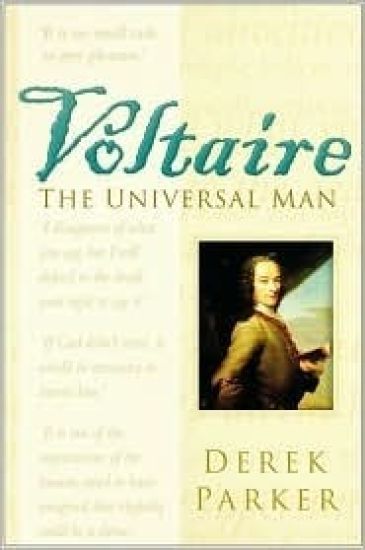
Francois Marie Arouet (pen name Voltaire) was born on November 21, 1694 in Paris. His humorous verses made him a favourite in society circles. His satirical wit got him in trouble and he was exiled from France on several occasions, imprisoned twice in the Bastille, and beaten by chevalier de Rohan-Chabot's men after making a public remark.
Voltaire

Voltaire

Wayne Andrews

New Directions Publishing Corporation
2007
nidottu
This is a short biography. Its subject, François Marie Arouet de Voltaire (1694-1778), would not have objected––he was careful to point out that “the surest way of being a bore is to tell everything.” What Wayne Andrews’s Voltaire may lack in laundry lists is made up in wit, learning, and an elegance of style eminently appropriate for an appreciation of a man who was never so ruthless as when eliminating the last trace of dust from his own writing. Indeed, Voltaire was the most successful writer of the eighteenth century. It matters little that his plays are today a lost cause, as is his poetry––the author of Candide and the Age of Louis XIV will always have his audience. His irreverence guarantees his immortality. While stressing Voltaire’s eternal campaign against Christianity and his monumental efforts to effect justice in an autocratic era, Andrews maintains that his primary loyalty was always to himself. The fervent anti-Christian had his firm friends in the Church. The social philosopher courted Catherine the Great with near servility. But, in Victor Hugo’s words: “His smile put an end to violence, his sarcasm put an end to despotism, his irony put an end to infallibility, his perseverance put an end to stubbornness, and the truth he proclaimed put an end to ignorance.”