Kirjojen hintavertailu. Mukana 11 699 587 kirjaa ja 12 kauppaa.

Kirjahaku

Etsi kirjoja tekijän nimen, kirjan nimen tai ISBN:n perusteella.

1000 tulosta hakusanalla Victor Bailey

The Rise and Fall of the Rehabilitative Ideal, 1895-1970
Spanning almost a century of penal policy and practice in England and Wales, this book is a study of the long arc of the rehabilitative ideal, beginning in 1895, the year of the Gladstone Committee on Prisons, and ending in 1970, when the policy of treating and training criminals was very much on the defensive. Drawing on a plethora of source material, such as the official papers of mandarins, ministers, and magistrates, measures of public opinion, prisoner memoirs, publications of penal reform groups and prison officers, the reports of Royal Commissions and Departmental Committees, political opinion in both Houses of Parliament and the research of the first cadre of criminologists, this book comprehensively examines a number of aspects of the British penal system, including judicial sentencing, law-making, and the administration of legal penalties. In doing so, Victor Bailey expertly weaves a complex and nuanced picture of punishment in twentieth-century England and Wales, one that incorporates the enduring influence of the death penalty, and will force historians to revise their interpretation of twentieth-century social and penal policy. This detailed and ground-breaking account of the rise and fall of the rehabilitative ideal will be essential reading for scholars and students of the history of crime and justice and historical criminology, as well as those interested in social and legal history.
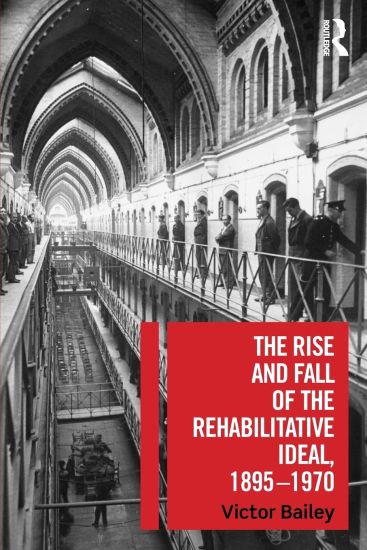
The Rise and Fall of the Rehabilitative Ideal, 1895-1970
Spanning almost a century of penal policy and practice in England and Wales, this book is a study of the long arc of the rehabilitative ideal, beginning in 1895, the year of the Gladstone Committee on Prisons, and ending in 1970, when the policy of treating and training criminals was very much on the defensive. Drawing on a plethora of source material, such as the official papers of mandarins, ministers, and magistrates, measures of public opinion, prisoner memoirs, publications of penal reform groups and prison officers, the reports of Royal Commissions and Departmental Committees, political opinion in both Houses of Parliament and the research of the first cadre of criminologists, this book comprehensively examines a number of aspects of the British penal system, including judicial sentencing, law-making, and the administration of legal penalties. In doing so, Victor Bailey expertly weaves a complex and nuanced picture of punishment in twentieth-century England and Wales, one that incorporates the enduring influence of the death penalty, and will force historians to revise their interpretation of twentieth-century social and penal policy. This detailed and ground-breaking account of the rise and fall of the rehabilitative ideal will be essential reading for scholars and students of the history of crime and justice and historical criminology, as well as those interested in social and legal history.
'This Rash Act'

'This Rash Act'

Victor Bailey

Stanford University Press
1998
sidottu
What made some 700 men and women in the Yorkshire town of Kingston-upon-Hull, in the years 1837 to 1900, decide to suffer no longer "the slings and arrows of outrageous fortune" and take their own lives? In this study, the author seeks to uncover the experiences that drove people to suicide; to analyze how suicide was understood by victims, by their families and friends, and by legal and medical authorities; to study how the presumed causes of suicide and the meanings of suicide changed over time and in response to changed social circumstances; and to see what "suicide narratives" elicited by coroners' inquests can tell us about Victorian life, beliefs, and values in general. The book is based on an unprecedentedly complete and comprehensive collection of inquest files covering the entire Victorian era in Hull (most coroners' files have not survived or exist only in fragmentary form). Hitherto, suicide in the Victorian period has been examined only on a national basis; where local evidence has been used, it has come chiefly from London. Through the testimony of relatives, neighbors, friends, and even the deceased (by means of suicide notes), the author has been able to get closer to the experience of suicide and its social construction than has been possible in any previous study. The framework within which the author evaluates the paths to suicide is the life cycle. By placing each suicide in its local socioeconomic context, and by examining each stage in the life course for each sex and for different social levels, the author has been able to assess causation factors with great confidence. He establishes arguments (such as the importance of declining wages and job security for older men and the loss of a marital partner for either sex) more securely than have earlier studies, and puts some new arguments on the agenda (such as the importance of the presence or absence of interpersonal ties and the influence of Poor Law policy).
Judges and Convicts

Judges and Convicts

Victor Bailey

TAYLOR FRANCIS LTD
2025
nidottu
Uncovering the origins of the new sentencing structure that emerged in the course of the nineteenth century, this book travels from the demise of the "Bloody Code" in the 1830s, through the mid-century transition from convict transportation to home-based penal servitude, and on to the remarkable and unprecedented mitigation of sentencing severity in the final two decades of the century.By providing such an extended span of analysis, this book reveals the discrete stages of development in sentencing policy and practice, and particularly the contribution of the small coterie of professional judges at the county Assizes, the Old Bailey (or Central Criminal Court), and the Middlesex Sessions, around whose sentencing decisions the study revolves. In consequence, readers are offered an overarching survey of the nineteenth-century trends in sentencing, including an account of the struggle between politicians, mandarins, and judges for supremacy in sentencing, along with a detailed explanation of that remarkable mitigation of sentencing severity that ultimately defined a new equation between crime and punishment, or the modern sentencing tariff.Judges and Convicts: The Principles and Patterns of Criminal Sentencing in Victorian England will be of great appeal to students and scholars of history, law, criminology, and sociology, particularly to those with an interest in the history of the criminal trial, the judiciary, punishment, and sentencing.
Judges and Convicts

Judges and Convicts

Victor Bailey

TAYLOR FRANCIS LTD
2025
sidottu
Uncovering the origins of the new sentencing structure that emerged in the course of the nineteenth century, this book travels from the demise of the "Bloody Code" in the 1830s, through the mid-century transition from convict transportation to home-based penal servitude, and on to the remarkable and unprecedented mitigation of sentencing severity in the final two decades of the century.By providing such an extended span of analysis, this book reveals the discrete stages of development in sentencing policy and practice, and particularly the contribution of the small coterie of professional judges at the county Assizes, the Old Bailey (or Central Criminal Court), and the Middlesex Sessions, around whose sentencing decisions the study revolves. In consequence, readers are offered an overarching survey of the nineteenth-century trends in sentencing, including an account of the struggle between politicians, mandarins, and judges for supremacy in sentencing, along with a detailed explanation of that remarkable mitigation of sentencing severity that ultimately defined a new equation between crime and punishment, or the modern sentencing tariff.Judges and Convicts: The Principles and Patterns of Criminal Sentencing in Victorian England will be of great appeal to students and scholars of history, law, criminology, and sociology, particularly to those with an interest in the history of the criminal trial, the judiciary, punishment, and sentencing.
‘This Rash Act’

‘This Rash Act’

Bailey Victor

Stanford University Press
2000
pokkari
What made some 700 men and women in the Yorkshire town of Kingston-upon-Hull, in the years 1837 to 1900, decide to suffer no longer “the slings and arrows of outrageous fortune” and take their own lives? In this study, the author seeks to uncover the experiences that drove people to suicide; to analyze how suicide was understood by victims, by their families and friends, and by legal and medical authorities; to study how the presumed causes of suicide and the meanings of suicide changed over time and in response to changed social circumstances; and to see what “suicide narratives” elicited by coroners’ inquests can tell us about Victorian life, beliefs, and values in general. The book is based on an unprecedentedly complete and comprehensive collection of inquest files covering the entire Victorian era in Hull (most coroners’ files have not survived or exist only in fragmentary form). Hitherto, suicide in the Victorian period has been examined only on a national basis; where local evidence has been used, it has come chiefly from London. Through the testimony of relatives, neighbors, friends, and even the deceased (by means of suicide notes), the author has been able to get closer to the experience of suicide and its social construction than has been possible in any previous study. The framework within which the author evaluates the paths to suicide is the life cycle. By placing each suicide in its local socioeconomic context, and by examining each stage in the life course for each sex and for different social levels, the author has been able to assess causation factors with great confidence. He establishes arguments (such as the importance of declining wages and job security for older men and the loss of a marital partner for either sex) more securely than have earlier studies, and puts some new arguments on the agenda (such as the importance of the presence or absence of interpersonal ties and the influence of Poor Law policy).
Experimental Mathematics in Action

Experimental Mathematics in Action

David Bailey; Jonathan Borwein; Neil Calkin; Russell Luke; Roland Girgensohn; Victor Moll

A K Peters
2007
sidottu
With the continued advance of computing power and accessibility, the view that "real mathematicians don't compute" no longer has any traction for a newer generation of mathematicians. The goal in this book is to present a coherent variety of accessible examples of modern mathematics where intelligent computing plays a significant role and in so doing to highlight some of the key algorithms and to teach some of the key experimental approaches.
La prévention des déchets

La prévention des déchets

Victor Bailly; Rémi Barbier; François-Joseph Daniel

PIE - Peter Lang
2021
nidottu
Depuis une vingtaine d'ann es, la pr vention des d chets est pass e du statut d'incantation celui de v ritable politique, dot e d'instruments, d'objectifs, de propositions op rationnelles. Des acteurs associatifs, politiques, institutionnels se sont efforc s de rep rer, d'inventer et de diffuser les mani res d'intervenir avant la phase d chet d'un produit ou d'une mati re. Cet ouvrage relate ce moment particulier de la politique des d chets, qu'il illustre avec les d marches de compostage partag et de langes lavables. Il met en lumi re certaines figures d'acteurs ayant oeuvr cette transition (entrepreneurs de pratiques, experts-militants, etc.), mais aussi les obstacles et limites qu'ils ont rencontr s. En croisant les niveaux d'analyse, il montre la difficult op rer une telle transition et intervenir au coeur des pratiques des individus. Aux difficult s associ es au travail laborieux d'animation et d'accompagnement, s'ajoutent les strat gies de r sistance de certains acteurs conomiques, ainsi que l'engagement peu ambitieux des acteurs publics. En d voilant les freins au changement, l'ouvrage contribue une r flexion th orique sur les transitions sociotechniques, le r le des innovateurs et l'ancrage des innovations dans les r gimes de consommation et de gestion des d chets.
Victory

Victory

Breton Bailey

Tellwell Talent
2023
pokkari
This book attempts to tell the history of the greatest naval battle fought against overwhelming odds by Britain's greatest hero, Lord Horatio Nelson, in 1805 off the Spanish coast of Trafalgar. Nelson, with a fleet of 27 ships, met the larger combined navies of the French and Spanish, off the harbour town of Cadiz.On the evening prior to the battle, Nelson had each captain from each British ship of the fleet board the flagship HMS Victory to review his plan of attack the next day. Nelson referred to these captains as his "Band of Brother's," and they cheered while some became emotional over the simplicity of the plan.Great efforts have been made by the author to ensure the readers feel what life was like on board a ship of the line of three decks and 104 long guns (cannons), and the food, scheduling, and, most of all, discipline.The book is intended to be used if the school system to support learning of the era as well as studying the literary value of a book for young adults. This book details what may have been witnessed by a 14-year-old boy in the normal daily life on board a first-rate battleship in its daily life and in full battle.Most of the events discussed in this story are true and identified as such. Many of the situations told as occurring to the main character, James, were likely events to have occurred to a young boy on board as he went through the daily routine.
Victory

Victory

Breton Bailey

Tellwell Talent
2023
sidottu
This book attempts to tell the history of the greatest naval battle fought against overwhelming odds by Britain's greatest hero, Lord Horatio Nelson, in 1805 off the Spanish coast of Trafalgar. Nelson, with a fleet of 27 ships, met the larger combined navies of the French and Spanish, off the harbour town of Cadiz.On the evening prior to the battle, Nelson had each captain from each British ship of the fleet board the flagship HMS Victory to review his plan of attack the next day. Nelson referred to these captains as his "Band of Brother's," and they cheered while some became emotional over the simplicity of the plan.Great efforts have been made by the author to ensure the readers feel what life was like on board a ship of the line of three decks and 104 long guns (cannons), and the food, scheduling, and, most of all, discipline.The book is intended to be used if the school system to support learning of the era as well as studying the literary value of a book for young adults. This book details what may have been witnessed by a 14-year-old boy in the normal daily life on board a first-rate battleship in its daily life and in full battle.Most of the events discussed in this story are true and identified as such. Many of the situations told as occurring to the main character, James, were likely events to have occurred to a young boy on board as he went through the daily routine.
The People's Victory

The People's Victory

Christine Allen; Fred Anguera; Shelly Bailes; Matthew Baume; Kirsten Berzon; Michael Boyajian; Billy Bradford; Kate Burns; Marvin Burrows; Geoff Callan; Joe Capley-Alfano; Frank Capley-Alfano; Beau Chandler; Sean Chapin; J.Scott Coatsworth; Michael Farino; Stuart Gaffney; Tim Garcia; Mike Goettemoeller; Baltimore Gonzalez; Carmen Goodyear; Tracy Hollister; Mark "Major" Jiminez; Davina Kotulski; Kitty Lambert-Rudd; Cheryle Lambert-Rudd; John Lewis; Amos Lim; Zack Lyons; Cathy Marino-Thomas; Michael Markiewicz; Brian Maschka

Marriage Equality USA
2017
sidottu
"The People's Victory is a mirror for each of us to see our own power to fight for justice and create the change we want to see in our world." – Gavin Newsom, Lieutenant Governor of CaliforniaIn 1996, a small group of Americans from all walks of life banded together to create one of the most miraculous political victories in modern American history. Opponents attacked the issue of marriage equality as amoral and a direct threat to families. Allies warned that it was a generation away from being practicable and a selfish drain of precious political capital. A stirring oral history told by those who almost inexplicably found themselves fighting on the front lines, The People's Victory recounts the successes – and the setbacks – that only served to strengthen everyone's resolve to resist, fight, and bring equal marriage rights to an entire nation. Through it all, these love warriors found their voice and home in Marriage Equality USA, the nation's oldest and largest grassroots organization of its kind. While high profile books, articles and documentaries have covered the judicial and legislative machinations, this book puts a human face on the people who made the everyday personal sacrifices to keep the movement alive. The People's Victory shares deeply moving personal testimonies of over sixty people, from Marvin Burrows, who was forced out of his home and lost many treasured possessions after losing his lost his partner of fifty years; to Kate Burns, who risked arrest for the first time when she stood up for her relationship; to Mike Goettemoeller, who pushed his mother in a wheelchair with Marriage Equality USA to fulfill her dream of marching in a Pride parade.Edie Windsor, the triumphant lead plaintiff in the Supreme Court case United States vs. Windsor recounts shouting down a major LGBTQ organization with "I'm 77 years old and I can't wait!!" when they attempted to belittle marriage as a critical issue. Writer and producer Del Shores shares the touching moment his young teenage daughter used tears and laughter to console him after the passage of Proposition 8 in California dealt a blow to the cause.The People's Victory is an inspirational roadmap for anyone who has felt passionately about an issue, but has questioned whether one person's contribution can make a difference. These candid accounts once again prove that every movement for important social change must be built on the acts of everyday. In fact, that is the only way the people have ever been victorious.In his introduction, California Lieutenant Governor Gavin Newsom writes: "I hope these stories inspire you to resist, to fight, to win and in the end write the next stories in our continuing push for a more just and perfect union.
Victor

Victor

Lorraine St Martin

iUniverse
2005
pokkari
"Victor" tells the story of a young man in German occupied Belgium, who became a Jesuit priest, and managed to sneak out of war torn Europe to escape to the United States, where he taught at Loyola University, and lectured throughout the south. Father Dossogne was a regular on a New Orleans radio talk show, and was quite athletic in his youth. Later he taught at Trinidad State College until his vision failed. "Victor" shows how many obstacles in life can be overcome through perseverance and sheer determination.
Victor

Victor

Joan Jara

Bloomsbury Publishing PLC
1998
pokkari
The life and times of Chilean folksinger Victor Jara, murdered in 1973 by the military after having worked to bring Salvador Allende into power and democracy to his country.