Kirjahaku
Etsi kirjoja tekijän nimen, kirjan nimen tai ISBN:n perusteella.
1000 tulosta hakusanalla Ashley Atkinson

Cyril Ashley
Outlook Verlag
2023
pokkari
Reprint of the original, first published in 1872.

Cyril Ashley
Outlook Verlag
2023
sidottu
Reprint of the original, first published in 1872.



The Ashley genealogy. A history of the descendants of Robert Ashley of Springfield, Massachusetts
Francis Bacon Trowbridge
Alpha Edition
2020
pokkari
This book has been considered by academicians and scholars of great significance and value to literature. This forms a part of the knowledge base for future generations. So that the book is never forgotten we have represented this book in a print format as the same form as it was originally first published. Hence any marks or annotations seen are left intentionally to preserve its true nature.


Evelyn Ashley
VDM Publishing House
2010
nidottu
Observera att förlaget som ger ut denna produkt baserar innehållet i sina produkter på fria källor som Wikipedia. Boken är med stor sannolikhet endast ett utdrag ur dessa informationskällor, alltså inte en vanlig bok i den bemärkelsen.

Headstrong (Ashley Tisdale Album)
VDM Publishing House
2010
nidottu
Observera att förlaget som ger ut denna produkt baserar innehållet i sina produkter på fria källor som Wikipedia. Boken är med stor sannolikhet endast ett utdrag ur dessa informationskällor, alltså inte en vanlig bok i den bemärkelsen.

Jack Ashley, Baron Ashley of Stoke
VDM Publishing House
2010
nidottu
Observera att förlaget som ger ut denna produkt baserar innehållet i sina produkter på fria källor som Wikipedia. Boken är med stor sannolikhet endast ett utdrag ur dessa informationskällor, alltså inte en vanlig bok i den bemärkelsen.

Anthony Ashley-Cooper, 1. Earl of Shaftesbury
Salupress
2012
nidottu

Anthony Ashley-Cooper, 7. Earl of Shaftesbury
Sent Publishing
2012
nidottu

Anthony Ashley-Cooper, 3. Earl of Shaftesbury
String Publishing
2012
nidottu

The Diaries of Anthony Ashley-Cooper, the Seventh Earl of Shaftesbury
Oxford University Press
2023
sidottu
Lord Ashley (later the 7th Earl of Shaftesbury), the 'Poor Man's Earl', is widely remembered as a leading aristocratic philanthropist whose concern for suffering and the oppressed victims of Victorian 'progress' saw him champion a range of social, industrial, educational, and health reforms. A deeply religious individual, his evangelicalism and sense of philanthropy as 'duty' make these extraordinarily rich and candid diaries a vital resource for understanding the motivations of a prominent philanthropist and Victorian social reformer. The Diaries of Anthony Ashley-Cooper, the Seventh Earl of Shaftesbury contain detailed accounts of his labours, religious and philosophical reflections, self analysis, and descriptions and criticisms of contemporaries, and offer thereby a fascinating insight into Victorian politics and social change. The full run of the diaries span the period 1825-85. This first volume, covering 1825-45, shows the emergence of Ashley as a passionate evangelical reformer and determined advocate for a range of domestic and international issues and causes. Ashley is seen maturing as a private and public figure, courting and marrying Lady Emily (Minny) Cowper and starting a family while searching for a role and purpose, reading, touring (Europe in 1833-4, and Britain in 1839), and studying, while also taking the first steps in his parliamentary career. Ministerial office did not last long but Ashley soon became a key figure in Tory political circles, working closely with figures such as Peel and Wellington, and establishing his own position on questions of social and industrial reform.
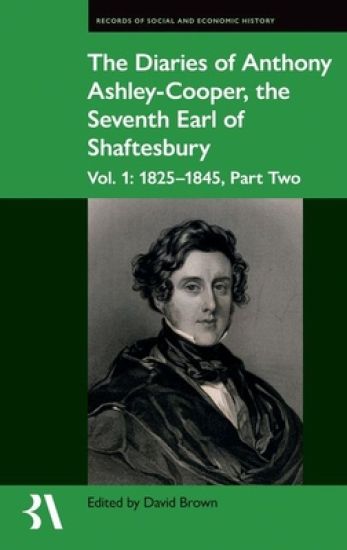
The Diaries of Anthony Ashley-Cooper, the Seventh Earl of Shaftesbury
Oxford University Press
2023
sidottu
Lord Ashley (later the Seventh Earl of Shaftesbury), the 'Poor Man's Earl', is widely remembered as a leading aristocratic philanthropist whose concern for suffering and the oppressed victims of Victorian 'progress' saw him champion a range of social, industrial, educational, and health reforms. A deeply religious individual, his evangelicalism and sense of philanthropy as 'duty' make these extraordinarily rich and candid diaries a vital resource for understanding the motivations of a prominent philanthropist and Victorian social reformer. The diaries contain detailed accounts of his labours, religious and philosophical reflections, self analysis, and descriptions and criticisms of contemporaries, and offer thereby a fascinating insight into Victorian politics and social change. The full run of the diaries span the period 1825-85. This first volume, covering 1825-45, shows the emergence of Ashley as a passionate evangelical reformer and determined advocate for a range of domestic and international issues and causes. In Volume 1, Part Two (covering 1843-5), the questions and issues that would dominate his public work for years to come and which he had begun to address in the period covered in Part One feature more prominently. His discussion of important topics – such as religious questions (including here the intense debates over Tractarianism); industrial working conditions, especially for children; and the work of the lunacy commission – show how he had by this point found his voice and become established as a key actor in those fields. Part Two also includes a narrative of a further European tour (in 1843). The volume closes with a political journal for 1834-42, detailing Ashley's role in, and view of, the turbulent parliamentary history of the period.


Reverend William Ashley Sunday, Meetings At Springfield, Illinois
Springfield Ministerial Association
Kessinger Pub
2008
pokkari

A Life Of Anthony Ashley Cooper V2: First Earl Of Shaftesbury, 1621-1683 (1871)
William D. Christie
KESSINGER PUBLISHING, LLC
2008
sidottu