Kirjojen hintavertailu. Mukana 12 390 323 kirjaa ja 12 kauppaa.

Kirjahaku

Etsi kirjoja tekijän nimen, kirjan nimen tai ISBN:n perusteella.

1000 tulosta hakusanalla Benjamin Walters

The Cambridge Companion to Walter Benjamin
This Companion offers a comprehensive introduction to the work and thought of the highly influential twentieth-century critic and theorist Walter Benjamin. The volume provides examinations of the different aspects of Benjamin's work that have had a significant effect on contemporary critical and historical thought. Topics discussed by experts in the field include Benjamin's relation to the avant-garde movements of his time, the form of the work of art, his theories on language and mimesis, modernity, his relation to Brecht and the Frankfurt School, his significance and relevance to modern cultural studies, his formative interpretation of Romanticism, and his autobiographical writings. The volume is aimed at readers who may be coming to Benjamin for the first time or who have some knowledge of Benjamin but would like to know more about the issues and concepts central to his work. Additional material includes a guide to further reading and a chronology.
The Cambridge Introduction to Walter Benjamin

The Cambridge Introduction to Walter Benjamin

David S. Ferris

Cambridge University Press
2008
sidottu
For students of modern criticism and theory, Walter Benjamin's writings have become essential reading. His analyses of photography, film, language, history, allegory, material culture, the poet Charles Baudelaire, and his vast examination of the social, political and historical significance of the Arcades of nineteenth-century Paris have left an enduring and important critical legacy. This volume examines in detail a substantial selection of his important critical writings on these topics from 1916 to 1940 and outlines his life in pre-war Germany, his association with the Frankfurt School, and the dissemination of his ideas and methodologies into a variety of academic disciplines since his death. David Ferris traces the development of Benjamin's key critical concepts and provides students with an accessible overview of the life, work and thought of one of the twentieth-century's most important literary and cultural critics.
In the Language of Walter Benjamin

In the Language of Walter Benjamin

Carol Jacobs

Johns Hopkins University Press
2000
pokkari
If Walter Benjamin (with an irony that belies his seemingly tragic life) is now recognized as one of the century's most important writers, reading him is no easy matter. Benjamin opens one of his most notable essays, "The Task of the Translator", with the words "No poem is intended for the reader, no image for the beholder, no symphony for the listener". How does one read an author who tells us that writing does not communicate very much to the reader? How does one learn to regard what comes to us from Benjamin as something other than direct expression? Carol Jacobs' In the Language of Walter Benjamin is an attempt to come to terms with this predicament. It does so by teasing out such guidelines for criticism as Benjamin seems to offer in The Origin of German Tragic Drama. Jacobs reminds us of Benjamin's distinction between truth and knowledge. She above all insists on his method of philosophical contemplation as performance, on a performance that demands precise immersion in the minute details of subject matter.
Utopia from Thomas More to Walter Benjamin

Utopia from Thomas More to Walter Benjamin

Miguel Abensour

Univocal Publishing LLC
2017
nidottu
Utopia poses a question. Not simply in the sense of a problem to be resolved and at the same time eliminated . . . but in the sense that, within the economy of the human condition, utopia, the aim of social alterity-of all social otherness-is ceaselessly being reborn, coming back to life despite all the blows rained down upon it, as if human resistance had taken up residence within it. For the French philosopher Miguel Abensour, the fictional genre of utopia has provided thinkers and artists a fertile ground to explore for the past 500 years, both as a way to imagine new emancipatory practices of shared existence and as a tyrannical imposition of power. Here, Abensours project is to examine the idea of utopia in two different but powerful moments in its trajectory: first, utopias beginning, when Thomas More sought a path for justice through a world in transformation, and second, when utopia faced its greatest danger, the moment that Walter Benjamin called catastrophe.
Nietzsche’s Nihilism in Walter Benjamin

Nietzsche’s Nihilism in Walter Benjamin

Mauro Ponzi

Springer International Publishing AG
2016
sidottu
This book reconstructs the lines of nihilism that Walter Benjamin took from Friedrich Nietzsche that define both his theory of art and the avant-garde, and his approach to political action. It retraces the eccentric route of Benjamin's philosophical discourse in the representation of the modern as a place of “permanent catastrophe”, where he attempts to overcome the Nietzschean nihilism through messianic hope. Using conventions from literary criticism this book explores the many sources of Benjamin's thought, demonstrating that behind the materialism which Benjamin incorporates into his Theses on the Concept of History is hidden Nietzsche's nihilism. Mauro Ponzi analyses how Benjamin’s Arcades Project uses figures such as Baudelaire, Marx, Aragon, Proust and Blanqui as allegories to explain many aspects of modernity. The author argues that Benjamin uses Baudelaire as a paradigm to emphasize the dark side of the modern era, offering us a key to the interpretation of communicative and cultural trends of today.
Nietzsche’s Nihilism in Walter Benjamin

Nietzsche’s Nihilism in Walter Benjamin

Mauro Ponzi

Springer International Publishing AG
2018
nidottu
This book reconstructs the lines of nihilism that Walter Benjamin took from Friedrich Nietzsche that define both his theory of art and the avant-garde, and his approach to political action. It retraces the eccentric route of Benjamin's philosophical discourse in the representation of the modern as a place of “permanent catastrophe”, where he attempts to overcome the Nietzschean nihilism through messianic hope. Using conventions from literary criticism this book explores the many sources of Benjamin's thought, demonstrating that behind the materialism which Benjamin incorporates into his Theses on the Concept of History is hidden Nietzsche's nihilism. Mauro Ponzi analyses how Benjamin’s Arcades Project uses figures such as Baudelaire, Marx, Aragon, Proust and Blanqui as allegories to explain many aspects of modernity. The author argues that Benjamin uses Baudelaire as a paradigm to emphasize the dark side of the modern era, offering us a key to the interpretation of communicative and cultural trends of today.
Der Prozess der Allegorisierung bei Walter Benjamin

Der Prozess der Allegorisierung bei Walter Benjamin

Romina Emilce Rodriguez

Verlag Unser Wissen
2023
pokkari
In diesem Beitrag werden wir uns mit Walter Benjamins philosophischer Verwendung der Allegorie, ihrer Besonderheit und Relevanz befassen. Wir argumentieren, dass es durch allegorische Bilder m glich ist, (uns) auf eine andere Art zu denken und zu denken. Eine Art und Weise, der es vielleicht gelingt, sich von einer immer mehr verdinglichenden und verdinglichenden Welt abzusetzen, die die Philosophie in ein Pendel mit der Kunst oder den k nstlerischen Formen stellt, und zwar so, dass ihr Dialog nicht nur fruchtbar, sondern eminent notwendig ist. Ein Dialog, in dem die allegorische Bedeutung ohne die philosophische Reflexion keinen (oder keinen) Sinn machen kann, und in dem die philosophische Reflexion ihren Reichtum verlieren w rde, wenn es keine allegorischen Figuren g be. Die Allegorie ist eine Ressource, die, wie wir im Laufe dieser Arbeit sehen werden, seit jeher in vielf ltiger Weise und mit erheblichen philosophisch-politischen Implikationen genutzt wird. Benjamins besondere Betonung dieser Ressource ist mit einer Form des Philosophierens und der politischen Praxis verbunden, die es ihm erm glicht, einen konzeptionellen Rahmen f r Geschichte, Zeit, Kunst, Wahrnehmung, Erinnerung, Subjekte und Objekte zu entwerfen, der sich von fr heren Ans tzen v llig unterscheidet.
Il processo di allegorizzazione in Walter Benjamin

Il processo di allegorizzazione in Walter Benjamin

Romina Emilce Rodriguez

Edizioni Sapienza
2023
pokkari
In questo articolo affronteremo l'uso filosofico dell'allegoria da parte di Walter Benjamin, la sua peculiarit e la sua rilevanza. Sosteniamo che attraverso le immagini allegoriche che possibile pensare e pensarci in modo diverso. Un modo che forse riesce a sottrarsi a un mondo sempre pi reificato e reificante, che pone la filosofia in un pendolo con l'arte o le forme artistiche, in modo tale che il loro dialogo non sia solo fecondo ma eminentemente necessario. Un dialogo in cui la significazione allegorica non pu avere senso (o non ha senso) senza la riflessione filosofica, e in cui la riflessione filosofica perderebbe la sua ricchezza se non ci fossero le figure allegoriche. L'allegoria una risorsa che, come vedremo nel corso del presente lavoro, stata utilizzata da sempre, in una variet di modi e con sostanziali implicazioni filosofico-politiche. La particolare enfasi di Benjamin su questa risorsa legata a una forma di filosofeggiare e di prassi politica che gli permette di configurare un quadro concettuale di storia, tempo, arte, percezione, memoria, soggetti e oggetti completamente diverso dagli approcci precedenti.
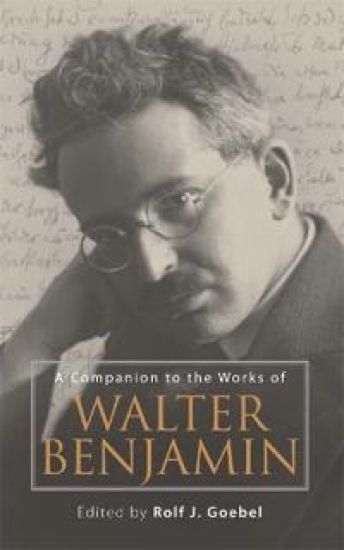
A Companion to the Works of Walter Benjamin
An advanced introduction to Benjamin's work and its actualization for our own times. Walter Benjamin (1892-1940) has emerged as one of the leading cultural critics of the twentieth century. His work encompasses aesthetics, metaphysical language and narrative theories, German literary history, philosophies of history, the intersection of Marxism and Messianic thought, urban topography, and the development of photography and film. Benjamin defined the task of the critic as one that blasts endangered moments of the past out of the continuum of history so that they attain new significance. This volume of new essays employs this principle of actualization as its methodological program in offering a new advanced introduction to Benjamin's own work. The essays analyze Benjamin's central texts, themes, terminologies, and genres in their original contexts while simultaneously situating them in new parameters, such as contemporary media, memory culture, constructions of gender, postcoloniality, and theories of urban topographies. The Companion brings together an international group of established and emerging scholars to explicate Benjamin's actuality from a multidisciplinary perspective. Designed for audiences interested in literary criticism, cultural studies, and neighboring disciplines, the volume serves as a stimulus for new debates about Benjamin's intellectual legacy today. Contributors: Wolfgang Bock, Willi Bolle, Dianne Chisholm, Adrian Daub, Dominik Finkelde, Eric Jarosinski, Lutz Koepnick, Vivian Liska, Karl Ivan Solibakke, Marc de Wilde, Bernd Witte Rolf J. Goebel is Distinguished Professor of German and Chair of the Department of WorldLanguages and Cultures at the University of Alabama in Huntsville.