Studienarbeit aus dem Jahr 2010 im Fachbereich P dagogik - Schulp dagogik, Note: 2,0, Helmut-Schmidt-Universit t - Universit t der Bundeswehr Hamburg, Sprache: Deutsch, Abstract: Eine Hausarbeit ber die Hitlerjugend als Sozialisationsinstanz mit einem kurzen historischen Abriss der Geschichte dieser Organisation. Beleuchtung des Lebens in der HJ anhand von Dienst und Widerstand unter Nutzung von Zeitzeugenberichten und Metaanalysen.
Quantum chromodynamics (QCD) is the fundamental quantum ?eld theory of quarks and gluons. In order to discuss it in a mathematically well-de?ned way, the theory has to be regularized. Replacing space-time by a Euclidean lattice has proven to be an e?cient approach which allows for both theor- ical understanding and computational analysis. Lattice QCD has become a standard tool in elementary particle physics. Asthetitlealreadysays:thisbookisintroductory!Thetextisintendedfor newcomerstothe?eld,servingasastartingpoint.Wesimplywantedtohavea bookwhichwecanputintothehandsofanadvancedstudentfora?rstreading on lattice QCD. This imaginary student brings as a prerequisite knowledge of higher quantum mechanics, some continuum quantum ?eld theory, and basic facts of elementary particle physics phenomenology. In view of the wealth of applications in current research the topics p- sented here are limited and we had to make some painful choices. We discuss QCD but omit most other lattice ?eld theory applications like scalar th- ries, gauge-Higgs models, or electroweak theory. Although we try to lead the reader up to present day understanding, we cannot possibly address all on- ing activities, in particular concerning the role of QCD in electroweak theory. Subjects like glueballs, topological excitations, and approaches like chiral p- turbation theory are mentioned only brie?y. This allows us to cover the other topics quite explicitly, including detailed derivations of key equations. The ?eld is rapidly developing. The proceedings of the annual lattice conferences provide information on newer directions and up-to-date results.
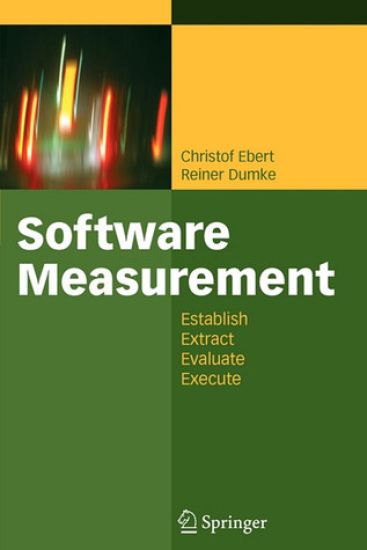
Our world and our society are shaped and increasingly governed by software. Since software is so ubiquitous and embedded in nearly everything we are doing, we need to stay in control. We have to make sure that the systems and their software are running as we intend - or better. Software measurement is the discipline that assures that we stay in control. In this volume, Ebert and Dumke provide a comprehensive introduction to software measurement. They detail knowledge and experiences about software measurement in an easily understood, hands-on presentation. Brief references are embedded from world-renown experts such as Alain Abran, Luigi Buglione, Manfred Bundschuh, David N. Card, Ton Dekkers, Robert L. Glass, David A. Gustafson, Marek Leszak, Peter Liggesmeyer, Andreas Schmietendorf, Harry Sneed, Charles Symons, Ruediger Zarnekow and Horst Zuse. Many examples and case studies are provided from Global 100 companies such as Alcatel-Lucent, Atos Origin, Axa, Bosch, Deloitte, Deutsche Telekom, Shell, Siemens and Vector Consulting. This combination of methodologies and applications makes the book ideally suited for both professionals in the software industry and for scientists looking for benchmarks and experiences. Besides the many practical hints and checklists readers will also appreciate the large reference list, which includes links to metrics communities where project experiences are shared. Further information, continuously updated, can also be found on the Web site related to this book: http://metrics.cs.uni-magdeburg.de/.
Driven by maturing Web service technologies and the wide acceptance of the service-oriented architecture paradigm, the software industry’s traditional business models and strategies have begun to change: software vendors are turning into service providers. In addition, in the Web service market, a multitude of small and highly specialized providers offer modular services of almost any kind and economic value is created through the interplay of various distributed service providers that jointly contribute to form individualized and integrated solutions. This trend can be optimally catalyzed by universally accessible service orchestration platforms – service value networks (SVNs) – which are the underlying organizational form of the coordination mechanisms presented in this book.Here, the authors focus on providing comprehensive business-oriented insights into today’s trends and challenges that stem from the transition to a service-led economy. They investigate current and future Web service business models and provide a framework for Web service value networks. Pricing mechanism basics are introduced and applied to the specific area of SVNs. Strategies for platform providers are analyzed from the viewpoint of a single provider, and so are pricing mechanisms in service value networks which are optimal from a network perspective. The extended concept of pricing Web service derivatives is also illustrated. The presentation concludes with a vision of how Web service markets in the future could be structured and what further developments can be expected to happen.This book will be of interest to researchers in business development and practitioners such as managers of SMEs in the service sector, as well as computer scientists familiar with Web technologies. The book’s comprehensive content provides readers with athorough understanding of the organizational, economic and technical implications of dealing with Web services as the nucleus of modern business models, which can be applied to Web services in general and Web service value networks specifically..
Quantum chromodynamics (QCD) is the fundamental quantum ?eld theory of quarks and gluons. In order to discuss it in a mathematically well-de?ned way, the theory has to be regularized. Replacing space-time by a Euclidean lattice has proven to be an e?cient approach which allows for both theor- ical understanding and computational analysis. Lattice QCD has become a standard tool in elementary particle physics. Asthetitlealreadysays:thisbookisintroductory!Thetextisintendedfor newcomerstothe?eld,servingasastartingpoint.Wesimplywantedtohavea bookwhichwecanputintothehandsofanadvancedstudentfora?rstreading on lattice QCD. This imaginary student brings as a prerequisite knowledge of higher quantum mechanics, some continuum quantum ?eld theory, and basic facts of elementary particle physics phenomenology. In view of the wealth of applications in current research the topics p- sented here are limited and we had to make some painful choices. We discuss QCD but omit most other lattice ?eld theory applications like scalar th- ries, gauge-Higgs models, or electroweak theory. Although we try to lead the reader up to present day understanding, we cannot possibly address all on- ing activities, in particular concerning the role of QCD in electroweak theory. Subjects like glueballs, topological excitations, and approaches like chiral p- turbation theory are mentioned only brie?y. This allows us to cover the other topics quite explicitly, including detailed derivations of key equations. The ?eld is rapidly developing. The proceedings of the annual lattice conferences provide information on newer directions and up-to-date results.
Wie kann Aktivität im Gehirn Gefühle auslösen? Wie kann „bloßes Fleisch“ – so wird der Körper in Cyberpunkromanen oft abfällig genannt -- subjektives Empfinden hervorbringen? Oder allgemeiner gesagt: Wie kann etwas Physisches etwas Nichtphysisches, subjektive Zustände erzeugen? Ob es der Zahnschmerz ist, die Freude beim Anblick der eigenen Kinder oder der Geschmack eines edlen Weins, sie alle haben denselben Ursprung in der Aktivität von Nervengewebe, im Bewusstsein. Christof Koch forscht seit Jahren über das Thema Bewusstsein. In einer Art Bestandsaufnahme zeigt er den derzeitigen Stand der Forschung auf, an dem auch maßgeblich Wissenschaftler wie Francis Crick, Ned Block, David Chalmers, Stanislas Dehaene, Giulio Tononi und Wolf Singer mitgewirkt haben. Ihm erscheint nicht als Widerspruch, mit naturwissenschaftlichen, empirischen Methoden erklären zu wollen, wie Gefühle entstehen. Wir sind uns der meisten Dinge, die in unserem Kopf vorgehen, nicht bewusst. Koch postuliert, dass Zombies ohne Bewusstsein in weiten Teilen unser Leben steuern, auch wenn wir der festen Überzeugung sind, darüber selbst zu bestimmen. Seiner Meinung nach wird es gelingen, empfindungsfähige Maschinen zu bauen – er liefert eine erste Vorlage hierfür im Buch. Er reflektiert so diverse Aspekte wie die Unterscheidung zwischen Aufmerksamkeit und Bewusstsein, das Unbewusste, die Physik und Biologie des freien Willen, Hunde, den Ring der Nibelungen, den Glauben an einen persönlichen Gott und Traurigkeit. Kochs Buch ist mehr als ein wissenschaftlicher Überblick – es ist zudem Bekenntnis, Autobiographie und futuristische Spekulation.
Risikomanagement ist ein Schlüsselwerkzeug für Führungskräfte im Projekt und in der Linie. Es hilft dabei, Chancen, Unsicherheiten und Gefahren bewusst und proaktiv anzupacken, und damit kritische Probleme zu vermeiden. Sein pragmatischer Einsatz ist heute überlebensnotwendig und aufgrund von wachsenden Anforderungen an Produkthaftung und Governance für die Unternehmensführung verpflichtend.Risikomanagement kompakt fasst praxisnah und verständlich zusammen, was Risikomanagement ist, wie es eingeführt und eingesetzt wird und was die Besonderheiten bei IT-Projekten und Software-Entwicklungsprojekten sind. Der Autor beschreibt auf Basis internationaler Projektarbeit, Führungserfahrung und Beratung in der Industrie die Anwendung professioneller Techniken, mit denen Risiken erkannt, bewertet, abgeschwächt und kontrolliert werden. Der Leser profitiert von praxiserprobten Verfahren und wird in die Lage versetzt, die aktuellen Techniken und Trends optimal für sein Unternehmen zu nutzen und erfolgreich und zielorientiert umzusetzen.Die Neuauflage wurde komplett überarbeitet und um die Themen Produkthaftung, Governance, agiles Risikomanagement, Lieferantenmanagement und konkrete Projektkennzahlen aus der Praxis erweitert.