

Kirjahaku
Etsi kirjoja tekijän nimen, kirjan nimen tai ISBN:n perusteella.
1000 tulosta hakusanalla David Grove

PRESTAZIONI ISTITUZIONALI GOVERNATIVE E CAPITALE SOCIALE IN GHANA
David Wand
Edizioni Sapienza
2021
nidottu
Governance of the provincial economy and finances
David Masamba Famode
Our Knowledge Publishing
2022
pokkari

Governance der Wirtschaft und der Finanzen der Provinz
David Masamba Famode
Verlag Unser Wissen
2022
pokkari

Governação da economia e finanças provinciais
David Masamba Famode
Edicoes Nosso Conhecimento
2022
pokkari

Desafios da governação empresarial e custo de fazer negócios no Zimbabué
David Foya
Edicoes Nosso Conhecimento
2023
pokkari
Este livro trata de quest es de governan a corporativa nos setores p blico e privado. As pr ticas de governan a corporativa no Zimb bue t m sido um espinho na carne para institui es p blicas e privadas. muito pior em institui es p blicas, mais ainda em empresas estatais, como TelOne, Grain Marketing Board, Cottco, s para citar alguns. O pr prio governo muito opaco em suas opera es e muito menos em lidar com quest es financeiras.Como resultado, o custo de fazer neg cios no Zimb bue extremamente dif cil devido falta de governan a corporativa e tica nos neg cios. Altos n veis de corrup o, burocracia, falta de sistemas financeiros e banc rios robustos e inconsist ncias pol ticas afetaram negativamente o custo dos neg cios.


Governing a Poor Country: Perspectives from a Former Chief Minister of Sierra Leone examines how and why the office of the Chief Minister of the Republic of Sierra Leone contributes to the political and economic management of the country. It raises and attempts to answer some fundamental questions about the wisdom, constitutionality, and the necessity of using that office to pursue innovative governance by the New Direction administration in Sierra Leone. Drawing from the governance experience of having served as the first Chief Minister of the country, Professor Francis provides a first-hand, candid, in-depth and critically reflective account of the role and mandate of that office. The book will be of interest to political leaders, academics, policy practitioners, diplomats, educators, journalists, and others interested in Sierra Leone, African politics, and national governance issues. ____________________________________ Professor Dr. David J. Francis is a distinguished statesman, an internationally accomplished academic, and a policy practitioner who variously served as Chief Minister, and Minister of Foreign Affairs and International Cooperation of the Republic of Sierra Leone between 2018 and 2023. Professor Francis was the Head of the Department of Peace Studies at the University of Bradford in the UK and held a concurrent Research Professorial Chair in African Peace & Conflict Studies at the same university? His publications include 12 books on Sierra Leone and African politics, peace, security, governance and development issues.

Although known as the founder of modern utilitarianism and the source of analytical jurisprudence, Bentham today is infrequently read but often caricatured. The present book, based on a study of Bentham's most important works, offers a reinterpretation of Bentham's main philosophical doctrines, his principle of utility and his analysis of law. The evidence indicates that Bentham was no `universalist' in morals, but embraced a dual standard - in politics the community's interest, in `private ethics' the agent's interest - which may in turn be based on the idea that government should serve the interests of those who are `governed'. The argument challenges many common assumptions about Bentham's view of human nature and of political institutions. A new reading is also given to his theory of law, which suggests Bentham's insight, originality, and continued interest for philosophers and legal theorists. In the Interest of the Governed was first published in 1973. This revised edition contains a new Preface, a revised Bibliography, and two new Indexes, one of Names and one of Subjects, which together replace the original index.
This book examines the limits to cosmopolitan liberal peacebuilding caused by its preoccupation with the values and assumptions of neoliberal global governance. The peace people experience is determined by the processes privileged in peacebuilding. This book is about four things that shape the processes involved. First, it is a critique of orthodox postconflict peacebuilding. It takes the position that the present approach, although seemingly hegemonic, is routinely ignored or manipulated by elites and society and converted into a miasma that to some degree wastes the energies and opportunities involved. Second, it is about alternatives which invoke the kind of peace people might seek in postconflict places if they had more control over the process of peacebuilding, a notion referred to here as ‘popular peace’. It is thus not the kind of critical work that some describe as ‘reflexive anti-liberalism’. Rather, it seeks alternatives that are grounded in the lives of people in postconflict spaces and which also reflect some of the essential values of Liberalism. Third, it is about the role of both informal and formal actors, institutions and practices in the creation of such a peace. For instance, it is concerned with the legitimacy of informal practices that lie beyond Liberal tolerance and which are vital in the pursuit of everyday peace. Fourth, it is about a ‘transversal’ (rather than vertical or hierarchical) relationship of global and local governance in securing a peace that reflects the needs and values of both. In short, this work is a response to the substantial inconsistencies that appear between peacebuilding rhetoric and everyday outcomes in postconflict places.This book will be of much interest to students of peacebuilding, post-conflict statebuilding, conflict studies, global governance and International Relations in general.
This book examines the limits to cosmopolitan liberal peacebuilding caused by its preoccupation with the values and assumptions of neoliberal global governance. The peace people experience is determined by the processes privileged in peacebuilding. This book is about four things that shape the processes involved. First, it is a critique of orthodox postconflict peacebuilding. It takes the position that the present approach, although seemingly hegemonic, is routinely ignored or manipulated by elites and society and converted into a miasma that to some degree wastes the energies and opportunities involved. Second, it is about alternatives which invoke the kind of peace people might seek in postconflict places if they had more control over the process of peacebuilding, a notion referred to here as ‘popular peace’. It is thus not the kind of critical work that some describe as ‘reflexive anti-liberalism’. Rather, it seeks alternatives that are grounded in the lives of people in postconflict spaces and which also reflect some of the essential values of Liberalism. Third, it is about the role of both informal and formal actors, institutions and practices in the creation of such a peace. For instance, it is concerned with the legitimacy of informal practices that lie beyond Liberal tolerance and which are vital in the pursuit of everyday peace. Fourth, it is about a ‘transversal’ (rather than vertical or hierarchical) relationship of global and local governance in securing a peace that reflects the needs and values of both. In short, this work is a response to the substantial inconsistencies that appear between peacebuilding rhetoric and everyday outcomes in postconflict places.This book will be of much interest to students of peacebuilding, post-conflict statebuilding, conflict studies, global governance and International Relations in general.
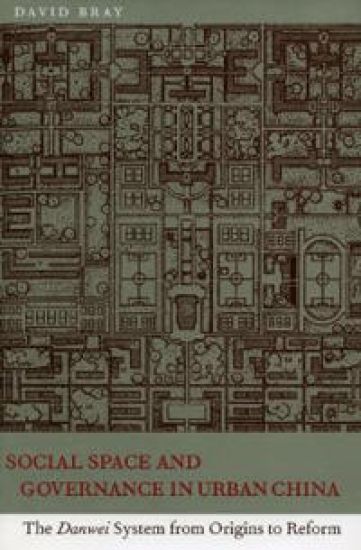
Centered on the urban workplace, the danwei (workunit) has been the fundamental social and spatial unit of urban China under socialism. Not only was it the source of employment, wages, and other material benefits for the vast majority of urban residents, it was also the institution through which the urban population was housed, organized, regulated, policed, educated, trained, protected, and surveyed. Furthermore, as the basic unit of urban society, each danwei became a community, providing its members with identity, a "face," and social belonging. With particular focus on the link between spatial forms and social organization, this book traces the origins and development of this critical institution up to the present day. Recent economic restructuring has seen the danwei lose its dominant role, yet its presence still influences the possibilities for urban transformation. Moreover, the author argues, the new institutions emerging in its place display important characteristics of the old danwei system.
How to Improve Governance
David Ferranti; Justin Jacinto; Anthony J. Ody
Brookings Institution
2009
nidottu
"In recent years, the developing world has seen a burst of efforts to reduce corruption, increase transparency and accountability, and improve governance. Needless to say, this is an important and encouraging development. However, the lack of a reliable compass to describe where a country is at a given moment—and where it could be heading in the absence or acceptance of proposed reforms—can result in disastrous missteps. The unfortunate absence of such a guide has helped lead to innumerable failed governments or ineffective regimes. This important book aims to fill that void. How to Improve Governance emphasizes the need for an overall analytical framework that can be applied to different countries to help analyze their current situations, identify potential areas for improvement, and assess their relative feasibility and the steps needed to promote them. A country-specific analysis needs to be comprehensive, in the sense that it includes the four concepts of transparency, accountability, governance, and anticorruption throughout the calculus. Without such an analytic framework, any reform attempt is likely to flounder for lack of a shared understanding of the underlying problems and of the feasible reforms. The book gives special emphasis to the potential for civil society groups to play a stronger role in holding governments accountable for their use of public resources, and to the importance of developing politically feasible, prioritized country strategies for reform.""Whether one looks at how to increase domestic demand for good governance, how to make government more accountable to the public, or how to build democratic processes that deliver results, the underlying issues are essentially the same.... As development actors of various types... seek to help, more and more of them are calling for a clearer conceptual framework to guide their efforts.""—From the Introduction"

How can a God-fearing man be a Good Samaritan when a confusing young woman is making it impossible?Levi Graham is a resilient, independent backwoodsman, who stumbles upon the injured young woman. Good Samaritan, he's finding out the hard way, is not his best strength. In addition to caring for this beautiful, confusing woman, he encounters a robbery, a fire, visits from relatives, and the cabin's previous owners, all disrupting his former peaceful life of solitude and trapping.Suspended between two worlds, Allison Kent is helpless to find her way back home without hurting the kind and handsome man who has graciously taken her in.Clutching her late mother's Burgundy Gloves, Allison can only hope time will awaken her from this awful nightmare. Strange people, strange ideas and a strange young man looking long and ardent at her. How can she convince him she has nothing to give when she no place to call home? Will she rouse from the dark fog before she's left to fend for herself? Will her heart heal before she breaks his to pieces? Inspiring romance of redemption and grace that grips your heart to the very end.All my romances are standalone, wholesome with a touch of pepper. Visit Amazon's Julia A David author's page below for a look at the Burgundy Gloves Short Video Cli

Measuring the Effectiveness of Regional Governing Systems
David K. Hamilton
Springer-Verlag New York Inc.
2012
sidottu
Regional governance is a topical public policy issue and is receiving increased attention from scholars, government officials and civic leaders. As countries continue to urbanize and centralize economic functions and population in metropolitan regions, the traditional governing system is not equipped to handle policy issues that spill over local government boundaries. Governments have utilized four basic approaches to address the regional governing problem: consolidating governments, adding a regional tier, creating regional special districts, and functional cooperative approaches. The first two are structural approaches that require major (radical) changes to the governing system. The latter two are governance approaches that contemplate marginal changes to the existing governance structure and rely generally on cooperation with other governments and collaboration with the nongovernmental sector. Canada and the United States have experimented with these basic forms of regional governance. This book is a systematic analysis of these basic forms as they have been experienced by North American cities. Utilizing cases from Canada and the United States, the book provides an in-depth analysis of the pros and cons of each approach to regional governance. This research provides an additional perspective on Canadian and U.S. regional governance and adds to the knowledge of Canadian and United States governing systems. This study contributes to the literature on the various approaches to regional governance as well as bringing together the most current literature on regional governance. The author develops a framework of the values that a regional governing system should provide and measures to assess how well each basic approach achieves these values. Based on this assessment, he suggests an approach to regional governance for North American metropolitan areas that best achieves these values.

Measuring the Effectiveness of Regional Governing Systems
David K. Hamilton
Springer-Verlag New York Inc.
2014
nidottu
Regional governance is a topical public policy issue and is receiving increased attention from scholars, government officials and civic leaders. As countries continue to urbanize and centralize economic functions and population in metropolitan regions, the traditional governing system is not equipped to handle policy issues that spill over local government boundaries. Governments have utilized four basic approaches to address the regional governing problem: consolidating governments, adding a regional tier, creating regional special districts, and functional cooperative approaches. The first two are structural approaches that require major (radical) changes to the governing system. The latter two are governance approaches that contemplate marginal changes to the existing governance structure and rely generally on cooperation with other governments and collaboration with the nongovernmental sector. Canada and the United States have experimented with these basic forms of regional governance. This book is a systematic analysis of these basic forms as they have been experienced by North American cities. Utilizing cases from Canada and the United States, the book provides an in-depth analysis of the pros and cons of each approach to regional governance. This research provides an additional perspective on Canadian and U.S. regional governance and adds to the knowledge of Canadian and United States governing systems. This study contributes to the literature on the various approaches to regional governance as well as bringing together the most current literature on regional governance. The author develops a framework of the values that a regional governing system should provide and measures to assess how well each basic approach achieves these values. Based on this assessment, he suggests an approach to regional governance for North American metropolitan areas that best achieves these values.

The next book in the gripping Flavia Albia series, by acclaimed author Lindsey Davis.

Witch Trinity - The Glove: Book Two
David Jones
Createspace Independent Publishing Platform
2017
nidottu
BOOK TWO OF THE WITCH TRINITY SAGAA SUPERNATURAL SERIES FOR THIS GENERATION Three witches, Delf, Shorn and Serena, are unaware of their magical abilities until they are Called to become Witch Trinity, the most powerful source of magic on earth. Women are going missing and an ancient witch, known as the Glove, is suspected.The Calling spell failed to wake Serena and without her Delf and Shorn have no choice but to hunt this witch on their own. Unknown to them their adversary is just a minor part of a much larger plan. A plan, if successful, will remove human life from the planet and leave it in the hands of the dark coven.

Reasonably comfortable with his possession of wealth, Monk moseys through his days taking care of his grandkids. After a car accident takes out his beloved Falcon and leaves him injured, he begins to see that many of the people around him are on edge. His wife, Agnes, no longer has a job and is working through parental issues with her father.Meanwhile, a book given to him in jest, may in fact be a primer for the disaffected rich to move the country away from democracy to autocracy by whatever means, including violence. Monk thinks this is silly until people connected to the book start dying. Foolishly drawn into this scheme, along with Agnes' sudden interest in sleuthing, Monk finds that they are now targets themselves, and decide to play along to learn more, even if it leads them to their possible demise.

A Troubled History: The Governance of Higher Education in Mississippi
David G. Sansing
NAUTILUS
2015
nidottu