Kirjojen hintavertailu. Mukana 11 717 486 kirjaa ja 12 kauppaa.

Kirjahaku

Etsi kirjoja tekijän nimen, kirjan nimen tai ISBN:n perusteella.

1000 tulosta hakusanalla David M Pack

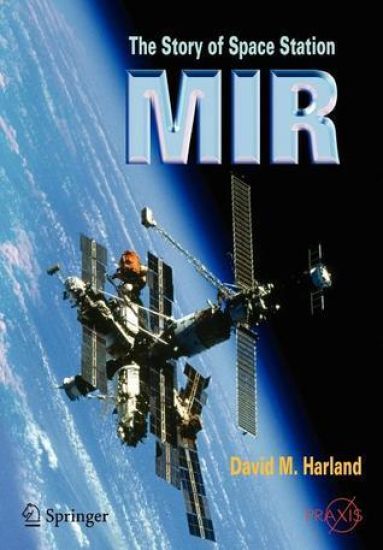
The Story of Space Station Mir

The Story of Space Station Mir

David M. Harland

Springer-Verlag New York Inc.
2005
nidottu
This successor edition picks up the story where the first edition left off in 1997, and runs through to Mir’s de-orbiting in March 2001, providing the definitive account of the Mir Space Station. The book reviews the origins of the Soviet space station programme, in particular the highly successful Salyuts 6 and 7, describes Mir’s structure, environment, power supply and maneuvering systems, and provides a comprehensive account of how it was assembled and how it operated in orbit. Tells how the Soviet Union's experience with a succession of Salyut space stations led to the development of Mir, which was assembled in space, piece by piece, between 1982 and 1996 and became an international research laboratory whose technology went on to form the 'core modules' of the International Space Station.
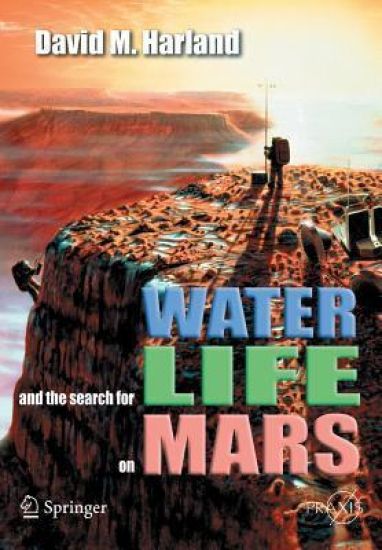
Water and the Search for Life on Mars

Water and the Search for Life on Mars

David M. Harland

Springer-Verlag New York Inc.
2005
nidottu
Mars has long been believed to have been cold, dead and dry for aeons, but there is now striking new proof that not only was Mars a relatively warm and wet place in geologically recent times, but that even today there are vast reserves of water frozen beneath the planet’s surface. As well as casting fascinating new insights into Mars’ past, this discovery is also forcing a complete rethink about the mechanisms of global planetary change and the possibility that there is microbial life on Mars. David Harland considers the issue of life on Mars in parallel with the origin of life on Earth. At the time the Viking instruments were designed, it was thought that all terrestrial life ultimately derived its energy from sunlight, and that the earliest form of life was the cyanobacteria with chlorophyll for photosynthesis. It was assumed the same would be the case on Mars and that microbial life would be on or near the surface that the Vikings had sampled. In parallel with these NASA projects, the European Space Agency developed the Mars Express remote-sensing orbiter, which has detected traces of methane that may have been released by microbes. If microbial life is found on Mars, will it be based on DNA? Will this indicate that life developed independently? Or that it has characteristics in common with the most ancient forms of terrestrial life? If life is found on two planets in the same planetary system, this would favour the panspermia hypothesis. And if martian life is radically different, then in light of the discovery of planetary systems around other stars, this would, as remarked by Philip Morrison of MIT, "transform life from the status of a miracle to that of a statistic". These are all questions that the exploration of Mars for life are aimed to answer.
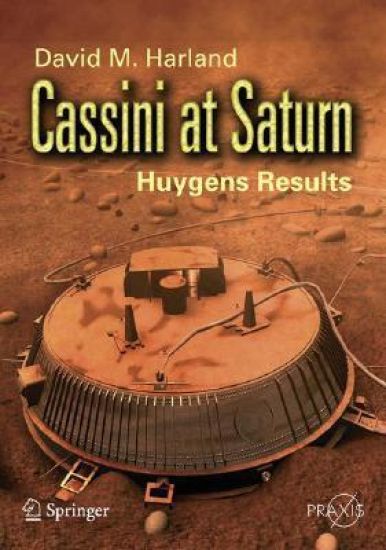
Cassini at Saturn

Cassini at Saturn

David M. Harland

Springer-Verlag New York Inc.
2007
nidottu
Cassini At Saturn – Huygens Results brings the story of the Cassini-Huygens mission and their joint exploration of the Saturnian system right up to date. Cassini entered orbit around Saturn June 2004 so this update includes 8 months of scientific data available for review, including the most spectacular images of Saturn, its rings and satellites ever obtained by a space mission. As the Cassini spacecraft approached its destination in spring 2004, the quality of the images already being returned by the spacecraft clearly demonstrated the spectacular nature of the close-range views that will be obtained. The book contains a 16-page colour section, comprising a carefully chosen selection of the most stunning images to be released during the spacecraft’s initial period of operation. The Huygens craft, released by Cassini, parachuted through the clouds of Saturn’s largest moon, Titan, in January 2005. David Harland tells the exciting story of the this craft’s journey to the surface of one of the most enigmatic bodies on the Solar System, the only moon to have a dense atmosphere and possibly lakes of liquid gas at -190ºC on its surface. Titan is considered to be an early Earth in deep freeze, possibly with the building blocks of life in its atmosphere. There will undoubtedly be enormous interest in the first results and images of Titan’s surface, and this book is the first incisive summary of this groundbreaking material.
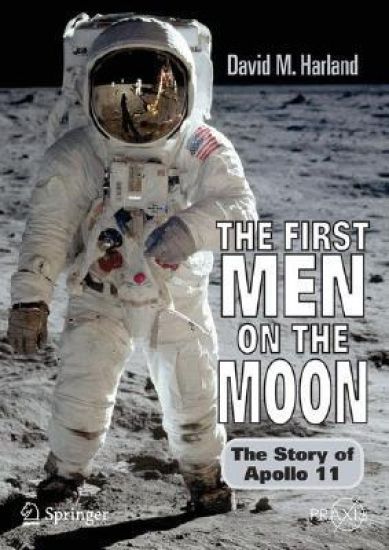
The First Men on the Moon

The First Men on the Moon

David M. Harland

Springer-Verlag New York Inc.
2006
nidottu
On 12 April 1961 Yuri Gagarin became the first man to orbit the Earth. One month later, President John F. Kennedy challenged the American nation to land a man on the Moon before the decade was out. On 16 July 1969, Neil Armstrong, Michael Collins and Buzz Aldrin set off in Apollo 11 to attempt this audacious mission, and succeeded magnificently. This book tells the story of Apollo 11, starting with crew selection and training, the choice of the landing site, and the assembly of the space vehicle, then a detailed account of the mission, featuring the lunar landing and moonwalk, and a review of how our knowledge of the Moon's history was revolutionised as a result. The story is enlivened by dialogue between the astronauts in space and the flight controllers in Mission Control.
Enterprise Collaboration

Enterprise Collaboration

David M. Levermore; Cheng Hsu

Springer-Verlag New York Inc.
2006
sidottu
Global supply chain is a fact of life in today's world. From the perspective of the First World, this practice reigns in outsourcing of jobs that, in the view of many, threatens a way of life. This argument actually implies that outsourcing represents a fair chance for the Third World to catch up and reverse-leverage through market economy. However, many in the Third World are also opposed to the global market economy from an opposite argument. The fact that matters is, of course, that globalization continues to progress relentlessly in its own momentum, and that the national playing grounds continue to level globally for both Worlds. Would globalization results in the rich nations getting richer and the poor poorer; or would it help the world united in the same economical reason? The questions that we the researchers could try to answer are a different kind, the kind that leads to the understanding of the elements of "the fittest" in the global competition. For instance, what defines an enterprise's staying power on the top of the food chain, or an economy's ability to design and control the global supply chains, in the long term? Evidently, to understand this ability the field needs to study the engineering prowess required, as much as the finance and management if the history of industrial revolution is any guide. Yet, the study on the engineering of global supply chains has been largely lacking.
NASA's Moon Program

NASA's Moon Program

David M. Harland

Springer-Verlag New York Inc.
2009
nidottu
In 'Paving the Way for Apollo 11' David Harland explains the lure of the Moon to classical philosophers, astronomers, and geologists, and how NASA set out to investigate the Moon in preparation for a manned lunar landing mission. It focuses particularly on the Lunar Orbiter and Surveyor missions.
Space Exploration 2008

Space Exploration 2008

David M. Harland; Brian Harvey

Springer-Verlag New York Inc.
2007
nidottu
The aim of the Space Exploration annuals is to provide a yearly update on recent space launches, missions and results, to be published every September. The annual will cover space exploration from a variety of angles, looking back at past missions, reviewing those currently under way and detailing those planned for the future, and encompassing both manned and unmanned spaceflight. The invited contributions, authored by leading figures in astronomy and space exploration and which make up the bulk of the annual each year, will cover a variety of topics and are written to appeal to a wide readership. One feature introduced in the first volume ‘Solar System Log’ featuring the very latest in the exploration of the planets, their moons and small Solar System bodies, will be retained for Space Exploration 2008, and will comprise seven chapters. In addition, there will be a special additional section entitled, ‘Return to the Moon’ containing three chapters.
Foundations of Systematics and Biogeography

Foundations of Systematics and Biogeography

David M. Williams; G. Nelson; Malte C. Ebach

Springer-Verlag New York Inc.
2007
sidottu
This volume draws attention to the seminal studies and important advances that have shaped systematic and biogeographic thinking and continue to influence its direction today. It traces concepts in homology and classification from the 19th century to the present through the provision of a unique anthology of scientific writings from Goethe, Agassiz, Geoffroy St. Hilaire, Owen, Naef, Zangerl and Nelson, among others. In addition, current attitudes and practices in comparative biology are interrogated, particularly in relation to evolutionary studies leading to a re-statement of the principal aims of the discipline.In order to alert prospective students to pitfalls common in systematics and biogeography, the book highlights three principal messages: biological classifications and their explanatory mechanisms are separate notions; most, if not all, homology concepts pre-date the works of Darwin; and that the foundation of all comparative biology is the concept of relationship - neither 'similarity' nor 'genealogical hypotheses of descent' are sufficient.
Exploring the Moon

Exploring the Moon

David M. Harland

Springer-Verlag New York Inc.
2008
nidottu
David Harland opens with a review of the robotic probes, namely the Rangers which returned television before crashing into the Moon, the Surveyors which 'soft landed' in order to investigate the nature of the surface, and the Lunar Orbiters which mapped prospective Apollo landing sites. He then outlines the historic landing by Apollo 11 in terms of what was discovered, and how over the next several missions the program was progressively geared up to enable the final three missions each to spend three days on comprehensive geological investigations. He concludes with a review of the robotic spacecraft that made remote-sensing observations of the Moon. Although aimed at the enthusiast, and can be read as an adventure in exploration, the book develops the scientific theme of lunar geology, and therefore will be of use as background reading for undergraduate students of planetary sciences. In addition, with the prospect of a resumption of human missions, it will help journalists understand what Apollo achieved after the 'flags and footprints' of the Apollo 11 landing in July 1969 and will commemorate the fortieth anniversary of that momentous event.
Algorithm Synthesis: A Comparative Study

Algorithm Synthesis: A Comparative Study

David M. Steier; A. Penny Anderson

Springer-Verlag New York Inc.
1989
nidottu
In early 1986, one of us (D.M.S.) was constructing an artificial intelligence system to design algorithms, and the other (A.P.A.) was getting started in program transformations research. We shared an office, and exchanged a few papers on the systematic development of algorithms from specifications. Gradually we realized that we were trying to solve some of the same problems. And so, despite radical differences between ourselves in research approaches, we set out together to see what we could learn from these papers. That's how this book started: a couple of graduate students trying to cope with The Literature. At first, there was just a list of papers. One of us (D.M.S.) tried to cast the papers in a uniform framework by describing the problem spaces searched, an approach used in artificial intelligence for understanding many tasks. The generalized problem space descriptions, though useful, seemed to abstract too much, so we decided to compare papers by different authors dealing with the same algorithm. These comparisons proved crucial: for then we began to see similar key design choices for each algorithm.
Factorization and Primality Testing

Factorization and Primality Testing

David M. Bressoud

Springer-Verlag New York Inc.
1989
sidottu
"About binomial theorems I'm teeming with a lot of news, With many cheerful facts about the square on the hypotenuse. " - William S. Gilbert (The Pirates of Penzance, Act I) The question of divisibility is arguably the oldest problem in mathematics. Ancient peoples observed the cycles of nature: the day, the lunar month, and the year, and assumed that each divided evenly into the next. Civilizations as separate as the Egyptians of ten thousand years ago and the Central American Mayans adopted a month of thirty days and a year of twelve months. Even when the inaccuracy of a 360-day year became apparent, they preferred to retain it and add five intercalary days. The number 360 retains its psychological appeal today because it is divisible by many small integers. The technical term for such a number reflects this appeal. It is called a "smooth" number. At the other extreme are those integers with no smaller divisors other than 1, integers which might be called the indivisibles. The mystic qualities of numbers such as 7 and 13 derive in no small part from the fact that they are indivisibles. The ancient Greeks realized that every integer could be written uniquely as a product of indivisibles larger than 1, what we appropriately call prime numbers. To know the decomposition of an integer into a product of primes is to have a complete description of all of its divisors.
Second Year Calculus

Second Year Calculus

David M. Bressoud

Springer-Verlag New York Inc.
1991
nidottu
Second Year Calculus: From Celestial Mechanics to Special Relativity covers multi-variable and vector calculus, emphasizing the historical physical problems which gave rise to the concepts of calculus. The book carries us from the birth of the mechanized view of the world in Isaac Newton's Mathematical Principles of Natural Philosophy in which mathematics becomes the ultimate tool for modelling physical reality, to the dawn of a radically new and often counter-intuitive age in Albert Einstein's Special Theory of Relativity in which it is the mathematical model which suggests new aspects of that reality. The development of this process is discussed from the modern viewpoint of differential forms. Using this concept, the student learns to compute orbits and rocket trajectories, model flows and force fields, and derive the laws of electricity and magnetism. These exercises and observations of mathematical symmetry enable the student to better understand the interaction of physics and mathematics.
Wilde in America

Wilde in America

David M. Friedman

WW Norton Co
2015
sidottu
On 3 January 1882, Oscar Wilde, a twenty-seven-year-old "genius"—by his own reckoning—arrived in New York. The Dublin-born Oxford man had made a spectacle of himself in London with his fashion sense, acerbic wit, and passion for art and design, and was hired to go to America to lecture on interior decorating. But Wilde had his own business plan: he would promote himself. And he did, creating a template for fame creation that still works today. Wilde presented himself as a "star", taking the stage in satin breeches and a velvet coat with lace trim as he sang the praises of sconces, embroidered pillows and himself. What he so presciently understood is that fame could launch a career as well as cap one. An enchanting tale of travel and transformation, comedy and capitalism, Wilde in America teaches us about our present as well as our past.
Extinction

Extinction

David M. Raup

WW Norton Co
1993
nidottu
In the geological record, there are five major mass extinctions—the "Big Five." The most famous happened at the end of the Cretaceous Period, when the dinosaurs and two-thirds of all marine animal species were wiped out, opening the door for the age of mammals and the rise of Homo Sapiens. Using this example as a springboard, David M. Raup leaps into an egaging discussion of the theories, assumptions, and difficulties associated with the science of species extinction. Woven is along the way are stories of the trilobite eye, tropical reefs, flying reptiles, and the fate of the heath hen on Martha's Vineyard, a very modern extinction.
The Nemesis Affair

The Nemesis Affair

David M. Raup

WW Norton Co
2000
nidottu
Nemesis is the name given by scientists to a (theoretical) small companion star to our sun. Every 26 million years, Nemesis's orbit brings it close enough to the sun to bombard our solar system with billions of comets. While most of the comets will float harmlessly beyond the outer planets, some passing through the sun's Oort Cloud will be deflected by its gravitational force toward Earth. Such a "large-body impact," the Nemesis theory holds, was responsible for the mass extinction that led to the demise of the dinosaurs. The next impact, millions of years from now, might very well extinguish humanity. In this lively, fascinating, and often disturbing book, updated and revised with the latest scientific evidence on terrestrial impacts, David M. Raup re-explores the controversies of the Nemesis theory from the trenches of the scientific community, and investigates the issues-both scientific and philosophical-of mass extinction. "A fascinating insider's view of scientists at work-and at odds-on the issues of extinction, evolution, and the fate of dinosaurs."-John Noble Wilford
Supreme Court Watch 2015

Supreme Court Watch 2015

David M. O'Brien

WW Norton Co
2018
nidottu
Each annual edition of Supreme Court Watch offers narratives and analyses of legal disputes, political battles, and social confrontations as they unfold before the Supreme Court. Included are numerous excerpts from the justices’ opinions and dissents on the most influential cases of the past term, as well as a preview of the cases awaiting the Court in the forthcoming term.
Constitutional Law and Politics: Civil Rights and Civil Liberties

Constitutional Law and Politics: Civil Rights and Civil Liberties

David M. O'Brien; Gordon Silverstein

W. W. Norton Company
2023
nidottu
Constitutional Law and Politics does more than give students a comprehensive and up-to-date set of cases; it provides the tools needed to make sense of them. Silverstein's contextualization of cases makes it easier for students to understand complicated decisions, engage with the field of American constitutional law, and succeed in the course. Silverstein includes recent landmark cases, such as Brnovich v. Democratic National Committee narrowing the application of the Voting Rights Act and Bostock v. Clayton County Georgia, which expands the scope of protections against discrimination on the basis of sex to include discrimination on the basis of sexual orientation and gender identity. The Twelfth Edition also will grapple with the Court's ruling in the Mississippi abortion case of Dobbs v. Jackson Women's Health Organization that overturned Roe v. Wade.
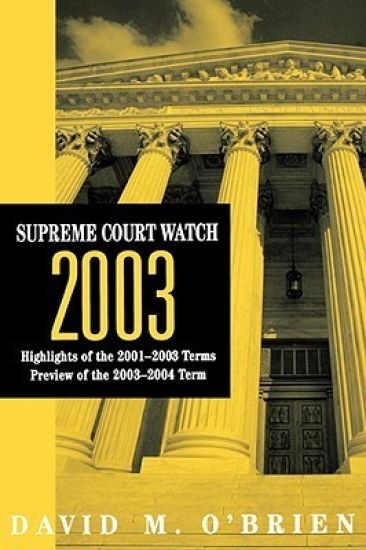
Supreme Court Watch 2003

Supreme Court Watch 2003

David M. O'Brien

W. W. Norton Company
2003
nidottu
Each annual edition of Supreme Court Watch o ffers students narratives and analyses of legal disputes, political battles, and social confrontations as they unfold before the Supreme Court. Included in Supreme Court Watch 2003 are numerous excerpts from the justices' opinions and dissents on the Court's most influential cases of the past two terms, as well as a running preview of the cases awaiting the Court in the forthcoming 2003-2004 term. The Watch is an ideal supplement to the author's two-volume casebook, Constitutional Law and Politics, and serves as an excellent addition to other books for courses on law, legal studies, and the judiciary.
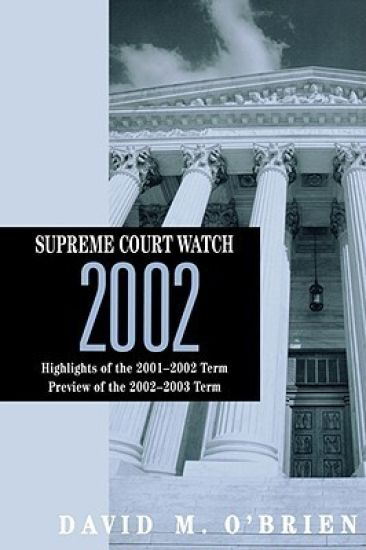
Supreme Court Watch 2002

Supreme Court Watch 2002

David M. O'Brien

W. W. Norton Company
2002
nidottu
Each annual edition of Supreme Court Watch offers students narratives and analyses of legal disputes, political battles, and social confrontations as they unfold before the Supreme Court. Also included are numerous excerpts from the justices' opinions and dissents on the Court's most influential cases of the past three terms, as well as a running preview of the cases awaiting the Court in the forthcoming term. Supreme Court Watch is an indispensable resource for any course on law, legal studies, and the judiciary.
Sense and Senility: The Neuropathology of the Aged Human Brain
nly two things are certain in life, one is that all of us will inevita­ Obly grow older, the other is that at some point during or at the end of this process we shall die. Inherent to the passage of time is a deterio­ ration in the structural and functional integrity of our bodies, this pro­ gressing to such an extent that one or more organ systems will eventu­ ally begin to fail with the continued health and well-being of the individual coming under threat. Age-associated deficiencies in the musculo-skeletal, cardiovascular, or endocrine systems producing arthri­ tis, hypertension, stroke or diabetes are all too apparent in our elderly population yet internally caused failures in the function of the nervous system provide the common, and mostly intractable, problems of memory and intellect or locomotion that face and frustrate clinicians. Perhaps the most important factor which can decide the outcome of research studies professing to examine the effects of the passage of time (i. e. the 'process of aging') on the function of the nervous system, or indeed any other organ system, is the selection of appropriate or repre­ sentative subjects for investigation. The heart of this problem lies in defining what might be considered as 'normal' aging as distinct from age-associated disease; setting the 'goal posts of normality' continues to 1 be a matter of considerable debate.