Kirjojen hintavertailu. Mukana 12 542 456 kirjaa ja 12 kauppaa.

Kirjahaku

Etsi kirjoja tekijän nimen, kirjan nimen tai ISBN:n perusteella.

1000 tulosta hakusanalla David R. Bates

Hong Kong as a Global Metropolis

Hong Kong as a Global Metropolis

David R. Meyer

Cambridge University Press
2000
sidottu
Hong Kong has remained the global metropolis for Asia since its founding in the 1840s following the Opium Wars between Britain and China. David Meyer traces its vibrant history from the arrival of the foreign trading firms, when it was established as one of the leading Asian business centers, to its celebrated handover to China in 1997. Throughout this period, Hong Kong has been prominent as a pivotal meeting-place of the Chinese and foreign social networks of capital, and as such has been China’s window onto the world economy, dominating other financial centers such as Singapore and Tokyo. Looking into the future, the author presents an optimistic view of Hong Kong in the twenty-first century, challenging those who predict its decline under Chinese rule. This accessible and broad-ranging look at the story of Hong Kong’s success will interest anyone concerned with its past, present and future.

Spain, Europe, and the 'Spanish Miracle', 1700–1900

Spain, Europe, and the 'Spanish Miracle', 1700–1900

David R. Ringrose

Cambridge University Press
1998
pokkari
David Ringrose here re-examines the history of Spain in the eighteenth and nineteenth centuries. He challenges the pessimism of prevailing assumptions about Spanish history, and its conventional separation into pre- and post-Napoleonic eras. Spain, Europe, and the ‘Spanish Miracle’, 1700–1900 also questions the importance of the empire for Spain’s own economy, suggesting instead that Spain evolved as part of Europe; indeed, some of the recently documented modernisation of the nineteenth century was already well under way in the eighteenth. In addition, the emergence of a governing élite closely tied to provincial society is placed in the context of traditional networks of patronage based upon close-knit family ties. Such a perspective makes the transitions of the 1930s and 1970s easier to explain. This important and challenging book will change our understanding of the history of modern Spain.
Doubt and the Demands of Democratic Citizenship

Doubt and the Demands of Democratic Citizenship

David R. Hiley

Cambridge University Press
2006
pokkari
The triumph of democracy has been heralded as one of the greatest achievements of the twentieth century, yet it seems to be in a relatively fragile condition in the United States, if one is to judge by the proliferation of editorials, essays, and books that focus on politics and distrust of government. Doubt and the Demands of Democratic Citizenship explores the reasons for public discontent and proposes an account of democratic citizenship appropriate for a robust democracy. David Hiley argues that citizenship is more than participating in the electoral process. It requires a capacity to participate in the deliberative process with other citizens who might disagree, a capacity that combines deep convictions with a willingness to subject those convictions. Hiley develops his argument by examining the connection between doubt and democracy generally, as well as through case studies of Socrates, Montaigne, and Rousseau, interpreting them in light of contemporary issues.
Defects and Geometry in Condensed Matter Physics

Defects and Geometry in Condensed Matter Physics

David R. Nelson

Cambridge University Press
2002
sidottu
Thermally excited defects such as vortices, disclinations, dislocations, vacancies and interstitials play a key role in the physics of crystals, superfluids, superconductors, liquid crystals and polymer arrays. Geometrical aspects of statistical mechanics become particularly important when thermal fluctuations entangle or crumple extended line-like or surface-like objects in three dimensions. In the case of entangled vortices above the first-order flux lattice melting transition in high temperature superconductors, the lines themselves are defects. A variety of low temperature theories combined with renormalization group ideas are used to describe the delicate interplay between defects, statistical mechanics and geometry characteristic of these problems in condensed matter physics. In this 2002 book, David Nelson provides a coherent and pedagogic graduate level introduction to the field of defects and geometry.
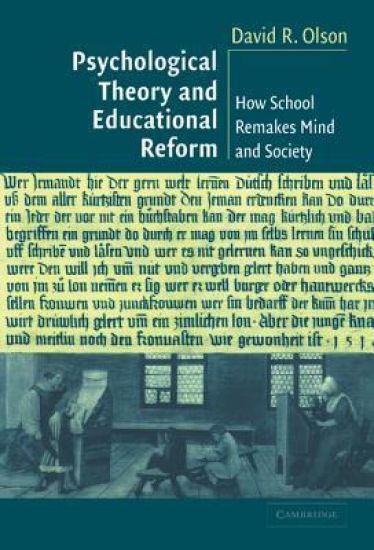
Psychological Theory and Educational Reform

Psychological Theory and Educational Reform

David R. Olson

Cambridge University Press
2003
sidottu
For well over a century educational reformers have looked for a breakthrough in the sciences of psychology and pedagogy that would dramatically improve the effectiveness of schooling. This book shows why such an ambition is an illusion. Schools are institutions which attempt to balance the needs of a bureaucratic society that funds them with the personal goals, interests, hopes and ambitions of the students who enroll in them. Reform efforts attempt to realign that balance without any clear conception of how the two are related. This book offers a theoretical account of the relation between the minds of learners and the institutional structure of the school that would account both for the ways that schooling remakes minds and societies and why such institutions are resistant to change.
Reading the Bible

Reading the Bible

David R Law

Continuum International Publishing Group Ltd.
2023
sidottu
Reading the Bible aims to provide a comprehensive, readable, and accessible guide to the diverse methods of biblical interpretation. The book falls into two parts. Part One 'What is Biblical Interpretation?' deals with basic issues concerning the interpretation of texts. Questions encountered include: 'What is interpretation?' and 'What does it mean for a text to have meaning, and how do we identify its meaning?' Part One of the book also discusses the role of 'pre-understanding', i.e., the way our cultural background and personal interests affects the way we read texts. Attention is paid to the problem of cultural and temporal time-gap. A further concern in this chapter is to introduce readers to such technical terms such as 'hermeneutics, ' 'exegesis' and 'eisegesis, ' 'semiotics, ' and diachronic and synchronic approaches to the interpretation of texts. Part Two, which forms the bulk of the book, provides a description of the main theories of biblical interpretation. Each chapter is divided into easily comprehensible sections, and examples of each method in practical application to the same two Old Testament and New Testament texts (Gen. 2.4b-3.24; Matt. 15.21-28) are provided. By seeing the different results that arise from applying the various methods to the same two texts, readers will gain a clear idea of how a particular method works and how it is distinct from other methods.
Reading the Bible

Reading the Bible

David R Law

T. T.Clark Ltd
2023
pokkari
Reading the Bible aims to provide a comprehensive, readable, and accessible guide to the diverse methods of biblical interpretation. The book falls into two parts. Part One 'What is Biblical Interpretation?' deals with basic issues concerning the interpretation of texts. Questions encountered include: 'What is interpretation?' and 'What does it mean for a text to have meaning, and how do we identify its meaning?' Part One of the book also discusses the role of 'pre-understanding', i.e., the way our cultural background and personal interests affects the way we read texts. Attention is paid to the problem of cultural and temporal time-gap. A further concern in this chapter is to introduce readers to such technical terms such as 'hermeneutics, ' 'exegesis' and 'eisegesis, ' 'semiotics, ' and diachronic and synchronic approaches to the interpretation of texts. Part Two, which forms the bulk of the book, provides a description of the main theories of biblical interpretation. Each chapter is divided into easily comprehensible sections, and examples of each method in practical application to the same two Old Testament and New Testament texts (Gen. 2.4b-3.24; Matt. 15.21-28) are provided. By seeing the different results that arise from applying the various methods to the same two texts, readers will gain a clear idea of how a particular method works and how it is distinct from other methods.
Enochic Judaism

Enochic Judaism

David R. Jackson

T. T.Clark Ltd
2004
nidottu
From the Books of Enoch, Jackson identifies a paradigm of order as opposed to deviation, which defined orthodoxy and elect identity in a manner which was absolutely exclusive. Over 300 years "Enochic Judaism" developed three working models within this paradigm to explain their worldview and its implications. These three models concerned 1) the fall of the angels under Shemikhazah (ethnic purity); 2) the revealing of secrets under the leadership of 'Aza'el (cultural purity); and 3) the going astray of the cosmos through the sin of the angels who govern its phenomena (liturgical purity). Jackson examines the way in which this tradition was developed within the Dead Sea Scrolls literature and notes its acceptance as authentic and authoritative within the so-called sectarian literature in particular.
Unity of Corinthian Correspondence

Unity of Corinthian Correspondence

David R. Hall

T. T.Clark Ltd
2003
nidottu
In The Unity of the Corinthian Correspondence, David Hall argues that 1 and 2 Corinthians are closely related. In both letters, Paul faces the same opponents, referring to them in the same disguised, indirect way in both 1 Corinthians and 2 Corinthians 1-9 before confronting them directly in 2 Corinthians 10-13. Furthermore, many passages in 2 Corinthians echo the teaching of 1 Corinthians, while others refer to the Corinthian reaction to the first letter. Hall therefore maintains that modern attempts to regard 1 and 2 Corinthians as a mosaic of fragments are based on a flawed methodology that fails to appreciate Paul's pastoral teaching. This is volume 251 in the Journal for the Study of the New Testament Supplement series.
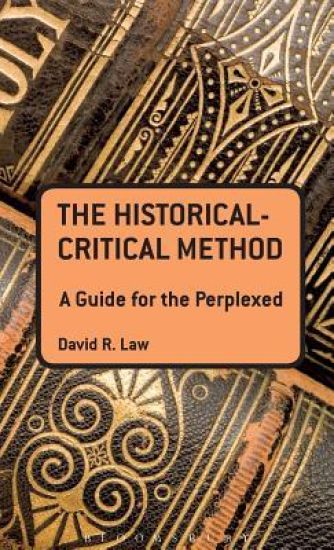
The Historical-Critical Method: A Guide for the Perplexed
This title offers an introduction to one of the core methods of approaching biblical texts. "Historical Critical Analysis" is the main way in which the Bible (both the Hebrew Bible/Old Testament and the New Testament) has been examined and read by scholars in the last century. The term refers to a range of methodologies which examine the origins of biblical texts, in relation to other contemporaneous texts, to form critical approaches and to questions of authorship, audience and authenticity. The aim is to get as close to the 'original text' and its 'original meaning' as possible. For many years "Historical Critical Method" has been the cornerstone upon which biblical scholarship is built, even as modern studies examine other theoretical approaches to reading the text in history, tradition, and from different audience perspectives "The Historical Critical Method" still presents the crucial starting point for students and scholars. "Continuum's Guides for the Perplexed" are clear, concise and accessible introductions to thinkers, writers and subjects that students and readers can find especially challenging - or indeed downright bewildering. Concentrating specifically on what it is that makes the subject difficult to grasp, these books explain and explore key themes and ideas, guiding the reader towards a thorough understanding of demanding material.
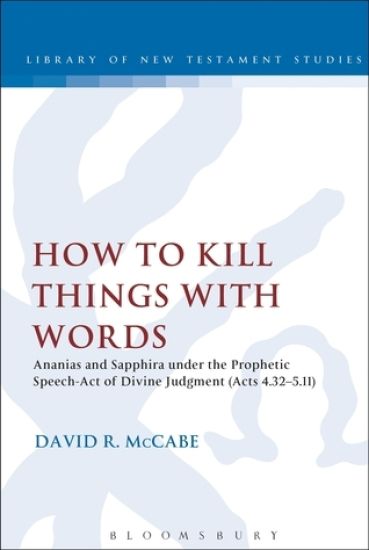
How to Kill Things with Words

How to Kill Things with Words

David R. McCabe

T. T.Clark Ltd
2013
nidottu
This work examines the dynamics of the Ananias and Sapphira episode in Acts and its role in the narrative of Luke-Acts. McCabe locates the passage within its literary context, and emphasizes the manner in which it is embedded in a discourse on the life of the Christian community expressed through shared goods. Utilizing Speech-Act Theory, McCabe argues that Peter's words, divinely sanctioned, directly execute the divine judgment upon the couple. This is argued by appealing to the social processes and conventions of language-use within the context of a 'community-of-goods' discourse as present in the Lukan narrative. McCabe appeals to the conventions deployed in the narrative world of Luke-Acts which undergird the efficacy of prophetic speech to effect divine judgment, including the patterns established by prophetic figures in the Scriptures of Israel and Luke's own characterization of Jesus as Prophet-King, followed by an examination of Luke's characterization of Peter as an apostolic-prophetic successor to Jesus, deputized to speak on behalf of God. McCabe concludes by examining the successful execution of the speech-act of divine judgment.