Kirjojen hintavertailu. Mukana 11 515 082 kirjaa ja 12 kauppaa.

Kirjahaku

Etsi kirjoja tekijän nimen, kirjan nimen tai ISBN:n perusteella.

657 tulosta hakusanalla Dissected Lives

Directed by God

Directed by God

Yaron Peleg

University of Texas Press
2016
nidottu
As part of its effort to forge a new secular Jewish nation, the nascent Israeli state tried to limit Jewish religiosity. However, with the steady growth of the ultraorthodox community and the expansion of the settler community, Israeli society is becoming increasingly religious. Although the arrival of religious discourse in Israeli politics has long been noticed, its cultural development has rarely been addressed. Directed by God explores how the country’s popular media, principally film and television, reflect this transformation. In doing so, it examines the changing nature of Zionism and the place of Judaism within it.Once the purview of secular culture, Israel’s media initially promoted alternatives to traditional religious expression; however, using films such as Kadosh, Waltz with Bashir, and Eyes Wide Open, Yaron Peleg shows how Israel’s contemporary film and television programs have been shaped by new religious trends and how secular Israeli culture has processed and reflected on its religious heritage. He investigates how shifting cinematic visions of Jewish masculinity and gender track transformations in the nation’s religious discourse. Moving beyond the secular/religious divide, Directed by God explores changing film and television representations of different Jewish religious groups, assessing what these representations may mean for the future of Israeli society.
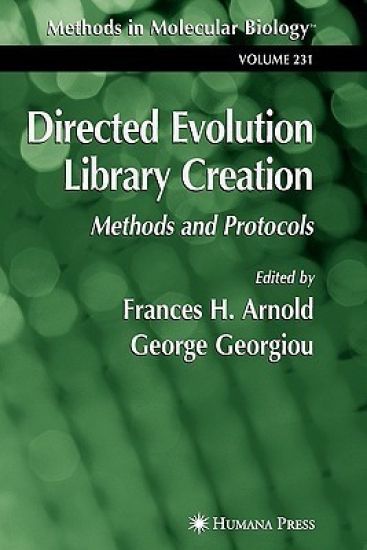
Directed Evolution Library Creation

Directed Evolution Library Creation

Springer-Verlag New York Inc.
2014
sidottu
Directed Evolution Library Creation: Methods and Protocols, Second Edition presents user-friendly protocols for both proven strategies and cutting-edge approaches for the creation of mutant gene libraries for directed evolution. As well as experimental methods, information on current computational approaches is provided in a user-friendly format that will allow researchers to make informed choices without needing to comprehend the full technical details of each algorithm. Directed evolution has become a fundamental approach for engineering proteins to enhance activity and explore structure-function relationships, and has supported the rapid development of the field of synthetic biology over the last decade. Divided into three convenient sections, topics include point mutagenesis strategies, recombinatorial methods wherein genetic diversity is sourced from multiple parental genes that are combined via either homology-dependent or -independent techniques and a variety of computational methods to guide the design and analysis of mutant libraries. Written in the successful Methods in Molecular Biology series format, chapters include introductions to their respective topics, lists of the necessary materials and reagents, step-by-step, readily reproducible protocols and notes on troubleshooting and avoiding known pitfalls.Authoritative and easily accessible, Directed Evolution Library Creation: Methods and Protocols, Second Edition will serve as a reliable manual for both novice and experienced protein engineers and synthetic biologists and will enable further technical innovation and the exploitation of directed evolution for a deeper understanding of protein design and function.
Directed Evolution Library Creation

Directed Evolution Library Creation

Springer-Verlag New York Inc.
2016
nidottu
Directed Evolution Library Creation: Methods and Protocols, Second Edition presents user-friendly protocols for both proven strategies and cutting-edge approaches for the creation of mutant gene libraries for directed evolution. As well as experimental methods, information on current computational approaches is provided in a user-friendly format that will allow researchers to make informed choices without needing to comprehend the full technical details of each algorithm. Directed evolution has become a fundamental approach for engineering proteins to enhance activity and explore structure-function relationships, and has supported the rapid development of the field of synthetic biology over the last decade. Divided into three convenient sections, topics include point mutagenesis strategies, recombinatorial methods wherein genetic diversity is sourced from multiple parental genes that are combined via either homology-dependent or -independent techniques and a variety of computational methods to guide the design and analysis of mutant libraries. Written in the successful Methods in Molecular Biology series format, chapters include introductions to their respective topics, lists of the necessary materials and reagents, step-by-step, readily reproducible protocols and notes on troubleshooting and avoiding known pitfalls.Authoritative and easily accessible, Directed Evolution Library Creation: Methods and Protocols, Second Edition will serve as a reliable manual for both novice and experienced protein engineers and synthetic biologists and will enable further technical innovation and the exploitation of directed evolution for a deeper understanding of protein design and function.
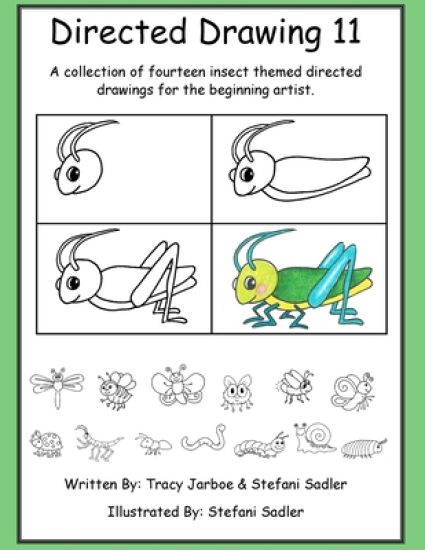
Directed Drawing-11-Insects

Directed Drawing-11-Insects

Tracy Jarboe; Abcschoolhouse Com

Createspace Independent Publishing Platform
2016
nidottu
We know that research has shown time and time again, the importance of art in the educational process. Children who are exposed to music and art instruction do much better in reading, math and science. They develop greater curiosity about, understanding of, and appreciation for, the subject matter being taught. We know that providing arts in education stimulates better behavior, personal esteem and socialization skills. The activities in this book are not intended to replace core instruction, but rather to enhance and extend the concepts taught within your current practice. These patterns may be used not only in the classroom, but as independent practice as they are applicable to both school and home learning. In this volume students will learn how to draw in a step-by-step manner which will build both confidence and ability in your young artists. Volume, "Insects", features twelve easy to draw favorites: Snail, Cricket, Fly, Ladybug, Firefly, Sowbug, Dragonfly, Ant, Caterpillar, Bumblebee, Worm, Butterflies, and a Walking Stick. In this e-book you will also find literature suggestions, writing prompts, templates, and interesting facts about each character. There are general art extensions, a book cover, and an achievement certificate included as well. It is our sincere hope that your students will experience success in learning to draw and in illustrating their academic works.
Directed by Desire

Directed by Desire

June Jordan

Copper Canyon Press
2007
pokkari
"Directed by Desire . . . is a powerful addition to the entire canon of American poetry."--BooklistNow in paperback, Directed by Desire is the definitive overview of June Jordan's -poetry. Collecting the finest work from Jordan's ten volumes, as well as dozens of "last poems" that were never published in Jordan's lifetime, these more than six hundred pages overflow with intimate lyricism, elegance, fury, meditative solos, and dazzling vernacular riffs.As Adrienne Rich writes in her introduction, June Jordan "wanted her readers, listeners, students, to feel their own latent power--of the word, the deed, of their own beauty and intrinsic value." From "These Poems" These poems they are things that I do in the dark reaching for you whoever you are and are you ready?The cloth edition of Directed by Desire was selected as a Library Journal Poetry Book of the Year and received the Lambda Book Award for Lesbian Poetry. June Jordan taught at UC Berkeley for many years and founded Poetry for the People. Her twenty-eight books include poetry, essays, fiction, and children's books. She was a regular columnist for The Progressive and a prolific writer whose articles appeared in The Village Voice, The New York Times, Ms. Magazine, and The Nation. After her death in 2002, a school in the San Francisco School District was renamed in her honor.
Directed Evolution Library Creation
Biological systems are very special substrates for engineering—uniquely the products of evolution, they are easily redesigned by similar approaches. A simple algorithm of iterative cycles of diversification and selection, evolution works at all scales, from single molecules to whole ecosystems. In the little more than a decade since the first reported applications of evolutionary design to enzyme engineering, directed evolution has matured to the point where it now represents the centerpiece of industrial biocatalyst development and is being practiced by thousands of academic and industrial scientists in com- nies and universities around the world. The appeal of directed evolution is easy to understand: it is conceptually straightforward, it can be practiced without any special instrumentation and, most important, it frequently yields useful solutions, many of which are totally unanticipated. Directed evolution has r- dered protein engineering readily accessible to a broad audience of scientists and engineers who wish to tailor a myriad of protein properties, including th- mal and solvent stability, enzyme selectivity, specific activity, protease s- ceptibility, allosteric control of protein function, ligand binding, transcriptional activation, and solubility. Furthermore, the range of applications has expanded to the engineering of more complex functions such as those performed by m- tiple proteins acting in concert (in biosynthetic pathways) or as part of mac- molecular complexes and biological networks.
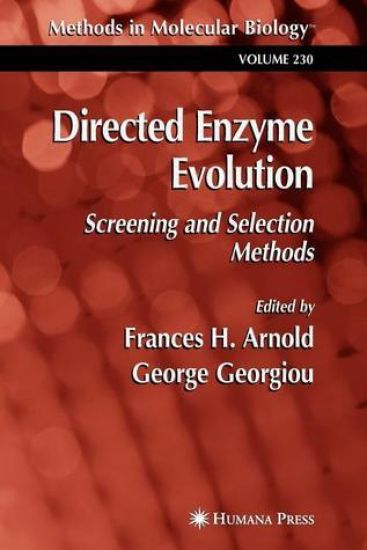
Directed Enzyme Evolution

Directed Enzyme Evolution

Humana Press Inc.
2003
sidottu
Directed evolution comprises two distinct steps that are typically applied in an iterative fashion: (1) generating molecular diversity and (2) finding among the ensemble of mutant sequences those proteins that perform the desired fu- tion according to the specified criteria. In many ways, the second step is the most challenging. No matter how cleverly designed or diverse the starting library, without an effective screening strategy the ability to isolate useful clones is severely diminished. The best screens are (1) high throughput, to increase the likelihood that useful clones will be found; (2) sufficiently sen- tive (i. e. , good signal to noise) to allow the isolation of lower activity clones early in evolution; (3) sufficiently reproducible to allow one to find small improvements; (4) robust, which means that the signal afforded by active clones is not dependent on difficult-to-control environmental variables; and, most importantly, (5) sensitive to the desired function. Regarding this last point, almost anyone who has attempted a directed evolution experiment has learned firsthand the truth of the dictum “you get what you screen for. ” The protocols in Directed Enzyme Evolution describe a series of detailed p- cedures of proven utility for directed evolution purposes. The volume begins with several selection strategies for enzyme evolution and continues with assay methods that can be used to screen enzyme libraries. Genetic selections offer the advantage that functional proteins can be isolated from very large libraries s- ply by growing a population of cells under selective conditions.
Directed Evolution Library Creation
Biological systems are very special substrates for engineering—uniquely the products of evolution, they are easily redesigned by similar approaches. A simple algorithm of iterative cycles of diversification and selection, evolution works at all scales, from single molecules to whole ecosystems. In the little more than a decade since the first reported applications of evolutionary design to enzyme engineering, directed evolution has matured to the point where it now represents the centerpiece of industrial biocatalyst development and is being practiced by thousands of academic and industrial scientists in com- nies and universities around the world. The appeal of directed evolution is easy to understand: it is conceptually straightforward, it can be practiced without any special instrumentation and, most important, it frequently yields useful solutions, many of which are totally unanticipated. Directed evolution has r- dered protein engineering readily accessible to a broad audience of scientists and engineers who wish to tailor a myriad of protein properties, including th- mal and solvent stability, enzyme selectivity, specific activity, protease s- ceptibility, allosteric control of protein function, ligand binding, transcriptional activation, and solubility. Furthermore, the range of applications has expanded to the engineering of more complex functions such as those performed by m- tiple proteins acting in concert (in biosynthetic pathways) or as part of mac- molecular complexes and biological networks.
Directed Enzyme Evolution

Directed Enzyme Evolution

Humana Press Inc.
2010
nidottu
Directed evolution comprises two distinct steps that are typically applied in an iterative fashion: (1) generating molecular diversity and (2) finding among the ensemble of mutant sequences those proteins that perform the desired fu- tion according to the specified criteria. In many ways, the second step is the most challenging. No matter how cleverly designed or diverse the starting library, without an effective screening strategy the ability to isolate useful clones is severely diminished. The best screens are (1) high throughput, to increase the likelihood that useful clones will be found; (2) sufficiently sen- tive (i. e. , good signal to noise) to allow the isolation of lower activity clones early in evolution; (3) sufficiently reproducible to allow one to find small improvements; (4) robust, which means that the signal afforded by active clones is not dependent on difficult-to-control environmental variables; and, most importantly, (5) sensitive to the desired function. Regarding this last point, almost anyone who has attempted a directed evolution experiment has learned firsthand the truth of the dictum “you get what you screen for. ” The protocols in Directed Enzyme Evolution describe a series of detailed p- cedures of proven utility for directed evolution purposes. The volume begins with several selection strategies for enzyme evolution and continues with assay methods that can be used to screen enzyme libraries. Genetic selections offer the advantage that functional proteins can be isolated from very large libraries s- ply by growing a population of cells under selective conditions.
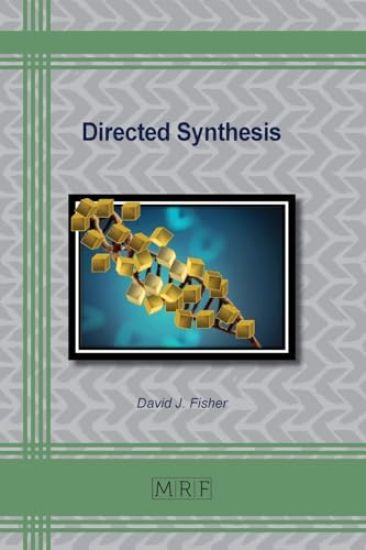
Directed Synthesis

Directed Synthesis

David Fisher

Materials Research Forum LLC
2023
pokkari
Structure-directed synthesis aims at the design and preparation of novel solid-state structures; using the structure-directing capability of some molecular additive, the so-called structure-directing agent. This general train of thought has led to the development of many weird and wonderful strategies. The book presents an in-depth review of the field and discusses the potential for further developments. Some of the topics are listed under 'Keywords'. The book references 343 original resources with their direct web links for in-depth reading.Keywords: Directed Synthesis, Multicomponent Colloidal Nanostructures, Nanoparticle-Seed Surfaces, Photocatalytic and Photo-Electrochemical Applications, Synthesis of Nanostructured Metal Oxides and Metal Oxalates, Wide-Bandgap Semiconductors and Metals with Surface Plasmon-Resonance Active Bands, Mesoporous Materials Possessing Multilevel Architectures, Spatially Distinct Nanostructured Organic and Inorganic Arrays, 2- and 3-Dimensional Periodic Composite Structures, Protein-Protein Interaction and DNA Hybridization, Polynuclear Complexes and Coordination Polymers of 3d Metals, Ultra-Small Metal Nanoclusters, Biomolecule-Nanocluster Composites, Nanostructured Sulphur-Carbon Nanotube Cathode.
Dissect and Learn Excel(R) VBA in 24 Hours

Dissect and Learn Excel(R) VBA in 24 Hours

Liaw Hocksang

Independently Published
2018
pokkari
No matter how complicated a program is, it is made of many smaller and tiny fundamental working parts of programming code. Each of them accomplishes a specific task. Some may just consist of only one or a few lines of code. Knowing the functions of these fundamental working parts, you can then easily write an unlimited number of working programs. And knowing them, you can easily understand the programs written by others and adopt into your programs the ideas and the efficient code that are presented in those programs.Dissect and Learn Excel VBA in 24 Hours is a series of quick references for intermediate users who are looking for ideas and samples of VBA code to accomplish certain tasks when they are in the process of writing a program. In this series, you will see thousands of tiny working parts of VBA code that are used to accomplish many simple and yet meaningful tasks. To add a new workbook, to auto-fill a range, to sort a table of data, to generate a table of contents for all chart sheets and worksheets in a workbook, to loop through and manipulate a folder of Excel files, to place a control on the Ribbon, to send an email, and to login to an account in the Internet are some examples of these tiny working parts. This series is for readers, who have at least a basic understanding of Excel VBA programming. In order to follow the discussions in the series, a reader must know what Sub procedures and Function procedures are, what Visual Basic Editor (VBE) is, how to add a VBA module to a workbook, how to set a reference to an application's type library, how to enable the Auto List Members feature in VBE, how to use the Macro Recorder in Excel in order to find out the methods and properties of objects that you are not familiar with, how to use the Object Browser to check the complete list of members for a particular object, how to write some simple procedures, in which VBA modules you should store your VBA code, and how to use the debugging tools in VBE.If you are new to Excel VBA, please teach yourself Excel VBA before exploring the contents in the series. You may refer to my earlier book entitled Learn Excel(R) VBA in 24 Hours - A quick reference for beginners, which was written for those who are new to Excel VBA. I hope this series of books will serve as quick references in facilitating you to write an unlimited number of working VBA programs. Let Excel VBA work for you.Book 3: Working with sheets, workbooks, and files focuses on commonly used operations on sheets, workbooks, and files. Copying a sheet, protecting a sheet, creating a table of sheets with hyperlinks, saving a copy of a workbook, self-deleting a workbook, protecting a workbook, accessing a password-forgotten VBA project, prompting users to select a folder, writing and reading a text file, looping through files in a folder, and creating and deleting folders are some of the operations.To understand better a concept discussed in this book, simply copy and paste the sample VBA code into the Immediate window or a VBA module, and run (or step through) the VBA code in VBE. To execute a few lines of code that are not in a Sub procedure, simply enclose them in a new procedure in a standard VBA module. To test a Sub procedure with required arguments, simply call the procedure by passing the arguments in the Immediate window such as DeleteAllFilesUsingFSO "C: \Temp\temp2\", True.The previous two books in the series discuss changing workbook appearance and working with ranges in a worksheet in Excel 2007-2016 for Windows. The forth, which will be the last book in this series focuses on working with controls and automation. It discusses, for example, adding controls to a worksheet and a UserForm, writing a Word document, sending an email via Outlook, logging in to an account on a web page, and working with various controls (such as list box, check box, button, and drop-down list) on a web page in Internet Explorer.
Dissect and Learn Excel(R) VBA in 24 Hours

Dissect and Learn Excel(R) VBA in 24 Hours

Liaw Hocksang

Createspace Independent Publishing Platform
2018
pokkari
No matter how complicated a program is, it is made of many smaller and tiny fundamental working parts of programming code. Each of them accomplishes a specific task. Some may just consist of only one or a few lines of code. Knowing the functions of these fundamental working parts, you can then easily write an unlimited number of working programs. And knowing them, you can easily understand the programs written by others and adopt into your programs the ideas and the efficient code that are presented in those programs. Dissect and Learn Excel VBA in 24 Hours is a series of quick references for intermediate users who are looking for ideas and samples of VBA code to accomplish certain tasks when they are in the process of writing a program. In this series, you will see thousands of tiny working parts of VBA code that are used to accomplish many simple and yet meaningful tasks. To add a new workbook, to auto-fill a range, to sort a table of data, to generate a table of contents for all chart sheets and worksheets in a workbook, to loop through and manipulate a folder of Excel files, to place a control on the Ribbon, to send an email, and to login to an account in the Internet are some examples of these tiny working parts. Book 2: Working with ranges focuses on commonly used operations related to worksheet ranges. Selecting a range, finding the last nonempty cell in a range, retrieving the properties of a range (such as address and font), changing the format of a range, converting formulas in a range to values, conditionally formatting a range, sorting a range, filtering a range, copying a range, and exporting a range out of Excel are some of the operations. To understand better a particular concept discussed in the book, simply copy and paste the sample VBA code stated in the book into the Immediate window or into a standard VBA module, and run the code (or step through the code by using the debugger in VBE). The result is either visible in the Immediate window or in an Excel worksheet. To execute a few lines of code that are not placed in a Sub procedure, simply enclose them in a new procedure in a standard VBA module. You can download the VBA code stated in the book from drive.google.com/file/d/0ByKhn-UYAjlQYm9LNTRWNzl4d2M, or search for any updated URL from the Author Page: amazon.com/Liaw-HockSang/e/B01LX701LY.