
Kirjahaku
Etsi kirjoja tekijän nimen, kirjan nimen tai ISBN:n perusteella.
1000 tulosta hakusanalla E. Edmonds

Annales des Sciences Naturelles; Partie Zoologique
E -L Bouvier; Edmond Perrier
Anatiposi Verlag
2023
pokkari
R impression inchang e de l' dition originale de 1860. La maison d' dition Anatiposi publie des livres historiques en r impression. En raison de leur ge, ces livres peuvent pr senter des pages manquantes ou une qualit moindre. Notre objectif est de pr server ces livres et de les rendre accessibles au public afin qu'ils ne se perdent pas.

Annales des Sciences Naturelles; Partie Zoologique
E -L Bouvier; Edmond Perrier
Anatiposi Verlag
2023
sidottu
R impression inchang e de l' dition originale de 1860. La maison d' dition Anatiposi publie des livres historiques en r impression. En raison de leur ge, ces livres peuvent pr senter des pages manquantes ou une qualit moindre. Notre objectif est de pr server ces livres et de les rendre accessibles au public afin qu'ils ne se perdent pas.


Bounded and Compact Integral Operators
David E. Edmunds; V.M Kokilashvili; Alexander Meskhi
Springer-Verlag New York Inc.
2002
sidottu
The monograph presents some of the authors' recent and original results concerning boundedness and compactness problems in Banach function spaces both for classical operators and integral transforms defined, generally speaking, on nonhomogeneous spaces. Itfocuses onintegral operators naturally arising in boundary value problems for PDE, the spectral theory of differential operators, continuum and quantum mechanics, stochastic processes etc. The book may be considered as a systematic and detailed analysis of a large class of specific integral operators from the boundedness and compactness point of view. A characteristic feature of the monograph is that most of the statements proved here have the form of criteria. These criteria enable us, for example, togive var ious explicit examples of pairs of weighted Banach function spaces governing boundedness/compactness of a wide class of integral operators. The book has two main parts. The first part, consisting of Chapters 1-5, covers theinvestigation ofclassical operators: Hardy-type transforms, fractional integrals, potentials and maximal functions. Our main goal is to give a complete description of those Banach function spaces in which the above-mentioned operators act boundedly (com pactly). When a given operator is not bounded (compact), for example in some Lebesgue space, we look for weighted spaces where boundedness (compact ness) holds. We develop the ideas and the techniques for the derivation of appropriate conditions, in terms of weights, which are equivalent to bounded ness (compactness).

Cel & Anna: A 22nd Century Love Story
Lindsay E. Edmunds
Createspace Independent Publishing Platform
2011
nidottu

The Time I Walked Down Fourth Street
Jennett E. Edmond
Createspace Independent Publishing Platform
2014
nidottu
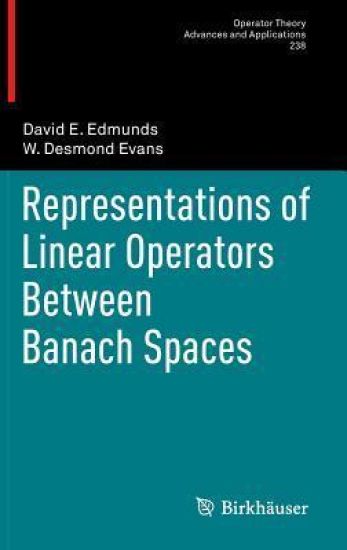
Representations of Linear Operators Between Banach Spaces
David E. Edmunds; W. Desmond Evans
Springer Basel
2013
sidottu
The book deals with the representation in series form of compact linear operators acting between Banach spaces, and provides an analogue of the classical Hilbert space results of this nature that have their roots in the work of D. Hilbert, F. Riesz and E. Schmidt. The representation involves a recursively obtained sequence of points on the unit sphere of the initial space and a corresponding sequence of positive numbers that correspond to the eigenvectors and eigenvalues of the map in the Hilbert space case. The lack of orthogonality is partially compensated by the systematic use of polar sets. There are applications to the p-Laplacian and similar nonlinear partial differential equations. Preliminary material is presented in the first chapter, the main results being established in Chapter 2. The final chapter is devoted to the problems encountered when trying to represent non-compact maps.
No detailed description available for "A Unified Theory of Syntactic Categories".
The architecture of the human language faculty has been one of the main foci of the linguistic research of the last half century. This branch of linguistics, broadly known as Generative Grammar, is concerned with the formulation of explanatory formal accounts of linguistic phenomena with the ulterior goal of gaining insight into the properties of the 'language organ'. The series comprises high quality monographs and collected volumes that address such issues. The topics in this series range from phonology to semantics, from syntax to information structure, from mathematical linguistics to studies of the lexicon. To discuss your book idea or submit a proposal, please contact Birgit Sievert
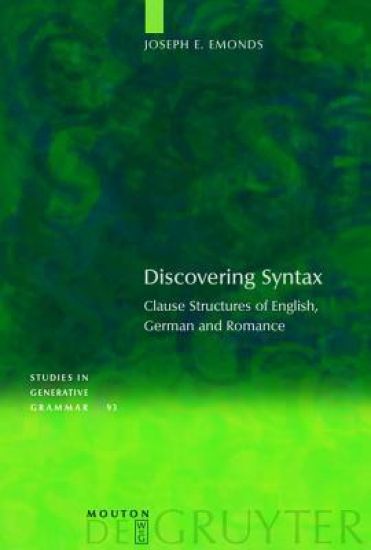
The essays in this volume, dating from 1991 onwards, focus on highly characteristic constructions of English, Romance languages, and German. Among clause-internal structures, the most puzzling are English double objects, particle constructions, and non-finite complementation (infinitives, participles and gerunds). Separate chapters in Part I offer relatively complete analyses of each. These analyses are integrated into the framework of Emonds (2000), wherein a simplified subcategorization theory fully expresses complement selection. Principal results of that framework constitute the initial essay of Part I. areas. The self-contained essays can all be read separately. They are rich in empirical documentation, and yet in all of them, solutions are constructed around a coherent, relatively simple theoretical core. In Romance languages, classic generative debates have singled out clitic and causative constructions as the most challenging. Separate essays in Part II lay out the often complex paradigms and propose detailed syntactic solutions, simple in their overall architecture yet rich in detailed predictions. Concerning movements to clausal edges, especially controversial topics include passives, English parasitic gaps, and the nature of verb-second systems exemplified by German.. The essays in Part III each use rather surprising but still theoretically constrained structural accounts to solve thorny problems in all three.

Hardy Operators, Function Spaces and Embeddings
David E. Edmunds; William D. Evans
Springer-Verlag Berlin and Heidelberg GmbH Co. K
2004
sidottu
Classical Sobolev spaces, based on Lebesgue spaces on an underlying domain with smooth boundary, are not only of considerable intrinsic interest but have for many years proved to be indispensible in the study of partial differential equations and variational problems. Many developments of the basic theory since its inception arise in response to concrete problems, for example, with the (ubiquitous) sets with fractal boundaries. The theory will probably enjoy substantial further growth, but even now a connected account of the mature parts of it makes a useful addition to the literature. Accordingly, the main themes of this book are Banach spaces and spaces of Sobolev type based on them; integral operators of Hardy type on intervals and on trees; and the distribution of the approximation numbers (singular numbers in the Hilbert space case) of embeddings of Sobolev spaces based on generalised ridged domains. This timely book will be of interest to all those concerned with the partial differential equations and their ramifications. A prerequisite for reading it is a good graduate course in real analysis.

Hardy Operators, Function Spaces and Embeddings
David E. Edmunds; William D. Evans
Springer-Verlag Berlin and Heidelberg GmbH Co. K
2011
nidottu
Classical Sobolev spaces, based on Lebesgue spaces on an underlying domain with smooth boundary, are not only of considerable intrinsic interest but have for many years proved to be indispensible in the study of partial differential equations and variational problems. Many developments of the basic theory since its inception arise in response to concrete problems, for example, with the (ubiquitous) sets with fractal boundaries. The theory will probably enjoy substantial further growth, but even now a connected account of the mature parts of it makes a useful addition to the literature. Accordingly, the main themes of this book are Banach spaces and spaces of Sobolev type based on them; integral operators of Hardy type on intervals and on trees; and the distribution of the approximation numbers (singular numbers in the Hilbert space case) of embeddings of Sobolev spaces based on generalised ridged domains. This timely book will be of interest to all those concerned with the partial differential equations and their ramifications. A prerequisite for reading it is a good graduate course in real analysis.

Bounded and Compact Integral Operators
David E. Edmunds; V.M Kokilashvili; Alexander Meskhi
Springer
2010
nidottu
The monograph presents some of the authors' recent and original results concerning boundedness and compactness problems in Banach function spaces both for classical operators and integral transforms defined, generally speaking, on nonhomogeneous spaces. Itfocuses onintegral operators naturally arising in boundary value problems for PDE, the spectral theory of differential operators, continuum and quantum mechanics, stochastic processes etc. The book may be considered as a systematic and detailed analysis of a large class of specific integral operators from the boundedness and compactness point of view. A characteristic feature of the monograph is that most of the statements proved here have the form of criteria. These criteria enable us, for example, togive var ious explicit examples of pairs of weighted Banach function spaces governing boundedness/compactness of a wide class of integral operators. The book has two main parts. The first part, consisting of Chapters 1-5, covers theinvestigation ofclassical operators: Hardy-type transforms, fractional integrals, potentials and maximal functions. Our main goal is to give a complete description of those Banach function spaces in which the above-mentioned operators act boundedly (com pactly). When a given operator is not bounded (compact), for example in some Lebesgue space, we look for weighted spaces where boundedness (compact ness) holds. We develop the ideas and the techniques for the derivation of appropriate conditions, in terms of weights, which are equivalent to bounded ness (compactness).



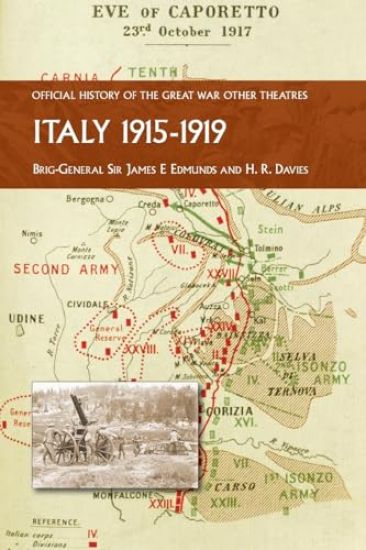
Official account of the Italian campaign from 1915, with special reference to Britain's support for her embattled Italian ally in the year between November 1917 and November 1918. Five British and four French divisions with supporting arms were engaged.Although the third member of the Central Powers triple alliance before the Great War, Italy wisely held aloof from the conflict which began in August 1914. But pressure from the western Allies - particularly France - caused her to abandon neutrality and join the war on the Allied side. This volume recounts what followed as it affected the British troops involved in supporting our tottering ally after the disastrous defeat at Caporetto in 1917. The preliminary chapters provide a sketch of the events that brought Italy into the war and the operations that took place before the arrival of the British divisions in November 1917. In all, five British and four French divisions with supporting arms and services (including air) came to the aid of the ltalians in 1917/1918, enabling her to recover and drive her German and Austrian foes back into the Alps by the armistice in November.
Official account of the Italian campaign from 1915, with special reference to Britain's support for her embattled Italian ally in the year between November 1917 and November 1918. Five British and four French divisions with supporting arms were engaged.Although the third member of the Central Powers triple alliance before the Great War, Italy wisely held aloof from the conflict which began in August 1914. But pressure from the western Allies - particularly France - caused her to abandon neutrality and join the war on the Allied side. This volume recounts what followed as it affected the British troops involved in supporting our tottering ally after the disastrous defeat at Caporetto in 1917. The preliminary chapters provide a sketch of the events that brought Italy into the war and the operations that took place before the arrival of the British divisions in November 1917. In all, five British and four French divisions with supporting arms and services (including air) came to the aid of the ltalians in 1917/1918, enabling her to recover and drive her German and Austrian foes back into the Alps by the armistice in November.