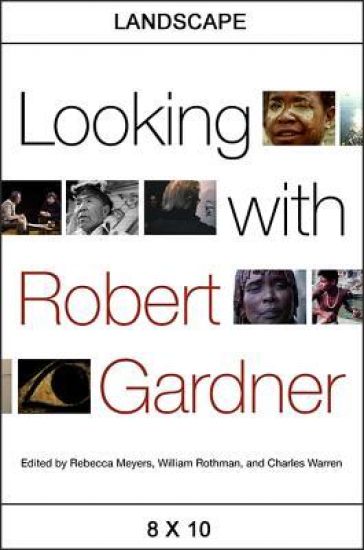
Assesses the range and magnitude of Robert Gardner's achievements as a filmmaker, photographer, writer, educator, and champion of independent cinema.During his lifetime, Robert Gardner (1925–2014) was often pigeonholed as an ethnographic filmmaker, then criticized for failing to conform to the genre's conventions-conventions he radically challenged. With the release of his groundbreaking film Dead Birds in 1963, Gardner established himself as one of the world's most extraordinary independent filmmakers, working in a unique border area between ethnography, the essay film, and poetic/experimental cinema. Richly illustrated, Looking with Robert Gardner assesses the range and magnitude of Gardner's achievements not only as a filmmaker but also as a still photographer, writer, educator, and champion of independent cinema. The contributors give critical attention to Gardner's most ambitious films, such as Dead Birds (1963, New Guinea), Rivers of Sand (1975, Ethiopia), and Forest of Bliss (1986, India), as well as lesser-known films that equally exemplify his mode of seeking anthropological understanding through artistic means. They also attend to his films about artists, including his self-depiction in Still Journey OnM (2011); to his roots in experimental film and his employment of experimental procedures; and to his support of independent filmmakers through the Harvard Film Study Center and the television series Screening Room, which provided an opportunity for numerous important film and video artists to present and discuss their work.
-~- T he articles in this book are dedicated to Martin Gardner, the world's greatest expositor and popularizer of mathematics. While our papers are confined to this single subject, Gardner's interests and accomplishments have a wide range of subjects. Hence, we have entitled the book the Mathematical Gardner, and would like to see other volumes such as the Magical, the Literary, the Philosophical, or the Scientific Gardner accompany it. Of course, our title is also an appropriate pun, for Martin Gardner's relationship to the mathematical community is similar to a gardener's relationship to a beautiful flower garden. The contributors to this volume comprise only a small part of a large body of mathematicians whose work has been nurtured by its exposition in "Mathematical Games"; Martin's column which appears every month in Scientific American. More than just a mathematical journalist, Martin connects his readers by passing along problems and information and stimulating creative activity. Thus, he is a force behind the scenes as well as a public figure. Two people were particularly helpful in putting this book together.
Rose Gardner Mystery Novella #6.5 in the New York Times and USA Today bestselling series. After her assistant DA boyfriend's near brush with death, Rose Gardner hopes to make it through the holiday season with a minimal amount of drama. But she can't forget the promise she made to the king of the Fenton County underworld in exchange for Mason's life. What's worse, she's not the only one keeping secrets-Mason has been working on a hush-hush case in his private time, Joe is grappling with the sudden reappearance of his sister after a mysterious two-year disappearance, and Hilary continues in her single-minded quest to secure a commitment from Joe at any cost-for motives only she understands. Though peace and quiet is all Rose wants, it's the last thing she's liable to get. And the ripple of secrets in her life threatens to create an undertow that will endanger her and everyone she holds dear. Includes POVs from Joe, Mason, Hilary, and Skeeter.
If you intend to save the world, you must first save yourself Wicca is now considered as one of the most popular religions and is fast growing in the United States according to some recent studies. Marla Alupoaicei, one of the authors of the book, which talked about the subtle dangers of Wicca, cited the many misconceptions about Wiccans during an interview. To find out more about the truth behind Wiccan, this book, is set to explore more facts about this religion and their practices. The aim of this book is to discuss the common misconceptions about Wicca, especially on two specific ideas: The Wiccans are worshipping the Devil, and Wiccans are dangerous people. By the end of your reading, you will be able to understand this group of people and understand why a great number of followers are becoming fascinated with their beliefs and practices. This book is trying to involve the reader into the religion by offering a wider perspective of the Wiccans culture. A practitioner of Wicca is called a Wiccan and though this group is often associated with witchcraft, there are so many misconceptions surrounding Wiccans that we aim to shed light to some of them. While the Wiccan can be a part of a group or coven, they can individually practice and free to choose what's good for their own spiritual search. The laws of Wicca are derived from the Wiccan Rede, a poem that early Wiccans claim to be handed down for generations and said to have its ancient origin. The Wiccan Rede "Bide the Wiccan Law ye must, In perfect love, in perfect trust, Eight words the Wiccan Rede fulfill: And ye harm none, do what ye will. What ye sends forth comes back to thee, And ever mind the Rule of Three Follow this with mind and heart, And merry ye meet and merry ye part." Many people turn to Wicca for many reasons and here are some of them. The Three-Fold Law The 3-Fold Law or the Rule of Three is called the Law of Return, similar to the ideology of Karma which serves as the basis of the Wiccans Basic Ideology. This ideology strongly encourages each Wiccan to assess every decision made. This just signifies that when you meet a true Wiccan, he/she will never do any anything to harm you for an unjust reason as this is against their moral code. The Rede firmly encourages every Wiccan to keep away from attempting to dominate, control or harm, and manipulate another person. The fourth line of the Rede - "And ye harm none, do what ye will." -is seen by other people as being too permissive but on the contrary, it serves its purpose as it demands that a Wiccan must carefully anticipate and evaluate all of the possible results of every decision made. Learn and experience the art of mysticism, the Wiccan way with this book.
In this volume, world-leading puzzle designers, puzzle collectors, mathematicians, and magicians continue the tradition of honoring Martin Gardner, who inspired them to enter mathematics, to enter magic, to bring magic into their mathematics, or to bring mathematics into their magic. This edited collection contains a variety of articles connected to puzzles, magic, and/or mathematics, including the history behind given puzzles, solitaire puzzles, two-person games, and mathematically interesting objects. Topics include tangrams, peg solitaire, sodoku, coin-weighing problems, anamorphoses, and more!
The first comprehensive bibliography of the publications of polymath Martin Gardner. Martin Gardner (1914-2010) was a polymath whose international reputation extended from mathematics to literature, philosophy to science, and magic to fiction. This comprehensive bibliography covers every aspect of Gardner's lengthy publishing career, from 1930 to 2010, and features detailed descriptions and indices of his writings on mathematics and many other topics. Editor Dana Richards worked directly with Gardner on this project from 1978 until Gardner's death; it draws on the two hundred boxes of Gardner's mathematical papers held in the Stanford archives
The Gardner Masonic Lodge was established in 1868, just eleven years after the formation of the city of Gardner, Kansas. Eleven years it took, but with Freemasons living and working in Gardner since the very beginning, as the town grew they knew it was time to start a lodge of their very own. Proudly holding an early membership composed of many of the same names as those influential men that made this area what it is today. From humble beginnings, leasing space from the local Odd Fellows hall to the first hall of our own that sadly went up in flames in 1906, to the community staple Masonic Temple erected promptly afterwards in 1907 which houses the lodge to this day. The Freemasons of Gardner held a key role, unknown to many, setting the foundation stone of the area with Gardner Masons found in every walk of life throughout this proud and trailblazing community. From the first mayor, earliest physicians and surgeons, farmers, ranchers, teachers, Sheriff's, officers, soldiers, and local business owners, Gardner Freemasons, while maybe not always publicly known, have often been all around you. We have been here since the start and after 150 years and two other lodges merging into our membership the Gardner Masons remain strong and have no plans on going anywhere soon. October of 2018 marked the sesquicentennial celebration of the lodge. In honor of that epic milestone and all the history that lay before it we strive to keep our history alive by preserving what we have and recovering what has been lost. It is now a feat of our own today, but a collective effort of every Freemason that has blessed our rosters over the years, that has brought us to this point. In honor of them we present to you with this history of Gardner Lodge No. 65, Ancient Free and Accepted Masons of Kansas.
A series of scholarly papers prepared for presentation to the '81 Club of Kansas City, Missouri, which was formed in 1881. The only forbidden topics are the Civil War, politics and religion.
Surrounded by the artists, writers and musicians who made up her court in Boston as they did in Venice, Isabella Stewart Gardner, a passionate art collector, was as revered and sought after as royalty. Henry James was inspired by the rich and powerful Gardner, as well as by the Palazzo Barbaro in Venice, when he wrote his novel The Wings of the Dove. Gardner was to recreate a larger-than-life version of Palazzo Barbaro in Boston, which is now the Isabella Stewart Gardner Museum. These dazzling letters bring to life James's passion for Venice and the Palazzo Barbaro, and serve as an introduction to the fascinating world of Isabella Stewart Gardner herself.