

Kirjahaku
Etsi kirjoja tekijän nimen, kirjan nimen tai ISBN:n perusteella.
712 tulosta hakusanalla Genesee Conference M. E. Church

Geneseo Centennial History 1836-1936
Alpha Edition
2021
pokkari
This book has been considered by academicians and scholars of great significance and value to literature. This forms a part of the knowledge base for future generations. So that the book is never forgotten we have represented this book in a print format as the same form as it was originally first published. Hence any marks or annotations seen are left intentionally to preserve its true nature.

Jacques Derrida argues that the feminist and intellectual Helene Cixous is the most important writer working within the French idiom today. To prove this, he elucidates the epistemological and historical interconnectedness of four terms: genesis, genealogy, genre, and genius, and how they pertain to or are implicated in Cixous's work. Derrida explores Cixous's genius (a masculine term in French, he is quick to point out) and the inspiration that guides and informs her writing. He marvels at her skillful working within multiple genres. He focuses on a number of her works, including her extraordinary novel Manhattan and her lyrical and evocative Dream I Tell You, a book addressed to Derrida himself and one in which Cixous presents a series of her dreams. Derrida also delves into the nature of the literary archive, the production of literature, and the importance of the poetic and sexual difference to the entirety of his own work. For forty years, Derrida had a close personal and intellectual relationship with Helene Cixous. Clever, playful, and eloquent, Geneses, Genealogies, Genres, and Genius charts the influence these two critical giants had on each other and is the most vital work to address Cixous's contribution to French thought.


Genese, Problematik Und Wirkung Nationalsozialistischer Literatur Am Beispiel Des Historischen Romans Zwischen 1890 Und 1945
Frank Westenfelder
Peter Lang AG
1989
nidottu
Der historische Roman ist nicht nur fur die nationalsozialistische Literatur von grosser Bedeutung, sondern hat auch seit dem 19. Jahrhundert seinen festen Platz in der deutschen Literatur. Er wird dabei vorwiegend von konservativen und volkischen Autoren zur Ubermittlung ihrer politischen Vorstellungen und ihrer Geschichtsbilder benutzt. In der vorliegenden Arbeit wird, ausgehend von einem ideologiekritischen Ansatz, die Genese nationalsozialistischer Literatur innerhalb eines Genres nachvollzogen. Das Ziel dabei ist ihre genauere Definition innerhalb ihres volkisch-konservativen Umfeldes, die Bestimmung von sprachlichen und formalen Besonderheiten und die Quantifizierbarkeit ihrer Wirkung."

Genèse et développement de la pensée politique et des sciences politiques en Albanie
Noela Makhmutai
Editions Notre Savoir
2025
pokkari

Génese e desenvolvimento do pensamento político e da ciência política na Albânia
Noela Makhmutai
Edicoes Nosso Conhecimento
2025
pokkari
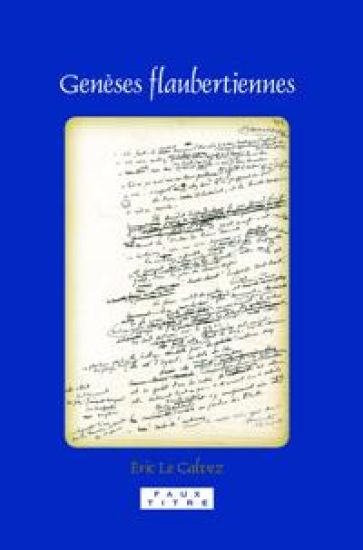
Genèses flaubertiennes emprunte la voie déjà tracée par Flaubert topographe (1997) et La Production du descriptif (2002) d’Éric Le Calvez et aborde la genèse de l’œuvre de Flaubert avec des questions qui relèvent de la théorie de la production textuelle. Le premier axe choisi examine des fragments d’avant-textes à partir d’une question théorique précise (relation description-récit, réécriture intertextuelle et construction d’un portrait), aussi est-il microgénétique. Le second axe, qui se situe entre une micro et une macrogénétique, élargit la perspective à un ensemble de contextes en fonction de différents points de vue : genèse ambiguë d’un motif récurrent ou d’un objet récurrent dans tout le récit d’un roman, voire problématique de l’autotextualité. En théorie, une approche macrogénétique serait davantage à même de respecter le travail de l’écrivain ; c’est aussi l’approche qui conviendrait le mieux a priori au questionnement narratologique. En pratique, la tâche est quasi impossible, car étudier la genèse de l’ensemble d’une scène nécessiterait des analyses qui se prolongeraient indéfiniment. Aussi les chapitres qui illustrent le troisième et dernier axe, macrogénétique pour sa part, rendent-ils compte de la formation de plusieurs scènes en se concentrant chaque fois sur des problèmes spécifiques, souvent de l’ordre d’une stylistique des brouillons.

Geneses Et Filiations
Classiques Garnier
2021
nidottu
Christine de Pizan's quill sketched the shape of both real and imaginary relationships, complex arborescences that highlight thought about genesis and filiation. Three threads- "naitre et heriter," "engendrer et transmettre," and "parentes et communautes"-allow us to grasp this.

Genese d'Un Style: La Phrase d'Andre Gide Dans Les Nourritures Terrestres
Marie-Therese Veyrenc
Klincksieck
1976
nidottu


Dans ses phases initiales, la theorie cellulaire suscite l'interet de l'epistemologue. Avec Schwann, puis avec Remak et Virchow, se developpe un puissant programme de recherche. Des le milieu du XIXeme siecle, la theorie cellulaire sert de clef de voute a l'edifice de la biologie: elle oriente observations et analyses, delimite le champ des hypotheses a controler, et constitue la trame des modeles analytiques qui s'en inspirent pour la depasser. C'est le point de depart oblige pour toute recherche sur les micro-structures integrees de l'etre vivant. Or comment cette remarquable theorie se forme-t-elle? Quelle combinaison de concepts, principes, analogies et modeles empiriques definit sa structure? Par quels mecanismes evolue-t-elle des ses premieres formulations? C'est a ces questions que cet ouvrage s'attache a repondre.

Genese Und Geltung: Für Gottfried Gabriel
Brill Mentis
2008
nidottu
Die Geltung philosophischer Argumente einerseits und deren Genese im Rahmen philosophischer Fragestellungen andererseits - beides l t sich, entgegen verbreiteter Denkgewohnheiten, nicht grunds tzlich trennen. Die Beitr ge dieses Bandes stellen die Komplementarit t von Genese und Geltung heraus und weisen damit Konzeptionen als unzureichend zur ck, in denen Genese als kontingente Entstehungsgeschichte begrifflicher Unterscheidungen und theoretischer Modelle gegen den in systematischen Zusammenh ngen durchgesetzten Geltungsanspruch ausgespielt wird. Eine deutliche Trennung von Genese und Geltung im Sinne einer Gegen berstellung von Gr nden des F r-wahr-Haltens und Gr nden des Wahrseins ist als terminologische Unterscheidung zweifellos unverzichtbar. Der Stellenwert dieser Unterscheidung hat sich allerdings durch die Entwicklung der j ngeren Philosophie in geradezu dramatischer Weise ver ndert. Im Rahmen metaphysischer Systeme lassen sich Geltungsfragen losgel st von Aspekten der Genese behandeln. F r eine nach-metaphysische Philosophie sind Gr nde dagegen immer nur als sprachlich artikulierte oder artikulierbare Gr nde verf gbar, und das Wahrsein ist vom F r-wahr-Halten eben nicht mehr in einer Platonistischen Weise geschieden. Die Gr nde des Wahrseins sind sprachgebunden und somit kontextuell und historisch bedingt: Geltung ohne Genese ist blind und Genese ohne Geltung ist leer. Die Beitr ge spiegeln diese spannungsreiche Verkn pfung von Genese und Geltung. Dabei reicht das Spektrum der an die Arbeiten Gottfried Gabriels anschlie enden Analysen von logischen und sprachphilosophischen berlegungen ber erkenntnistheoretische und wissenschaftsgeschichtliche Untersuchungen bis hin zu Fragen der epistemischen Relevanz des literarischen Sprachgebrauchs und zu Problemen der Moralphilosophie.

Geneseo, New York
VDM Publishing House
2010
nidottu
Observera att förlaget som ger ut denna produkt baserar innehållet i sina produkter på fria källor som Wikipedia. Boken är med stor sannolikhet endast ett utdrag ur dessa informationskällor, alltså inte en vanlig bok i den bemärkelsen.
Nearrings arise naturally in various ways, but most nearrings studied today arise as the endomorphisms of a group or cogroup object of a category. These nearrings are rings if the group object is also a cogroup object. During the first half of the twentieth century, nearfields were formalized and applications to sharply transitive groups and to foundations of geometry were utilized. Planar nearrings grew out of the geometric success of the planar nearfields and have found numerous applications to various branches of mathematics as well as to coding theory, cryptography, the design of statistical experiments, families of mutually orthogonal Latin squares and constructing planes with circles having radius and centre even though there is no metric involved. Even though nearrings may lack the extra symmetry of a ring, there is often a very sophisticated elegance in their structure. It has recently been observed that there is an abundance of symmetry in finite cirucular planar nearrings, which disappear if the nearring is a ring.
La Genése Et La Rédaction De l'Emile De J.-J. Rousseau
Peter D. Jimack
Voltaire Foundation
1960
sidottu

PREMIERE PARTIE: DERRIDA LECTEUR DE HUSSERL : . . . . . . . . . . . 7 1. 1. L'EIDOSET LE TEMPS . . . . . . . . . . . . . . . . . . . . . . . . . . . . . . . . . . . . . . . . . . . . . . . . . . . . . . . . . . . . . . . . . . . . . . . . . 9 1. Le probleme de la genese: Ie temps et la verite . . . . . . . . . . . . . . . . . . . . . . . . . . . . . . . . . . . . . . . . . . . . 11 2. L'etre a toujours deja commence: geneses phenomenologique, ontologique, empirique . . . . . . . . . . . . . . . . . . . . . . . . . . . . . . . . . . . . . . . . . . . . . . . . . . . . . . . . . . . . . . . . . . . . . . . . . . . . . . . . . . . . . . . . . . . . . 16 3. La teleologie transcendantale et sa crise empirique : l'eidos Europe . . . . . . . . . . . . . . . . . . . . . . . . . . . . . . . . . . . . . . . . . . . . . . . . . . . . . . . . . . . . . . . . . . . . . . . . . . . . . . . . . . . . . . 29 1. 2. L'ABSOLU EST LE PASSAGE . . . . . . . . . . . . . . . . . . . . . . . . . . . . . . . . . . . . . . . . . . . . . . . . . . . . . . . . . . . . 39 1. Reactivation de l'origine : la question en retour . . . . . . . . . . . . . . . . . . . . . . . . . . . . . . . . . . . . . . . . . . . 40 2. La verite ne peut vivre qu'a condition de survivre . . . . . . . . . . . . . . . . . . . . . . . . . . . . . . . . . . . . . . . 45 3. L'ecriture et Ie sens transcendantal de la mort . . . . . . . . . . . . . . . . . . . . . . . . . . . . . . . . . . . . . . . . . . . . . . 47 4. La crise de l'histoire : Ie fait, l'eidos et la faute . . . . . . . . . . . . . . . . . . . . . . . . . . . . . . . . . . . . . . . . . . . . 51 1. 3. L'OUBLI ET LA MEMOIRE (DE L'IDEALITE) . . . . . . . . . . . . . . . . . . . . . . . . . . . . . . . . 57 1. La difference n'habite que Ie langage . . . . . . . . .. . . . . . . . . . . . . . . . . . . . . . . . . . . . . . . . . . . . . . . . . . . . . . . . . . 62 2. Memoire et oubli de I'idealite. . . . . . . . . . . . . . . . . . . . . . . . . . . . . . . . . . . . . . . . . . . . . . . . . . . . . . . . . . . . . . . . . . . . . . . 68 3. L'epoche et Ie discours solitaire de l'fune . . . . . . . . . . . . . . . . . . . . . . . . . . . . . . . . . . . . . . . . . . . . . . . . . . . . . 75 4. Intuition originaire et signification . . . . . . . . . . . . . . . . . . . . . . . . . . . . . . . . . . . . . . . . . . . . . . . . . . . . . . . . . . . . . . . 79 5. La duree de l'Augenblick : Ie monde dans Ie temps . . . . . . . . . . . . . . . . . . . . . . . . . . . . . . . . . . . . . . 83 6. Widersinnigkeit et Sinnlosigkeit : (Idealite de la Bedeutung et non-intuition) . . . . . . . . . . . . . . . . . . . . . . . . . . . . . . . . . . . . . . . . . . 92 DEUXIEME PARTIE: DERRIDA DEVANT HEIDEGGER : . . . . . . . . . . . 99 2. 1. L'ETRE NE SE RASSEMBLE PAS . . . . . . . . . . . . . . . . . . . . . . . . . . . . . . . . . . . . . . . . . . . . . . . . . . . . 101 1. De I'epoque de la representation . . . . . . . . . . . . . . . . . . . . . . . . . . . . . . . . . . . . . . . . . . . . . . . . . . . . . . . . . . . . . . . . . 101 2. Des envois . . . . . . . . . . . . . . . . . . . . . . . . . . . . . . . . . . . . . . . . . . . . . . . . . . . . . . . . . . . . . . . . . . . . . . . . . . . . . . . . . . . . . . . . . . . . . . . . . . 111 3. Le paradoxe de I'origine chez Heidegger . . . . . . . . . . . . . . . . . . . . . . . . . . . . . . . . . . . . . . . . . . . . . . . . . . . 126 2. 2. D'OU NOUS VIENT L' AVENIR ? . . . . . . . . . . . . . . . . . . . . . . . . . . . . . . . . . . . . . . . . . . . . . . . . . . . . 133 1. Temporalite et historialite originaires . . . . . . . . . . . . . . . . . . . . . . . . . . . . . . . . . . . . . . . . . . . . . . . . . . . . . . . . . 133 2. Genese et origine du temps . . . . . . . . . . . . . . . . . . . . . . . . . . . . . . . . . . . . . . . . . . . . . . . . . . . . . . . . . . . . . . . . . . . . . . . . 143 2. 3. LA VIE DU DASEIN . . . . . . . . . . . . . . . . . . . . . . . . . . . . . . . . . . . . . . . . . . . . . . . . . . . . . . . . . . . . . . . . . . . . . . . . . . . 165 1. Le Dasein ne passe pas . . . . . : . . . . . . . . . . . . . . . . . . . . . . . . . . . . . . . . . . . . . . . . . . . . . . . . . . . . . . . . . . . . . . . . . . . . . . . . 166 2. Ma mort est-elle possible ? . . . . . . . . . . . . . . . . . . . . . . . . . . . . . . . . . . . . . . . . . . . . . . . . . . . . . . . . . . . . . . . . . . . . . . . . 179 4 CONCLUSIONS . . . . . . . . . . . . . . . . . . . . . . . . . . . . . . . . . . . . . . . . . . . . . . . . . . . . . . . . . . . . . . . . . . . . . . . . . . . . . . . . . . . . . . . . . . . . . . . . . . . . . 205 1 . . . . . . . . . . . . . . . . . . . . . . . . . . . . . . . . . . . . . . . . . . . . . . . . . . . . . . . . . . . . . . . . . . . . . . . . . . . . . . . . . . . . . . . . . . . . . . . . . . . . . . . . . . . . . . . . . . . . . . . . . . . . . . . . 205 2 . . . . . . . . . . . . . . . . . . . . . . . . . . . . . . . . . . . . . . . . . . . . . . . . . . . . . . . . . . . . . . . . . . . . . . . . . . . . . . . . . . . . . . . . . . . . . . . . . . . . . . . . . . . . . . . . . . . . . . . . . . . . . . . . 208 3 . . . . . . . . . . . . . . . . . . . . . . . . . . . . . . . . . . . . . . . . . . . . . . . . . . . . . . . . . . . . . . . . . . . . . . . . . . . . . . . . . . . . . . . . . .. . . . . . . . . . . . . . . . . . . . . . . . . . . . . . . . . . . . . . 214 4 . . . . . . . . . . . . . . . . . . . . . . . . . . . . . . . . . . . . . . . . . . . . . . . . . . . . . . . . . . . . . . . . . . . . . . . . . . . . . . . . . . . . . . . . . . . . . . . . . . . . . . . . . . . . . . . . . . . . . . . . . . . . . . . . 218 BIBLIOGRAPHIE . . . . . . . . . . . . . . . . . . . . . . . . . . . . . . . . . . . . . . . . . . . . . . . . . . . . . . . . . . . . . . . . . . . . . . . . . . . . . . . . . . . . . . . . . . . . . . . . .

La Genese ExpliquÃ(c)e D'après Les Textes Primitifs ......
Hutson Street Press
2025
sidottu

La Genese ExpliquÃ(c)e D'après Les Textes Primitifs ......
Hutson Street Press
2025
pokkari