
Kirjahaku
Etsi kirjoja tekijän nimen, kirjan nimen tai ISBN:n perusteella.
1000 tulosta hakusanalla Hans Claesson



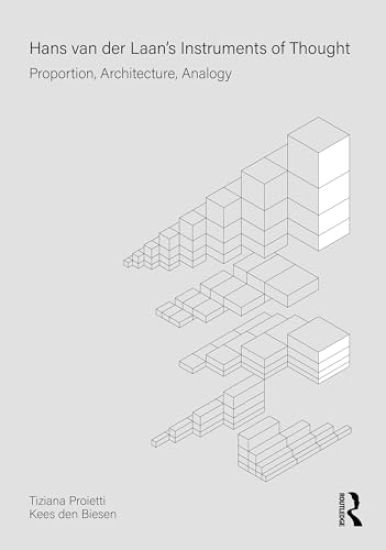
Hans van der Laan’s Instruments of Thought
Tiziana Proietti; Kees Biesen
TAYLOR FRANCIS LTD
2024
nidottu
The work of the Dutch Benedictine monk and architect Hans van der Laan (1904–1991) offers important insights into the ways in which artifacts address the complexity of human physical, cognitive, and social needs. Van der Laan developed a number of powerful lines of thought, three of which are introduced here: the search for a theory of architecture; the establishment of a three-dimensional system of proportions named Plastic Number; and analogy as the mainspring of human thinking. This triad of deeply interconnected intellectual strategies represents his most important ‘instruments of thought’ and is rooted in the careful observation of phenomena as they are presented to us rather than relying on conventional beliefs. Van der Laan's instruments of thought lead us to reconsider the origins of human creation, urging a deeper examination of our perceptual and cognitive response to the limitlessness of the surrounding environment. On this basis, Van der Laan develops a unique philosophy of culture and design that includes considerations on the relationship between nature, culture, and religious ritual.Although this book is informative, its principal aim is to be formative. On the basis of Van der Laan’s instruments of thought, the authors develop a methodology to explore the Plastic Number theory and the many ways in which we perceive and interpret proportion. Reintroducing playful creativity and intellectual exploration into architectural pedagogy and design practice, this book is a gateway for a deeper understanding of the effects of the built environment on human behavior and the various ways in which the human mind perceives and decodes artifacts.
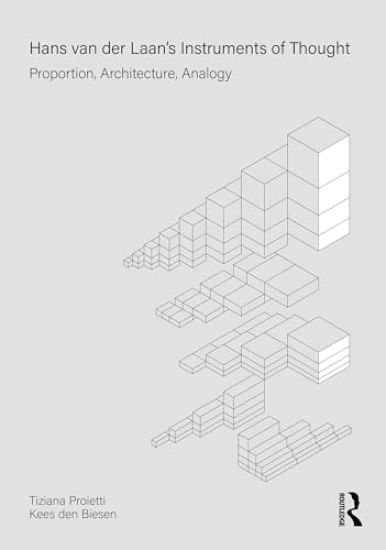
Hans van der Laan’s Instruments of Thought
Tiziana Proietti; Kees Biesen
TAYLOR FRANCIS LTD
2024
sidottu
The work of the Dutch Benedictine monk and architect Hans van der Laan (1904–1991) offers important insights into the ways in which artifacts address the complexity of human physical, cognitive, and social needs. Van der Laan developed a number of powerful lines of thought, three of which are introduced here: the search for a theory of architecture; the establishment of a three-dimensional system of proportions named Plastic Number; and analogy as the mainspring of human thinking. This triad of deeply interconnected intellectual strategies represents his most important ‘instruments of thought’ and is rooted in the careful observation of phenomena as they are presented to us rather than relying on conventional beliefs. Van der Laan's instruments of thought lead us to reconsider the origins of human creation, urging a deeper examination of our perceptual and cognitive response to the limitlessness of the surrounding environment. On this basis, Van der Laan develops a unique philosophy of culture and design that includes considerations on the relationship between nature, culture, and religious ritual.Although this book is informative, its principal aim is to be formative. On the basis of Van der Laan’s instruments of thought, the authors develop a methodology to explore the Plastic Number theory and the many ways in which we perceive and interpret proportion. Reintroducing playful creativity and intellectual exploration into architectural pedagogy and design practice, this book is a gateway for a deeper understanding of the effects of the built environment on human behavior and the various ways in which the human mind perceives and decodes artifacts.
Hans Jonas
TAYLOR FRANCIS LTD
2024
sidottu
This book offers new perspectives on the early and formative years of the German-Jewish philosopher Hans Jonas, through innovative studies of his German and Hebrew work in pre-war Germany and Palestine.Covering all facets of Jonas’s early work, the book brings together leading scholars to explore key conceptual, historical, genealogical, and biographical contexts. Some of the main topics examined include his deep intellectual history of Western thought and its origins in late antiquity through the category of Gnosis, the intellectual influence of Heidegger, Bultmann, Husserl, and Spengler, his relation to Christian theology, and his interest in Judaism and Zionism. Existing research on his early work is not only limited in size but also often methodologically deficient, for it is common to interpret the early in light of the late and as teleologically leading to it. By introducing new materials and addressing new questions, this book offers innovative perspectives on Jonas’s intellectual project as a whole and provides a historical and conceptual foundation for further scholarly explorations of his oeuvre.Providing fresh insights into the work of one of the twentieth century’s most influential philosophers, the book will appeal to students and researchers working in intellectual history, Jewish studies, and religion.

This book presents the first systematic overview and analysis of the deep connection between Scharoun and China, offering insights into East-West cultural exchange and enriching existing understandings of modernism.The German architect Hans Scharoun has typically been pigeonholed as a leading figure in “expressionist” architecture. As this book shows, however, this understanding oversimplifies the multifaceted nature of Scharoun’s career and overlooks his central role within the tradition of Neues Bauen. The book begins with Scharoun’s early interactions with East Asian architects in the 1930s, his active involvement in the Chinese Werkbund (1941–42), and his extensive research on Chinese architecture and urban culture in the mid-1940s and 1950s. The book then examines Scharoun’s postwar architectural designs and urban planning projects, most notably the Kollektivplan, the Volksschule Darmstadt, and the Berliner Philharmonie, which incorporated original spatial and urbanistic concepts such as “Stadtlandschaft,” “Raum der Mitte,” and “aperspectival” space, inspired to varying degrees by Chinese architectural and urban planning traditions.The book will appeal to scholars and students of modern architecture, urban planning, and architectural theory, especially those interested in modernism and East-West cultural exchange.

Hans's Little Black Book: The Perfect Dating Companion for a Handsome Man Named Hans. A secret place for names, phone numbers, and addresses.
Wingman Publishing
Independently Published
2019
nidottu
Keep a record of all the girls that catch your eye


Hans-Michel, Of De Geschonde En Herstelde Eght Van De Gewaande Gouverneur, Van Surinaamen (1753)
Anonymous
KESSINGER PUBLISHING, LLC
2009
pokkari

Hans Christian Andersen's Stories For The Household (1893)
Hans Christian Andersen
KESSINGER PUBLISHING, LLC
2009
pokkari
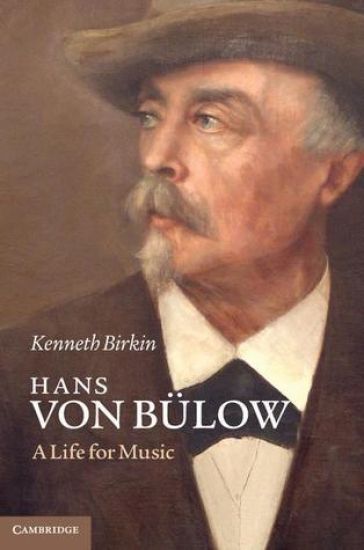
Drawing upon an extensive selection of rare letters, reviews and memoirs, Kenneth Birkin sets Hans von Bülow's work as a recitalist, chamber-music artist and orchestral conductor at the centre of a disturbed and eventful life. Bülow's Zukunftsmusik advocacy and ruthless criticism of performance standards in Berlin and Munich antagonised a musical 'establishment' nonetheless spellbound by his keyboard and orchestral mastery. Birkin pays particular attention to the Tristan and Meistersinger premieres, Cosima's desertion, the European and American tours and operatic activities in Hamburg and Hanover, as well as Bülow's pedagogic activities and forays into musical journalism. The book makes liberal use of Bülow's correspondence, published and unpublished, which personalises the narrative. Contemporary comments and reviews, translated here for the first time, give the reader an insight into the critical and public reaction. An extensive Appendix records the dates and venues of all Bülow's public appearances, both as pianist and conductor.

The Captivity of Hans Stade of Hesse in A.D. 1547–1555, Among the Wild Tribes of Eastern Brazil
Hans Stade
Cambridge University Press
2010
pokkari
The publications of the Hakluyt Society (founded in 1846) made available edited (and sometimes translated) early accounts of exploration. The first series, which ran from 1847 to 1899, consists of 100 books containing published or previously unpublished works by authors from Christopher Columbus to Sir Francis Drake, and covering voyages to the New World, to China and Japan, to Russia and to Africa and India. First published in English in 1874, this book contains Hans Stade's autobiographical account of his capture by the indigenous Brazillian Tupinamba people in 1554, and his description of their customs. Stade was held prisoner for a year, and according to his sensational report he witnessed many acts of cannibalism and was offered roasted human flesh by the chief of a Tupinamba village. The nineteenth-century editor added a preface describing the area of Brazil in question, where he himself had spent three years of 'exile'.

Memoirs of Hans Hendrik, the Arctic Traveller, Serving under Kane, Hayes, Hall and Nares, 1853–1876
Hans Hendrik
Cambridge University Press
2014
pokkari
First published in 1878, this English translation of the memoirs of Hans Hendrik (c.1834–89), a native Greenlander, provides a valuable alternative perspective on polar exploration in the nineteenth century. Inuit were often employed on Arctic expeditions of the period. Hendrik is remarkable, however, not only because his skills as a guide and hunter were called on repeatedly during several expeditions - notably those led by Elisha Kent Kane, Isaac Israel Hayes, Charles Francis Hall and George Strong Nares - but also because he wrote his own account of these experiences. The memoirs show that Hendrik distinguished himself through his application of survival skills and that he dealt with numerous challenges, including the forced abandonment of ship and drifting for months on an ice floe. Instances of sickness and malnutrition are also recorded, as is the poor treatment that Hendrik and other Inuit sometimes experienced from their employers.
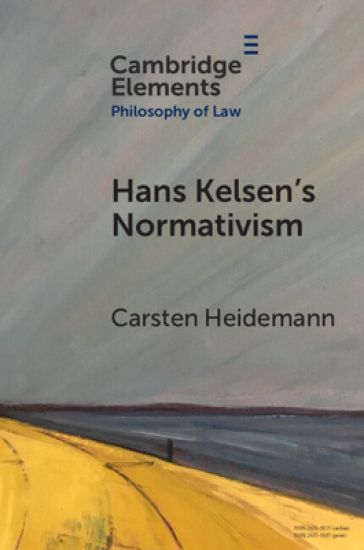
Hans Kelsen's Pure Theory of Law is the most prominent example of legal normativism. This text traces its origins and its genesis. In philosophy, normativism started with Hume's distinction between Is- and Ought-propositions. Kant distinguished practical from theoretical judgments, while resting even the latter on normativity. Following him, Lotze and the Baden neo-Kantians instrumentalized normativism to secure a sphere of knowledge which is not subject to the natural sciences. Even in his first major text, Kelsen claims that law is solely a matter of Ought or normativity. In the second phase of his writings, he places himself into the neo-Kantian tradition, holding legal norms to be Ought-judgments of legal science. In the third phase, he advocates a barely coherent naive normative realism. In the fourth phase, he supplements the realist view with a strict will-theory of norms, coupled with set-pieces from linguistic philosophy; classical normativism is more or less dismantled.

Hans Andersen's Stories
Hans Christian Andersen
BCR (Bibliographical Center for Research)
2009
pokkari