James Joyce and Photography is the first book to explore in-depth James Joyce's personal and professional engagement with photography. Photographs, photographic devices and photographically-inspired techniques appear throughout Joyce’s work, from his narrator's furtive proto-photographic framing in Silhouettes (c. 1897), to the aggressively-minded 'Tulloch-Turnbull girl with her coldblood kodak' in Finnegans Wake (1939).Through an exploration of Joyce's manuscripts and photographic and newspaper archival material, as well as the full range of his major works, this book sheds new light on his sustained interest in this visual medium. This project takes Joyce’s intention in Dubliners (1914) to ‘betray the soul of that hemiplegia or paralysis which many consider a city’ as key to his interaction with photography, which in his literature occupies a dual position between stasis and innovation.
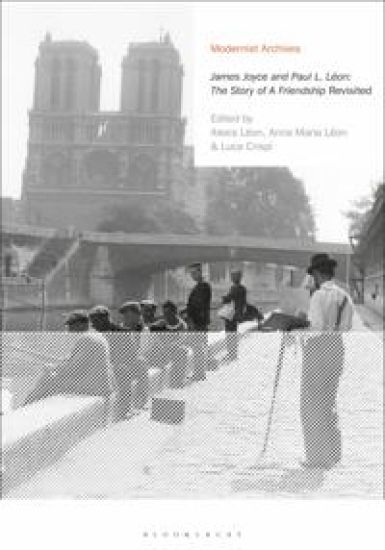
James Joyce spent the last decade of his life in Paris, struggling to finish his great final work Finnegans Wake amidst personal and financial hardship and just as Europe was being engulfed by the rising tide of fascism. Bringing together new archival discoveries and personal accounts, this book explores one of the central relationships of his final years: that with his friend, confidant and adviser Paul L. Léon. Providing first-hand accounts of Joyce’s Paris circle – which included Samuel Beckett and Vladimir Nabokov – the book makes available again the text of Lucie (Léon) Noel’s personal memoir of the relationship between her husband and the Irish writer (published as James Joyce and Paul L. Léon: The Story of Friendship in 1950), including his valiant rescue of Joyce’s Paris archives from occupying Nazi forces. The book also collects for the first time Leon’s clandestine letters to his wife from August to December 1941, chronicling his desperate state of body and mind while interned in Drancy, France’s main Nazi transit camp, and then in Compiègne, just before he was deported to Auschwitz-Birkenau. Joyce died suddenly on 13 January 1941 in Zurich and Léon was murdered by the Nazis on 4 April 1942 in Silesia. Annotated throughout with contextual commentary by Luca Crispi and Mary Gallagher, this is an essential resource for scholars of James Joyce and of the literary culture of Paris in the 1930s and first years of World War II in France.
As a genetic study, this book uncovers the creative DNA of James Joyce’s oeuvre by looking at the cultural forces that shaped him and that he in turn shaped in the creation of his books, developing a two-way relationship with history, memory and national identity. Following his development as an author, it revisits and redirects Joyce’s attitudes towards the Irish Revival. From Chamber Music, through Ulysses to Finnegans Wake Joyce sought to define a cultural identity that went, in many respects, against the mainstream, but that nonetheless belonged to the wider Revivalist project with which it shared certain characteristics and aspirations. Joyce’s historical and genealogical imagination is read through a careful investigation of the cultural materials that went into his work. Based on evidence from his personal library and the extensive archive of reading notes, ideas, sketches and drafts, this book investigates how Joyce used, absorbed and repurposed these materials creatively in his writing; it does so by bringing for the first time the methods of genetic criticism into the domain of cultural memory and the sociology of the text. Thus this books defines “cultural genetics” as an exploration of the textual material that are Joyce’s sources interacts with the culture that produced and received them.
Putting Joyce back into dialogue with other Irish writers of his generation, this book shows that his experiments with narrative styles and structures were a renegotiation rather than a rejection of earlier Irish conventions. While Joyce is undoubtedly the best known, other Irish writers were also influenced by European movements in naturalism and decadence that were shaping European Modernism as it emerged in the 1890s. Reading Joyce's works in the context of often forgotten contemporaries such as George Moore, George Egerton, Hannah Lynch, Shan Bullock, Forrest Reid and Charlotte O’Conor Eccles enhances our understanding of their works as well as Joyce’s, both thematically and stylistically, and shines a much-needed light on previously critically underexamined writers. By focusing on the transformation of Joyce from Irish writer to Modernist artist we gain crucial insights into why many of Joyce’s contemporaries are not read today despite their initial popularity. This book utilises Joyce’s troubled publication and reception history to identify the wider trends of the Irish short story cycle and Bildungsroman, thereby enhancing readers’ understanding of the literary marketplace for Irish books in this period.”
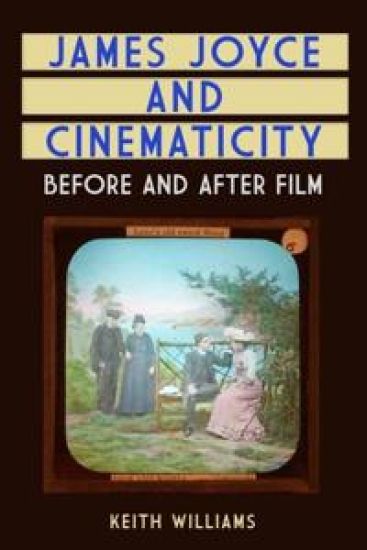
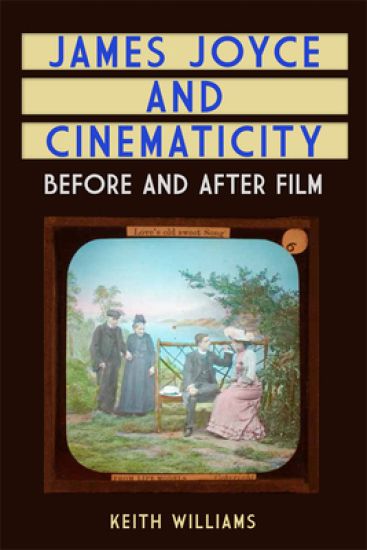
Investigates how the cinematic tendency of Joyce's writing developed from media predating film In this book, Keith Williams explores Victorian culture's emergent 'cinematicity' as a key creative driver of Joyce's experimental fiction, showing how Joyce's style and themes share the cinematograph's roots in Victorian optical entertainment and science. The book reveals Joyce's references to optical toys, shadowgraphs, magic lanterns, panoramas, photographic analysis and film peepshows. Close analyses of his works show how his techniques elaborated and critiqued their effects on modernity's 'media-cultural imaginary'.
James Joyce, Rural Ireland, and Modernity: Beyond the Pale offers a fundamental reappraisal of the dominant Dublin-centric readings of James Joyce by delving into his depiction of rural Ireland. The title takes its name from 'the Pale', the area around Dublin that has historically been most subject to British influence. As the first full-length study of its kind, it shows how Joyce, often considered the urban modernist par excellence, in fact went beyond this particular pale in his work. This monograph takes its place alongside other recent criticism relating to 'alternative modernities' by foregrounding rurality as a vital context to any discussion of modernity. An inherently interdisciplinary work, this book draws on theories relating to postcolonialism, ecocriticism and cultural geography, and includes chapters on cosmopolitanism/provincialism, the Irish peasantry, Dublin's semi-rurality, and Joyce's literal and literary journeys west.
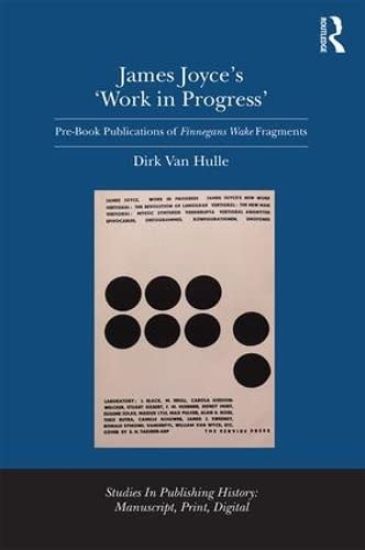
The text of Finnegans Wake is not as monolithic as it might seem. It grew out of a set of short vignettes, sections and fragments. Several of these sections, which James Joyce confidently claimed would "fuse of themselves", are still recognizable in the text of Finnegans Wake. And while they are undeniably integrated very skillfully, they also function separately. In this publication history, Dirk Van Hulle examines the interaction between the private composition process and the public life of Joyce's 'Work in Progress', from the creation of the separate sections through their publication in periodicals and as separately published sections. Van Hulle highlights the beautifully crafted editions published by fine arts presses and Joyce's encouragement of his daughter's creative talents, even as his own creative process was slowing down in the 1930s. All of these pre-book publications were "alive" in both bibliographic and textual terms, as Joyce continually changed the texts in order to prepare the book publication of Finnegans Wake. Van Hulle's book offers a fresh perspective on these texts, showing that they are not just preparatory versions of Finnegans Wake but a 'Work in Progress' in their own right.
James Joyce and Catholicism is the first historicist study to explore the religious cultural contexts of Joyce's final masterpiece. Drawing on letters, authorial manuscripts and other archival materials, the book works its way through a number of crucial themes; heresy, anticlericalism, Mariology, and others. Along the way, the book considers Joyce's vexed relationship with the Catholic Church he was brought up in, and the unique forms of Catholicism that blossomed in Ireland at the turn of the last century, and during the first years of the Irish Free State.
Investigates how the cinematic tendency of Joyce's writing developed from media predating filmFirst comprehensive consideration of Joyce in the context of pre-filmic 'cinematicity'.Research and analysis based on recent 'media archaeology'.Examines the shaping of Joyce's fiction by late-Victorian visual culture and science.Shows that key aspects of his literary experimentation derive from 'forgotten' popular cultural practices and 'vernacular modernism'.Shows Joyce's interaction with and critique of Modernity's developing 'media cultural imaginary'.In this book, Keith Williams explores Victorian culture's emergent 'cinematicity' as a key creative driver of Joyce's experimental fiction, showing how Joyce's style and themes share the cinematograph's roots in Victorian optical entertainment and science. The book reveals Joyce's references to optical toys, shadowgraphs, magic lanterns, panoramas, photographic analysis and film peepshows. Close analyses of his works show how his techniques elaborated and critiqued their effects on modernity's 'media-cultural imaginary'.
The first book-length treatment of Joyce and hospitality Assesses Joyce's employment of the Lukan Good Samaritan parable in relation to his short fiction and Ulysses Articulates how Joyce teaches us to be more charitable readers James Joyce and Samaritan Hospitality reads Dubliners and Ulysses through studies of hospitality, particularly that articulated in the Lukan parable of the Good Samaritan. It traces the origins of the novel in part to the physical attacks on Joyce in 1904 Dublin and 1907 Rome, showing how these incidents and the parable were incorporated into his short story 'Grace' and throughout Ulysses, especially its last four episodes. Richard Rankin Russell discusses the rich theory of hospitality developed by Joyce and demonstrates that he sought to make us more charitable readers through his explorations and depictions of Samaritan hospitality.
James Joyce and Samaritan Hospitality reads Dubliners and Ulysses through studies of hospitality, particularly that articulated in the Lukan parable of the Good Samaritan. It traces the origins of the novel in part to the physical attacks on Joyce in 1904 Dublin and 1907 Rome, showing how these incidents and the parable were incorporated into his short story 'Grace' and throughout Ulysses, especially its last four episodes. Richard Rankin Russell discusses the rich theory of hospitality developed by Joyce and demonstrates that he sought to make us more charitable readers through his explorations and depictions of Samaritan hospitality.
Some scholars see James Joyce's Finnegans Wake as a work of satire and irony; others see it as a playground for the English language. I love the book, and its release into the public domain in many parts of the world enabled me to produce this illustrated Volume. Finnegans Wake endures the reputation of being one of the most challenging works of fiction in the English language. When asked what he made of it, Ezra Pound contended, "Nothing so far as I make out, nothing short of divine vision or a new cure for the clap can possibly be worth all the circumambient peripherization." Oliver Gogarty believed it was "the most colossal leg pull in literature since Macpherson's Ossian." But if a picture can clarify a thousand words, then perhaps pictures can help illuminate Joyce's masterpiece. My copy of Finnegans Wake includes 219,035 words. At one picture per one thousand words, it would take only 220 pictures to explain the entire text. This illustrated book, Volume 1, contains Finnegans Wake Book 1, Chapters 1 and 2, at 15,751 words. I have incorporated over 300 illustrations, so you can see that these two chapters are explained awfully thoroughly. At this rate, the final set of illustrated Volumes will contain over 4,170 images, an over-explanation ratio of more than 19:1. So quickly can confusing things come to brightness. All the illustrations are authentic and promote the tradition of prickly debate started with the publication of Joyce's original book. As critic Omar Gosh says, "It is a real piece of work." "I can't wait to see the movie." - Dick Tator, The Banana Republican. "We hope to carry on the tradition for this work of many initially negative reviews, ranging from bafflement to open hostility: It's a real piece of work." - Segovia Carpet, The Unterrified English Major News. "If Boose isn't America's leading classic literature illustrator, I can see why." - Isabelle Ringing. "Where's Finnegan? Where's the wake?" - Ginger Vitas, The Typesetter Tabloid. "This is the best e-book I've ever seen." - Abraham Lincoln. "Here Comes - Pictures of - Everybody." - Vito Powers. "Even more dense and obscure than the original." - Stephen Dedalus, The Fowlmouth Forum. "Clearly, the author's mind is not polluted with a single idea." - Ira Gurgitate, The Emma Wroyd Journal of Paid Endorsements. "...truly... a book... Joyce... pictures... lunchtime..." - Felix Cited. "The author continues to erode the literary value of Finnegans Wake, now infesting it with dubious illustrations." - Daryl Lickt, The Cellar Door Shower "Boose is an unbelievable illustrator." - F. Stop Fitzgerald. "O june of eves the jenniest, thou who fleeest flicklesome the fond fervid frondeur to thickly thyself attach..." - J. Joyce, Finnegans Wake.
Some scholars see James Joyce's Finnegans Wake as a work of satire and irony; others see it as a playground for the English language. Its release into the public domain in many parts of the world enabled the production of this illustrated Volume. Finnegans Wake endures the reputation of being one of the most challenging works of fiction in the English language. When asked what he made of it, Ezra Pound contended, "Nothing so far as I make out, nothing short of divine vision or a new cure for the clap can possibly be worth all the circumambient peripherization." Oliver Gogarty believed it was "the most colossal leg pull in literature since Macpherson's Ossian." But if a picture can clarify a thousand words, then perhaps pictures can help illuminate Joyce's masterpiece. Finnegans Wake includes 219,035 words. At one picture per one thousand words, it would take only 220 pictures to fully explain the entire text. This illustrated book, Volume 2, contains Finnegans Wake Book 1, Chapters 3 through 7, with 53,565 words. With the addition of 295 illustrations, you can see that these five chapters are explained awfully thoroughly, with an over-explanation ratio of more than 5:1. So quickly can confusing things come to brightness. All the illustrations are authentic and promote the tradition of prickly debate started with the publication of Joyce's original book. As critic Ira Gurgitate proclaims, "It's a real piece of work." What They're Saying About Finnegans Wake Illustrated: "These illustrations look like I need a drink." - Rhoda Booke, Loose Change Quaarterly. "This is the best e-book I've ever read." - Benjamin Franklin, Poor Gomer's Almanac. "This is the perfect mixture of an unreadable book and 21st Century Dada." - Sheila Takya, The Paid Endorser. "So many pictures, so little art." - Amelia Barfup, The Hourly World News. "Even the worst book has an end." - Ira Gurgitate, The Pittsburgh Drifter. "What have I done to deserve this? Why was I born? Why am I living?" - Trudy Ages, The Trivial Messenger. "Even worse than I expected, which is saying something." - Rhoda Mule, KRUD Radio. "...Jeeves... Wooster... pictures... classic... cocktail time..." - Mike Easter, The Hard Times. "This book made me physically ill, even worse than Boose's other illustrated classics." - Myra Mains "If Boose isn't America's leading classics illustrator, I can see why." - Isabelle Ringing, The Illiterary Journal. "It's like attending a wake for someone who died decades ago, then being served Champagne that's been sitting open all that time." - Lucinda Head. "Boose is an unbelievable illustrator." - F. Stop Fitzgerald, Dept. of Fine Arts, Florida University. "Finnegans Wake Illustrated has the look and pacing of a two-camera sitcom filmed by a bunch of eighth graders and conceived by their less bright classmates." - Helen Wheels. "I'd rather be drinking." - Tyrone Shoelaces, The Daily Bungle. "Finnegans Wake Illustrated is rated PG-13 (Parents strongly cautioned). It will make your children stupid." - Curt Reply, The Hard Times. "...so indescribably bad that I do not intend to waste anyone's time by describing it." - Segovia Carpet. "This Dada book is truly a modern surreal experience." - Salvador Doily. "With the addition of all the pictures, it's now much funnier than any of my plays." - William Shakespeare, Spinning in his grave. "It is very strange. This Mr. Bunbury seems to suffer from curiously bad health." - Oscar Wilde. "...your pristopher polombos, hence our Kat Kresbyterians; the curt witty wotty dashes never quite just right at the trim trite truth letter... look at this prepronominal funferal, engraved and retouched and edgewiped and puddenpadded, very like a whale's egg farced with pemmican..." - James Joyce.
Building on his enormously successful series of Philosophers in 90 Minutes, Paul Strathern now applies his witty and incisive prose to brief biographical studies of the world's great writers. He brings their lives and ideas to life in entertaining and accessible fashion. Far from being a novelty, each book is a highly refined appraisal of the writer and his work, authoritative and clearly presented.