Kirjojen hintavertailu. Mukana 11 717 486 kirjaa ja 12 kauppaa.

Kirjahaku

Etsi kirjoja tekijän nimen, kirjan nimen tai ISBN:n perusteella.

1000 tulosta hakusanalla JAMES W. LEE

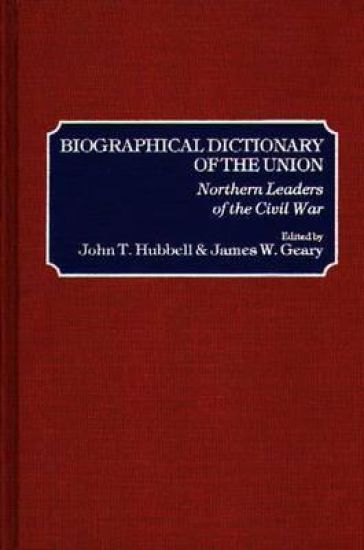
Biographical Dictionary of the Union

Biographical Dictionary of the Union

James W. Geary; John T. Hubbell

Greenwood Press
1995
sidottu
The Civil War and the men and women who lived during that time continue to interest, preoccupy, and bemuse a wide and various population. This volume provides information on 872 men and women of the Union, covering those who influenced the course of public policy, opinion, and events. Coverage of political leaders, such as congressmen and cabinet officers, is comprehensive, while others, such as editors, photographers, and abolitionists, are covered selectively. Military leaders are included for specific contributions to the Union.Each profile provides biographical information about the person, stressing the war years and offering an assessment of the individual's place in the Union. Each entry concludes with bibliographic sources. Taken together, the profiles illumine those mystic chords of memory that continue to tie us yet to the Civil War generation.

Historical Dictionary of Data Processing

Historical Dictionary of Data Processing

James W. Cortada

Greenwood Press
1987
sidottu
This dictionary offers a ready reference to the biographies of more than 160 individuals prominent in the history of data processing. It includes scientists, engineers, government officials, executives of major computer manufacturing companies, and users of data processing technology, and extends in time from antiquity through the 1980s. In an attempt to inform readers at all levels of specialization, the volume gives basic information to the general reader while providing reference materials that will serve the specialist as a starting point for further research.
Archives of Data-Processing History

Archives of Data-Processing History

James W. Cortada

Greenwood Press
1990
sidottu
The history of the computer, and of the industry it spawned, is the latest entrant into the field of historical studies. Scholars beginning to turn their attention to the subject of computing need James Cortada's Archives of Data Procesing History as a brief introduction to sources immediately available for investigation. Each essay provides an overview of a major government, academic, or industrial archival collection dealing with the history of computing, the industry, and its leaders and is written by the archivist/historian who has worked with or is responsible for the collection.The archives give practical information on hours, organization, contacts, telephone numbers, survey of contents, and assessments of the historical significance of the collections and their institutions. Reference and business librarians will definitely want to add this volume to their collections. Those interested in the history of technology, the business history of the industry, and the history of major institutions will want to consult it.
A Bibliographic Guide to the History of Computing, Computers, and the Information Processing Industry
As millions of people have been exposed to computing through the tremendous growth of microcomputers, there has developed an increasing appreciation of the history of data processing, which dates back many decades before the arrival of the computer. Stretching back to at least the 1860s, such early technologies as adding machines, punch cards, and the office appliance industry are now being recognized for their place in the history of the information processing industry. This work brings together a comprehensive list of sources that offer a general introduction to the literature of the industry.Divided into nine chapters covering topics and historical periods, the bibliography provides an annotated list of published materials describing both the history of the industry and significant items of general interest. Each chapter is introduced with a short review of historically important issues and comments on the literature, and contains contemporary publications as well as more recent material. To give the work a continuing usefulness, ongoing publications, such as computer magazines, are highlighted. Entries are grouped under nearly 100 subheadings, covering such material as contemporary descriptions of hardware and software of the past, seminal technical papers, industry surveys, programming languages, significant individuals and companies, and the role of Japan and microcomputing. All citations are annotated with a brief summary of either the work's contents or its historical importance, while two indexes provide both subject references and author citations. This bibliography will be an important reference source for courses in the history of data processing and business history, and a useful addition to public, college, and university libraries.
Spain in the Nineteenth-Century World

Spain in the Nineteenth-Century World

James W. Cortada

Praeger Publishers Inc
1994
sidottu
Designed as a companion to the acclaimed Spain in the Twentieth-Century World (Greenwood Press, 1980), this volume is a survey of 19th-century Spanish diplomacy. Although the 19th century is often considered highly fragmented in Spanish history, this distinguished set of writers shows that insofar as diplomacy goes, Spain has followed very consistent lines of activities throughout the century. Spaniards have attempted to use diplomacy to further national and international objectives with mixed results. This study adds insight into the national political affairs of Spain while dealing directly with the events of such regions as North Africa, Santo Domingo, Mexico, the United States, Portugal, France, Great Britain, Chile, and Peru. It is also an important contribution to the diplomacy of the 19th-century, post-Napoleonic Mediterranean world.
The President as Party Leader

The President as Party Leader

James W. Davis

Praeger Publishers Inc
1992
sidottu
In spite of all that has been written on the U.S. presidency, no book before this has come forth in the 20th century on the president as party leader. A respected senior scholar, James W. Davis has studied the presidency for more than 40 years and has been on the campaign trail with candidates and incumbents and at national party meetings. He has written a lively text that is tailor-made for courses on the presidency, political parties, and elections. This is good reading for everyone who is interested in American government and politics and who wants to understand what makes a president a strong leader.This history and political analysis shows how presidents and political parties need each other and demonstrates why presidents must understand and be immersed in the political process to be effective. The text examines the emergence of the party leader through nominating and general election campaigns, presidential and congressional party interaction, eras of divided government, as well as the relationship between the president and the party's national committee. It also presents the role of the presidential party and of the president in his public roles and then discusses reforms that may strengthen the president as an executive and as a party leader.
Second Bibliographic Guide to the History of Computing, Computers, and the Information Processing Industry
Complementing the author's 1990 bibliography, A Bibliographic Guide to the History of Computing, Computers, and the Information Processing Industry, this bibliography provides 2,500 new citations, covering all significant literature published since the late 1980s. It includes all aspects of the subject—biographies, company histories, industry studies, product descriptions, sociological studies, industry directories, and traditional monographic histories—and covers all periods from the beginnings to the personal computer. New to this volume is a chapter on the management of information processing operations, useful to both historians and managers of information technology. Together with the earlier bibliography, this work provides the most comprehensive bibliographic guide to the history of computers, computing, and the information processing industry.The organization of the book follows that of the earlier work, with the addition of the new chapter on the management of information processing. All entries are new to this volume. Titles are annotated, and each chapter begins with a short introduction. A full table of contents and author and subject indexes enhance accessibility to the material.
A Bibliographic Guide to the History of Computer Applications, 1950–1990
Covering over 40 industries and dozens of applications, this is the first bibliography on the history of computer applications. After an introductory essay on the history of applications, the volume is divided into two time periods and includes over 1,600 entries, arranged by application and industry. Users will find sections on such fields as higher education, manufacturing, law enforcement, accounting, space travel, ATMs, artificial intelligence, banking, and trucking. Entries are annotated to describe their content and, when appropriate, their historical significance. Compiled by a historian for other historians and economists, the bibliography draws on the entire spectrum of contemporary and historical literature: books, user's guides, trade journals, industry publications, technology and scholarly magazines and journals, and newsletters, including both American and European sources. As the author of several books on information processing and a member of the IBM Corporation, Cortada is in a good position to pick the historically significant literature for inclusion in this bibliography.
Information Technology as Business History

Information Technology as Business History

James W. Cortada

Praeger Publishers Inc
1996
sidottu
This comprehensive overview of the history of computing and its industry, and of commercial applications of the computer also outlines the history of how computing operations were managed within American companies. Based on extensive research in the contemporary business literature, this work is one of the few which looks at computing as business history, and it is the first to look at the broad scope of computing from the perspective of the business historian. The work is also directed at business managers to help them appreciate and understand the uses of the computer in their firms.
Leadership Selection in Six Western Democracies
A comparative survey which discusses how national leaders in six Western democracies, Australia, Canada, France, Germany, Great Britain, and the United States, are nominated for the highest office in their country. The combinations of methods each country utilizes to nominate their leaders are described. The text emphasizes that most national leaders have served a long apprenticeship in various public offices—sometimes having made several attempts—before actually being nominated to the nation's highest public office. Increasingly, the text shows that opinion polls, television, and professional campaign management are playing a greater role in the leadership selection process in all six countries. This book will be of interest to upper-level college and graduate students and faculty in comparative government, political parties, and public affairs and academic as well as public libraries.
Poison Gas

Poison Gas

James W. Hammond Jr.

Praeger Publishers Inc
1999
sidottu
The threat of poison gas, and other related biological warfare agents, holds our society hostage to the possible actions of terrorist groups or rogue states. This study hopes to convince policymakers and the general public that the bad reputation that surrounds the use of gas is largely the result of propaganda, misinformation, and oft-repeated half-truths. With proper precautions and discipline, neither the military nor society need fear gas as a weapon of mass destruction, wielded by dictators and cowards who utilize the loopholes in international agreements and flaunt world opinion. While not advocating the use of toxic gas in warfare, the author argues that education and common sense are the most effective tools to combat the gases that remain in arsenals around the world. After a discussion of the earliest uses of gas and other similar tactics in warfare, this book explains how our image of gas has been shaped by early pronouncements that branded it a treacherous and barbarous weapon. The fear of retribution, as well as political motivations, prevented the use of gas warfare in the Second World War, but its use resurfaced in later decades both in warfare and in combatting internal strife. The author details various types of gas and discusses the most effective measures to counter each one. He also chronicles the long history of attempts to outlaw gas, why these attempts have failed, and why such efforts are not likely to succeed in the future.
Joint Industrial Councils in British History

Joint Industrial Councils in British History

James W. Stitt

Praeger Publishers Inc
2006
sidottu
Joint Industrial Councils: Inception, Adoption, and Utilization, 1917-1939 is a study of how a WWI proposal for permanent improvement in labor-management relations came about, why the target industries ignored it, and how it found a purpose in the second-tier industries for which it was not originally intended. The press, social reformers, academics, and various business interests touted JICs as the beginning of worker control of industry, while skilled trade unions saw them as a plot to harm workers' interests. Their eventual modest use was directed to needs within individual industrial enterprises and not to more global missions, such as the remaking of British industry in general. But successful JICs undertook serious issues that management and unions needed to address, such as wage rates, retirement plans for workers, and safety-related concerns. Moreover, the level of labor-management understanding in JIC industries improved to the point that these industries suffered no strikes in the inter-war period; the conditions of employment for the workers improved; and productivity increased.