Kirjojen hintavertailu. Mukana 11 342 296 kirjaa ja 12 kauppaa.

Kirjahaku

Etsi kirjoja tekijän nimen, kirjan nimen tai ISBN:n perusteella.

1000 tulosta hakusanalla Jacques Derrida

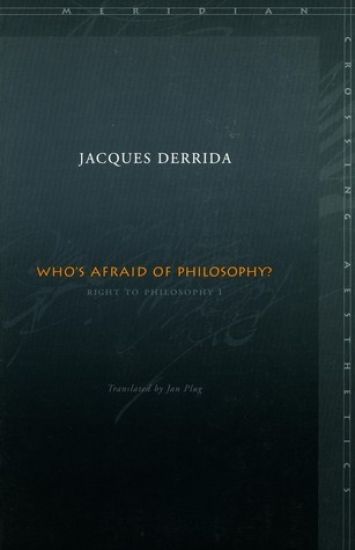
Who's Afraid of Philosophy?

Who's Afraid of Philosophy?

Jacques Derrida

Stanford University Press
2002
pokkari
This volume reflects Jacques Derrida's engagement in the late 1970s with French political debates on the teaching of philosophy and the reform of the French university system. He was a founding member of the Research Group on the Teaching of Philosophy (Greph), an activist group that mobilized opposition to the Giscard government's proposals to "rationalize" the French educational system in 1975, and a convener of the Estates General of Philosophy, a vast gathering in 1979 of educators from across France. While addressing specific contemporary political issues on occasion, thus providing insight into the pragmatic deployment of deconstructive analysis, the essays deal mainly with much broader concerns. With his typical rigor and spark, Derrida investigates the genealogy of several central concepts which any debate about teaching and the university must confront. Thus there are essays on the "teaching body," both the faculty corps and the strange interplay in the French (but not only the French) tradition between the mind and body of the professor; on the question of age in teaching, analyzed through a famous letter of Hegel; on the class, the classroom, and the socio-economic concept of class in education; on language, especially so-called "natural languages" like French; and on the legacy of the revolutionary tradition, the Estates General, in the university. The essays are linked by the extraordinary care and precision with which Derrida undertakes a political intervention into, and a philosophical analysis of, the institutionalization of philosophy in the university.
Eyes of the University

Eyes of the University

Jacques Derrida

Stanford University Press
2004
sidottu
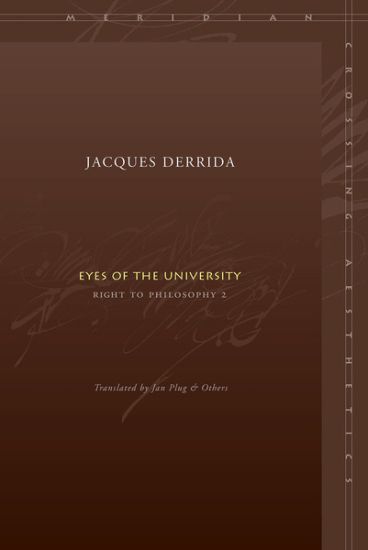
Completing the translation of Derrida's monumental work Right to Philosophy (the first part of which has already appeared under the title of Who's Afraid of Philosophy?), Eyes of the University brings together many of the philosopher's most important texts on the university and, more broadly, on the languages and institutions of philosophy. In addition to considerations of the implications for literature and philosophy of French becoming a state language, of Descartes' writing of the Discourse on Method in French, and of Kant's and Schelling's philosophies of the university, the volume reflects on the current state of research and teaching in philosophy and on the question of what Derrida calls a "university responsibility." Examining the political and institutional conditions of philosophy, the essays collected here question the growing tendency to orient research and teaching towards a programmable and profitable end. The volume is therefore invaluable for the light it throws upon an underappreciated aspect of Derrida's own engagement, both philosophical and political, in struggles against the stifling of philosophical research and teaching. As a founding member of the Research Group on the Teaching of Philosophy and as one of the conveners of the Estates General of Philosophy, Derrida was at the forefront of the struggle to preserve and extend the teaching of philosophy as a distinct discipline, in secondary education and beyond, in the face of conservative government education reforms in France. As one of the founders of the Collège International de Philosophie, he worked to provide a space for research in and around philosophy that was not accepted or legitimated in other institutions. Documenting and reflecting upon these engagements, Eyes of the University brings together some of the most important and incisive of Derrida's works.
Eyes of the University

Eyes of the University

Jacques Derrida

Stanford University Press
2004
pokkari
Completing the translation of Derrida's monumental work Right to Philosophy (the first part of which has already appeared under the title of Who's Afraid of Philosophy?), Eyes of the University brings together many of the philosopher's most important texts on the university and, more broadly, on the languages and institutions of philosophy. In addition to considerations of the implications for literature and philosophy of French becoming a state language, of Descartes' writing of the Discourse on Method in French, and of Kant's and Schelling's philosophies of the university, the volume reflects on the current state of research and teaching in philosophy and on the question of what Derrida calls a "university responsibility." Examining the political and institutional conditions of philosophy, the essays collected here question the growing tendency to orient research and teaching towards a programmable and profitable end. The volume is therefore invaluable for the light it throws upon an underappreciated aspect of Derrida's own engagement, both philosophical and political, in struggles against the stifling of philosophical research and teaching. As a founding member of the Research Group on the Teaching of Philosophy and as one of the conveners of the Estates General of Philosophy, Derrida was at the forefront of the struggle to preserve and extend the teaching of philosophy as a distinct discipline, in secondary education and beyond, in the face of conservative government education reforms in France. As one of the founders of the Collège International de Philosophie, he worked to provide a space for research in and around philosophy that was not accepted or legitimated in other institutions. Documenting and reflecting upon these engagements, Eyes of the University brings together some of the most important and incisive of Derrida's works.
Paper Machine

Paper Machine

Jacques Derrida

Stanford University Press
2005
sidottu
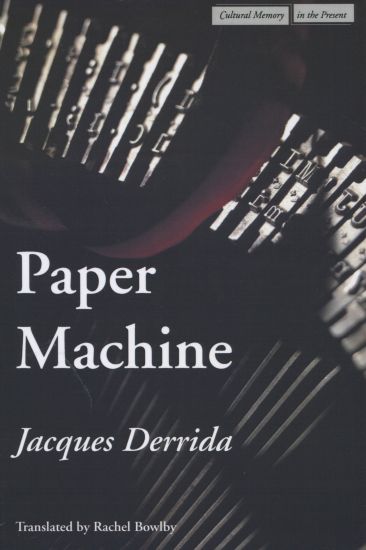
This book questions the book itself, archivization, machines for writing, and the mechanicity inherent in language, the media, and intellectuals. Derrida questions what takes place between the paper and the machine inscribing it. He examines what becomes of the archive when the world of paper is subsumed in new machines for virtualization, and whether there can be a virtual event or a virtual archive. Derrida continues his long-standing investigation of these issues, and ties them into the new themes that governed his teaching and thinking in the past few years: the secret, pardon, perjury, state sovereignty, hospitality, the university, animal rights, capital punishment, the question of what sort of mediatized world is replacing the print epoch, and the question of the "wholly other." Derrida is remarkable at making seemingly occasional pieces into part of a complexly interconnected trajectory of thought.
Paper Machine

Paper Machine

Jacques Derrida

Stanford University Press
2005
pokkari
This book questions the book itself, archivization, machines for writing, and the mechanicity inherent in language, the media, and intellectuals. Derrida questions what takes place between the paper and the machine inscribing it. He examines what becomes of the archive when the world of paper is subsumed in new machines for virtualization, and whether there can be a virtual event or a virtual archive. Derrida continues his long-standing investigation of these issues, and ties them into the new themes that governed his teaching and thinking in the past few years: the secret, pardon, perjury, state sovereignty, hospitality, the university, animal rights, capital punishment, the question of what sort of mediatized world is replacing the print epoch, and the question of the "wholly other." Derrida is remarkable at making seemingly occasional pieces into part of a complexly interconnected trajectory of thought.
Psyche

Psyche

Jacques Derrida

Stanford University Press
2007
sidottu
Psyche: Inventions of the Other is the first publication in English of the twenty-eight essay collection Jacques Derrida published in two volumes in 1998 and 2003. In Volume I, Derrida advances his reflection on many topics: psychoanalysis, theater, translation, literature, representation, racism, and nuclear war, among others. The essays in this volume also carry on Derrida's engagement with a number of key thinkers and writers: Barthes, Benjamin, de Man, Flaubert, Freud, Heidegger, Lacoue-Labarthe, Levinas, and Ponge. Included in this volume are new or revised translations of seminal essays (for example, "Psyche: Invention of the Other," "The Retrait of Metaphor," "At This Very Moment in This Work Here I Am," "Tours de Babel" and "Racism's Last Word"), as well as three essays that appear here in English for the first time.
Psyche

Psyche

Jacques Derrida

Stanford University Press
2007
pokkari
Psyche: Inventions of the Other is the first publication in English of the twenty-eight essay collection Jacques Derrida published in two volumes in 1998 and 2003. In Volume I, Derrida advances his reflection on many topics: psychoanalysis, theater, translation, literature, representation, racism, and nuclear war, among others. The essays in this volume also carry on Derrida's engagement with a number of key thinkers and writers: Barthes, Benjamin, de Man, Flaubert, Freud, Heidegger, Lacoue-Labarthe, Levinas, and Ponge. Included in this volume are new or revised translations of seminal essays (for example, "Psyche: Invention of the Other," "The Retrait of Metaphor," "At This Very Moment in This Work Here I Am," "Tours de Babel" and "Racism's Last Word"), as well as three essays that appear here in English for the first time.
Rogues

Rogues

Jacques Derrida

Stanford University Press
2005
sidottu
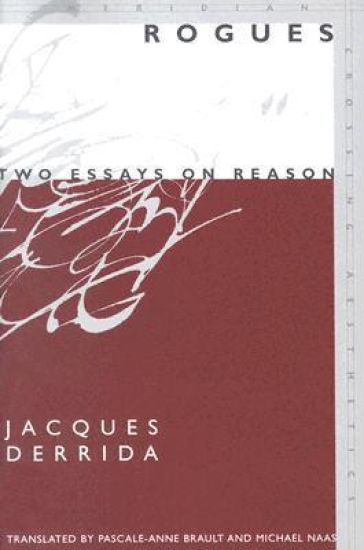
Rogues, published in France under the title Voyous, comprises two major lectures that Derrida delivered in 2002 investigating the foundations of the sovereignty of the nation-state. The term "État voyou" is the French equivalent of "rogue state," and it is this outlaw designation of certain countries by the leading global powers that Derrida rigorously and exhaustively examines. Derrida examines the history of the concept of sovereignty, engaging with the work of Bodin, Hobbes, Rousseau, Schmitt, and others. Against this background, he delineates his understanding of "democracy to come," which he distinguishes clearly from any kind of regulating ideal or teleological horizon. The idea that democracy will always remain in the future is not a temporal notion. Rather, the phrase would name the coming of the unforeseeable other, the structure of an event beyond calculation and program. Derrida thus aligns this understanding of democracy with the logic he has worked out elsewhere. But it is not just political philosophy that is brought under deconstructive scrutiny here: Derrida provides unflinching and hard-hitting assessments of current political realities, and these essays are highly engaged with events of the post-9/11 world.
Rogues

Rogues

Jacques Derrida

Stanford University Press
2005
pokkari
Rogues, published in France under the title Voyous, comprises two major lectures that Derrida delivered in 2002 investigating the foundations of the sovereignty of the nation-state. The term "État voyou" is the French equivalent of "rogue state," and it is this outlaw designation of certain countries by the leading global powers that Derrida rigorously and exhaustively examines. Derrida examines the history of the concept of sovereignty, engaging with the work of Bodin, Hobbes, Rousseau, Schmitt, and others. Against this background, he delineates his understanding of "democracy to come," which he distinguishes clearly from any kind of regulating ideal or teleological horizon. The idea that democracy will always remain in the future is not a temporal notion. Rather, the phrase would name the coming of the unforeseeable other, the structure of an event beyond calculation and program. Derrida thus aligns this understanding of democracy with the logic he has worked out elsewhere. But it is not just political philosophy that is brought under deconstructive scrutiny here: Derrida provides unflinching and hard-hitting assessments of current political realities, and these essays are highly engaged with events of the post-9/11 world.
H. C. for Life, That Is to Say...

H. C. for Life, That Is to Say...

Jacques Derrida

Stanford University Press
2006
sidottu
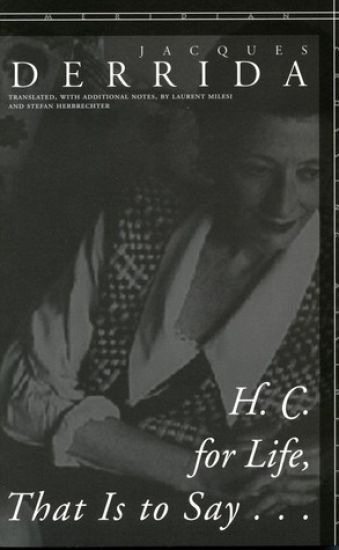
H. C. for Life, That Is to Say . . . is Derrida's literary critical recollection of his lifelong friendship with Hélène Cixous. The main figure that informs Derrida's reading here is that of "taking sides." While Hélène Cixous in her life and work takes the side of life, "for life," Derrida admits always feeling drawn to the side of death. Rather than being an obvious choice, taking the side of life is an act of faith, by wagering one's life on life. H. C. for Life sets up and explores this interminable "argument" between Derrida and Cixous as to what death has in store deep within life itself, before the end. In addition to being a memoir, it is also a theoretical confrontation—for example about the meaning of "might" and "omnipotence," and a philosophical and philological analysis of the crypts within the vast oeuvre of Hélène Cixous. Finally, the book is Derrida's tribute to the thought of the woman whom he regards as one of the great French poets, writers, and thinkers of our time.
H. C. for Life, That Is to Say...

H. C. for Life, That Is to Say...

Jacques Derrida

Stanford University Press
2006
pokkari
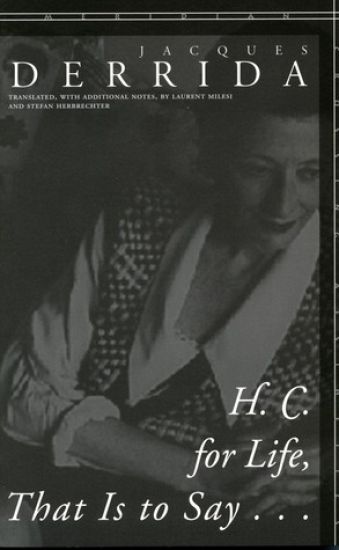
H. C. for Life, That Is to Say . . . is Derrida's literary critical recollection of his lifelong friendship with Hélène Cixous. The main figure that informs Derrida's reading here is that of "taking sides." While Hélène Cixous in her life and work takes the side of life, "for life," Derrida admits always feeling drawn to the side of death. Rather than being an obvious choice, taking the side of life is an act of faith, by wagering one's life on life. H. C. for Life sets up and explores this interminable "argument" between Derrida and Cixous as to what death has in store deep within life itself, before the end. In addition to being a memoir, it is also a theoretical confrontation—for example about the meaning of "might" and "omnipotence," and a philosophical and philological analysis of the crypts within the vast oeuvre of Hélène Cixous. Finally, the book is Derrida's tribute to the thought of the woman whom he regards as one of the great French poets, writers, and thinkers of our time.
Psyche

Psyche

Jacques Derrida

Stanford University Press
2008
sidottu
Psyche: Inventions of the Other is the first publication in English of the twenty-eight essay collection Jacques Derrida published in two volumes in 1998 and 2003. Advancing his reflection on many issues, such as sexual difference, architecture, negative theology, politics, war, nationalism, and religion, Volume II also carries on Derrida's engagement with a number of key thinkers and writers: De Certeau, Heidegger, Kant, Lacoue-Labarthe, Mandela, Rosenszweig, and Shakespeare, among others. Included in this volume are new or revised translations of seminal essays (for example, "Geschlecht I: Sexual Difference, Ontological Difference," "Geschlecht II: Heidegger's Hand," "How to Avoid Speaking: Denials," and "Interpretations at War: Kant, the Jew, the German").
Psyche

Psyche

Jacques Derrida

Stanford University Press
2008
pokkari
Psyche: Inventions of the Other is the first publication in English of the twenty-eight essay collection Jacques Derrida published in two volumes in 1998 and 2003. Advancing his reflection on many issues, such as sexual difference, architecture, negative theology, politics, war, nationalism, and religion, Volume II also carries on Derrida's engagement with a number of key thinkers and writers: De Certeau, Heidegger, Kant, Lacoue-Labarthe, Mandela, Rosenszweig, and Shakespeare, among others. Included in this volume are new or revised translations of seminal essays (for example, "Geschlecht I: Sexual Difference, Ontological Difference," "Geschlecht II: Heidegger's Hand," "How to Avoid Speaking: Denials," and "Interpretations at War: Kant, the Jew, the German").
Copy, Archive, Signature

Copy, Archive, Signature

Jacques Derrida

Stanford University Press
2010
sidottu
This book makes available for the first time in English—and for the first time in its entirety in any language—an important yet little-known interview on the topic of photography that Jacques Derrida granted in 1992 to the German theorist of photography Hubertus von Amelunxen and the German literary and media theorist Michael Wetzel. Their conversation addresses, among other things, questions of presence and its manufacture, the technicity of presentation, the volatility of the authorial subject, and the concept of memory. Derrida offers a penetrating intervention with regard to the distinctive nature of photography vis-à-vis related technologies such as cinema, television, and video. Questioning the all-too-facile divides between so-called old and new media, original and reproduction, analog and digital modes of recording and presenting, he provides stimulating insights into the ways in which we think and speak about the photographic image today. Along the way, the discussion fruitfully interrogates the question of photography in relation to such key concepts as copy, archive, and signature. Gerhard Richter introduces the volume with a critical meditation on the relationship between deconstruction and photography by way of the concepts of translation and invention. Copy, Archive, Signature will be of compelling interest to readers in the fields of contemporary European critical thought, photography, aesthetic theory, media studies, and French Studies, as well as those following the singular intellectual trajectory of one the most influential thinkers of our time.
Copy, Archive, Signature

Copy, Archive, Signature

Jacques Derrida

Stanford University Press
2010
pokkari
This book makes available for the first time in English—and for the first time in its entirety in any language—an important yet little-known interview on the topic of photography that Jacques Derrida granted in 1992 to the German theorist of photography Hubertus von Amelunxen and the German literary and media theorist Michael Wetzel. Their conversation addresses, among other things, questions of presence and its manufacture, the technicity of presentation, the volatility of the authorial subject, and the concept of memory. Derrida offers a penetrating intervention with regard to the distinctive nature of photography vis-à-vis related technologies such as cinema, television, and video. Questioning the all-too-facile divides between so-called old and new media, original and reproduction, analog and digital modes of recording and presenting, he provides stimulating insights into the ways in which we think and speak about the photographic image today. Along the way, the discussion fruitfully interrogates the question of photography in relation to such key concepts as copy, archive, and signature. Gerhard Richter introduces the volume with a critical meditation on the relationship between deconstruction and photography by way of the concepts of translation and invention. Copy, Archive, Signature will be of compelling interest to readers in the fields of contemporary European critical thought, photography, aesthetic theory, media studies, and French Studies, as well as those following the singular intellectual trajectory of one the most influential thinkers of our time.
Limited Inc

Limited Inc

Jacques Derrida

Northwestern University Press
1988
nidottu
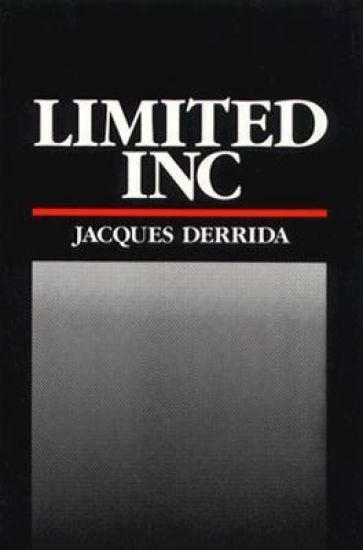
Limited Inc is a major work in the philosophy of language by the celebrated French thinker Jacques Derrida. The book's two essays, "Limited Inc" and "Signature Event Context," constitute key statements of the Derridean theory of deconstruction. They are the clearest exposition to be found of Derrida's most controversial idea, that linguistic meaning is fundamentally indeterminate because the contexts that fix meaning are never stable. Limited Inc includes an important new afterword by the author.
Voice and Phenomenon

Voice and Phenomenon

Jacques Derrida

Northwestern University Press
2010
nidottu
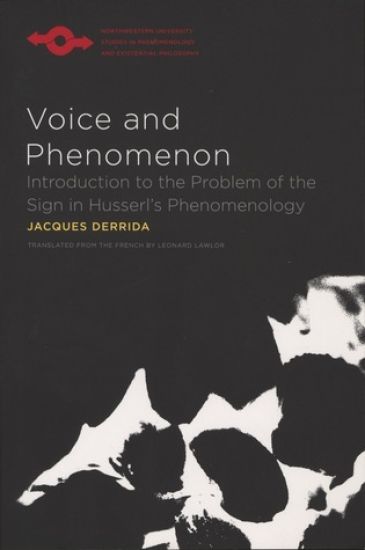
Published in 1967, when Derrida is 37 years old, Voice and Phenomenon appears at the same moment as Of Grammatology and Writing and Difference. All three books announce the new philosophical project called “deconstruction.” Although Derrida will later regret the fate of the term “deconstruction,” he will use it throughout his career to define his own thinking. While Writing and Difference collects essays written over a 10 year period on diverse figures and topics, and Of Grammatology aims its deconstruction at “the age of Rousseau,” Voice and Phenomenon shows deconstruction engaged with the most important philosophical movement of the last hundred years: phenomenology.Only in relation to phenomenology is it possible to measure the importance of deconstruction. Only in relation to Husserl’s philosophy is it possible to understand the novelty of Derrida’s thinking. Voice and Phenomenon therefore may be the best introduction to Derrida’s thought in general. To adapt Derrida’s comment on Husserl’s Logical Investigations, it contains “the germinal structure” of Derrida’s entire thought. Lawlor’s fresh translation of Voice and Phenomenon brings new life to Derrida’s most seminal work.
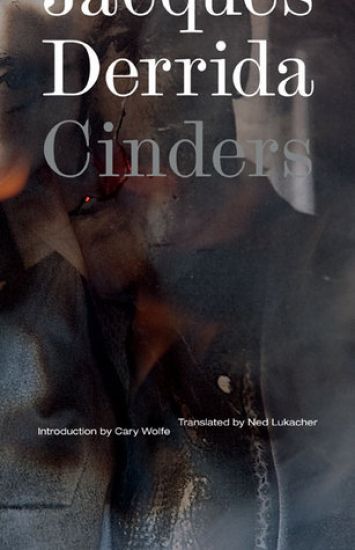
Cinders

Cinders

Jacques Derrida

University of Minnesota Press
2014
nidottu
“More than fifteen years ago,” Jacques Derrida writes in the prologue to this remarkable and uniquely revealing book, “a phrase came to me, as though in spite of me. . . . It imposed itself upon me with the authority, so discreet and simple it was, of a judgment: ‘cinders there are’ (il y a lÀ cendre). . . . I had to explain myself to it, respond to it-or for it.” In Cinders Derrida ranges across his work from the previous twenty years and discerns a recurrent cluster of arguments and images, all involving in one way or another ashes and cinders. For Derrida, cinders or ashes-at once fragile and resilient-are “the better paradigm for what I call the trace-something that erases itself totally, radically, while presenting itself.”In a style that is both highly condensed and elliptical, Cinders offers probing reflections on the relation of language to truth, writing, the voice, and the complex connections between the living and the dead. It also contains some of his most essential elaborations of his thinking on the feminine and on the legacy of the Holocaust (both a word-from the Greek hÓlos, “whole,” and kaustÓs, “burnt”-and a historical event that invokes ashes) in contemporary poetry and philosophy. In turning from the texts of other philosophers to his own, Cinders enables readers to follow the trajectory from Derrida’s early work on the trace, the gramma, and the voice to his later writings on life, death, time, and the spectral. Among the most accessible of this renowned philosopher’s many writings, Cinders is an evocative and haunting work of poetic self-analysis that deepens our understanding of Derrida’s critical and philosophical vision.
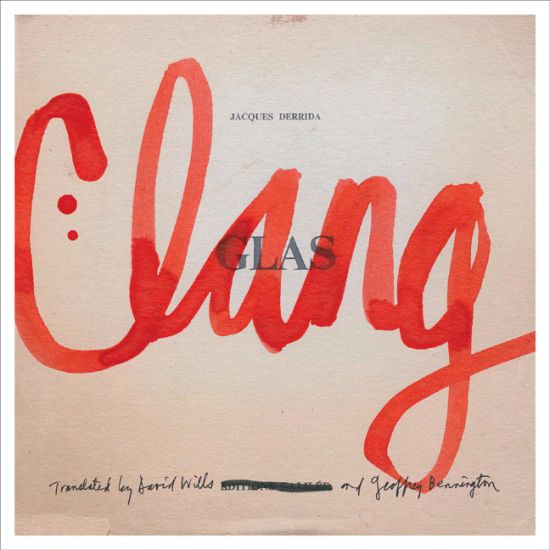
Clang

Clang

Jacques Derrida

University of Minnesota Press
2021
sidottu
A new translation of Derrida’s groundbreaking juxtaposition of Hegel and Genet, forcing two incompatible discourses into dialogue with each other Jacques Derrida’s famously challenging book Glas puts the practice of philosophy and the very acts of writing and reading to the test. Formatted with parallel texts, its left column discusses G. W. F. Hegel and its right column engages Jean Genet, with numerous notes and interpolations in the margins. The resulting work, published for the first time in French in 1974, is a collage that practices theoretical thinking as a form of grafting. Presented here in an entirely new translation as Clang-its title resonating like the sound of an alarm or death knell-this book brilliantly juxtaposes Hegel’s totalizing, hierarchical system of thought with Genet’s autobiographical, carceral erotics. It innovatively forces two incompatible discourses into dialogue with each other: philosophical and literary, familial and perverse, logical and sensory. In both content and structure, Clang heightens the significance of all encounters across ruptures of thought or experience and vibrates with the impact of discordant languages colliding.
Clang

Clang

Jacques Derrida

University of Minnesota Press
2021
nidottu
A new translation of Derrida’s groundbreaking juxtaposition of Hegel and Genet, forcing two incompatible discourses into dialogue with each other Jacques Derrida’s famously challenging book Glas puts the practice of philosophy and the very acts of writing and reading to the test. Formatted with parallel texts, its left column discusses G. W. F. Hegel and its right column engages Jean Genet, with numerous notes and interpolations in the margins. The resulting work, published for the first time in French in 1974, is a collage that practices theoretical thinking as a form of grafting. Presented here in an entirely new translation as Clang-its title resonating like the sound of an alarm or death knell-this book brilliantly juxtaposes Hegel’s totalizing, hierarchical system of thought with Genet’s autobiographical, carceral erotics. It innovatively forces two incompatible discourses into dialogue with each other: philosophical and literary, familial and perverse, logical and sensory. In both content and structure, Clang heightens the significance of all encounters across ruptures of thought or experience and vibrates with the impact of discordant languages colliding.