Kirjojen hintavertailu. Mukana 11 342 296 kirjaa ja 12 kauppaa.

Kirjahaku

Etsi kirjoja tekijän nimen, kirjan nimen tai ISBN:n perusteella.

1000 tulosta hakusanalla James M. Hutchisson

Print Markets and Political Dissent

Print Markets and Political Dissent

James M. Brophy

Oxford University Press
2024
sidottu
Moving book history in a new direction, this study examines publishers as brokers of Central Europe's political public sphere. They created international print markets, translated new texts, launched new journals, supported outspoken authors, and experimented with popular formats. Most of all, they contested censorship with finesse and resolve, thereby undermining the aim of Prussia and Austria to criminalize democratic thought. By packaging dissent through popular media, publishers cultivated broad readerships, promoted political literacy, and refashioned citizenship ideals. As political actors, intellectual midwives, and cultural mediators, publishers speak to a broad range of scholarly interests. Their outsize personalities, their entrepreneurial zeal, and their publishing achievements portray how print markets shaped the political world. The narrow perimeters of political communication in the late-absolutist states of Prussia and Austria curtailed the open market of ideas. The publishing industry contested this information order, working both within and outside legal parameters to create a modern public sphere. Their expansion of print markets, their cat-and-mouse game with censors, and their ingenuity in packaging political commentary sheds light on the production and reception of dissent. Against the backdrop of censorship and police surveillance, the successes and failures of these citizens of print tell us much about nineteenth-century civil society and Central Europe's tortuous pathway to political modernization. Cutting across a range of disciplines, this study will engage social and political historians as well as scholars of publishing, literary criticism, cultural studies, translation, and the public sphere. The history of Central Europe's print markets between Napoleon and the era of unification doubles as a political tale. It sheds important new light on political communication and how publishers exposed German-language readers to the Age of Democratic Revolution.
Clothing and Queer Style in Early Modern English Drama

Clothing and Queer Style in Early Modern English Drama

James M. Bromley

Oxford University Press
2021
sidottu
This book examines early modern drama's depiction of non-standard forms of masculinity grounded in superficiality, inauthenticity, affectation, and the display of the extravagantly clothed body. Practices of extravagant dress destabilized distinctions between able-bodied and disabled, human and non-human, and the past and present, distinctions that structure normative ways of thinking about sexuality. In city comedies by Ben Jonson, George Chapman, Thomas Middleton, and Thomas Dekker, extravagantly dressed male characters imagine alternatives to the prevailing modes of subjectivity, sociability, and eroticism in early modern London. While these characters are situated in hostile narrative and historical contexts, this book draws on recent work on disability, materiality, and queer temporality to rethink their relationship to those contexts in order to access the world-making possibilities of early modern queer style. In their rich representations of life in London around the turn of the seventeenth century, these plays not only were, but also remain, uniquely sensitive to the intersection of sexuality, urbanization, and material culture. The attachments and pleasures of early modern sartorial extravagance they depict can estrange us from the epistemologies that narrow current thinking about sexuality's relationship to authenticity, pedagogy, interiority, and privacy.
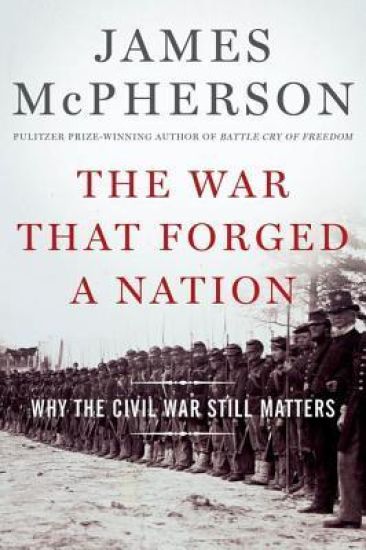
The War That Forged a Nation

The War That Forged a Nation

James M. McPherson

Oxford University Press Inc
2015
sidottu
More than 140 years ago, Mark Twain observed that the Civil War had "uprooted institutions that were centuries old, changed the politics of a people, transformed the social life of half the country, and wrought so profoundly upon the entire national character that the influence cannot be measured short of two or three generations." In fact, five generations have passed, and Americans are still trying to measure the influence of the immense fratricidal conflict that nearly tore the nation apart. In The War that Forged a Nation, Pulitzer Prize-winning historian James M. McPherson considers why the Civil War remains so deeply embedded in our national psyche and identity. The drama and tragedy of the war, from its scope and size--an estimated death toll of 750,000, far more than the rest of the country's wars combined--to the nearly mythical individuals involved--Abraham Lincoln, Robert E. Lee, Stonewall Jackson--help explain why the Civil War remains a topic of interest. But the legacy of the war extends far beyond historical interest or scholarly attention. Here, McPherson draws upon his work over the past fifty years to illuminate the war's continuing resonance across many dimensions of American life. Touching upon themes that include the war's causes and consequences; the naval war; slavery and its abolition; and Lincoln as commander in chief, McPherson ultimately proves the impossibility of understanding the issues of our own time unless we first understand their roots in the era of the Civil War. From racial inequality and conflict between the North and South to questions of state sovereignty or the role of government in social change--these issues, McPherson shows, are as salient and controversial today as they were in the 1860s. Thoughtful, provocative, and authoritative, The War that Forged a Nation looks anew at the reasons America's civil war has remained a subject of intense interest for the past century and a half, and affirms the enduring relevance of the conflict for America today.
Cost and Choice

Cost and Choice

James M. Buchanan

University of Chicago Press
1979
nidottu
"As he usually does, Professor Buchanan has produced an interesting and provocative piece of work. [Cost and Choice] starts off as an essay in the history of cost theory; the central ideas of the book are traced to Davenport and Knight in the United States, and to a series of distinguished writers associated at various times with the London School of Economics. The author emerges from this discussion with what can be described as the ultimate in subjectivist cost doctrines. . . . Economists should learn the lessons offered to us in this little book—and learn them well. It can save them from serious errors."—William J. Baumol, Journal of Economic Literature
The Limits of Liberty

The Limits of Liberty

James M. Buchanan

University of Chicago Press
1977
nidottu
"The Limits of Liberty is concerned mainly with two topics. One is an attempt to construct a new contractarian theory of the state, and the other deals with its legitimate limits. The latter is a matter of great practical importance and is of no small significance from the standpoint of political philosophy."—Scott Gordon, Journal of Political EconomyJames Buchanan offers a strikingly innovative approach to a pervasive problem of social philosophy. The problem is one of the classic paradoxes concerning man's freedom in society: in order to protect individual freedom, the state must restrict each person's right to act. Employing the techniques of modern economic analysis, Professor Buchanan reveals the conceptual basis of an individual's social rights by examining the evolution and development of these rights out of presocial conditions.
Legislating in the Dark

Legislating in the Dark

James M. Curry

University of Chicago Press
2015
sidottu
The 2009 financial stimulus bill ran to more than 1,100 pages, yet it wasn't even given to Congress in its final form until thirteen hours before debate was set to begin, and it was passed twenty-eight hours later. How are representatives expected to digest so much information in such a short time. The answer? They aren't. With Legislating in the Dark, James M. Curry reveals that the availability of information about legislation is a key tool through which Congressional leadership exercises power. Through a deft mix of legislative analysis, interviews, and participant observation, Curry shows how congresspersons-lacking the time and resources to study bills deeply themselves-are forced to rely on information and cues from their leadership. By controlling their rank-and-file's access to information, Congressional leaders are able to emphasize or bury particular items, exploiting their information advantage to push the legislative agenda in directions that they and their party prefer. Offering an unexpected new way of thinking about party power and influence, Legislating in the Dark will spark substantial debate in political science.
Legislating in the Dark

Legislating in the Dark

James M. Curry

University of Chicago Press
2015
nidottu
The 2009 financial stimulus bill ran to more than 1,100 pages, yet it wasn't even given to Congress in its final form until thirteen hours before debate was set to begin, and it was passed twenty-eight hours later. How are representatives expected to digest so much information in such a short time. The answer? They aren't. With Legislating in the Dark, James M. Curry reveals that the availability of information about legislation is a key tool through which Congressional leadership exercises power. Through a deft mix of legislative analysis, interviews, and participant observation, Curry shows how congresspersons-lacking the time and resources to study bills deeply themselves-are forced to rely on information and cues from their leadership. By controlling their rank-and-file's access to information, Congressional leaders are able to emphasize or bury particular items, exploiting their information advantage to push the legislative agenda in directions that they and their party prefer. Offering an unexpected new way of thinking about party power and influence, Legislating in the Dark will spark substantial debate in political science.
Can Ethics Be Christian?

Can Ethics Be Christian?

James M. Gustafson

University of Chicago Press
1977
nidottu
Is there a special relation between religious beliefs and moral behavior? In particular, is there a distinctive Christian moral character and how is this manifested in moral actions? The influential theologian James M. Gustafson probes these questions and offers an analysis of the distinctively religious reasons of the "heart and mind" which constitute the basis for a Christian ethics. Professor Gustafson grounds his discussion in a concrete example of moral conduct which deeply impressed him. The incident—narrated in detail at the start and referred to throughout—concerns a nonreligious colleague who came to the aid of an intoxicated soldier. Although seemingly trivial, this incident, in the author's view, approximates the normal sorts of experiences in which individuals have to make moral decisions every day; it becomes a touchstone to investigate the logical, social, and religious elements in moral decision making.
Protestant and Roman Catholic Ethics: Prospects for Rapprochement

Protestant and Roman Catholic Ethics: Prospects for Rapprochement

James M. Gustafson

University of Chicago Press
1980
nidottu
"If Catholic and Protestant ethicians were asked to name a single theologian who was qualified to write a comprehensive overview of the historical divergences of Catholic and Protestant positions on ethical questions, the bases for those divergences in fundamentally different philosophical and theological perspectives, and the possibilities for future convergences of the traditions, my guess is that James Gustafson would be the one. . . . This brilliant and tightly argued book . . . will be the most important book on moral theology to appear this year."--John Coleman, National Catholic Reporter
Ethics from a Theocentric Perspective, Volume 1

Ethics from a Theocentric Perspective, Volume 1

James M. Gustafson

University of Chicago Press
1983
nidottu
"Ethics from a Theocentric Perspective will surprise some, shock others, and unleash a flood of speculation about what has happened to James Gustafson. The answer quite simply is nothing has happened to Gustafson except that he has now turned his attention to developing his constructive theological position, and we should all be very glad. . . . In this, the first of two volumes, Gustafson displays his colors as a constructive theologian, and they are indeed brilliant and splendid. . . . Though Gustafson is a theologian who works in the Christian tradition, he reminds us that the God Christians worship is not merely the Christian God. For Gustafson the kind of God who is the object of the theologians's reflection eludes or surpasses the inevitably confessional activity of Christian theological reflection. Thus Gustafson, the constructive theologian, is also Gustafson the revisionist theologian who takes as his task nothing less than challenging the anthropocentrism that he alleges characterizes mainstream Western Christian theology."—Stanley Hauerwas, Journal of Religion
Ethics from a Theocentric Perspective, Volume 2

Ethics from a Theocentric Perspective, Volume 2

James M. Gustafson

University of Chicago Press
1992
nidottu
Gustafson's two-volume work has been hailed as a major contribution to Christian ethics. In this second volume, Gustafson considers marriage, suicide, and the allocation of resources in famine and in biomedical research to develop an ethical outlook in which divine purpose is the basis of moral activity. "Breadth and subtlety, wisdom and insight . . . Gustafson is a first-rate theologian."—Commonweal "The two-volume work, now complete, will be a benchmark for discussions of Christian ethics for years to come. With it Gustafson becomes one of the thinkers by whom others can, by agreement or divergence, define their own ethics."—Roger L. Shinn, Christianity and Crisis"Gustafson's theocentrism is an original and creative contribution to modern ethical discussion."—Douglas Sturm, Ethics
Getting Your Way

Getting Your Way

James M. Jasper

University of Chicago Press
2006
sidottu
Getting other people to do what we want is a useful skill for anyone. Whether you’re seeking a job, negotiating a deal, or angling for that big promotion, you’re engaged in strategic thought and action. In such moments, you imagine what might be going on in another person’s head and how they’ll react to what you do or say. At the same time, you also try to pick the best way to realize your goals, both with and without the other person’s cooperation. Getting Your Way teaches us how to win that game by offering a fuller understanding of how strategy works in the real world.As we all know, rules of strategy are regularly discovered and discussed in popular books for business executives, military leaders, and politicians. Those works with their trendy lists of pithy maxims and highly effective habits can help people avoid mistakes or even think anew about how to tackle their problems. But they are merely suggestive, as each situation we encounter in the real world is always more complex than anticipated, more challenging than we had hoped. James M. Jasper here shows us how to anticipate those problems before they actually occur—by recognizing the dilemmas all strategic players must negotiate, with each option accompanied by a long list of costs and risks. Considering everyday dilemmas in a broad range of familiar settings, from business and politics to love and war, Jasper explains how to envision your goals, how to make the first move, how to deal with threats, and how to employ strategies with greater confidence.Alexander the Great, Genghis Khan, Rosa Parks, Hugo Chávez, and David Koresh all come into play in this smart and engaging book, one that helps us recognize and prepare for the many dilemmas inherent in any strategic action.
Getting Your Way

Getting Your Way

James M. Jasper

University of Chicago Press
2015
nidottu
Getting other people to do what we want is a useful skill for anyone. Whether you're seeking a job, negotiating a deal, or angling for that big promotion, you're engaged in strategic thought and action. In such moments, you imagine what might be going on in another person's head and how they'll react to what you do or say. At the same time, you also try to pick the best way to realize your goals, both with and without the other person's cooperation. Getting Your Way teaches us how to win that game by offering a fuller understanding of how strategy works in the real world. As we all know, rules of strategy are regularly discovered and discussed in popular books for business executives, military leaders, and politicians. Those works with their trendy lists of pithy maxims and highly effective habits can help people avoid mistakes or even think anew about how to tackle their problems. But they are merely suggestive, as each situation we encounter in the real world is always more complex than anticipated, more challenging than we had hoped. James M. Jasper here shows us how to anticipate those problems before they actually occur-by recognizing the dilemmas all strategic players must negotiate, with each option accompanied by a long list of costs and risks. Considering everyday dilemmas in a broad range of familiar settings, from business and politics to love and war, Jasper explains how to envision your goals, how to make the first move, how to deal with threats, and how to employ strategies with greater confidence. Alexander the Great, Genghis Khan, Rosa Parks, Hugo Chavez, and David Koresh all come into play in this smart and engaging book, one that helps us recognize and prepare for the many dilemmas inherent in any strategic action.
Restless Nation

Restless Nation

James M. Jasper

University of Chicago Press
2000
sidottu
In Restless Nation, James M. Jasper isolates a narrative that lies very close to the core of the American character. From colonial times to the present day, Americans have always had a deep-rooted belief in the "fresh start"—a belief that still has Americans moving from place to place faster than the citizens of any other nation.
Restless Nation

Restless Nation

James M. Jasper

University of Chicago Press
2002
nidottu
In Restless Nation, James M. Jasper isolates a narrative that lies very close to the core of the American character. From colonial times to the present day, Americans have always had a deep-rooted belief in the "fresh start"—a belief that still has Americans moving from place to place faster than the citizens of any other nation.
The Art of Moral Protest

The Art of Moral Protest

James M. Jasper

University of Chicago Press
1998
sidottu
Protest has become an everyday part of modern societies, one of the few recognized outlets for voicing and discussing basic moral commitments. Protest movements shape our thinking about social change and human agency. At a time when schools, the media, and even religious institutions offer little guidance for our moral judgments, protest movements have become a central source for providing us with ethical visions and creative ideas. In this book, James Jasper integrates diverse examples of protest, from 19th-century boycotts to recent anti-nuclear, animal-rights, and environmental movements, into a understanding of how social movements operate. He highlights their creativity, not only in forging new morals but in adopting courses of action and inventing organizational forms. The work stresses the role of individuals, both as lone protesters and as key decision-makers, and it emphasizes the open-ended nature of strategic choices as protesters, their opponents, their allies, and the government respond to each other's actions. The book also synthesizes the many concepts developed in recent years as part of the cultural approach to social movements, placing them in context and showing what they mean for other scholarly traditions. Drawing on lengthy interviews, historical materials, surveys, and his own participation in protests, Jasper offers a systematic overview of the field of social movements. He weaves together accounts of large-scale movements with individual biographies, placing the movements in cultural perspective and focusing on individuals' experiences.
The Art of Moral Protest

The Art of Moral Protest

James M. Jasper

University of Chicago Press
1999
nidottu
Protest has become an everyday part of modern societies, one of the few recognized outlets for voicing and discussing basic moral commitments. Protest movements shape our thinking about social change and human agency. At a time when schools, the media, and even religious institutions offer little guidance for our moral judgments, protest movements have become a central source for providing us with ethical visions and creative ideas. In this book, James Jasper integrates diverse examples of protest, from 19th-century boycotts to recent anti-nuclear, animal-rights, and environmental movements, into an understanding of how social movements operate. He highlights their creativity, not only in forging new morals but in adopting courses of action and inventing organizational forms. The work stresses the role of individuals, both as lone protesters and as key decision-makers, and it emphasizes the open-ended nature of strategic choices as protesters, their opponents, their allies, and the government respond to each other's actions. The book also synthesizes the many concepts developed in recent years as part of the cultural approach to social movements, placing them in context and showing what they mean for other scholarly traditions. Drawing on lengthy interviews, historical materials, surveys, and his own participation in protests, Jasper offers a systematic overview of the field of social movements. He weaves together accounts of large-scale movements with individual biographies, placing the movements in cultural perspective and focusing on individuals' experiences.
Between Copernicus and Galileo

Between Copernicus and Galileo

James M. Lattis

University of Chicago Press
1994
sidottu
Between Copernicus and Galileo is the story of Christoph Clavius, the Jesuit astronomer and teacher whose work helped set the standards by which Galileo's famous claims appeared so radical, and whose teachings guided the intellectual and scientific agenda of the Church in the central years of the Scientific Revolution. Though relatively unknown today, Clavius was enormously influential throughout Europe in the late 16th and early 17th centuries through his astronomy books - the standard texts used in many colleges and universities, and the tools with which Descartes, Gassendi and Mersenne, among many others, learned their astronomy. James Lattis uses Clavius's own publications, as well as archival materials, to trace the central role Clavius played in integrating traditional Ptolemaic astronomy and Aristotelian natural philosophy into an orthodox cosmology. Although Clavius strongly resisted the new cosmologies of Copernicus and Tycho, Galileo's invention of the telescope ultimately eroded the Ptolemaic world view. By tracing Clavius's views from medieval cosmology to the 17th century, Lattis illuminates the conceptual shift from Ptolemaic to Copernican astronomy and the social, intellectual and theological impact of the Scientific Revolution.
Between Copernicus and Galileo

Between Copernicus and Galileo

James M. Lattis

University of Chicago Press
1995
nidottu
Between Copernicus and Galileo is the story of Christoph Clavius, the Jesuit astronomer and teacher whose work helped set the standards by which Galileo's famous claims appeared so radical, and whose teachings guided the intellectual and scientific agenda of the Church in the central years of the Scientific Revolution. Though relatively unknown today, Clavius was enormously influential throughout Europe in the late 16th and early 17th centuries through his astronomy books - the standard texts used in many colleges and universities, and the tools with which Descartes, Gassendi and Mersenne, among many others, learned their astronomy. James Lattis uses Clavius's own publications, as well as archival materials, to trace the central role Clavius played in integrating traditional Ptolemaic astronomy and Aristotelian natural philosophy into an orthodox cosmology. Although Clavius strongly resisted the new cosmologies of Copernicus and Tycho, Galileo's invention of the telescope ultimately eroded the Ptolemaic world view. By tracing Clavius's views from medieval cosmology to the 17th century, Lattis illuminates the conceptual shift from Ptolemaic to Copernican astronomy and the social, intellectual and theological impact of the Scientific Revolution.
The Emotions of Protest

The Emotions of Protest

James M. Jasper

University of Chicago Press
2018
pokkari
In Donald Trump's America, protesting has roared back into fashion. The Women's March, held the day after Trump's inauguration, may have been the largest in American history, and resonated around the world. Between Trump's tweets and the march's popularity, it is clear that displays of anger dominate American politics once again. There is an extensive body of research on protest, but the focus has mostly been on the calculating brain--a byproduct of structuralism and cognitive studies--and less on the feeling brain. James M. Jasper's work changes that, as he pushes the boundaries of our present understanding of the social world. In The Emotions of Protest, Jasper lays out his argument, showing that it is impossible to separate cognition and emotion. At a minimum, he says, we cannot understand the Tea Party or Occupy Wall Street or pro and anti-Trump rallies without first studying the fears and anger, moral outrage, and patterns of hate and love that their members feel. This is a book centered on protest, but Jasper also points toward broader paths of inquiry that have the power to transform the way social scientists picture social life and action. Through emotions, he says, we are embedded in a variety of environmental, bodily, social, moral, and temporal contexts, as we feel our way both consciously and unconsciously toward some things and away from others. Politics and collective action have always been a kind of laboratory for working out models of human action more generally, and emotions are no exception. Both hearts and minds rely on the same feelings racing through our central nervous systems. Protestors have emotions, like everyone else, but theirs are thinking hearts, not bleeding hearts. Brains can feel, and hearts can think.