Kirjojen hintavertailu. Mukana 11 433 028 kirjaa ja 12 kauppaa.

Kirjahaku

Etsi kirjoja tekijän nimen, kirjan nimen tai ISBN:n perusteella.

1000 tulosta hakusanalla John H. Harding Jr

Playing God?

Playing God?

John H. Evans

University of Chicago Press
2002
nidottu
Technology evolves at a dazzling speed, and nowhere more so than in the field of genetic engineering, where the possibility of directly changing the genes of one's children is quickly becoming a reality. The public is rightly concerned, but interestingly, they have not had much to say about the implications of recent advancements in human genetics. Playing God? asks why and explores the social forces that have led to the thinning out of public debate over human genetic engineering. John H. Evans contends that the problem lies in the structure of the debate itself. Disputes over human genetic engineering concern the means for achieving assumed ends, rather than being a healthy discussion about the ends themselves. According to Evans, this change in focus occurred as the jurisdiction over the debate shifted from scientists to bioethicists, a change which itself was caused by the rise of the bureaucratic state as the authority in such matters. The implications of this timely study are twofold. Evans not only explores how decisions about the ethics of human genetic engineering are made, but also shows how the structure of the debate has led to the technological choices we now face.
Contested Reproduction

Contested Reproduction

John H. Evans

University of Chicago Press
2010
sidottu
Scientific breakthroughs have led us to a point where soon we will be able to make specific choices about the genetic makeup of our offspring. In fact, this reality has arrived - and it is only a matter of time before the technology becomes widespread. Much like past arguments about stem-cell research, the coming debate over these reproductive genetic technologies (RGTs) will be both political and, for many people, religious. In order to understand how the debate will play out in the United States, John H. Evans conducted the first in-depth study of the claims made about RGTs by religious people from across the political spectrum, and "Contested Reproduction" is the stimulating result. Some of the opinions Evans documents are familiar, but others - such as the idea that certain genetic conditions produce a 'meaningful suffering' that is, ultimately, desirable - provide a fascinating glimpse of religious reactions to cutting-edge science. Not surprisingly, Evans discovers that for many people opinion on the issue closely relates to their feelings about abortion, but he also finds a shared moral language that offers a way around the unproductive polarization of the abortion debate and other culture-war concerns. "Contested Reproduction" is a prescient, profound look into the future of a hot-button issue.
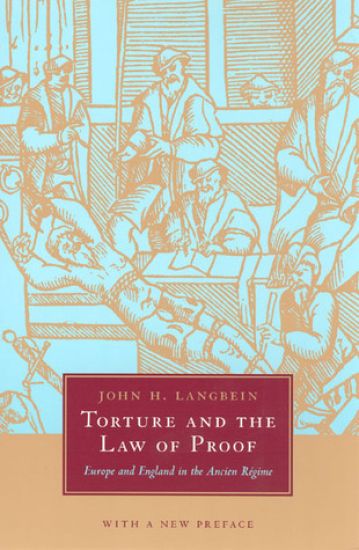
Torture and the Law of Proof

Torture and the Law of Proof

John H. Langbein

University of Chicago Press
2006
nidottu
"In Torture and the Law of Proof", John H. Langbein explores the world of the thumbscrew and the rack, engines of torture authorized for investigating crime in European legal systems from medieval times until well into the eighteenth century. Drawing on juristic literature and legal records, Langbein's book, first published in 1977, remains the definitive account of how European legal systems became dependent on the use of torture in their routine criminal procedures and how they eventually worked themselves free of it. The book has recently taken on an eerie relevance as a consequence of controversial American and British interrogation practices in the Iraq and Afghanistan wars. In a new introduction, Langbein contrasts the "new" law of torture with the older European law and offers pointed lessons about the difficulty of reconciling coercion with accurate investigation. Embellished with fascinating illustrations of torture devices taken from eighteenth-century criminal code, this crisply written account will engage all those interested in torture's remarkable grip on European legal history.
Why Parties Matter

Why Parties Matter

John H. Aldrich; John D. Griffin

University of Chicago Press
2018
sidottu
Since the founding of the American Republic, the North and South have followed remarkably different paths of political development. Among the factors that have led to their divergence throughout much of history are differences in the levels of competition among the political parties. While the North has generally enjoyed a well-defined two-party system, the South has tended to have only weakly developed political parties and at times no system of parties to speak of. With Why Parties Matter, John H. Aldrich and John D. Griffin make a compelling case that competition between political parties is an essential component of a democracy that is responsive to its citizens and thus able to address their concerns. Tracing the history of the parties through four eras the Democratic-Whig party era that preceded the Civil War; the post-Reconstruction period; the Jim Crow era, when competition between the parties virtually disappeared; and the modern era Aldrich and Griffin show how and when competition emerged between the parties and the conditions under which it succeeded and failed. In the modern era, as party competition in the South has come to be widely regarded as matching that of the North, the authors conclude by exploring the question of whether the South is poised to become a one-party system once again with the Republican party now dominant.
Why Parties Matter

Why Parties Matter

John H. Aldrich; John D. Griffin

University of Chicago Press
2018
nidottu
Since the founding of the American Republic, the North and South have followed remarkably different paths of political development. Among the factors that have led to their divergence throughout much of history are differences in the levels of competition among the political parties. While the North has generally enjoyed a well-defined two-party system, the South has tended to have only weakly developed political parties and at times no system of parties to speak of. With Why Parties Matter, John H. Aldrich and John D. Griffin make a compelling case that competition between political parties is an essential component of a democracy that is responsive to its citizens and thus able to address their concerns. Tracing the history of the parties through four eras the Democratic-Whig party era that preceded the Civil War; the post-Reconstruction period; the Jim Crow era, when competition between the parties virtually disappeared; and the modern era Aldrich and Griffin show how and when competition emerged between the parties and the conditions under which it succeeded and failed. In the modern era, as party competition in the South has come to be widely regarded as matching that of the North, the authors conclude by exploring the question of whether the South is poised to become a one-party system once again with the Republican party now dominant.
The Gestation of German Biology

The Gestation of German Biology

John H. Zammito

University of Chicago Press
2017
sidottu
The emergence of biology as a distinct science in the eighteenth century has long been a subject of scholarly controversy. Michel Foucault, on the one hand, argued that its appearance only after 1800 represented a fundamental rupture with the natural history that preceded it, marking the beginnings of modernity. Ernst Mayr, on the other hand, insisted that even the word "biology" was unclear in its meaning as late as 1800, and that the field itself was essentially prospective well into the 1800s. In The Gestation of German Biology, historian of ideas John Zammito presents a different version of the emergence of the field, one that takes on both Foucault and Mayr and emphasizes the scientific progress throughout the eighteenth century that led to the recognition of the need for a special science. The embrace of the term biology around 1800, Zammito shows, was the culmination of a convergence between natural history and human physiology that led to the development of comparative physiology and morphology the foundations of biology. Magisterial in scope, Zammito's book offers nothing less than a revisionist history of the field, with which anyone interested in the origins of biology will have to contend.
The Genesis of Kant's Critique of Judgment

The Genesis of Kant's Critique of Judgment

John H. Zammito

University of Chicago Press
1992
nidottu
In this philosophically sophisticated and historically significant work, John H. Zammito reconstructs Kant's composition of The Critique of Judgment and reveals that it underwent three major transformations before publication. He shows that Kant not only made his "cognitive" turn, expanding the project from a "Critique of Taste" to a Critique of Judgment but he also made an "ethical" turn. This "ethical" turn was provoked by controversies in German philosophical and religious culture, in particular the writings of Johann Herder and the Sturm und Drang movement in art and science, as well as the related pantheism controversy. Such topicality made the Third Critique pivotal in creating a "Kantian" movement in the 1790s, leading directly to German Idealism and Romanticism. The austerity and grandeur of Kant's philosophical writings sometimes make it hard to recognize them as the products of a historical individual situated in the particular constellation of his time and society. Here Kant emerges as a concrete historical figure struggling to preserve the achievements of cosmopolitan Aufkl-rung against challenges in natural science, religion, and politics in the late 1780s. More specifically Zammito suggests that Kant's Third Critique was animated throughout by a fierce personal rivalry with Herder and by a strong commitment to traditional Christian ideas of God and human moral freedom. "A work of extraordinary erudition. Zammito's study is both comprehensive and novel, connecting Kant's work with the aesthetic and religious controversies of the late eighteenth century. He seems to have read everything. I know of no comparable historical study of Kant's Third Critique."-Arnulf Zweig, translator and editor of Kant's ;IPhilosophical Correspondence, 1759-1799;X"An intricate, subtle, and exciting explanation of how Kant's thinking developed and adjusted to new challenges over the decade from the first edition of the Critique of Pure Reason to the appearance of the Critique of Judgment."—John W. Burbidge, Review of Metaphysics"There has been for a long time a serious gap in English commentary on Kant's Critique of Judgment; Zammito's book finally fills it. All students and scholars of Kant will want to consult it."—Frederick Beiser, Times Literary Supplement
Kant, Herder, and the Birth of Anthropology

Kant, Herder, and the Birth of Anthropology

John H. Zammito

University of Chicago Press
2002
nidottu
If Kant had never made the "critical turn" of 1773, would he be worth more than a paragraph in the history of philosophy? Most scholars think not. But in this pioneering book, John H. Zammito challenges that view by revealing a precritical Kant who was immensely more influential than the one philosophers think they know. Zammito also reveals Kant's former student and latter-day rival, Johann Herder, to be a much more philosophically interesting thinker than is usually assumed and, in many important respects, historically as influential as Kant. Relying on previously unexamined sources, Zammito traces Kant's friendship with Herder as well as the personal tensions that destroyed their relationship. From this he shows how two very different philosophers emerged from the same beginnings and how, because of Herder's reformulation of Kant, anthropology was born out of philosophy. Shedding light on an overlooked period of philosophical development, this book is a major contribution to the history of philosophy and the social sciences, and especially to the history of anthropology.
A Nice Derangement of Epistemes

A Nice Derangement of Epistemes

John H. Zammito

University of Chicago Press
2004
sidottu
Since the 1950s, many philosophers of science have attacked positivism—the theory that scientific knowledge is grounded in objective reality. Reconstructing the history of these critiques, John H. Zammito argues that while so-called postpositivist theories of science are very often invoked, they actually provide little support for fashionable postmodern approaches to science studies.Zammito shows how problems that Quine and Kuhn saw in the philosophy of the natural sciences inspired a turn to the philosophy of language for resolution. This linguistic turn led to claims that science needs to be situated in both historical and social contexts, but the claims of recent "science studies" only deepened the philosophical quandary. In essence, Zammito argues that none of the problems with positivism provides the slightest justification for denigrating empirical inquiry and scientific practice, delivering quite a blow to the "discipline" postmodern science studies.Filling a gap in scholarship to date, A Nice Derangement of Epistemes will appeal to historians, philosophers, philosophers of science, and the broader scientific community.
A Nice Derangement of Epistemes

A Nice Derangement of Epistemes

John H. Zammito

University of Chicago Press
2004
nidottu
Since the 1950s, many philosophers of science have attacked positivism—the theory that scientific knowledge is grounded in objective reality. Reconstructing the history of these critiques, John H. Zammito argues that while so-called postpositivist theories of science are very often invoked, they actually provide little support for fashionable postmodern approaches to science studies.Zammito shows how problems that Quine and Kuhn saw in the philosophy of the natural sciences inspired a turn to the philosophy of language for resolution. This linguistic turn led to claims that science needs to be situated in both historical and social contexts, but the claims of recent "science studies" only deepened the philosophical quandary. In essence, Zammito argues that none of the problems with positivism provides the slightest justification for denigrating empirical inquiry and scientific practice, delivering quite a blow to the "discipline" postmodern science studies.Filling a gap in scholarship to date, A Nice Derangement of Epistemes will appeal to historians, philosophers, philosophers of science, and the broader scientific community.
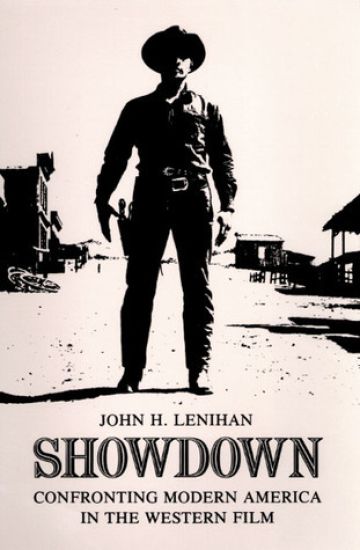
Showdown

Showdown

John H. Lenihan

University of Illinois Press
1980
nidottu
"Lenihan's fine study [brings] new levels of scholarship and sophistication to the study of western films.... Should prove useful in the classroom, both for social history and film history courses. It will introduce readers to a new way to view some of the old horse operas that they had once taken for granted as fluffy entertainment." -- Western American Literature '"The best of the recent books to deal with Westerns produced since World War II --- in fact, probably the best recent study of the Western." -- Journal of the West "Recommended for the student of film and the hardcore film buff. The rest of you will be surprised, delighted, perhaps even angered by some of the conclusions Lenihan has come to." -- Film World
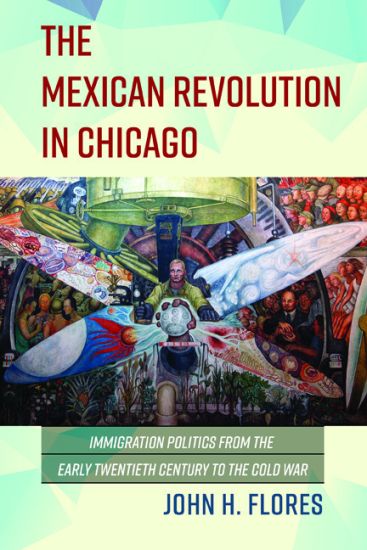
The Mexican Revolution in Chicago

The Mexican Revolution in Chicago

John H Flores

University of Illinois Press
2018
sidottu
Few realize that long before the political activism of the 1960s, there existed a broad social movement in the United States spearheaded by a generation of Mexican immigrants inspired by the revolution in their homeland. Many revolutionaries eschewed U.S. citizenship and have thus far been lost to history, though they have much to teach us about the increasingly international world of today. John H. Flores follows this revolutionary generation of Mexican immigrants and the transnational movements they created in the United States. Through a careful, detailed study of Chicagoland, the area in and around Chicago, Flores examines how competing immigrant organizations raised funds, joined labor unions and churches, engaged the Spanish-language media, and appealed in their own ways to the dignity and unity of other Mexicans. Painting portraits of liberals and radicals, who drew support from the Mexican government, and conservatives, who found a homegrown American ally in the Roman Catholic Church, Flores recovers a complex and little known political world shaped by events south of the U.S border.
Taking Heaven by Storm

Taking Heaven by Storm

John H. Wigger

University of Illinois Press
2001
nidottu
In 1770 there were fewer than 1,000 Methodists in America. Fifty years later, the church counted more than 250,000 adherents. Identifying Methodism as America's most significant large-scale popular religious movement of the antebellum period, John H. Wigger reveals what made Methodism so attractive to post-revolutionary America. Taking Heaven by Storm shows how Methodism fed into popular religious enthusiasm as well as the social and economic ambitions of the "middling people on the make"--skilled artisans, shopkeepers, small planters, petty merchants--who constituted its core. Wigger describes how the movement expanded its reach and fostered communal intimacy and "intemperate zeal" by means of an efficient system of itinerant and local preachers, class meetings, love feasts, quarterly meetings, and camp meetings. He also examines the important role of African Americans and women in early American Methodism and explains how the movement's willingness to accept impressions, dreams, and visions as evidence of the work and call of God circumvented conventional assumptions about education, social standing, gender, and race. A pivotal text on the role of religion in American life, Taking Heaven by Storm shows how the enthusiastic, egalitarian, entrepreneurial, lay-oriented spirit of early American Methodism continues to shape popular religion today.
Poetry and Violence

Poetry and Violence

John H. McDowell

University of Illinois Press
2008
nidottu
John H. McDowell provides an in-depth look at the Mexican ballad form known as the corrido, a body of poetry that draws from violence for its subject matter. Through interviews with male and female corrido composers and performers, plus a generous sampling of ballad texts, McDowell reveals a living vernacular tradition that chronicles local and regional rivalries and spawned the narcocorrido, ballads set in the drug trade and particularly popular along the Rio Grande border. Detailed and rife with social and cultural implications, Poetry and Violence is a compelling commentary on violence as both human experience and communicative action.
The Mexican Revolution in Chicago

The Mexican Revolution in Chicago

John H Flores

University of Illinois Press
2018
nidottu
Few realize that long before the political activism of the 1960s, there existed a broad social movement in the United States spearheaded by a generation of Mexican immigrants inspired by the revolution in their homeland. Many revolutionaries eschewed U.S. citizenship and have thus far been lost to history, though they have much to teach us about the increasingly international world of today. John H. Flores follows this revolutionary generation of Mexican immigrants and the transnational movements they created in the United States. Through a careful, detailed study of Chicagoland, the area in and around Chicago, Flores examines how competing immigrant organizations raised funds, joined labor unions and churches, engaged the Spanish-language media, and appealed in their own ways to the dignity and unity of other Mexicans. Painting portraits of liberals and radicals, who drew support from the Mexican government, and conservatives, who found a homegrown American ally in the Roman Catholic Church, Flores recovers a complex and little known political world shaped by events south of the U.S border.
The Ahmadiyya in the Gold Coast

The Ahmadiyya in the Gold Coast

John H. Hanson

Indiana University Press
2017
sidottu
The Ahmadiyya Muslim Community, a global movement with more than half a million Ghanaian members, runs an extensive network of English-language schools and medical facilities in Ghana today. Founded in South Asia in 1889, the Ahmadiyya arrived in Ghana when a small coastal community invited an Ahmadiyya missionary to visit in 1921. Why did this invitation arise and how did the Ahmadiyya become such a vibrant religious community? John H. Hanson places the early history of the Ahmadiyya into the religious and cultural transformations of the British Gold Coast (colonial Ghana). Beginning with accounts of the visions of the African Methodist Binyameen Sam, Hanson reveals how Sam established a Muslim community in a coastal context dominated by indigenous expressions and Christian missions. Hanson also illuminates the Islamic networks that connected this small Muslim community through London to British India. African Ahmadi Muslims, working with a few South Asian Ahmadiyya missionaries, spread the Ahmadiyya's theological message and educational ethos with zeal and effectiveness. This is a global story of religious engagement, modernity, and cultural transformations arising at the dawn of independence.