

Kirjahaku
Etsi kirjoja tekijän nimen, kirjan nimen tai ISBN:n perusteella.
1000 tulosta hakusanalla Marianne Stringer

Victoria Benedictsson (1850-88) var en svensk författare och dramatiker som lät publicera sig under pseudonymen Ernst Ahlgren. Trots den korta tid som hennes författargärning omfattade anses hon som en av de främsta bland 1880-talets realistiska författare.Fru Marianne (1887) handlar om en romantiskt lagd, bortskämd borgarflicka som gifter sig med en bonde och flyttar ut på landsbygden. Det nya livet som bondhustru är dock inte okomplicerat och det verkliga livet skiljer sig betydligt från den bild hon skapat sig genom romanerna.I Fru Marianne får läsaren följa en ung kvinnas utveckling, de insikter hon tillägnar sig och de krav som ställs på en vuxen kvinna i rollen som hustru och mor. Romanen kan även ses som ett försök från Benedictssons sida att bidra med nyanser till den debatt kring äktenskapet som pågick vid den här tiden.

Chez Marianne 3 on suositun ranskan kielen oppimateriaalisarjan edistyneen tason oppikirja. Se on suunniteltu etenkin yliopistojen, ammattikorkeakoulujen sekä kansalais- ja työväenopistojen kursseille, mutta soveltuu myös osaamisen syventämiseen itseopiskelussa. Eurooppalaisessa viitekehyksessä kirja sijoittuu tasolle B1-B2.Mediasta ja kirjallisuudesta valikoidut autenttiset tekstit tutustuttavat opiskelijan erilaisiin teksti- ja tyylilajeihin, suullista ilmaisua unohtamatta. Ranskalaisen yhteiskunnan ja kulttuurin lisäksi teksteissä käsitellään ajankohtaisia aiheita, kuten ekologisuus ja terveet elämäntavat. Kieliopissa kerrataan ranskan perusrakenteet. Monipuoliset harjoitukset laajentavat sanavarastoa ja kehittävät valmiutta ilmaista itseä luontevasti ranskan kielellä.

La vie de Marianne, ou les aventures de Madame la comtesse de ***, par Monsieur de Marivaux. ... of 4; Volume 1
Pierre Carlet De Chamblain De Marivaux
Wentworth Press
2018
sidottu

La vie de Marianne, ou les aventures de Madame la comtesse de ***. Par M. de Marivaux. of 4; Volume 1
Pierre Carlet De Chamblain De Marivaux
Wentworth Press
2018
sidottu
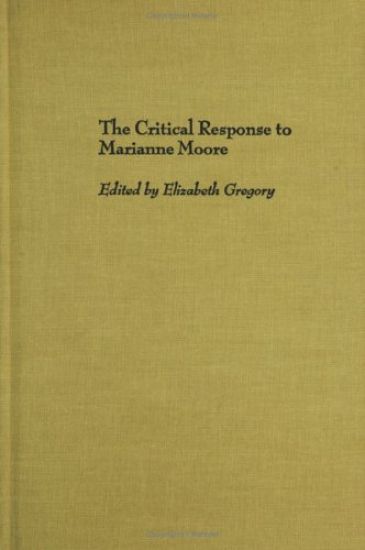
Gregory documents for the first time, the critical reception history of the great modernist poet Marianne Moore. This collection of 71 of the most important and provocative reviews and essays from across Moore's long career (1915-1972) includes pivotal articles by H. D., T. S. Eliot, Mark Van Doren, Ezra Pound, Richard Aldington, Edith Sitwell, Harriet Monroe, Alfred Kreymborg, William Carlos Williams, Scofield Thayer, Wallace Stevens, F. R. Leavis, Morton Zabel, Randall Jarrell, Elizabeth Bishop, W.H. Auden, Muriel Rukeyser, Glenway Wescott, Kenneth Koch, John Ashbery, Hilton Kramer and many others. The individual reviews are themselves of considerable literary note. And together they chart the development of a major contributor to the American modernist scene, whose work actively critiques the structures of literary authority. The critical reviews also move beyond the modernist period, to track the evolution of her career in the 1950s and 1960s, when she crossed the line from the elite little magazines into popular culture. The editor's introduction analyses the ways in which the two stages of Moore's career converge. In addition to the historical texts, which cover the period from 1916 to 1999, this volume includes two new essays that offer fresh approaches to reading Moore.

This book traces the development of Marianne Moore's poetry throughout her sixty-year career as one of America's finest poets. Margaret Holley examines changes in Moore's approach to moral and artistic values, and discusses how language and form were distinctive in each of the poet's major phases. The study shows how the solitary, satirical voice of Moore's early verses matured into the wise observer of the later, major poems. Holley demonstrates how the virtuoso work of the middle years, infused with compassion and a sense of community, relaxed into the playful meditations of Moore's old age, when fame had brought her wide readership and acclaim. In exploring how shifts in Moore's poetic voice reflected important stages of her overall poetic growth, Holley provides detailed readings of the poems. The poetic strategies examined include: Moore's deployment of emblems and mottoes, her blend of overt and covert quotation, changes in her metaphoric language, her use of model stanzas in syllabic verse, her preferences for rhyme and closure, and her distinct spatial imagination.

Down Goes Marianne: Monson, Delcassé, and the Anglo-French Dispute Over Fashoda
Craig E. Saucier
Southern Girl Press
2013
nidottu
The Fashoda crisis of 1898 was a confrontation between Britain and France over imperial control of the Upper Nile valley. On the surface, the contested prize, a deserted and crumbling fortress on the Nile, appeared to have little intrinsic significance. In fact, the crisis involved a range of larger and interrelated issues: quarrels over imperial preponderance in Africa and the Nile valley, concerns over the stability of the Ottoman Empire, and polemics over national honor. Little disagreement exists in historical literature about its significance as a turning point in the relations between Britain and France. The crisis forced the resolution of the Egyptian and Upper Nile questions and ultimately served as the catalyst to eventual rapprochement. The Entente Cordiale of 1904 proved to be the instrument that ended centuries of Anglo-French antagonism and contributed to the formation of the Triple Entente. The crisis followed the meeting at Fashoda in mid-September 1898 between Captain Jean-Baptiste Marchand and Colonel Herbert Kitchener, both under orders to claim the region on behalf of their governments. For four months, the dispute brought France and Britain near the brink of war. British Prime Minister Lord Salisbury and French Foreign M inister Th ophile Delcass stood At the heart of the negotiations to resolve the crisis. This work focuses on the role of Sir Edmund John Monson, British ambassador to France. Much of the historical scholarship concentrates on the policies of Salisbury and Delcass and provides a limited assessment of Monson's role during the negotiations. Furthermore, most of these works ignore crucial domestic considerations-most significantly, the Dreyfus Affair that altered the setting in which the negotiations were to be conducted. Throughout the crisis, the French temper grew more explosive and more unpredictable. As the French government failed to control the domestic agitation over revision and the accompanying turmoil, Monson increasingly feared French leaders might attempt to divert public attention away from the Affair with a military confrontation against Britain. Monson's role during the crisis followed two phases. From September to October 1898, he provided an active voice for Salisbury and thus engaged Delcass in often animated discussions. From October to November, however, growing dissatisfaction with Monson's performance diminished his influence. Three factors ensured his relegation to the periphery of the discussions. First, the growth of professionalism within the British diplomatic service and a technological revolution in communications diminished ambassadors' independence and initiative. Second, the international prestige of the British empire meant that foreign governments generally conducted their diplomatic relations with Britain in London. Third, Salisbury and Delcass ultimately preferred to negotiate through the French ambassador in London. On the one hand, in Paris, Delcass grew frustrated with his inability to persuade the ambassador to moderate Britain's hard-line position. On the other hand, in London, Salisbury increasingly doubted the soundness and reliability of Monson's reporting. As a result, the negotiations that resolved the Fashoda crisis shifted to London and Monson was thereafter ignored. Clearly, Monson clearly played a minimal role in the ultimate resolution of the Fashoda crisis. Consequently, the concentration on the ambassador presents the reader with an interesting if not obvious question -- namely, why bother? Given the institutional and technological limitations placed upon him, the reader might question whether Monson could have played anything but a peripheral function. Therefore, the consideration of Monson's role during the crisis helps to provide a more thorough appreciation of the changing nature of British diplomatic representation in the late nineteenth century.

Relieved widow Marianne has vowed never to let a man have power over her again after surviving a hellish marriage. Determined to maintain her independence, she refuses to let her scheming nephew turn her into an unpaid governess for his daughters and takes refuge with Ellen, Countess of Havers, at the countess's first house party.Alexander Rotherhithe, Marquis of Glenkellie, never stopped loving Marianne despite the way she broke his heart by marrying another man. Finding her available again and setting her traps for more unwary young men, his anger flares - until he finds out the truth about Marianne's marriage.Can Alexander accept the truth that she never intended to betray him - and can Marianne look past her fear and dare to love again?A Marquis for Marianne is the second book in the Blushing Brides series after An Earl for Ellen, but can be enjoyed as a standalone novel.

The Oxford University Studies in the Enlightenment series, previously known as SVEC (Studies on Voltaire and the Eighteenth Century), has published over 500 peer-reviewed scholarly volumes since 1955 as part of the Voltaire Foundation at the University of Oxford. International in focus, Oxford University Studies in the Enlightenment volumes cover wide-ranging aspects of the eighteenth century and the Enlightenment, from gender studies to political theory, and from economics to visual arts and music, and are published in English or French.
This first book-length study of girls' primary education in France gives a concrete picture of how Frenchwomen were, and are, prepared for their roles in society.Until the 1960s, the primary school provided the only formal education for the majority of French children. Long recognized as a major inculcator of patriotic and moral values, the French primary school also played the vital role of preparing girls for their expected adult lives.Linda L. Clark describes in detail this socialization process. By analyzing a wide variety of documents from 1870 to the present-textbooks, curriculum materials, students' notebooks, examination questions, inspectors' reports, and teachers' memoirs-she has uncovered not only what was taught to girls, but the social and political assumptions that lay behind the primary school's messages about feminine personalities and activities.The book goes on to establish the relationship of feminine images to important aspects of French social, economic, and political life. A chapter on the preparation of girls for the world of work, for example, reveals the discrepancy between formal teaching about "femininity" and women's actual participation in society.

Remembering Marika: Marianne Gosztonyi Ainley, 1937-2008
Harald Kunze
Crossfield Publishing
2014
nidottu

When Marianne Testa disappears, leaving her husband and two children behind, the village of Skaneateles, New York, is consumed by the mystery. Has she met with foul play, run away for some reason, died in some secluded spot? As the weeks roll by without an answer, the mystery swells into a national topic.Meanwhile, Paul is forced to live two lives. He plays the heartbroken husband and father to the increasingly intrusive public. But even temporarily, he cannot set aside his compulsion to seduce every attractive young woman he meets. Looking for Marianne compels the reader to join in the thirst for an answer.- - -"There's no hero or heroine in Looking for Marianne. Every important character in the novel is ready to make some large or small ethical compromise in order to get what they want.""Ron Iannone has an extensive background in writing and producing musicals and dramas, and that experience serves him well in his fiction writing. Conversations, events, and inner thoughts come in, hit their marks, propel the story, and move on. Like a well-written and well-staged play, Looking for Marianne never hurries and never stands still.""Ron Iannone writes simple, declarative, and often powerful sentences. He writes not for the elite, but for regular readers.""Looking for Marianne is like real life. You get all the information you can, you think hard about it, but in the end, you can't be totally sure about anything."
This work has been selected by scholars as being culturally important and is part of the knowledge base of civilization as we know it.This work is in the public domain in the United States of America, and possibly other nations. Within the United States, you may freely copy and distribute this work, as no entity (individual or corporate) has a copyright on the body of the work.Scholars believe, and we concur, that this work is important enough to be preserved, reproduced, and made generally available to the public. To ensure a quality reading experience, this work has been proofread and republished using a format that seamlessly blends the original graphical elements with text in an easy-to-read typeface.We appreciate your support of the preservation process, and thank you for being an important part of keeping this knowledge alive and relevant.

This work has been selected by scholars as being culturally important and is part of the knowledge base of civilization as we know it.This work is in the public domain in the United States of America, and possibly other nations. Within the United States, you may freely copy and distribute this work, as no entity (individual or corporate) has a copyright on the body of the work.Scholars believe, and we concur, that this work is important enough to be preserved, reproduced, and made generally available to the public. To ensure a quality reading experience, this work has been proofread and republished using a format that seamlessly blends the original graphical elements with text in an easy-to-read typeface.We appreciate your support of the preservation process, and thank you for being an important part of keeping this knowledge alive and relevant.

Goethes briefwechsel mit Marianne von Willemer
Max F Hecker; Marianne Von Willemer; Johann Wolfgang Von Goethe
Hutson Street Press
2025
sidottu

Goethes briefwechsel mit Marianne von Willemer
Max F Hecker; Marianne Von Willemer; Johann Wolfgang Von Goethe
Hutson Street Press
2025
pokkari

La vie de Marianne
Hutson Street Press
2025
sidottu

La vie de Marianne
Hutson Street Press
2025
pokkari

Briefwechsel Zwischen Goethe Und Marianne Von Willemar (suleika)
Hutson Street Press
2025
sidottu