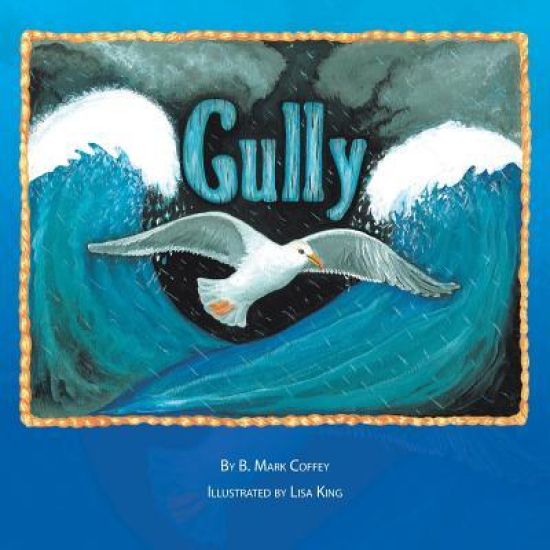
Gully is the story of a young seagull who is a little mischievous and adventurous at the same time. He wants to be treated as if he were older, more grown up than he is, and he is willing to take some risks to get the approval of his peers. His impulsive behavior appears to him to be brave, but he soon learns how much trouble you can get into when you don't listen to your parents. When he ends up battling for his life in a huge storm he nds safety on a stretch of beach he has always wished to be able to go to. He ends up there alright injured with a broken wing and desperate. He nds help from a young ordinary boy and girl on vacation with their aunt. Gully learns a lot about life through his new found friends who help him recover from his injury and teach him about love and friendship, and just being yourself. As Gully gains back his physical strength he also gains real con dence and no longer has to pretend he is grown up. He just knows through his life experiences that he has grown up. He's got a few bumps and bruises to prove it.
"Hitting The Mark" is a special type of sales book that comes along even now and then to make a real impact on professional selling. Years in the making and fully field tested, the concepts in this book are solid and require no extra refinement or tweaking.As a general contractor, trade contractor, remodeler, renovator, home builder, carpenter, handyman, occupational therapist, physical therapist, interior designer, architect, durable medical equipment contractor, or anyone else who designs and sells solutions for general remodeling for homes or businesses, decorating updates, or aging-in-place treatments, you will get results as soon as you open the book and begin putting these concepts into practice.Whether you maintain an office or showroom where people come to you to see examples of products and discuss what you can do with them, or you go to them in their home or office to discuss their needs and propose solutions, you need a system of sorting through all of the people you meet and talk with (regardless of how that contact is originated) to identify the most interested ones and determine where to devote your time and focus.Without an objective, definitive way of rating all of these sales leads that you accumulate as you operate your business, and a way of determining who to spend your time with, it's easy to waste your energy on people who have very little or no interest in actually making a purchasing decision. At the other end of the spectrum is ignoring people who really are good candidates for making a decision because the chemistry wasn't there and you didn't connect with them or find any common ground.That's where this book becomes invaluable. It is based on the "ready, willing, and able" formula that most salespeople and small business owners are familiar with, but it adds a very important missing ingredient that turns this into the perfect rating system.For the first time, the three main criteria in evaluating someone's level of interest and ability to make a decision - "ready," "willing," and "able" - have been quantified and defined as objective criteria that will mean the same regardless of who uses them. Then the missing ingredient of how well someone likes you and your approach to their issues - and wants to do business with you - is added so that you can focus your time and energy where you have the highest probability of making a sale.This book lays out a system that takes all of the guesswork out of rating a customer according to their level of interest, ability to make a decision, and likelihood of doing business with you. No more subjectivity and shades of gray. Now a set of totally objective criteria can be applied, and you'll know instantly how likely someone is to make a decision to use your services or expertise to help them achieve the safety, comfort, convenience, security, accessibility, and peace-of-mind they are seeking in a renovation.The 8 chapters are: 1 - Why You Need A Rating System, 2 - The "Ready, Willing, And Able" Test, 3 - An "A" Rating Isn't Sufficient, 4 - Going Behind The Mark, 5 - Only A Few Can Be An "A-1," 6 - Don't Discount The "D"s, 7 - Marking Outside The Lines, and 8 - Getting The Most From Your Customers & Sales Leads.This is the last rating system you will ever need.
Are you prepared for medical emergencies, equipped with the knowledge to handle survival situations when every second counts? Have you ever wondered how you could be your own first responder in critical medical scenarios?Ask yourself: - How can I gain essential medical knowledge to navigate survival situations with confidence? - What are the key skills needed to be a medical first responder in emergency situations? - Is there a comprehensive guide that unveils the secrets of survival medicine, ensuring I'm prepared for the unexpected?Meet the Author: The Medical Survival GuideThe author, a seasoned professional in emergency medicine, understands the challenges and fears individuals face when confronted with medical emergencies. They've been in the trenches, responding to crises and realizing the need for accessible, life-saving knowledge that anyone can grasp. The author is your guide, your ally, in your journey towards medical survival mastery.What to Expect: - Unlock the secrets of medical survival with a comprehensive guide tailored for individuals in any emergency situation. - Master essential medical skills, from basic first aid to advanced life-saving techniques. - Explore real-world scenarios and case studies, learning from the experiences of seasoned emergency medicine professionals. - Understand the psychology of emergency response, enabling you to stay calm and effective in high-pressure situations. - Discover practical tips and strategies for creating your emergency medical kit and being prepared for any situation. - Learn from renowned experts in the field of emergency medicine, gaining insights that could make the difference between life and death. - Empower yourself to be your own first responder, taking charge of medical emergencies and ensuring the safety of yourself and those around you.
Robert William Chambers (May 26, 1865 - December 16, 1933) was an American artist and fiction writer, best known for his book of short stories entitled The King in Yellow, published in 1895.He was born in Brooklyn, New York, to William P. Chambers (1827-1911), a corporate and bankruptcy lawyer, and Caroline Smith Boughton (1842-1913). His parents met when Caroline was twelve years old and William P. was interning with her father, Joseph Boughton, a prominent corporate lawyer. Eventually the two formed the law firm of Chambers and Boughton which continued to prosper even after Joseph's death in 1861. Robert's great-grandfather, William Chambers (birth unknown), a lieutenant in the British Royal Navy, was married to Amelia Saunders, (1765-1822), the great grand daughter of Tobias Saunders, of Westerly, Rhode Island. The couple moved from Westerly, to Greenfield, Massachusetts and then to Galway, New York, where their son, also William Chambers, (1798-1874) was born. The second William graduated from Union College at the age of 18, and then went to a college in Boston, where he studied to be a doctor. Upon graduating, he and his wife, Eliza P. Allen (1793-1880), a direct descendant of Roger Williams, the founder of Providence, Rhode Island were among the first settlers of Broadalbin, New York. His brother was architect Walter Boughton Chambers. Robert was first educated at the Brooklyn Polytechnic Institute, and then entered the Art Students' League at around the age of twenty, where the artist Charles Dana Gibson was his fellow student. Chambers studied at the cole des Beaux-Arts, and at Acad mie Julian, in Paris from 1886 to 1893, and his work was displayed at the Salon as early as 1889. On his return to New York, he succeeded in selling his illustrations to Life, Truth, and Vogue magazines. Then, for reasons unclear, he devoted his time to writing, producing his first novel, In the Quarter (written in 1887 in Munich). His most famous, and perhaps most meritorious, effort is The King in Yellow, a collection of Art Nouveau short stories published in 1895. This included several famous weird short stories which are connected by the theme of a fictitious drama of the same title, which drives those who read it insane.E. F. Bleiler described The King in Yellow as one of the most important works of American supernatural fiction.It was also strongly admired by H. P. Lovecraft and his circle. Chambers returned to the weird genre in his later short story collections The Maker of Moons, The Mystery of Choice and The Tree of Heaven, but none earned him as much success as The King in Yellow. Some of Chambers's work contains elements of science fiction, such as In Search of the Unknown and Police , about a zoologist who encounters monsters. Chambers later turned to writing romantic fiction to earn a living. According to some estimates, Chambers had one of the most successful literary careers of his period, his later novels selling well and a handful achieving best-seller status. Many of his works were also serialized in magazines. His novel The Man They Hanged was about Captain Kidd, and argued that Kidd was not a pirate, and had been made a scapegoat by the British government.During World War I he wrote war adventure novels and war stories, some of which showed a strong return to his old weird style, such as "Marooned" in Barbarians (1917). After 1924 he devoted himself solely to writing historical fiction.Chambers for several years made Broadalbin, New York, his summer home. Some of his novels touch upon colonial life in Broadalbin and Johnstown.On July 12, 1898, he married Elsa Vaughn Moller (1882-1939). They had a son, Robert Edward Stuart Chambers (who sometimes used the name Robert Husted Chambers).Robert W. Chambers died on December 16, 1933, after having undergone intestinal surgery three days earlier.
The 18th century was a wealth of knowledge, exploration and rapidly growing technology and expanding record-keeping made possible by advances in the printing press. In its determination to preserve the century of revolution, Gale initiated a revolution of its own: digitization of epic proportions to preserve these invaluable works in the largest archive of its kind. Now for the first time these high-quality digital copies of original 18th century manuscripts are available in print, making them highly accessible to libraries, undergraduate students, and independent scholars.Medical theory and practice of the 1700s developed rapidly, as is evidenced by the extensive collection, which includes descriptions of diseases, their conditions, and treatments. Books on science and technology, agriculture, military technology, natural philosophy, even cookbooks, are all contained here.++++The below data was compiled from various identification fields in the bibliographic record of this title. This data is provided as an additional tool in helping to insure edition identification: ++++British LibraryT112135'Essai sur le feu' formed volume 1 of 'Essais de physique', Geneva, 1790. Only volume 1 of the 'Essais' was published. With a half-title.London: printed for E. Jeffery, 1791. 2], xi, 5],304p., tables; 8
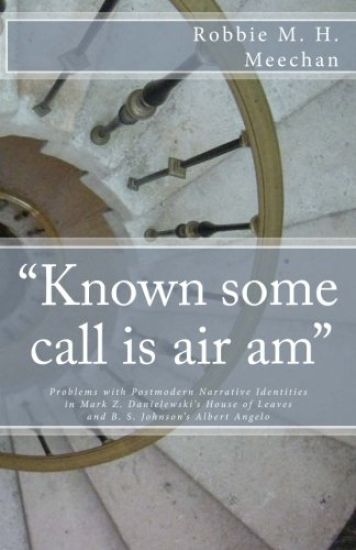
Mark Z. Danielewski's House of Leaves and B.S. Johnson's Albert Angelo both employ interesting and differing modes of narration: in House of Leaves three different levels of narration compete for attention, and in some aspects, veracity; and Albert Angelo juggles first, second and third person narration before the author himself enters as narrator. This study examines how the postmodern nature of both texts creates problematic narrative identities within them. Fittingly for a movement that is notoriously difficult to define, postmodernism seems to create problems for those seeking stable and fixed identities amongst individuals. It is this problem that this book highlights within the medium of postmodernist literature by paying particular attention to the fragmented nature of its narratorship, and examining if Jean Baudrillard's theories on consumerism and simulations, and Jean-Fran ois Lyotard's notions of grand and mini-narratives are to blame.
The 18th century was a wealth of knowledge, exploration and rapidly growing technology and expanding record-keeping made possible by advances in the printing press. In its determination to preserve the century of revolution, Gale initiated a revolution of its own: digitization of epic proportions to preserve these invaluable works in the largest archive of its kind. Now for the first time these high-quality digital copies of original 18th century manuscripts are available in print, making them highly accessible to libraries, undergraduate students, and independent scholars.Delve into what it was like to live during the eighteenth century by reading the first-hand accounts of everyday people, including city dwellers and farmers, businessmen and bankers, artisans and merchants, artists and their patrons, politicians and their constituents. Original texts make the American, French, and Industrial revolutions vividly contemporary.++++The below data was compiled from various identification fields in the bibliographic record of this title. This data is provided as an additional tool in helping to insure edition identification: ++++British LibraryT231902With an additional titlepage in French which reads: 'Les declarations & depositions faites au Conseil le Lundi 22. d'Octobre 1688. touchant la naissance du Prince de Galles'. English and French texts on facing pages. Printed on the continent, probably H Amsterdam?, 1710?]. 2],109, 1]p.; 8
The 18th century was a wealth of knowledge, exploration and rapidly growing technology and expanding record-keeping made possible by advances in the printing press. In its determination to preserve the century of revolution, Gale initiated a revolution of its own: digitization of epic proportions to preserve these invaluable works in the largest archive of its kind. Now for the first time these high-quality digital copies of original 18th century manuscripts are available in print, making them highly accessible to libraries, undergraduate students, and independent scholars.Delve into what it was like to live during the eighteenth century by reading the first-hand accounts of everyday people, including city dwellers and farmers, businessmen and bankers, artisans and merchants, artists and their patrons, politicians and their constituents. Original texts make the American, French, and Industrial revolutions vividly contemporary.++++The below data was compiled from various identification fields in the bibliographic record of this title. This data is provided as an additional tool in helping to insure edition identification: ++++British LibraryT223115The typography definitely suggests this to be an early 18th century reprint.London: printed, and sold by the booksellers of London and Westminster, 1710?] 48p.; 8
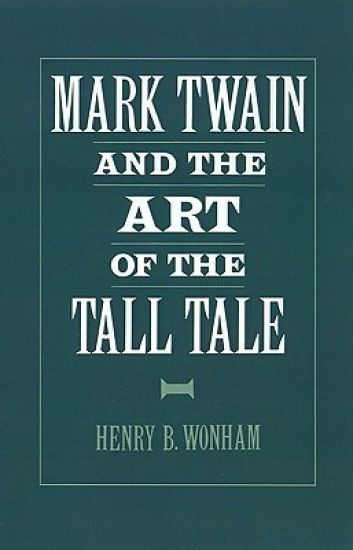
Mark Twain and the Art of the Tall Tale is a study of a peculiarly American comic strategy and its role in Mark Twain's fiction. Henry Wonham examines how Mark Twain used the oral genre of the tall tale to experiment with narrative structure throughout his career. Wonham argues that in his major fiction Twain manipulated conventional approaches to reading and writing by engaging his audience in a series of rhetorical games, whose rules he adapted from the conventions of tall tale performance and response. The book offers a history of the tall tale in American oral and written language, and shows how Twain's appropriation of the genre developed from the early works such as The Innocents Abroad through Tom Sawyer, Huck Finn, and Pudd'nhead Wilson.
How did Mark Twain develop his remarkable oral style of writing which was so carefully crafted? And what can we learn about nineteenth-century America from the public speeches of this humorist and teacher who charmed his country and exported his notions of Americanism around the world? This is the very first book-length critical analysis to deal exclusively with Twain's oratory. Another reference volume in the Great American Orators Series, it is designed for students, teachers, and professionals in the fields of speech communication and American studies.The volume, bringing Mark Twain again to the center stage, opens with an assessment of Twain as a great American orator and then appraises his rhetoric, lectures, occasional speeches, and summarizes his impact on his listeners. Professor Vallin shows how he used humor, varying styles of satire to attack Victorian hegemony and to exalt the common man, and how he emerged as the Representative American. He used vernacular expressions to bridge different sections of the country and spoke hundreds of times to thousands of listeners on a wide variety of topics, giving both simple talks and well-planned addresses. Sixteen selected speeches exemplify his eloquent and varied styles as a communicator. The volume also provides a chronology, a bibliographical essay that is a definitive one on Mark Twain as a public speaker, and a general index.











![The Several Declarations Toghether [Sic] with the Several Depositions Made in Council on Monday October 22. 1688. Concerning the Birth of the Prince of Wales. N.B. Those Marked with This Mark * Were Roman Catholicks.](/covers/9781170181997.jpg)
![The Several Declarations Toghether [sic] with the Several Depositions Made in Council on Monday October 22. 1688. Concerning the Birth of the Prince of Wales. N.B. Those Marked with This Mark * Were Roman Catholicks](/covers/9781385087626.jpg)