Learn the aircraft design process from a systems-engineering perspective, designed for both aspiring and practicing aerospace engineers Aircraft design incorporates a range of technological areas, including aerodynamics, flight dynamics, propulsion, and structure. Aircraft engineering design therefore requires techniques from systems engineering to integrate the requirements from these disparate areas into a coherent whole. There has never been a greater need for successful aerospace engineers to have a grasp of systems engineering and its applications in the field. Aircraft Design: A Systems Engineering Approach meets this need with a volume which takes the reader from conceptual design to detail design. Offering a systems engineering approach that weighs the needs of different aircraft components holistically, it provides readers with a practical look into the process of aircraft design. Now fully updated to reflect the latest industry developments, it promises to continue as an indispensable tool for modern students in the field. Readers of the second edition of Aircraft Design will also find: Brand new material on structural design, spoiler design, winglets, aircraft modification and modernization, and moreDetailed discussion of emerging topics including all-electric aircraft design, VTOL aircraft design, and many othersGuidance on the latest FAA requirements with a design impact Aircraft Design is ideal for senior undergraduate and graduate students interested in aircraft design, advanced aircraft design, and air vehicle design. The book may also be of interest to mechanical, industrial, and systems engineers working in the aerospace sector.
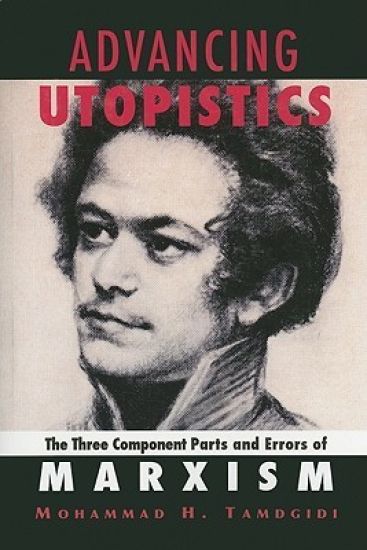
Mohammad H. Tamdgidi is Assistant Professor of Sociology at the University of Massachusetts Boston. He is the Founding Editor of Human Architecture:Journal of the Sociology of Self-Knowledge.
Mohammad H. Tamdgidi is Assistant Professor of Sociology at the University of Massachusetts Boston. He is the Founding Editor of Human Architecture:Journal of the Sociology of Self-Knowledge.
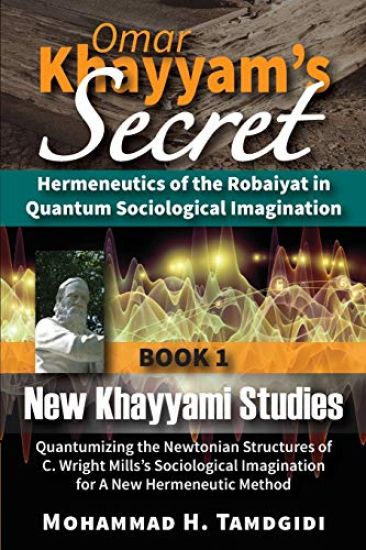
Omar Khayyam's Secret: Hermeneutics of the Robaiyat in Quantum Sociological Imagination is a twelve-book series of which this book, subtitled New Khayyami Studies: Quantumizing the Newtonian Structures of C. Wright Mills's Sociological Imagination for A New Hermeneutic Method, is the first volume. Each book is independently readable, although it will be best understood as a part of the whole series. In the overall series, the transdisciplinary sociologist Mohammad H. Tamdgidi shares the results of his decades-long research on Omar Khayyam, the enigmatic 11th/12th centuries Persian Muslim sage, philosopher, astronomer, mathematician, physician, writer, and poet from Neyshabour, Iran, whose life and works still remain behind a veil of deep mystery. Tamdgidi's purpose has been to find definitive answers to the many puzzles still surrounding Khayyam, especially regarding the existence, nature, and purpose of the Robaiyat in his life and works. To explore the questions posed, he advances a new hermeneutic method of textual analysis, informed by what he calls the quantum sociological imagination, to gather and study all the attributed philosophical, religious, scientific, and literary writings of Khayyam. In this first book of the series, following a common preface and introduction to the series, Tamdgidi develops the quantum sociological imagination method framing his hermeneutic study in the series as a whole. In the prefatory note he shares the origins of this series and how the study is itself a moment in the trajectory of a broader research project. In his introduction, he describes how centuries of Khayyami studies, especially during the last two, have reached an impasse in shedding light on his enigmatic life and works, especially his attributed Robaiyat. The four chapters of the book are then dedicated to developing the quantum sociological imagination as a new hermeneutic method framing the Khayyami studies in the series. The method builds, in an applied way, on the results of Tamdgidi's recent work in the sociology of scientific knowledge, Liberating Sociology: From Newtonian Toward Quantum Imagination: Volume 1: Unriddling the Quantum Enigma (2020), where he explored extensively, in greater depth, and in the context of understanding the so-called "quantum enigma," the Newtonian and quantum ways of imagining reality. In this first book, he shares the findings of that research in summary amid new applied insights developed in relation to Khayyami studies. In the first chapter, Tamdgidi raises a set of eight questions about the structure of C. Wright Mills's sociological imagination as a potential framework for Khayyami studies. In the second chapter, he shows how the questions are symptomatic of Newtonian structures that still continue to frame Mills's sociological imagination. In the third chapter, the author explores how the sociological imagination can be reinvented to be more in tune with the findings of quantum science. In the last chapter, the implications of the quantum sociological imagination for devising a hermeneutic method for new Khayyam and Robaiyat studies are outlined. In conclusion, the findings of this first book of the Omar Khayyam's Secret series are summarized.
Omar Khayyam's Secret: Hermeneutics of the Robaiyat in Quantum Sociological Imagination is a twelve-book series of which this book, subtitled New Khayyami Studies: Quantumizing the Newtonian Structures of C. Wright Mills's Sociological Imagination for A New Hermeneutic Method, is the first volume. Each book is independently readable, although it will be best understood as a part of the whole series. In the overall series, the transdisciplinary sociologist Mohammad H. Tamdgidi shares the results of his decades-long research on Omar Khayyam, the enigmatic 11th/12th centuries Persian Muslim sage, philosopher, astronomer, mathematician, physician, writer, and poet from Neyshabour, Iran, whose life and works still remain behind a veil of deep mystery. Tamdgidi's purpose has been to find definitive answers to the many puzzles still surrounding Khayyam, especially regarding the existence, nature, and purpose of the Robaiyat in his life and works. To explore the questions posed, he advances a new hermeneutic method of textual analysis, informed by what he calls the quantum sociological imagination, to gather and study all the attributed philosophical, religious, scientific, and literary writings of Khayyam. In this first book of the series, following a common preface and introduction to the series, Tamdgidi develops the quantum sociological imagination method framing his hermeneutic study in the series as a whole. In the prefatory note he shares the origins of this series and how the study is itself a moment in the trajectory of a broader research project. In his introduction, he describes how centuries of Khayyami studies, especially during the last two, have reached an impasse in shedding light on his enigmatic life and works, especially his attributed Robaiyat. The four chapters of the book are then dedicated to developing the quantum sociological imagination as a new hermeneutic method framing the Khayyami studies in the series. The method builds, in an applied way, on the results of Tamdgidi's recent work in the sociology of scientific knowledge, Liberating Sociology: From Newtonian Toward Quantum Imagination: Volume 1: Unriddling the Quantum Enigma (2020), where he explored extensively, in greater depth, and in the context of understanding the so-called "quantum enigma," the Newtonian and quantum ways of imagining reality. In this first book, he shares the findings of that research in summary amid new applied insights developed in relation to Khayyami studies. In the first chapter, Tamdgidi raises a set of eight questions about the structure of C. Wright Mills's sociological imagination as a potential framework for Khayyami studies. In the second chapter, he shows how the questions are symptomatic of Newtonian structures that still continue to frame Mills's sociological imagination. In the third chapter, the author explores how the sociological imagination can be reinvented to be more in tune with the findings of quantum science. In the last chapter, the implications of the quantum sociological imagination for devising a hermeneutic method for new Khayyam and Robaiyat studies are outlined. In conclusion, the findings of this first book of the Omar Khayyam's Secret series are summarized.
Omar Khayyam's Secret: Hermeneutics of the Robaiyat in Quantum Sociological Imagination is a twelve-book series of which this book is the second volume, subtitled Khayyami Millennium: Reporting the Discovery and the Reconfirmation of the True Dates of Birth and Passing of Omar Khayyam (AD 1021-1123). Each book is independently readable, although it will be best understood as a part of the whole series. In the overall series, the transdisciplinary sociologist Mohammad H. Tamdgidi shares the results of his decades-long research on Omar Khayyam, the enigmatic 11th/12th centuries Persian Muslim sage, philosopher, astronomer, mathematician, physician, writer, and poet from Neyshabour, Iran, whose life and works still remain behind a veil of deep mystery. Tamdgidi's purpose has been to find definitive answers to the many puzzles still surrounding Khayyam, especially regarding the existence, nature, and purpose of the Robaiyat in his life and works. To explore the questions posed, he advances a new hermeneutic method of textual analysis, informed by what he calls the quantum sociological imagination, to gather and study all the attributed philosophical, religious, scientific, and literary writings of Khayyam. In this second book of the series, Tamdgidi lays down an essential foundation for the series by revisiting the unresolved questions surrounding the dates of birth and passing of Omar Khayyam. Critically reexamining the manner in which Omar Khayyam's birth horoscope as reported in Zahireddin Abolhassan Beyhaqi's Tatemmat Sewan al-Hekmat (Supplement to the Chest of Wisdom) was used by Swāmi Govinda Tīrtha in his The Nectar of Grace: Omar Khayyam's Life and Works (1941) to determine Khayyam's birth date, Tamdgidi uncovers a number of serious internal inconsistencies and factual inaccuracies that prevented Tīrtha (and, since then, other scholars more or less taking for granted his results) from arriving at a reliable date for Khayyam's birth, hurling Khayyami studies into decades of confusion regarding Khayyam's life and works. Tamdgidi then shares in the book the detailed account of his own discovery of Khayyam's true date of birth for the first time, a finding that eluded Khayyami studies for centuries and is bound to revolutionize the studies for decades to come. Tamdgidi then turns his attention to the task of definitively establishing the true date of passing of Omar Khayyam. Conducting an in-depth, superposed analysis of Beyhaqi's Tatemmat Sewan el-Hekmat (Supplement to the Chest of Wisdom), Abdorrahman Khazeni's Mizan ol-Hekmat (Balance of Wisdom), Nezami Arouzi's Chahar Maqaleh (Four Discourses), and Yar Ahmad Rashidi Tabrizi's Tarabkhaneh (House of Joy), amid other relevant texts, he succeeds in firmly reconfirming and further discovering, in a textually reliable way, not only the year, the season, the month, and the day, but even the most likely time of day at which the poet mathematician, astronomer, and calender reformer died as a solar centenarian, completing his 102nd solar year age. Strange is that these discoveries are made just in time as we approach the first solar millennium of Omar Khayyam's birth date on June 10, AD 1021, at sunrise of Neyshabour, Iran, and the ninth solar centennial of his passing on June 10, AD 1123, on the eve also of his birthday, closing the circle of his life's "coming and going."
Omar Khayyam's Secret: Hermeneutics of the Robaiyat in Quantum Sociological Imagination is a twelve-book series of which this book is the second volume, subtitled Khayyami Millennium: Reporting the Discovery and the Reconfirmation of the True Dates of Birth and Passing of Omar Khayyam (AD 1021-1123). Each book is independently readable, although it will be best understood as a part of the whole series. In the overall series, the transdisciplinary sociologist Mohammad H. Tamdgidi shares the results of his decades-long research on Omar Khayyam, the enigmatic 11th/12th centuries Persian Muslim sage, philosopher, astronomer, mathematician, physician, writer, and poet from Neyshabour, Iran, whose life and works still remain behind a veil of deep mystery. Tamdgidi's purpose has been to find definitive answers to the many puzzles still surrounding Khayyam, especially regarding the existence, nature, and purpose of the Robaiyat in his life and works. To explore the questions posed, he advances a new hermeneutic method of textual analysis, informed by what he calls the quantum sociological imagination, to gather and study all the attributed philosophical, religious, scientific, and literary writings of Khayyam. In this second book of the series, Tamdgidi lays down an essential foundation for the series by revisiting the unresolved questions surrounding the dates of birth and passing of Omar Khayyam. Critically reexamining the manner in which Omar Khayyam's birth horoscope as reported in Zahireddin Abolhassan Beyhaqi's Tatemmat Sewan al-Hekmat (Supplement to the Chest of Wisdom) was used by Swāmi Govinda Tīrtha in his The Nectar of Grace: Omar Khayyam's Life and Works (1941) to determine Khayyam's birth date, Tamdgidi uncovers a number of serious internal inconsistencies and factual inaccuracies that prevented Tīrtha (and, since then, other scholars more or less taking for granted his results) from arriving at a reliable date for Khayyam's birth, hurling Khayyami studies into decades of confusion regarding Khayyam's life and works. Tamdgidi then shares in the book the detailed account of his own discovery of Khayyam's true date of birth for the first time, a finding that eluded Khayyami studies for centuries and is bound to revolutionize the studies for decades to come. Tamdgidi then turns his attention to the task of definitively establishing the true date of passing of Omar Khayyam. Conducting an in-depth, superposed analysis of Beyhaqi's Tatemmat Sewan el-Hekmat (Supplement to the Chest of Wisdom), Abdorrahman Khazeni's Mizan ol-Hekmat (Balance of Wisdom), Nezami Arouzi's Chahar Maqaleh (Four Discourses), and Yar Ahmad Rashidi Tabrizi's Tarabkhaneh (House of Joy), amid other relevant texts, he succeeds in firmly reconfirming and further discovering, in a textually reliable way, not only the year, the season, the month, and the day, but even the most likely time of day at which the poet mathematician, astronomer, and calender reformer died as a solar centenarian, completing his 102nd solar year age. Strange is that these discoveries are made just in time as we approach the first solar millennium of Omar Khayyam's birth date on June 10, AD 1021, at sunrise of Neyshabour, Iran, and the ninth solar centennial of his passing on June 10, AD 1123, on the eve also of his birthday, closing the circle of his life's "coming and going."
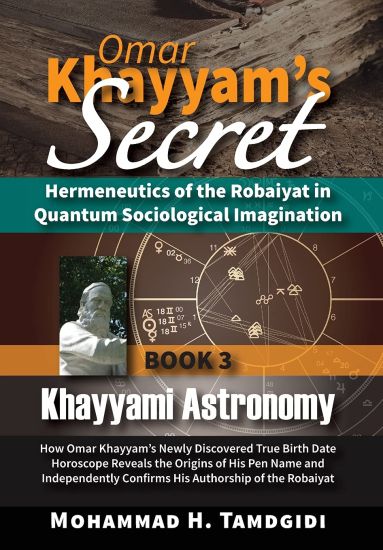
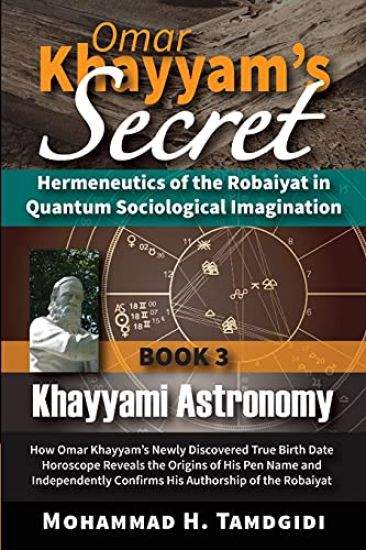
Omar Khayyam's Secret: Hermeneutics of the Robaiyat in Quantum Sociological Imagination is a twelve-book series of which this book is the third volume, subtitled Khayyami Astronomy: How Omar Khayyam's Newly Discovered True Birth Date Horoscope Reveals the Origins of His Pen Name and Independently Confirms His Authorship of the Robaiyat. Each book is independently readable, although it will be best understood as a part of the whole series. In the overall series, the transdisciplinary sociologist Mohammad H. Tamdgidi shares the results of his decades-long research on Omar Khayyam, the enigmatic 11th/12th centuries Persian Muslim sage, philosopher, astronomer, mathematician, physician, writer, and poet from Neyshabour, Iran, whose life and works still remain behind a veil of deep mystery. Tamdgidi's purpose has been to find definitive answers to the many puzzles still surrounding Khayyam, especially regarding the existence, nature, and purpose of the Robaiyat in his life and works. To explore the questions posed, he advances a new hermeneutic method of textual analysis, informed by what he calls the quantum sociological imagination, to gather and study all the attributed philosophical, religious, scientific, and literary writings of Khayyam. Omar Khayyam's true birth date horoscope, as newly discovered in this series, is comprised of a dazzling number of Air Triplicities sharing a vertex on a Sun-Mercury Cazimi point on the same Ascendant degree 18 of Gemini. Among other features, his Venus, Sextile with Moon, also plays a lifelong, secretively creative role to intentionally balance his chart. These features would not have escaped the attention of Omar Khayyam, a master astronomer and expert in matters astrological, no matter how much he embraced, doubted, or rejected astrological interpretations. In this third book of the series, conducting an in-depth hermeneutic analysis of Khayyam's horoscope, Tamdgidi reports having discovered the origins of Khayyam's pen name in his horoscope. The long-held myth that "Khayyam" was a parental name, even if true, in no way takes away from the new finding; it only adds to its intrigue. Tamdgidi's hermeneutic analysis of Khayyam's horoscope in intersection with extant Khayyami Robaiyat also leads him to discover an entirely neglected signature quatrain that he proves could not be from anyone but Khayyam, one that provides a reliably independent confirmation of his authorship of the Robaiyat. He also shows how another neglected quatrain reporting its poet to have aged to a hundred is from Khayyam. This means all the extant Khayyami quatrains are now in need of hermeneutic reevaluation. Tamdgidi's further study of a sample of fifty Khayyami Robaiyat leads him to conclude that their poet definitively intended the poems to remain in veil, that they were considered to be a collection of interrelated quatrains and not sporadic separate quatrains written marginally in pastime, that they were meant to offer a life's intellectual journey as in a "book of life," that the poems' critically nuanced engagement with astrology was not incidental but essential throughout the collection, and that, judging from the signature quatrain discovered, 1000 quatrains were intended to comprise the collection. Oddly it appears that, after all, "The Khayyam who stitched his tents of wisdom" was a trope that had its origins in Omar Khayyam's horoscope heavens.
Omar Khayyam's Secret: Hermeneutics of the Robaiyat in Quantum Sociological Imagination is a twelve-book series of which this book is the third volume, subtitled Khayyami Astronomy: How Omar Khayyam's Newly Discovered True Birth Date Horoscope Reveals the Origins of His Pen Name and Independently Confirms His Authorship of the Robaiyat. Each book is independently readable, although it will be best understood as a part of the whole series. In the overall series, the transdisciplinary sociologist Mohammad H. Tamdgidi shares the results of his decades-long research on Omar Khayyam, the enigmatic 11th/12th centuries Persian Muslim sage, philosopher, astronomer, mathematician, physician, writer, and poet from Neyshabour, Iran, whose life and works still remain behind a veil of deep mystery. Tamdgidi's purpose has been to find definitive answers to the many puzzles still surrounding Khayyam, especially regarding the existence, nature, and purpose of the Robaiyat in his life and works. To explore the questions posed, he advances a new hermeneutic method of textual analysis, informed by what he calls the quantum sociological imagination, to gather and study all the attributed philosophical, religious, scientific, and literary writings of Khayyam. Omar Khayyam's true birth date horoscope, as newly discovered in this series, is comprised of a dazzling number of Air Triplicities sharing a vertex on a Sun-Mercury Cazimi point on the same Ascendant degree 18 of Gemini. Among other features, his Venus, Sextile with Moon, also plays a lifelong, secretively creative role to intentionally balance his chart. These features would not have escaped the attention of Omar Khayyam, a master astronomer and expert in matters astrological, no matter how much he embraced, doubted, or rejected astrological interpretations. In this third book of the series, conducting an in-depth hermeneutic analysis of Khayyam's horoscope, Tamdgidi reports having discovered the origins of Khayyam's pen name in his horoscope. The long-held myth that "Khayyam" was a parental name, even if true, in no way takes away from the new finding; it only adds to its intrigue. Tamdgidi's hermeneutic analysis of Khayyam's horoscope in intersection with extant Khayyami Robaiyat also leads him to discover an entirely neglected signature quatrain that he proves could not be from anyone but Khayyam, one that provides a reliably independent confirmation of his authorship of the Robaiyat. He also shows how another neglected quatrain reporting its poet to have aged to a hundred is from Khayyam. This means all the extant Khayyami quatrains are now in need of hermeneutic reevaluation. Tamdgidi's further study of a sample of fifty Khayyami Robaiyat leads him to conclude that their poet definitively intended the poems to remain in veil, that they were considered to be a collection of interrelated quatrains and not sporadic separate quatrains written marginally in pastime, that they were meant to offer a life's intellectual journey as in a "book of life," that the poems' critically nuanced engagement with astrology was not incidental but essential throughout the collection, and that, judging from the signature quatrain discovered, 1000 quatrains were intended to comprise the collection. Oddly it appears that, after all, "The Khayyam who stitched his tents of wisdom" was a trope that had its origins in Omar Khayyam's horoscope heavens.
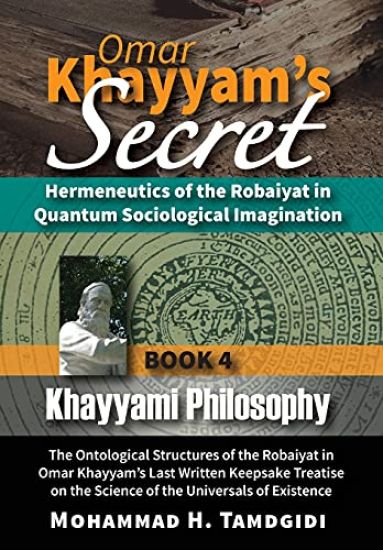
Omar Khayyam's Secret: Hermeneutics of the Robaiyat in Quantum Sociological Imagination, authored by Mohammad H. Tamdgidi, is a 12-book series of which this is the 4th volume, subtitled Khayyami Philosophy: The Ontological Structures of the Robaiyat in Omar Khayyam's Last Written Keepsake Treatise on the Science of the Universals of Existence. Each book, independently readable, can be best understood as a part of the whole series.Having confirmed in the prior three books of the series the true dates of birth and passing of Omar Khayyam, his pen name origins, and his authorship of a robaiyat collection, Tamdgidi explores in this fourth book the origins, nature, and purpose of such a collection by applying the series' quantum sociological imagination method to hermeneutically explore the ontological structures of the Robaiyat in Khayyam's last written treatise.Khayyam's treatise, found in the early 20th century and still largely ignored or misread, radically challenges the mythical narratives built over the centuries about him as one who thought existence is unknowable, having died not solving its riddles. Strangely, his treatise instead offers a logically coherent and brilliant worldview of someone who has found his answers as far as human existence is concerned. Khayyam even goes so far as confidently saying he hopes his peers would agree that his brief treatise is more useful than volumes.Offering the Persian text and his new English translation of the treatise, Tamdgidi undertakes in this book a detailed clause-based hermeneutic study of the treatise. He also explores its broader intellectual and historical contexts by examining its relation to the book "Savior from Error" by Khayyam's junior (by more than three decades) contemporary foe, Muhammad Ghazali, while questioning the long-held belief that the treatise was requested by and addressed to Fakhr ol-Molk, a son of the famous vizier Nezam ol-Molk.Tamdgidi finds instead that the treatise was written in AD 1095-96, a few years earlier than thought, for another son of Nezam ol-Molk, Moayyed ol-Molk, who served at the time Soltan Muhammad, Malekshah's son. The treatise was intended as a philosophical foundation to move the post-Malekshah Iran in a more independent direction by way of influencing his son, Muhammad. Ghazali in his book, likely written to please Ahmad Sanjar (Malekshah's younger son who disliked Khayyam) and his vizier at the time, Fakhr ol-Molk, anonymously chastised Khayyam as a philosopher, duplicitously feeding the cynical metaphors that some theologians and Sufis hurled at Khayyam down the centuries.Khayyam's treatise unveils his vision of existence as a participatory universe where the subject has objective status, shedding a new light on the ontological structures of the Robaiyat. His "succession order" thesis of existence is an alternative Islamic creationist-evolutionary worldview that offers a prescient quantum conceptualist vision of the universe as a unitary, relatively self-reliant, self-knowing, and self-creative, substance lovingly created by an absolutely good God in His own image. Existence is essentially good but, due to its good volitionally self-creative nature, can be potentially subject to incidental defects that are nevertheless knowable and curable to build both a spiritually fulfilling and a joyful life in this world. Other than God's Necessary Existence there is no "another world"; judgment days, heavens, and hells are definitely real this-worldly, not after-worldly, existents. In Khayyam's view, human existence can be what good we artfully make of it, starting here-and-now from our own personal selves in our this-worldly lifetimes. It is to creatively realize such an existence that the Robaiyat must have been intended.
Omar Khayyam's Secret: Hermeneutics of the Robaiyat in Quantum Sociological Imagination, authored by Mohammad H. Tamdgidi, is a 12-book series of which this is the 4th volume, subtitled Khayyami Philosophy: The Ontological Structures of the Robaiyat in Omar Khayyam's Last Written Keepsake Treatise on the Science of the Universals of Existence. Each book, independently readable, can be best understood as a part of the whole series.Having confirmed in the prior three books of the series the true dates of birth and passing of Omar Khayyam, his pen name origins, and his authorship of a robaiyat collection, Tamdgidi explores in this fourth book the origins, nature, and purpose of such a collection by applying the series' quantum sociological imagination method to hermeneutically explore the ontological structures of the Robaiyat in Khayyam's last written treatise.Khayyam's treatise, found in the early 20th century and still largely ignored or misread, radically challenges the mythical narratives built over the centuries about him as one who thought existence is unknowable, having died not solving its riddles. Strangely, his treatise instead offers a logically coherent and brilliant worldview of someone who has found his answers as far as human existence is concerned. Khayyam even goes so far as confidently saying he hopes his peers would agree that his brief treatise is more useful than volumes.Offering the Persian text and his new English translation of the treatise, Tamdgidi undertakes in this book a detailed clause-based hermeneutic study of the treatise. He also explores its broader intellectual and historical contexts by examining its relation to the book "Savior from Error" by Khayyam's junior (by more than three decades) contemporary foe, Muhammad Ghazali, while questioning the long-held belief that the treatise was requested by and addressed to Fakhr ol-Molk, a son of the famous vizier Nezam ol-Molk.Tamdgidi finds instead that the treatise was written in AD 1095-96, a few years earlier than thought, for another son of Nezam ol-Molk, Moayyed ol-Molk, who served at the time Soltan Muhammad, Malekshah's son. The treatise was intended as a philosophical foundation to move the post-Malekshah Iran in a more independent direction by way of influencing his son, Muhammad. Ghazali in his book, likely written to please Ahmad Sanjar (Malekshah's younger son who disliked Khayyam) and his vizier at the time, Fakhr ol-Molk, anonymously chastised Khayyam as a philosopher, duplicitously feeding the cynical metaphors that some theologians and Sufis hurled at Khayyam down the centuries.Khayyam's treatise unveils his vision of existence as a participatory universe where the subject has objective status, shedding a new light on the ontological structures of the Robaiyat. His "succession order" thesis of existence is an alternative Islamic creationist-evolutionary worldview that offers a prescient quantum conceptualist vision of the universe as a unitary, relatively self-reliant, self-knowing, and self-creative, substance lovingly created by an absolutely good God in His own image. Existence is essentially good but, due to its good volitionally self-creative nature, can be potentially subject to incidental defects that are nevertheless knowable and curable to build both a spiritually fulfilling and a joyful life in this world. Other than God's Necessary Existence there is no "another world"; judgment days, heavens, and hells are definitely real this-worldly, not after-worldly, existents. In Khayyam's view, human existence can be what good we artfully make of it, starting here-and-now from our own personal selves in our this-worldly lifetimes. It is to creatively realize such an existence that the Robaiyat must have been intended.
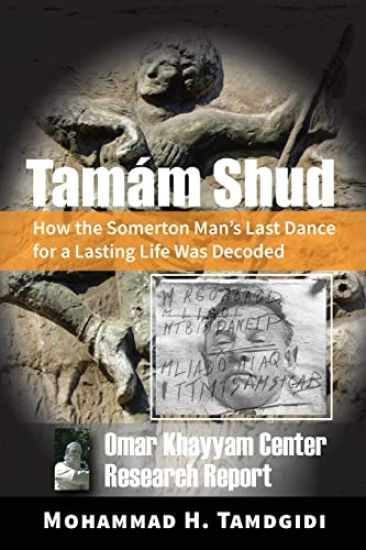
2024 Update Note: For a detailed new update on the interpretation of the Somerton man's code in the context of new findings proposed and reported in 2022 and thereafter about the identity of the Somerton man as being Carl Webb, read OKCIR's 2024 research report on the OKCIR site titled "The Somerton Man Carl Webb's WWII Death Poems Staged in His Eternal Shadow-Show "Tam m Shud" -- A Lasting J. C. Williamsonian Suicide Mystery Play Still Staging, Now Featuring Us, from the Somerton Beach in Australia Since Its Opening on Nov. 30, 1948." A press release for the same was published on April 15, 2024, titled,"Rest of Australia's Somerton Man Case Mystery Solved Using His Own Code As Deciphered in 2021, OKCIR Sociologist Reports." The 2021 publication still has evidentiary value since it documents how the 2021 deciphering of the Somerton man code, preceding 2022 findings, anticipated the 2022 proposed findings and its results.]In this OKCIR Research Report, hermeneutic sociologist, Khayyami scholar, and founding director of Omar Khayyam Center for Integrative Research (OKCIR), Mohammad H. (Behrooz) Tamdgidi, Ph.D., reports having solved the mystery of the code associated with the so-called "Somerton Man" or "Tam m Shud" case.The mysterious code appearing on the back page of a first edition copy of Edward FitzGerald's The Rubaiyat of Omar Khayyam -- found months following the death of The Somerton Man (TSM) in South Adelaide, Australia, on Dec. 1, 1948 -- was a suicide contemplation and planning note he was poetically drafting for himself in the form of a quatrain on the back of his copy of The Rubaiyat, giving a gist of why and how he planned to carry out a deliberately mystery-laden suicide as his last dance for a lasting life. The code was the creative DNA of his suicide plot.It was written in the 'Tam m Shud' transliteration style -- in this case not from Persian, but from Arabic with which he must have been familiar, either natively due to coming ancestrally from the ethnically diverse and widely multilingual Russian Caucasus and/or by training and education. In other words, the 'Tam m Shud' torn-out piece found in TSM's fob pocket not only served as a bread crumb lead to his suicide note, it also offered the key to the code's deciphering.DNA is a self-replicating matter that reproduces the basic structure of a substance. TSM's 'code' offers the DNA of his last dance performance in public hoping of a lasting life, one that was sketched amid his medical suffering. He was reflecting on his life, terminal illness, and expected imminent death, while reading the meanings conveyed about life and death in FitzGerald's translation of Omar Khayyam's Rubaiyat -- a work of art that offered TSM a practical and proven example of how one can physically die but endure in human memory and spirit forever.This report mainly focuses on deciphering TSM's code, but the findings are then used to shed brief new light on one and/or another alternative wider story of what took place in Adelaide in 1948, in the years leading to it, and in the decades thereafter. The report invites readers to rethink the relevance of Omar Khayyam's poetry to the case, and also asks a pertinent question about another fold of the mystery, that is, why did it take so long to decipher a code that could have actually been decoded much earlier? The Somerton Man or Tam m Shud case has important lessons for us beyond the confines of the personal troubles of a man and those he knew, inviting us to use our sociological imaginations to explore such troubles in relation to the public issues that concern us all beyond the shores of Australia, and beyond the national and disciplinary walls fragmenting our lives, universities, and scientific methods in favor of transcultural and transdisciplinary modes of inquiry.
Omar Khayyam's Secret: Hermeneutics of the Robaiyat in Quantum Sociological Imagination, by Mohammad H. Tamdgidi, is a twelve-book series of which this book is the sixth volume, subtitled Khayyami Science: The Methodological Structures of the Robaiyat in All the Scientific Works of Omar Khayyam. Each book, independently readable, can be best understood as a part of the whole series.In Book 6, Tamdgidi shares the Arabic texts, his new English translations (based on others' or his new Persian translations, also included in the volume), and hermeneutic analyses of five extant scientific writings of Khayyam: a treatise in music; a treatise on balance to weigh precious metals in a body composed of them; a treatise on dividing a circle quadrant to achieve a certain proportionality; a treatise on solving all cubic (and lower degree) algebraic equations using geometric methods; and a treatise on explaining three postulation problems in Euclid's book Elements. Khayyam wrote three other non-extant scientific treatises on nature, geography, and music, while a treatise in arithmetic is differently extant since it influenced the work of later Islamic and Western scientists. His work in astronomy on solar calendar reform is also differently extant in the calendar used in Iran today. A short tract on astrology attributed to him has been neglected. Tamdgidi studies the scientific works in relation to Khayyam's own theological, philosophical, and astronomical views. The study reveals that Khayyam's science was informed by a unifying methodological attention to ratios and proportionality. So, likewise, any quatrain he wrote cannot be adequately understood without considering its place in the relational whole of its parent collection. Khayyam's Robaiyat is found to be, as a critique of fatalistic astrology, his most important scientific work in astronomy rendered in poetic form.Studying Khayyam's scientific works in relation to those of other scientists out of the context of his own philosophical, theological, and astronomical views, would be like comparing the roundness of two fruits while ignoring that they are apples and oranges. Khayyam was a relational, holistic, and self-including objective thinker, being systems and causal-chains discerning, creative, transdisciplinary, transcultural, and applied in method. He applied a poetic geometric imagination to solving algebraic problems and his logically methodical thinking did not spare even Euclid of criticism. His treatise on Euclid unified numerical and magnitudinal notions of ratio and proportionality by way of broadening the notion of number to include both rational and irrational numbers, transcending its Greek atomistic tradition.Khayyam's classification of algebraic equations, being capped at cubic types, tells of his applied scientific intentions that can be interpreted, in the context of his own Islamic philosophy and theology, as an effort in building an algebraic and numerical theory of everything that is not only symbolic of body's three dimensions, but also of the three-foldness of intellect, soul, and body as essential types of a unitary substance created by God to evolve relatively on its own in a two-fold succession order of coming from and going to its Source. Although the succession order poses limits, as captured in the astrological imagination, existence is not fatalistic. Khayyam's conceptualist view of the human subject as an objective creative force in a participatory universe allows for the possibility of human self-determination and freedom depending on his or her self-awakening, a cause for which the Robaiyat was intended. Its collection would be a balanced unity of wisdom gems ascending from multiplicity toward unity using Wine and various astrological, geometrical, numerical, calendrical, and musical tropes in relationally classified quatrains that follow a logical succession order.
Omar Khayyam's Secret: Hermeneutics of the Robaiyat in Quantum Sociological Imagination, by Mohammad H. Tamdgidi, is a twelve-book series of which this book is the sixth volume, subtitled Khayyami Science: The Methodological Structures of the Robaiyat in All the Scientific Works of Omar Khayyam. Each book, independently readable, can be best understood as a part of the whole series.In Book 6, Tamdgidi shares the Arabic texts, his new English translations (based on others' or his new Persian translations, also included in the volume), and hermeneutic analyses of five extant scientific writings of Khayyam: a treatise in music; a treatise on balance to weigh precious metals in a body composed of them; a treatise on dividing a circle quadrant to achieve a certain proportionality; a treatise on solving all cubic (and lower degree) algebraic equations using geometric methods; and a treatise on explaining three postulation problems in Euclid's book Elements. Khayyam wrote three other non-extant scientific treatises on nature, geography, and music, while a treatise in arithmetic is differently extant since it influenced the work of later Islamic and Western scientists. His work in astronomy on solar calendar reform is also differently extant in the calendar used in Iran today. A short tract on astrology attributed to him has been neglected. Tamdgidi studies the scientific works in relation to Khayyam's own theological, philosophical, and astronomical views. The study reveals that Khayyam's science was informed by a unifying methodological attention to ratios and proportionality. So, likewise, any quatrain he wrote cannot be adequately understood without considering its place in the relational whole of its parent collection. Khayyam's Robaiyat is found to be, as a critique of fatalistic astrology, his most important scientific work in astronomy rendered in poetic form.Studying Khayyam's scientific works in relation to those of other scientists out of the context of his own philosophical, theological, and astronomical views, would be like comparing the roundness of two fruits while ignoring that they are apples and oranges. Khayyam was a relational, holistic, and self-including objective thinker, being systems and causal-chains discerning, creative, transdisciplinary, transcultural, and applied in method. He applied a poetic geometric imagination to solving algebraic problems and his logically methodical thinking did not spare even Euclid of criticism. His treatise on Euclid unified numerical and magnitudinal notions of ratio and proportionality by way of broadening the notion of number to include both rational and irrational numbers, transcending its Greek atomistic tradition.Khayyam's classification of algebraic equations, being capped at cubic types, tells of his applied scientific intentions that can be interpreted, in the context of his own Islamic philosophy and theology, as an effort in building an algebraic and numerical theory of everything that is not only symbolic of body's three dimensions, but also of the three-foldness of intellect, soul, and body as essential types of a unitary substance created by God to evolve relatively on its own in a two-fold succession order of coming from and going to its Source. Although the succession order poses limits, as captured in the astrological imagination, existence is not fatalistic. Khayyam's conceptualist view of the human subject as an objective creative force in a participatory universe allows for the possibility of human self-determination and freedom depending on his or her self-awakening, a cause for which the Robaiyat was intended. Its collection would be a balanced unity of wisdom gems ascending from multiplicity toward unity using Wine and various astrological, geometrical, numerical, calendrical, and musical tropes in relationally classified quatrains that follow a logical succession order.
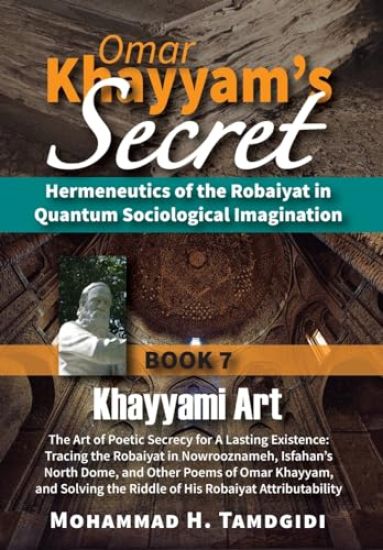
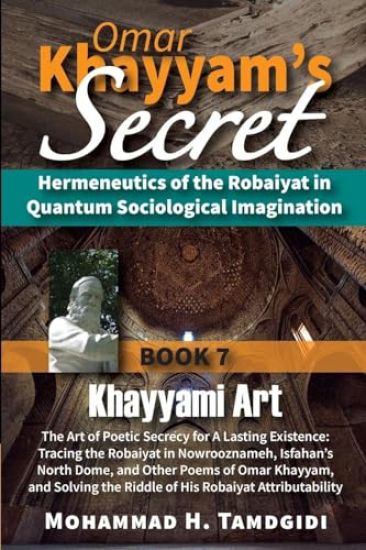
Omar Khayyam's Secret: Hermeneutics of the Robaiyat in Quantum Sociological Imagination, by Mohammad H. Tamdgidi, is a 12-book series of which this book is the 7th volume, subtitled Khayyami Art: The Art of Poetic Secrecy for a Lasting Existence: Tracing the Robaiyat in Nowrooznameh, Isfahan's North Dome, and Other Poems of Omar Khayyam, and Solving the Riddle of His Robaiyat Attributability. Each book, independently readable, can be best understood as a part of the whole series.In Book 7, Tamdgidi shares his updated edition of Khayyam's Persian book Nowrooznameh, and for the first time his new English translation of it, followed by his analysis of its text. He then visits recent findings about the possible contribution of Khayyam to the design of Isfahan's North Dome. Next, he shares the texts, and his new Persian and English translations and analyses of Khayyam's other Arabic and Persian poems. Finally he studies the debates about the attributability of the Robaiyat to Khayyam.Tamdgidi verifiably shows that Nowrooznameh was written by Khayyam, arguing that its unjustifiable neglect has prevented Khayyami studies from answering important questions about Khayyam's life, works, and his times. Nowrooznameh is primarily a work in literary art, rather than in science, tasked not with reporting on past truths but with creating new truths in the spirit of Khayyam's conceptualist view of reality. Iran owes the continuity of its Zoroastrian calendar month names to the way Khayyam artfully recast their meanings in the book in order to prevent their being dismissed during the Islamic solar calendar reform underway under his invited direction. The book also sheds light on the mysterious function of Isfahan's North Dome, revealing it as having been to serve, as part of an observatory complex, for the annual Nowrooz celebrations and leap-year declarations of the new calendar. The North Dome, to whose design Khayyam contributed and in fact bears symbols of his unitary view of a world created for happiness by God, marks where the world's most accurate solar calendar of the time was calculated. It deserves to be named after Omar Khayyam (not Taj ol-Molk) and declared as a cultural world heritage site. Nowrooznameh is also a pioneer in the prince-guidance books genre that anticipated the likes of Machiavelli's The Prince by centuries, the difference being that Khayyam's purpose was to inculcate his Iranian and Islamic love for justice and the pursuit of happiness in the young successors of Soltan Malekshah. Iran is famed for its ways of converting its invaders into its own culture, and Nowrooznameh offers a textbook example for how it was done by Khayyam.Nowrooznameh also offers by way of its intricately multilayered meanings the mediating link between Khayyam's philosophical, theological, and scientific works, and his Robaiyat, showing through metaphorical clues of his beautiful prose how his poetry could bring lasting spiritual existence to its poet posthumously. Khayyam's other Arabic and Persian poems also provide significant clues about the origins, the nature, and the purpose of the Robaiyat as his lifelong project and magnum opus.Tamdgidi argues that the thesis of Khayyam's Robaiyat as a secretive artwork of quatrains organized in an intended reasoning order as a 'book of life' serving to bring about his lasting spiritual existence can solve the manifold puzzles contributing to the riddle of his Robaiyat attributability. He posits, and in the forthcoming books of this series will show, that the lost quatrains comprising the original Robaiyat have become extant over the centuries, such that we can now reconstruct, by way of solving their 1000-piece jigsaw puzzle, the collection as it was meant to be read as an ode of interrelated quatrains by Khayyam.
Omar Khayyam's Secret: Hermeneutics of the Robaiyat in Quantum Sociological Imagination, by Mohammad H. Tamdgidi, is a 12-book series of which this book is the 7th volume, subtitled Khayyami Art: The Art of Poetic Secrecy for a Lasting Existence: Tracing the Robaiyat in Nowrooznameh, Isfahan's North Dome, and Other Poems of Omar Khayyam, and Solving the Riddle of His Robaiyat Attributability. Each book, independently readable, can be best understood as a part of the whole series.In Book 7, Tamdgidi shares his updated edition of Khayyam's Persian book Nowrooznameh, and for the first time his new English translation of it, followed by his analysis of its text. He then visits recent findings about the possible contribution of Khayyam to the design of Isfahan's North Dome. Next, he shares the texts, and his new Persian and English translations and analyses of Khayyam's other Arabic and Persian poems. Finally he studies the debates about the attributability of the Robaiyat to Khayyam.Tamdgidi verifiably shows that Nowrooznameh was written by Khayyam, arguing that its unjustifiable neglect has prevented Khayyami studies from answering important questions about Khayyam's life, works, and his times. Nowrooznameh is primarily a work in literary art, rather than in science, tasked not with reporting on past truths but with creating new truths in the spirit of Khayyam's conceptualist view of reality. Iran owes the continuity of its Zoroastrian calendar month names to the way Khayyam artfully recast their meanings in the book in order to prevent their being dismissed during the Islamic solar calendar reform underway under his invited direction. The book also sheds light on the mysterious function of Isfahan's North Dome, revealing it as having been to serve, as part of an observatory complex, for the annual Nowrooz celebrations and leap-year declarations of the new calendar. The North Dome, to whose design Khayyam contributed and in fact bears symbols of his unitary view of a world created for happiness by God, marks where the world's most accurate solar calendar of the time was calculated. It deserves to be named after Omar Khayyam (not Taj ol-Molk) and declared as a cultural world heritage site. Nowrooznameh is also a pioneer in the prince-guidance books genre that anticipated the likes of Machiavelli's The Prince by centuries, the difference being that Khayyam's purpose was to inculcate his Iranian and Islamic love for justice and the pursuit of happiness in the young successors of Soltan Malekshah. Iran is famed for its ways of converting its invaders into its own culture, and Nowrooznameh offers a textbook example for how it was done by Khayyam.Nowrooznameh also offers by way of its intricately multilayered meanings the mediating link between Khayyam's philosophical, theological, and scientific works, and his Robaiyat, showing through metaphorical clues of his beautiful prose how his poetry could bring lasting spiritual existence to its poet posthumously. Khayyam's other Arabic and Persian poems also provide significant clues about the origins, the nature, and the purpose of the Robaiyat as his lifelong project and magnum opus.Tamdgidi argues that the thesis of Khayyam's Robaiyat as a secretive artwork of quatrains organized in an intended reasoning order as a 'book of life' serving to bring about his lasting spiritual existence can solve the manifold puzzles contributing to the riddle of his Robaiyat attributability. He posits, and in the forthcoming books of this series will show, that the lost quatrains comprising the original Robaiyat have become extant over the centuries, such that we can now reconstruct, by way of solving their 1000-piece jigsaw puzzle, the collection as it was meant to be read as an ode of interrelated quatrains by Khayyam.