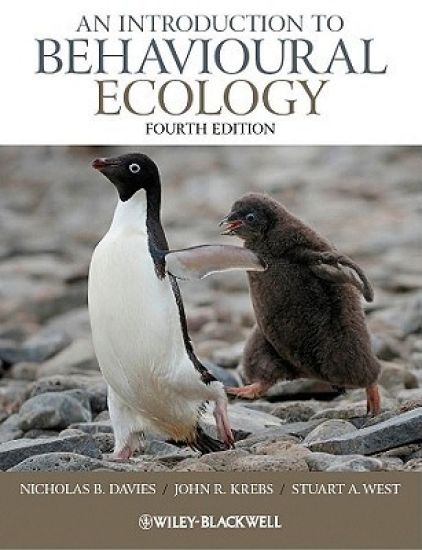
This textbook helped to define the field of Behavioural Ecology. In this fourth edition the text has been completely revised, with new chapters and many new illustrations and full colour photographs. The theme, once again, is the influence of natural selection on behaviour – an animal's struggle to survive and reproduce by exploiting and competing for resources, avoiding predators, selecting mates and caring for offspring, – and how animal societies reflect both cooperation and conflict among individuals. Stuart A. West has joined as a co-author bringing his own perspectives and work on microbial systems into the book. Written in the same engaging and lucid style as the previous editions, the authors explain the latest theoretical ideas using examples from micro-organisms, invertebrates and vertebrates. There are boxed sections for some topics and marginal notes help guide the reader. The book is essential reading for students of behavioural ecology, animal behaviour and evolutionary biology. Key Features: Long-awaited new edition of a field-defining textbookNew chapters, illustrations and colour photographsNew co-authorFocuses on the influence of natural selection on behavior, and how animal societies reflect both cooperation and conflict among individuals "The long-awaited update to a classic in this field is now here, presenting new directions in thinking and addressing burning questions. Richly informed by progress in many other disciplines, such as sensory physiology, genetics and evolutionary theory, it marks the emergence of behavioural ecology as a fully fledged discipline.... This is a marvellous book, written in a lucid style. A must-read for those in the field, it is also a cornucopia of new thinking for anyone interested in evolution and behaviour."—Manfred Milinski, Nature, 2012
Feminist theory has come a long way from its nascent beginnings—no longer can it be classified as “liberal,” “socialist,” or “radical.” It has shaped and evolved to take on multiple meanings and forms, each distinct in its own perspective and theory. In Feminisms and Educational Research, the authors explore the various forms of feminisms, tracing their history and their relation to gendered knowledge and identity. Unlike other books on feminism, the authors do not attempt to push that a particular theory is more correct than another, but rather they give a complete overview of each of the forms of feminism. The authors then couple the philosophical and theoretical ideas of western feminisms with the aims and conduct of educational research, exploring how they interact and influence each other. Focusing on more recent feminists, both in education and related disciplines, the book highlights illustrative examples from research to form a basis of understanding how the different feminisms have changed education.
Innovation Barriers, Indicators and Policies explores the historical coevolution of these three core concepts in the field: barriers, indicators, and policies. The authors show how these concepts have coevolved and reinforced each other throughout the history of Innovation Studies. This detailed historical review on the general conception of innovation is warranted in order to support a clear understanding of innovation barriers, indicators, and related policies as they have been shaped and co-evolved through time. Based on the thorough review of innovation barriers undertaken herein, we see that financial and non-financial obstacles do not affect the innovation output directly. Instead they impede the effect of the innovation determinants, whether these determinants are firm-specific, network-specific, or referring to the contextual environment. Section 2 presents a thorough discussion on the historical evolution of the innovation concept and its connection to the concepts of barriers, indicators, and policies. Section 3 discusses the beginnings of the measurement of innovation barriers, as well as the linkage between the study of obstacles to innovation and a policy-driven approach towards scientific and technological progress. Finally, Section 4 concludes with the main findings and avenues for future study.
The Flora of Iraq is the only flora for this region in the Middle East. It enables anyone documenting, studying and/or managing Iraq’s vast and rich flora to identify the vascular cryptograms and flowering plants. In addition to the detailed taxonomic information, a large amount of supplementary data of general biological interest and economic interest is provided, as well as notes on vernacular names. Nearing completion, it fills a major gap in the floral knowledge of Iraq. Volume 6 covers the Compositae in its entirety.
Coral reefs represent the most spectacular and diverse marine ecosystem on the planet as well as a critical source of income for millions of people. However, the combined effects of human activity have led to a rapid decline in the health of reefs worldwide, with many now facing complete destruction. Their world-wide deterioration and over-exploitation has continued and even accelerated in many areas since the publication of the first edition in 2009. At the same time, there has been a near doubling in the number of scientific papers that have been written in this short time about coral reef biology and the ability to acclimate to ocean warming and acidification. This new edition has been thoroughly revised and updated, incorporating the significant increase in knowledge gained over the last decade whilst retaining the book's focus as a concise and affordable overview of the field. The Biology of Coral Reefs provides an integrated overview of the function, physiology, ecology, and behaviour of coral reef organisms. Each chapter is enriched with a selection of 'boxes' on specific aspects written by internationally recognised experts. As with other books in the Biology of Habitats Series, the emphasis in this book is on the organisms that dominate this marine environment although pollution, conservation, climate change, and experimental aspects are also included. Indeed, particular emphasis is placed on conservation and management due to the habitat's critically endangered status. A global range of examples is employed which gives the book international relevance.
Coral reefs represent the most spectacular and diverse marine ecosystem on the planet as well as a critical source of income for millions of people. However, the combined effects of human activity have led to a rapid decline in the health of reefs worldwide, with many now facing complete destruction. Their world-wide deterioration and over-exploitation has continued and even accelerated in many areas since the publication of the first edition in 2009. At the same time, there has been a near doubling in the number of scientific papers that have been written in this short time about coral reef biology and the ability to acclimate to ocean warming and acidification. This new edition has been thoroughly revised and updated, incorporating the significant increase in knowledge gained over the last decade whilst retaining the book's focus as a concise and affordable overview of the field. The Biology of Coral Reefs provides an integrated overview of the function, physiology, ecology, and behaviour of coral reef organisms. Each chapter is enriched with a selection of 'boxes' on specific aspects written by internationally recognised experts. As with other books in the Biology of Habitats Series, the emphasis in this book is on the organisms that dominate this marine environment although pollution, conservation, climate change, and experimental aspects are also included. Indeed, particular emphasis is placed on conservation and management due to the habitat's critically endangered status. A global range of examples is employed which gives the book international relevance.
What use is physical chemistry to the student of biochemistry and biology? This central question is answered in this book mainly through the use of worked examples and problems. The book starts by introducing the laws of thermodynamics, and then uses these laws to derive the equations relevant to the student in dealing with chemical equilibria (including the binding of small molecules to proteins), properties of solutions, acids and bases, and oxidation-reduction processes. The student is thus shown how a knowledge of thermodynamic qualities makes it possible to predict whether, and how, a reaction will proceed. Thermodynamics, however, gives no information about how fast a reaction will happen. The study of the rates at which processes occur (kinetics) forms the second main theme of the book. This section poses and answers questions such as `how is the rate of a reaction affected by temperature, pH, ionic strength, and the nature of the reactants? These same ideas are then shown to be useful in the study of enzyme-catalysed reactions.
The traveller to India is urged to visit that country's western shore with the Arabian Sea where, about 300 miles to the south of Bombay, an exceedingly lovely coast reaches the peak of its harmony at the erstwhile Portuguese enclave of Goa. The ambience of this alluring province is an exquisite balance of palm trees and rice fields, aged colonial homes -many still elegant and brightly painted -slowly being swallowed up by the exuberant tropical vegetation, incredible blossoms, colorful and courteous people and, deeper inland, some splendid examples of 17th and 18th century Portuguese ecclesiastical architecture. A feast for the eyes by day, and in the evening enough fresh fish and other good food to satisfy the most demanding gourmet. This was the paradisiacal setting for the first International Conference on the Neural Organization of Sensory Systems (ICONOSS for short), sponsored jointly by the International Brain Research Organization (IBRO), the Tata Institute for Fundamental Research at Bombay, the Department of Atomic Energy of the Government of India, and the Department of Science and Technology of the Government of India. About 100 participants were pleasantly confined at Fort Aguada, a resort cunningly built amongst the ruins of an old Portuguese fort. The conference program achieved an international flavor, recruiting scientists from many nations: India (naturally), Australia, Britain, Canada, Germany, Finland, France, Hungary, Japan, the Netherlands, Sweden, Switzerland and the United States of America. The subjects discussed were as diverse as the countries represented.
The integrity of democratic elections, both in the United States and abroad, is an important problem. In this Element, we present a data-driven approach that evaluates the performance of the administration of a democratic election, before, during, and after Election Day. We show that this data-driven method can help to improve confidence in the integrity of American elections.
This title was first published in 2000: Serving the State is an invaluable two-volume exploration of global trends in public administration education and training. Volume 2 of this important reference work explores traditions and contexts. Included for examination are the French and Islamic traditions, The Netherlands, Scandinavia, Latin America, Small Island States and former communist countries such as Poland and the Ukraine as well as other countries undergoing rapid economic change.
This title was first published in 2000: Serving the State is an invaluable two-volume exploration of global trends in public administration education and training. Volume 2 of this important reference work explores traditions and contexts. Included for examination are the French and Islamic traditions, The Netherlands, Scandinavia, Latin America, Small Island States and former communist countries such as Poland and the Ukraine as well as other countries undergoing rapid economic change.
The traveller to India is urged to visit that country's western shore with the Arabian Sea where, about 300 miles to the south of Bombay, an exceedingly lovely coast reaches the peak of its harmony at the erstwhile Portuguese enclave of Goa. The ambience of this alluring province is an exquisite balance of palm trees and rice fields, aged colonial homes -many still elegant and brightly painted -slowly being swallowed up by the exuberant tropical vegetation, incredible blossoms, colorful and courteous people and, deeper inland, some splendid examples of 17th and 18th century Portuguese ecclesiastical architecture. A feast for the eyes by day, and in the evening enough fresh fish and other good food to satisfy the most demanding gourmet. This was the paradisiacal setting for the first International Conference on the Neural Organization of Sensory Systems (ICONOSS for short), sponsored jointly by the International Brain Research Organization (IBRO), the Tata Institute for Fundamental Research at Bombay, the Department of Atomic Energy of the Government of India, and the Department of Science and Technology of the Government of India. About 100 participants were pleasantly confined at Fort Aguada, a resort cunningly built amongst the ruins of an old Portuguese fort. The conference program achieved an international flavor, recruiting scientists from many nations: India (naturally), Australia, Britain, Canada, Germany, Finland, France, Hungary, Japan, the Netherlands, Sweden, Switzerland and the United States of America. The subjects discussed were as diverse as the countries represented.
This volume explores the Greco-Roman and Jewish origins of the New Testament and early Christianity. It pays particular attention to the gospels and the traditions which places those sacred texts.
Mosaic warfare is named for the idea of creating a complex image from small pieces. This report studies Mosaic warfare and explores three dimensions of variability: (1) fractionation of capabilities from large multicapability platforms onto multiple smaller ones; (2) employment of heterogenous mixes of capabilities throughout a battlespace; and (3) rapid composition of a set of needed capabilities in a time and place to accomplish a mission.