Kirjojen hintavertailu. Mukana 11 342 296 kirjaa ja 12 kauppaa.

Kirjahaku

Etsi kirjoja tekijän nimen, kirjan nimen tai ISBN:n perusteella.

1000 tulosta hakusanalla Ralph Barton Perry

Collected Works of Ralph Waldo Emerson

Collected Works of Ralph Waldo Emerson

Ralph Waldo Emerson

Harvard University Press
1987
sidottu
In 1845 Emerson delivered a series of lectures entitled "Uses of Great Men; Plato, or the Philosopher; Swedenborg, or the Mystic; Montaigne, or the Skeptic; Shakespeare, or the Poet; Napoleon, or the Man of the World; and Goethe, or the Writer." Emerson's approach to his great men stands in interesting contrast to that of his friend Carlyle in his Heroes and Hero Worship of 1841.Although by 1845 Emerson had been lecturing for over ten years, Representative Men, published in 1850, was the first of his works to consist of his lectures as delivered, with only minima! revision and expansion. The book retains the immediacy of the spoken word, and the freedom and daring inspired by a live audience.This critical edition is based on Emerson's holograph manuscript, which served as printer's copy for the first American edition, collated with subsequent editions and with Emerson's own corrections. The historical introduction relates the book to Emerson's life and times and discusses its literary origins, composition, and contemporary reception. A textual introduction and apparatus have been provided by the textual editor, and there are full informational notes. The volume has been awarded the seal of the Center for Scholarly EditionsJoseph Slater, General EditorDouglas Emory Wilson, Textual Editor
Collected Works of Ralph Waldo Emerson

Collected Works of Ralph Waldo Emerson

Ralph Waldo Emerson

Harvard University Press
1994
sidottu
Emerson traveled broadly in England and Scotland in 1833 and again on lecture tour fifteen years later. Drawing on his experiences there as well as his wide reading in British history, he set forth in English Traits his view of the English as a nation. Published in 1856, this was one of his most popular books, perhaps because of its playfulness and wit and clarity of style.English Traits is a searching and distinctive portrayal of English culture that today offers a revealing perspective on American viewpoints and preoccupations in the mid-nineteenth century. It is notable, too, for revealing an interesting side of Emerson's complex character; here we find Emerson the practical Yankee, analyzing English power, resourcefulness, determination, and materialism.The historical introduction to this fullscale critical edition, places English Traits in the context of Emerson's career and travels, and discusses the book's contemporary reception. The explanatory notes provide a treasury of helpful information. This is the definitive scholarly edition of English Traits.Historical Introduction by Philip NicoloffNotes by Robert E. BurkholderText Established and Textual Introduction and Apparatus by Douglas Emory Wilson
Early Lectures of Ralph Waldo Emerson

Early Lectures of Ralph Waldo Emerson

Ralph Waldo Emerson

Harvard University Press
1959
sidottu
Famous first as a lecturer, Ralph Waldo Emerson molded his books on the rostrum. Yet relatively few of his hundreds of lectures have ever been published. Now, in a projected series of three volumes of which this is the first, the complete surviving lectures of Emerson’s earlier years are made available. In a readable and critical text, these volumes will establish an important step in Emerson’s creative process—that which lies between the notes jotted down in the journals and the finished text of the essays as prepared for print.The lectures, more sustained and organized than the journals and fresher and more direct than the essays, represent the vital missing middle panel in the total picture of Emerson’s literary achievement. It is in the early lectures, fruits of those vigorous and formative years, that we find the first ordering of his journal thoughts. To see his mind at its most sustained activity in these crucial few years when he was first exploring his own proper world of thought and growing with a sense of “power and hope,” we need above all to have the complete, original texts of the lectures.For the years covered by this volume, all passages later published elsewhere by Emerson and others are included together with much new material. The lectures are the immediate source of much in his essays, whose composition cannot be understood without them. As important in their own right as either journals or essays, the lectures also have a coordinate interest and should be studied with the other two forms of his writing.This volume contains among others the lectures on Science, Biography, and English Literature. The editors have supplied extensive textual and informational notes, invaluable for an intelligent reading of material originally intended for oral communication.
Early Lectures of Ralph Waldo Emerson

Early Lectures of Ralph Waldo Emerson

Ralph Waldo Emerson

Harvard University Press
1964
sidottu
The notable link between Ralph Waldo Emerson’s journals and his essays is formed by the lectures that reflected his developing views on issues of his time. This second volume of a welcome edition of the early lectures follows the earlier experimental series of lectures and presents the works of Emerson the now professional lecturer who revealed to his audience central ideas and themes which later crystallized into Essays, First Series.“The Philosophy of History,” a series of 12 lectures, explores the nature of man in his society, past and present, and singles out the individual as the center of society and history. A second series of 10 lectures on “Human Culture” begins with the duty and the right of the individual to cultivate his powers and proceeds to consider various means by which this cultivation can be accomplished. The occasional “Address on Education,” which Emerson delivered between these two series, may be seen as a link between them.Of the twenty-three lectures in this volume, only three have been previously published. The lectures have been reproduced from Emerson’s manuscripts, approximating as nearly as possible the original version read by the author to his audience.
Early Lectures of Ralph Waldo Emerson

Early Lectures of Ralph Waldo Emerson

Ralph Waldo Emerson

Harvard University Press
1972
sidottu
In July 1839 Emerson wrote in his journal: "A lecture is a new literature...only then is the orator successful when he is himself agitated & is as much a hearer as any of the assembly. In that office you may & shall...yet see the electricity part from the cloud & shine from one part of heaven to the other." In this final volume of the early lectures we see the mature lecturer, directing himself toward that eloquence to which he aspired and finding a new vocation. With these lectures—ten from the series "Human Life," nine from the series "The Present Age," the "Address to the People of East Lexington," and two surviving lectures from the series "The Times"—Emerson produced virtually all his earned income from 1838-1842. The volume includes a biographical and critical introduction. A comprehensive index has been carefully prepared for the three volumes.
Ralph Waldo Emerson

Ralph Waldo Emerson

Ralph Waldo Emerson

The Belknap Press
2015
sidottu
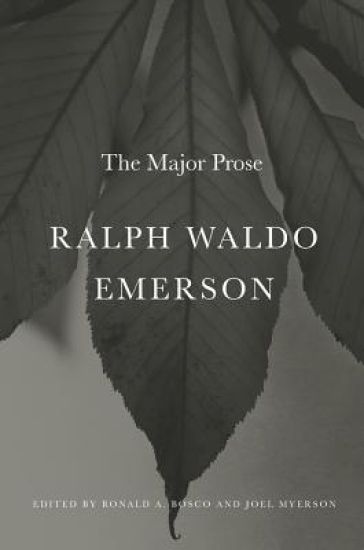
Upon its completion, The Collected Works of Ralph Waldo Emerson (1971–2013) was hailed as a major achievement of scholarship and textual editing. Drawing from the ten volumes of the Collected Works, Ronald A. Bosco and Joel Myerson have gathered some of Emerson’s most memorable prose published during his lifetime and under his direct supervision. The editors have enhanced those selections with additional writings to produce the only anthology that represents in a single volume the full range of Emerson’s written and spoken prose genres—sermons, lectures, addresses, and essays—that took on their public life in the pulpit or lecture hall, or on the printed page.Ralph Waldo Emerson: The Major Prose demonstrates the remarkable scope of Emerson’s interests, from science, literature, art, philosophy, natural history, and religion to pressing social issues such as slavery and women’s rights, to the character of his contemporaries, including Lincoln and Thoreau. Emerson’s classic essays Nature, “Self-Reliance,” and “Experience” complement his less familiar but no less vital texts, including the deeply heterodox sermon on “The Lord’s Supper,” which effectively announced his resignation from the ministry, and late essays on “American Civilization,” “Character,” and “Works and Days.” Edited according to the most rigorous modern standards, Ralph Waldo Emerson: The Major Prose provides an authoritative compendium of writings by one of America’s most significant literary figures and public intellectuals.
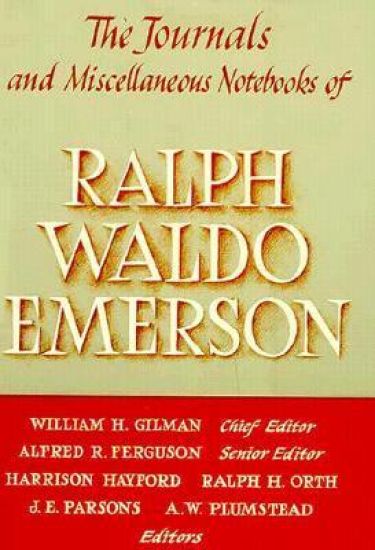
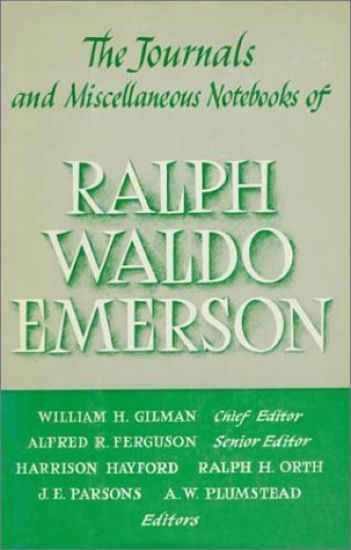
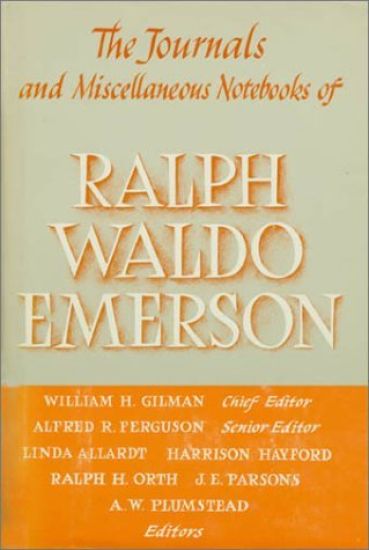
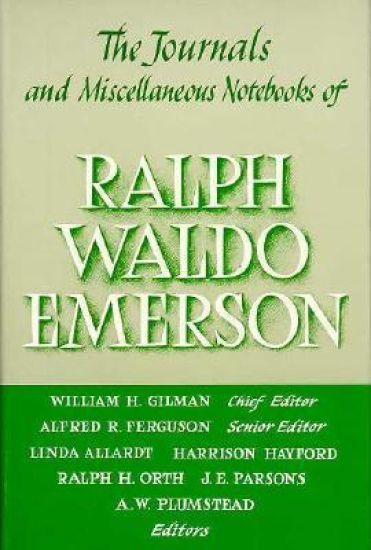
Journals and Miscellaneous Notebooks of Ralph Waldo Emerson

Journals and Miscellaneous Notebooks of Ralph Waldo Emerson

Ralph Waldo Emerson

Harvard University Press
1960
sidottu
Ralph Waldo Emerson, the man and thinker, will be fully revealed for the first time in this new edition of his journals and notebooks. The old image of the ideal nineteenth-century gentleman, created by editorial omissions of his spontaneous thoughts, is replaced by the picture of Emerson as he really was. His frank and often bitter criticisms of men and society, his “nihilizing,” his anguish at the death of his first wife, his bleak struggles with depression and loneliness, his sardonic views of woman, his earthy humor, his ideas of the Negro, of religion, of God—these and other expressions of his private thought and feeling, formerly deleted or subdued, are here restored. Restored also is the full evidence needed for studies of his habits of composition, the development of his style, and the sources of his ideas. Cancelled passages are reproduced, misreadings are corrected, and hitherto unpublished manuscripts are now printed. The text comes as close to a literal transcription as is feasible. A full apparatus of annotation, identification of quotations, and textual notes is supplied. Reproduced in this volume are twelve facsimile manuscript pages, many with Emerson’s marginal drawings.The first volume includes some of the “Wide Worlds,” journals begun while Emerson was at Harvard, and four contemporary notebooks, mostly unpublished. In these storehouses of quotation, juvenile verse, themes, and stories are the first versions of Emerson’s “Valedictory Poem,” Bowdoin Prize Essays, and first published work. Together they give a faithful picture of Emerson’s apprenticeship as an artist and reveal the extent of his hidden and frustrated ambition—to become a writer.
Journals and Miscellaneous Notebooks of Ralph Waldo Emerson

Journals and Miscellaneous Notebooks of Ralph Waldo Emerson

Ralph Waldo Emerson

Harvard University Press
1961
sidottu
Ralph Waldo Emerson, the man and thinker, will be fully revealed for the first time in this new edition of his journals and notebooks. The old image of the ideal nineteenth-century gentleman, created by editorial omissions of his spontaneous thoughts, is replaced by the picture of Emerson as he really was. His frank and often bitter criticisms of men and society, his “nihilizing,” his anguish at the death of his first wife, his bleak struggles with depression and loneliness, his sardonic views of woman, his earthy humor, his ideas of the Negro, of religion, of God—these and other expressions of his private thought and feeling, formerly deleted or subdued, are here restored. Restored also is the full evidence needed for studies of his habits of composition, the development of his style, and the sources of his ideas.The second volume prints the exact texts of nine journals and three notebooks. It reveals the shape of some of Emerson’s enduring interests, in embryo “essays” on the moral sense, moral beauty, taste, greatness and fame, friendship, compensation, and the unity of God and the universe. Restored from oblivion are suppressed passages on the Negro and revelations of acute melancholy and rebelliousness. These records of his developing thought are also the history of his early obscurity, when the fame he sought was still painfully remote.
Journals and Miscellaneous Notebooks of Ralph Waldo Emerson

Journals and Miscellaneous Notebooks of Ralph Waldo Emerson

Ralph Waldo Emerson

Harvard University Press
1963
sidottu
Ralph Waldo Emerson’s life from 1826 to 1832 has a classic dramatic structure, beginning with his approbation to preach in October 1826, continuing with his courtship, his brief marriage to Ellen Tucker, and his misery after her death, and concluding with his departure from the ministry.The journals and notebooks of these years are far fewer than those in the preceding six years. Emerson noted down many ideas for sermons in his journals, but as time went on he wrote the sermons independently. Occasionally he wrote openly about family matters, but except for the passionate response to Ellen and her death the journals tell little about the impact upon him of other people and outside events. The pattern is consistent with the earlier journals: Emerson used them mainly to record his thought, to develop and express his ideas. His religious and intellectual interests were undergoing significant changes in orientation or emphasis. He was less concerned with the existence of God than with the nature and influence of Christ. He continued to reassert the truth of Christianity, but in his growing unorthodoxy he came to show less and less sympathy with the church, with forms and ritual, with convention. And he began to wonder whether it is not the worst part of the man that is the minister.During these years, Emerson read more in Madame de Staël, Wordsworth, Gérando, and Coleridge, less in Milton, the Augustans, Dugald Stewart, and Scott. In style, he moved from a rambling, bookish rhetoric to the tautness and the cadences that mark his later Essays.
Journals and Miscellaneous Notebooks of Ralph Waldo Emerson

Journals and Miscellaneous Notebooks of Ralph Waldo Emerson

Ralph Waldo Emerson

Harvard University Press
1964
sidottu
Ralph Waldo Emerson’s decision to quit the ministry, arrived at painfully during the summer and fall of 1832, was accompanied by illness so severe that he was forced to give up any immediate thought of a new career. Instead, in December, he embarked on a tour of Europe that was to take him to Italy, France, Scotland, and England. Within a year after his return in the fall in 1833, his health largely restored, he went to live in the town of Concord, his home from then on.The record of Emerson’s ten months in Europe which makes up a large part of this book is unusually detailed and personal, actually a diary recording what Emerson saw and did as well as what he thought. He describes cities, scenes, and buildings that he found striking in one way or another and he gives impressions of the people he met. During his travels he made the acquaintance of Landor, of Lafayette, and of Carlyle, Wordsworth, and Coleridge, all of whom stimulated him. In Paris he was so much stirred by a visit to the Jardin des Plantes that he determined “to become a naturalist.”On his return to America, still without a profession, he reverted in his journals to the more impersonal form they had taken in his days as a minister, focusing on his inner experiences rather than on external events. Notes start dotting the pages once again, this time not so much for future sermons—although for years he did a certain amount of occasional preaching as for the addresses of the public lecturer he would soon become.Through the thirty-four months covered by this volume, the journals continue to he the advancing record of Emerson’s mind, demonstrating a growing maturity and firmness of style by compression and aphorism.
Journals and Miscellaneous Notebooks of Ralph Waldo Emerson

Journals and Miscellaneous Notebooks of Ralph Waldo Emerson

Ralph Waldo Emerson

Harvard University Press
1965
sidottu
The journals of 1835–1838, perhaps the richest Ralph Waldo Emerson had yet written, cover the pivotal years when he brought to Concord his second wife, Lydia Jackson of Plymouth, published Nature (1836), and wrote “The American Scholar” (1837) and the Divinity School Address (1838). As he turned from the pulpit to the lecture platform in the 1830’s, the journals became more and more repository for the substance of future lectures; his annual winter series, particularly those dealing with The Philosophy of History, in 1836–1837, and Human Culture, in 1837–1838, were drawn largely from materials contained in this volume.Along with lecture material, the journals of these years include Emerson’s notes on his extensive reading, expressions of his griefs and joys, and his perennial reflections on man and his relation to nature and the divine. The birth of his son Waldo in October of 1836 compensated perhaps for the death of his beloved brother Charles the previous May. New friendships with Margaret Fuller, Henry Thoreau, and especially Bronson Alcott (whom Emerson called “the highest genius of the time”) replaced to a degree the close intellectual companionship he had enjoyed with Charles.Printed here for the first time are the complete texts of these journals. They reveal the continuity of Emerson’s development and add to the understanding both of his thought and of his methods of literary composition.
Journals and Miscellaneous Notebooks of Ralph Waldo Emerson

Journals and Miscellaneous Notebooks of Ralph Waldo Emerson

Ralph Waldo Emerson

Harvard University Press
1966
sidottu
Volume VI in this series contains quotation books and miscellaneous notebooks that Ralph Waldo Emerson kept between 1824 and 1838, and to which he added occasionally as late as the 1860s. With some attempt at a systematic listing, but more often at random, he set down an enormous variety of entries from Burke, Montaigne, Madame de Staël, Bacon, Plutarch, Jeremy Taylor, and a host of other writers both famous and obscure, with frequent comments of his own.One book contains Emerson’s lengthy translations of Goethe, while another is devoted to his brother Charles, who died in 1836, and includes, among other items, excerpts from Charles’s letters to his fiancée. A third contains an interview with a survivor of the battle of Concord and household accounts from the fall and winter of 1835, just after Emerson’s marriage to Lydia Jackson.Frequent annotations show that Emerson referred to several of these books in composing the sermons he began to give late in 1826, and that many of the entries found their way into his public lectures, into Nature, and into Essays: First Series. These pages are a fascinating indication of the sources on which Emerson drew steadily in his writing and thinking, and reflect clearly, although indirectly, his own characteristic philosophy.
Journals and Miscellaneous Notebooks of Ralph Waldo Emerson

Journals and Miscellaneous Notebooks of Ralph Waldo Emerson

Ralph Waldo Emerson

Harvard University Press
1969
sidottu
When Ralph Waldo Emerson began these journals in June of 1838, he “had achieved initial success in each of his main forms of public utterance. The days of finding his proper role and public voice were now behind him…and his…personal life had healed from earlier wounds.” Now he was married to Lydia Jackson of Plymouth and was the father of a young son, Waldo. They lived in a large, comfortable house in Concord, only a half-day’s drive from Boston but close to the solitude of nature. Still to come was the controversy he would create by his address to the graduating class at Harvard Divinity School, an address in which he would say that the Divinity School trained ministers for a dead church. These journals record his responses to the severe criticism and trace his struggles as he overcame the stings of attack with a growing confidence in himself as a thinker, lecturer, and writer.In addition to introspective writings, the journals contain Emerson’s observations on his reading, on his country, especially during the presidential campaign of 1840, on slavery, on art and nature, on religion and the need for a new understanding of its meaning, and on love. His relations with such close friends as Bronson Alcott and Margaret Fuller also are reflected here, as are his developing friendships with Thoreau, Jones Very, Samuel Ward, Caroline Sturgis, and William Ellery Channing, the poet.During this period he gave three series of lectures and published his second book, Essays, which contains some of his greatest work: “Self Reliance,” “Compensation,” and “The Over-Soul.” The major workshop for Essays, these journals are indispensable for the study of Emerson’s creative processes. Many entries are published here for the first time, including experimental lists of topics for Essays and possibly the earliest draft of the poem “The Sphinx.”For Emerson, the journal was one of the most important of literary genres. His own journals not only formed his “artificial memory,” but became “a living part of him.” He later wrote, “The man is only half himself, the other half is his expression.”
Journals and Miscellaneous Notebooks of Ralph Waldo Emerson

Journals and Miscellaneous Notebooks of Ralph Waldo Emerson

Ralph Waldo Emerson

Harvard University Press
1970
sidottu
In July 1841, Ralph Waldo Emerson wrote to Thomas Carlyle: “My whole philosophy…teaches acquiescence and optimism.” The journals in this volume, beginning in the summer of 1841, record the spiritual history of two years that can be viewed as the most critical test in Emerson’s life of his ability to maintain the two aspects of that philosophy.Early in 1842 his son Waldo died, and the man who only months before had described himself as “professor of the joyous Science” found himself once again confronting the full implications of grief. Seeking to comprehend the loss, he used his journals to articulate and rediscover the vital faith upon which his philosophy rested. In passages that went eventually into “Experience,” and in the earliest drafts of the poem “Threnody,” which appear for the first time in these pages, he discovered that even this harsh event had its “compensations.” Waldo’s death forced a reassessment of the convictions that gave life to his earlier writings. He transformed his numb responses into his most moving poetry and prose, giving new and significant meaning to his “old motto”: “I am Defeated all the time, yet to Victory I am born.”Emerson’s motto is revealing, for its concepts display aptly the bipolarity that characterizes so much of his thought during these crucial years. He carried on at length an internal debate between the active and passive life styles. He saw his friends committed in their various ways to a more emphatic practice of their philosophies than he was able to undertake. Moving between engagement and withdrawal, commitment and aloofness, action and passivity, he consistently sought that point of equilibrium where the opposing forces of his thought could be held in creative tension.As Emerson’s private experience deepened, he was becoming more completely the public man of letters: writing, publishing, editing The Dial, and lecturing. His travels brought him in contact with the leading men of his day, and with sights and exposures which even his beloved New England could not offer. Amidst the public duties, however, it was Concord which remained the still, vital center of his life. A brilliant and widely diversified range of visitors brought the world to Emerson’s home and inspired him to explore personal and literary issues which he would develop in his journals and later utilize in lectures and essays.Emerson saw his calling as that of a poet; these journals are abundant in verse. Working versions of some of his most noted poems reveal the complex relationship between his private and literary life and the manner in which he attempted to fuse the diversities of his thought. In the eight regular journals and three miscellaneous notebooks of this volume is the record of these fusions. This period of his life closes, as it opened, with “acquiescence and optimism.” But the creative skepticism which is so characteristic of the second series of essays and the poems of 1841–1843 is the mark of a “very real philosophy,” tempered and tried by adversity, by success, and by “Experience.”
Journals and Miscellaneous Notebooks of Ralph Waldo Emerson

Journals and Miscellaneous Notebooks of Ralph Waldo Emerson

Ralph Waldo Emerson

Harvard University Press
1973
sidottu
Emerson's journals of 1847-1848 deal primarily with his second visit to Europe, occasioned by a British lecture tour that began at Manchester and Liverpool in November of 1847, took him to Scotland in the following February, and concluded in London during June after he had spent a month as a sightseer in Paris. The journals of these years, along with associated notebooks and letters, recorded the materials for lectures that Emerson composed while abroad, for additional lectures on England and the English that he wrote shortly after his return to Concord, and ultimately, for English Traits, the book growing out of his travels that he was to publish in 1856.Travel abroad provided a needed change for Emerson in 1847 as it had done on previous occasions, though with his usual discounting of the values of mere change of place he was slow in deciding to make the trip. Discouragement with the prevailing political climate at the time of the Mexican War and the old uncertainty about his own proper role in the "Lilliput" of American society were much on his mind as the year began. In March he thought of withdrawing temporarily "from all domestic & accustomed relations"--preferably to enjoy "an absolute leisure with books," though he also recognized the want of some "stated task" to stimulate his flagging vitality; in July he finally agreed to accept a long-standing invitation to visit England as a lecturer. As matters turned out, a full schedule of lectures and travel, unexpectedly heavy social engagements along the way, and proliferating correspondence left Emerson little time for reading but did not prevent him from filling his journals with sharp observations on the passing scene.As Emerson moved about England his acknowledged admiration for the English rose every day, though he was careful to distinguish their less admirable qualities.The Englishman's "stuff or substance seems to be the best of the world," he told Margaret Fuller. "I forgive him all his pride. My respect is the more generous that I have no sympathy with him, only an admiration." He took a wry amusement from the new experience of being lionized by his hosts. In his journals are lively portraits of those who entertained him, such as Richard Monckton Milnes, his particular sponsor in the society of London and Paris, and sketches of literary notables including Rogers, Dc Quincey, Wilson, Tennyson, and Dickens. He renewed acquaintance with Wordsworth and recorded in detail the pronouncements of his old friend Carlyle. Settling in London in March and April of 1848, he divided his time between work at his desk, visits to nearby points of interest, and the mixed pleasures of a busy social life. In May he went to France just as an abortive uprising against the new provisional government was brewing. Four weeks in Paris served to correct his old "prejudice" against the French, who on closer acquaintance rose in his estimation just as the English had done. In June he returned to London to lecture, and in July, after visiting Stonehenge with Carlyle, he sailed home. As the journals reveal, he reached Concord refreshed and renewed by the change of scene, the new acquaintance, and the generous reception that the trip had brought him, and with an enlarged perspective that revealed to him once again the "proper glory" of his own country.
Journals and Miscellaneous Notebooks of Ralph Waldo Emerson

Journals and Miscellaneous Notebooks of Ralph Waldo Emerson

Ralph Waldo Emerson

Harvard University Press
1975
sidottu
Like Goethe, Ralph Waldo Emerson wanted to be the cultural historian and interpreter of his age—its business, politics, discoveries. The journals and notebooks included in this volume and covering in depth the years 1848 to 1851 reflect Emerson’s preoccupations with the events of these often turbulent years in America.On his return to Concord from his successful lecture trip to England and visit to Paris in 1847–1848, Emerson resumed his familiar life of writer, thinker, and lecturer. Impressions of his recent European travels appear in passages in this volume which are used later in English Traits (1856). He writes of technological and scientific discoveries in America and abroad—one of which, the discovery of ether, was to involve his brother-in-law in legal embroilment. He ponders the meaning, for “the age” or “the times,” of reports on the Dew textile mills in Lawrence, Massachusetts, of faster steamers daily breaking records, of new geological and paleontological findings, of theories of race, and many other matters that were coming increasingly to the fore in the mid-nineteenth century. Many passages on these topics, used first in lectures, later appear in his essays “Fate,” “Wealth,” and “Power” in Conduct of Life (1860). He was also adding to his critical biographies for Representative Men (1850), with special attention to Swedenborg, always a source of particular interest for Emerson.Between 1850 and 1853, Emerson traveled farther west to lecture than he had hitherto ventured—to Pittsburgh, Cincinnati, St. Louis, and many other cities in the midwest. One notebook in the present volume records his customary percipient observations of places and people encountered during these western trips.The tragic drowning of Margaret Fuller Ossoli and her family on her return from Italy in 1850 prompted Emerson to consider a collaboration on her life and writings, and another notebook printed here contains her memorabilia, including original entries by Emerson. Memoirs of Margaret Fuller Ossoli by Emerson, William Henry Charming, and James Freeman Clarke, was published in 1852.Passage of the Fugitive Slave Law in 1850 brought to a boil something in Emerson that had long been simmering. Concerned with slavery, freedom, and the future of the black population in America more than his public record had shown, he now delivered himself of an outburst—pained, vitriolic, ironic—a more sustained response to a single issue than appears elsewhere in all his journals. In this latest move in a compounding national tragedy he could see only chicanery and deterioration, the crumbling of America’s moral fiber. He saw the Fugitive Slave Law in a larger context of a sick age; like Tennyson and Arnold in England, he lamented in moods of spite and chagrin the loss of faith and of an old world where political men of honor stood firm for the moral law. Most of his journal outburst went into his addresses “The Fugitive Slave Law,” 1851 and 1854.
Journals and Miscellaneous Notebooks of Ralph Waldo Emerson

Journals and Miscellaneous Notebooks of Ralph Waldo Emerson

Ralph Waldo Emerson

Harvard University Press
1977
sidottu
The journals printed in this volume, covering the years 1852 to 1855, find Emerson increasingly drawn to the issues and realities of the pragmatic, hard-working nineteenth century. His own situation as a middle-aged, property-owning New Englander with a large household to support gave him a strong sense of everyday financial necessity, and his wide reading for his projected book on the English impressed him deeply with the worldly success that had come to that unphilosophical people. The growing crisis over slavery at home, moreover, demanded the attention of every citizen, even one as reluctant to engage in social issues as Emerson.Emerson's extensive reading about the English, which ranged from Camden's Britannia through the diaries of Samuel Pepys and Thomas Moore to the latest issues of the London Times, convinced him that, despite its materialism, England was "the best of actual nations." The robust physical health of the English, their common sense, and their instinct for fair play insured that the future belonged to them and their transatlantic cousins, the Americans.Yet the facts of American political life often led Emerson to wonder whether his country had any future at all. So long as his fellow citizens were willing to countenance the evil of slavery, they could not play their proper role in the world, the pages of his journals indicate, Emerson, like an increasing number of other Americans, was coming to believe that the issue had to he resolved, whatever the cost.
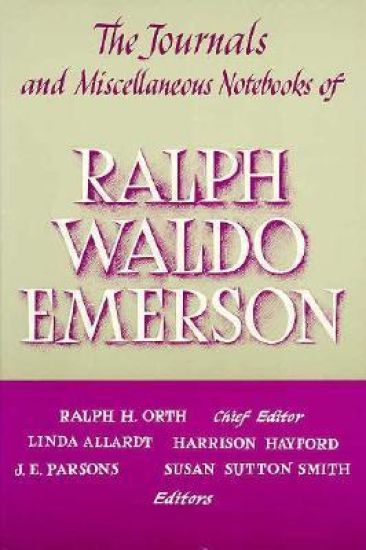
Journals and Miscellaneous Notebooks of Ralph Waldo Emerson

Journals and Miscellaneous Notebooks of Ralph Waldo Emerson

Ralph Waldo Emerson

Harvard University Press
1978
sidottu
The journals from 1854 to 1861 show the ripeness of Ralph Waldo Emerson’s thought overshadowed by the gravest problem of his time—slavery. In addition to completing English Traits (1856) and Conduct of Life (1860), Emerson wrote many of the lectures and articles that made up his next book, Society and Solitude. He also contributed often to The Atlantic Monthly after helping to found that magazine in 1857. Throughout these years he extended his strenuous trips as a lyceum lecturer, crossing and recrossing the frozen Mississippi several times each winter. In Concord, he continued his omnivorous reading, his beloved walks, and his friendships with Alcott, Channing, and Thoreau, but at home or away he saw America’s future darkening daily. In 1856, Emerson wrote to his brother William, “But what times are these, & how they make our studies impertinent, & even ourselves the same! I am looking into the map to see where I shall go with my children when Boston & Massachusetts surrender to the slave-trade.”Influenced by events such as the murder of New England men in bloody Kansas and the assault on Charles Sumner in the U.S. Congress in 1856, by a growing friendship with Theodore Parker, and by John Brown’s visits to Concord in 1857 and 1859, Emerson became one of the most notable speakers against slavery. He armed himself for his emergence from the study by marshalling his thoughts on liberty as he would have ranged his thoughts on any other topic. Notebook WO Liberty, rediscovered in the Library of Congress in 1964, collects his ideas on slavery and human liberty. Probably begun in 1854 it contains drafts or records of seven antislavery speeches, including his major antislavery address, “American Slavery,” first given in January, 1855. These notebooks and journals bring the philosopher of "the infinitude of the private man" to January 1861 and the brink of war.