Kirjojen hintavertailu. Mukana 12 390 323 kirjaa ja 12 kauppaa.

Kirjahaku

Etsi kirjoja tekijän nimen, kirjan nimen tai ISBN:n perusteella.

1000 tulosta hakusanalla Sabine Mercer

Cross Your Heart, Connie Pickles

Cross Your Heart, Connie Pickles

Sabine Durrant

Penguin Books Ltd
2005
pokkari
Welcome to the world of Connie Pickles. Best Friend #1 - Julie: Big boobs. Big ideas. Big fibber. Best Friend #2 - William: Giver of chocolate buttons. A shoulder for Connie to cry on. Makes other girls flutter and blush. Best Friend #3 - Delilah: hormone-crazed victim of a girls-only school. Flutters and blushes A LOT. Mother: French. Beautiful. Broke. Bra-expert. A romantic disaster area. Needs help.Connie used to be the only sensible person in her world. But now her life is spiralling out of control. Her mother refuses to fall for the right man, William is acting strangely and Connie's own heart is in tatters. So with a little help (and a lot of hindrance) from her friends, she sets out to solve the eternal mysteries of love, money, French things (including kisses) and incredibly uncomfortable underwear.
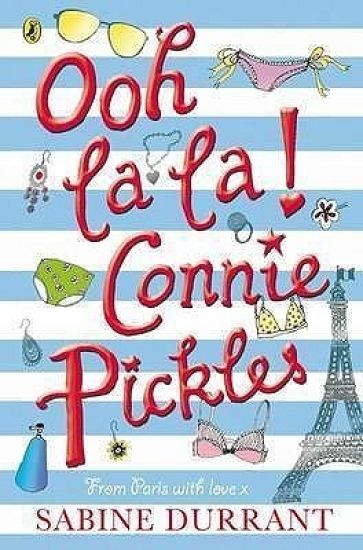
Ooh La La! Connie Pickles

Ooh La La! Connie Pickles

Sabine Durrant

Penguin Books Ltd
2007
pokkari
Connie Pickles is fulfilling her destiny. She's in Paris, and she has big plans. She will fall in love with someone other than William. She will find her long lost grandparents. She will become très chic. But sometimes even destiny doesn't go to plan . . .Sabine Durrant has the laugh-out-loud humour of Louise Rennison, the sharp perception of Anne Fine and the instant girl-appeal of a younger Bridget Jones. Perfect for girls aged 11+.
The Parody Exception in Copyright Law

The Parody Exception in Copyright Law

Sabine Jacques

Oxford University Press
2019
sidottu
Parodies have been created throughout times and cultures. A glimpse at the general judicial latitude generally afforded to parodies, satires, caricatures, and pastiches demonstrates the social and cultural value of this particular form of artistic expression. With the advent of technologies and the evolution of copyright legislation, creative endeavours in the form of parody gathered a new youth but became unlawful. While copyright law grants exclusive rights to right-holders, this right is not absolute. Legislation includes specific exceptions, which preclude right-holders from exercising their prerogatives in particular cases which foster creativity and cultural diversity within that society. The parody exception pertains to this ultimate objective by permitting users to reproduce copyright-protected materials for the purpose of parody. To understand the meaning and scope of the parody exception, this book examines and compares five jurisdictions which differ in their protection of parodies: France, Australia, Canada, the US and the United Kingdom. This book is concerned with finding an appropriate balance between the protection awarded to right-holders and the public interest. This is achieved by analysing the parody exception to the economic rights of right-holders, the preservation of moral rights and the interaction of the parody exception with contract law. As parodies constitute an artistic expression protected under the right to freedom of expression, this book also considers the influence of freedom of expression on the interpretation of this specific copyright exception. Furthermore, this book aims at providing guidance on how to resolve conflicts where fundamental rights are in conflict. This is the first book in English to offer an in-depth investigation into the parody exception in copyright law, and comments on industry practices linked to this form of creative endeavours.
Deaf People, Language, and Emancipation in Modern France, 1789–1914
Following the death in 1789 of Abbé de l'Epée, the first teacher of deaf pupils renowned in France and beyond, revolutionaries committed to founding national institutes for the education of deaf pupils. No one doubted their ability to become full-fledged citizens and communicate fully in sign language and written French. One hundred years later, deaf writers and journalists were editing journals and penning articles about the impact of politics on the education and social opportunities of deaf people. But in broader contexts, deaf people's capacities were increasingly reframed within newly established, exclusionary, and othering scientific and medical categories. What made such a reversal possible? Deaf People, Language, and Emancipation in Modern France, 1789-1914 investigates how defining deafness was rarely about an auditory variation; teachers, physicians, legal advisors, and governmental representatives understood instead a human variation in the light of a range of norms, expectations, and misconceptions. Drawing on a wide range of contemporary debates about deaf identity, the book considers how such understandings of deafness developed, and how deaf people variously challenged these fields of knowledge and their purported expertise to redefine and claim equal rights. As a history that makes space for the diversity of deaf and hearing people's aspirations, Sabine Arnaud aims to give space to figures who defy linear visions of history. Much beyond the debates about the teaching of speech or the use of sign language, this book analyses the broad creation of sign language and fingerspelling systems, deaf people's command of rhetoric and poetics, their mobilization of literary tools, and broad exercise of citizenship. These distinctive developments in the history of deaf people's empowerment challenge and broaden current conceptions of identity politics. Such an historical approach is crucial in order to understand the emergence of a deaf community and to rethink the different and often contradictory readings of deafness in medical or cultural terms that we are faced with to this day