

Kirjahaku
Etsi kirjoja tekijän nimen, kirjan nimen tai ISBN:n perusteella.
1000 tulosta hakusanalla Steven R Harrison


Drugs, Crime, and Justice is an engaging, yet comprehensive, analysis of the interrelationships among drug use/abuse, crime, and justice. The first four chapters introduce readers to the interrelationships between drugs and crime, while the second later chapters provide readers with an overview of historical and contemporary policies, as well as a comprehensive review of research on policing drug markets, arresting drug offenders, and prosecution and sentencing of drug offenders in state and federal courts. The authors also examine and assess the impact of the war on drugs and conclude with a discussion of recent policy changes such as drug courts and reform/repeal of mandatory minimum sentences and an examination of new and emerging drug policies in the 21st Century.

Herbal Remedies Guidebook: Natural Alternatives to Feel Better
Steven R. Watson; Lynda M. LaCroix
Createspace Independent Publishing Platform
2010
nidottu

Lighting, HD, Film and Business: A Maverick's World
Steven R. Flanigan
Createspace Independent Publishing Platform
2010
nidottu

Bible Prophecy Study Course: Lesson Set 1
Steven R. Messick
Createspace Independent Publishing Platform
2010
nidottu

Bible Prophecy Study Course - Lesson Set 2
Steven R. Messick
Createspace Independent Publishing Platform
2010
nidottu

Bible Prophecy Study Course - Lesson Set 3
Steven R. Messick
Createspace Independent Publishing Platform
2010
nidottu


1 IN ODYSSEUS'S WAKE 1 1 LOGOS 13 3 THE NEW LABYRINTH 47 4 THE SKEIN OF ARIADNE 65 S "HEAR YE, CRETANS AND GREEKS!" 93 6 THE BATTLE OF NAXOS 119 7 RAPANUI 139 8 TALKI NG BOARDS OF TH E PACI FIC 153 9 ATOP TERE VAKA 167 10 "ALL THE BIRDS ... " 187 11 SURFING THE RONGORONGO 205 Suggested Reading 223 Index 227 A "glyph" (short for hieroglyph) is a sign in a script. And a "breaker" is a person who cracks a script's code. A "glyph breaker" is then a decipherer, someone who lets us read the unreadable, that linguistic magician who gives voice to the mute past. Until 1984 no one had been able to read Crete's 3600-year old Phaistos Disk, Europe's earliest literature and greatest written enigma. Until 1994 no one could make sense of Easter Island's mysterious Iongorongo writing, Oceania's only script predating the twentieth century. No one had ever deciphered two wholly different historical scripts before. Until now. This is the true story of these two achievements.
An Introduction to Trenchless Technology
Steven R. Kramer; William J. McDonald; James C. Thomson
Springer-Verlag New York Inc.
2012
nidottu
In the past decade, the field of trenchless technology has expanded rapidly in products, equipment, and utilization. This expansion would not have occurred without a strong increase ineconomic incentives to the user. Because theoperating environment has changed, trenchless technology is often the preferred alternative to traditional methods of digging holes and installing conduits. The infrastructure in which we live has become more congested and has to beshared by several users. In addition, the cost of restoring a road or landscaped area after construction may be higher than the cost of installing the conduit. These factors add to the need for trenchless technology-the ability to dig holes without disturbing the surface. In some ways, trenchless technology is a futuristic concept. Ruth Krauss in a children'sbookofdefinitions wrote,"AHole...Is to Dig." But thisstatement is not necessarily true. Today, a hole could be to bore. Trenchless technology is not new. But it certainly has become the buzzword of the construction industry and it appears that it will have a growing impact in the way contractors, utilities, and others install new facilities. Methods to bore horizontal holes were practiced as early as the 18005, but this technology has greatly changed. Today's tools include sophisticated drilling methods, state-of the-art power systems, and electronic guidance techniques. These tools can bore faster, safer, and more accurately, and in many instances more economically, than open-cllt methods. Technology has played an important role in these advances, but economics has become the driving force in making these systems popular.
?While steroids from the periphery have profound effects on the nervous system, the nervous system also produces its own steroids de novo (“neurosteroids”). The physiological importance of neurosteroids is beginning to be understood. These steroids potentially have roles in sedative/hypnotic behavior, anxiety, learning, and memory. At the cellular level, neurosteroids affect neuronal excitability, synaptic plasticity and cell proliferation and survival. Early findings hold promise for future strategies to treat specific psychologicalconditions and neurological diseases. This Brief will focus on the current state of understanding of brainderived neurosteroids.
An Introduction to Trenchless Technology
Steven R. Kramer
Springer-Verlag New York Inc.
2012
nidottu
In the past decade, the field of trenchless technology has expanded rapidly in products, equipment, and utilization. This expansion would not have occurred without a strong increase in economic incentives to the user. Because the operating environment has changed, trenchless technology is often the preferred alternative to traditional methods of digging holes and installing conduits. The infrastructure in which we live has become more congested and has to be shared by several users. In addition, the cost of restoring a road or landscaped area after construction may be higher than the cost of installing the conduit. These factors add to the need for trenchless technology-the ability to dig holes without disturbing the surface. In some ways, trenchless technology is a futuristic concept. Ruth Krauss in a children's book of definitions wrote, "A Hole .. .Is to Dig." But this statement is not necessarily true. Today, a hole could be to bore.



Neuroscience for the Mental Health Clinician, Second Edition
Steven R. Pliszka
Guilford Press
2016
nidottu
Accessible and succinct, this book has given thousands of clinicians and students the basic understanding of neuroscience that is essential in contemporary mental health practice. Steven R. Pliszka synthesizes current knowledge on the neurobiological bases of major psychiatric disorders. He explores the brain systems that underlie cognition, emotions, and behavior; how disturbances in these systems can lead to psychopathology; and the impact of genetic and environmental risk factors across development. The book also addresses the ways that both pharmacological and psychosocial treatments act on the brain as they bring about a reduction in symptoms. Illustrations include 93 black-and-white figures and 14 color plates. New to This Edition *Incorporates over a decade of important advances in brain science. *Heightened focus on brain networks. *Cutting-edge discussions of genetics and epigenetics, the biological impact of stress, neurotransmitters, novel depression treatments, and other timely topics. *Detailed chapters on autism spectrum disorder and dementia. *Numerous new and revised figures.

Neuroscience for the Mental Health Clinician, Second Edition
Steven R. Pliszka
Guilford Press
2016
sidottu
Accessible and succinct, this book has given thousands of clinicians and students the basic understanding of neuroscience that is essential in contemporary mental health practice. Steven R. Pliszka synthesizes current knowledge on the neurobiological bases of major psychiatric disorders. He explores the brain systems that underlie cognition, emotions, and behavior; how disturbances in these systems can lead to psychopathology; and the impact of genetic and environmental risk factors across development. The book also addresses the ways that both pharmacological and psychosocial treatments act on the brain as they bring about a reduction in symptoms. Illustrations include 93 black-and-white figures and 14 color plates. New to This Edition *Incorporates over a decade of important advances in brain science. *Heightened focus on brain networks. *Cutting-edge discussions of genetics and epigenetics, the biological impact of stress, neurotransmitters, novel depression treatments, and other timely topics. *Detailed chapters on autism spectrum disorder and dementia. *Numerous new and revised figures.
Roping the reader in with humor and real-world case examples presented as mysteries to be solved, this engaging text has been updated with new cases, the latest version of SPSS, and new coverage of multivariate analysis of variance. Steven R. Terrell prepares students and practitioners to become informed consumers of statistics so that they can make decisions based on data, and understand decisions others have made. He identifies six simple steps and guides readers to master them--from identifying a researchable problem to stating a hypothesis; identifying independent and dependent variables; and selecting, computing, and interpreting appropriate statistical tests. All techniques are demonstrated both manually and with the help of SPSS software. New to This Edition *All software instructions and examples are updated to SPSS Version 25. *Expanded chapter on the analysis of variance (ANOVA)--now covers multivariate ANOVA. *New and revised examples and quiz items pertaining to a broader range of fields, such as business, information systems, and medical sciences, along with education and psychology. Pedagogical Features *Examples of SPSS screenshots used for analyzing data. *User-friendly cautionary notes, "Putting it All Together" recaps, and alerts, such as "notice the effect size" or "check the direction of the mean scores." *End-of-chapter "Quiz Time" exercises that guide students to answer intriguing questions like whether working from home increases productivity, or whether age affects how long it takes to complete a doctoral degree. *Lists of key terms and formulas in each chapter, plus end-of-book glossary.
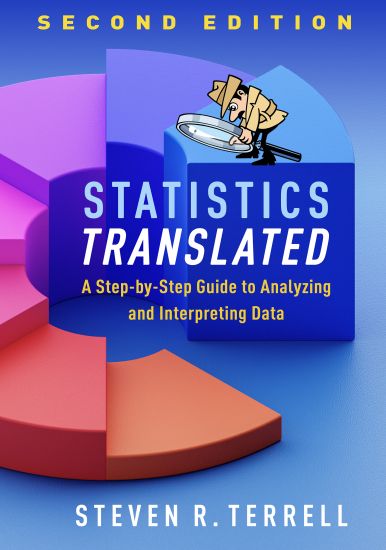
Roping the reader in with humor and real-world case examples presented as mysteries to be solved, this engaging text has been updated with new cases, the latest version of SPSS, and new coverage of multivariate analysis of variance. Steven R. Terrell prepares students and practitioners to become informed consumers of statistics so that they can make decisions based on data, and understand decisions others have made. He identifies six simple steps and guides readers to master them--from identifying a researchable problem to stating a hypothesis; identifying independent and dependent variables; and selecting, computing, and interpreting appropriate statistical tests. All techniques are demonstrated both manually and with the help of SPSS software. New to This Edition *All software instructions and examples are updated to SPSS Version 25. *Expanded chapter on the analysis of variance (ANOVA)--now covers multivariate ANOVA. *New and revised examples and quiz items pertaining to a broader range of fields, such as business, information systems, and medical sciences, along with education and psychology. Pedagogical Features *Examples of SPSS screenshots used for analyzing data. *User-friendly cautionary notes, "Putting it All Together" recaps, and alerts, such as "notice the effect size" or "check the direction of the mean scores." *End-of-chapter "Quiz Time" exercises that guide students to answer intriguing questions like whether working from home increases productivity, or whether age affects how long it takes to complete a doctoral degree. *Lists of key terms and formulas in each chapter, plus end-of-book glossary.
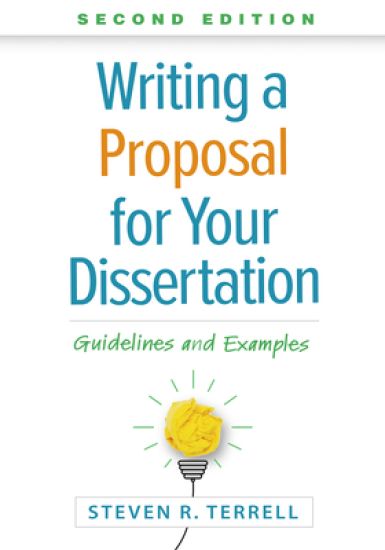
Writing a Proposal for Your Dissertation, Second Edition
Steven R. Terrell
Guilford Publications
2022
nidottu
The encouraging book that has guided thousands of students step by step through crafting a strong dissertation proposal is now in a thoroughly revised second edition. It includes new guidance for developing methodology-specific problem statements, an expanded discussion of the literature review, coverage of the four-chapter dissertation model, and more. Terrell demonstrates how to write each chapter of the proposal, including the problem statement, purpose statement, and research questions and hypotheses; literature review; and detailed plans for data collection and analysis. "Let's Start Writing" exercises serve as building blocks for drafting a complete proposal. Other user-friendly features include case-study examples from diverse disciplines, “Do You Understand?” checklists, and end-of-chapter practice tests with answers. Appendices present an exemplary proposal written three ways to demonstrate quantitative, qualitative, and mixed methods approaches, and discuss how to structure a four-chapter dissertation. New to This Edition *Introduction offering a concise overview of the entire proposal-writing process and the doctoral experience. *Additional help with tailoring problem and purpose statements for quantitative, qualitative, and mixed-methods studies. *Expanded discussion of the review of literature, including a criterion for judging the quality of primary versus secondary sources. *Many new examples from different disciplines, such as studies of depression treatments, approaches to reducing offender recidivism, health effects of irradiated crops, strength training in college football, and remote teaching and learning during COVID-19. *Focus on the five-chapter model is broadened to include specific guidance for four-chapter dissertations. *Broader, more detailed reference list and glossary.