Kirjahaku
Etsi kirjoja tekijän nimen, kirjan nimen tai ISBN:n perusteella.
1000 tulosta hakusanalla Torsten Schmidt

The sublime - along with beauty the most important aesthetic category of the 18th century - experienced an amazing renaissance in art, philosophy and scholarship at the end of the 20th century. Using the examples of Peter Handke, Christoph Ransmayr, Botho Strauss and Raoul Schrott, the present study shows the extent to which notions of the sublime have proved productive in contemporary literature. Particular attention is paid to the interrelationships between the literary texts and the aesthetic theories of Immanuel Kant, Friedrich Schiller, Jean-Francois Lyotard and Martin Seel, among others. The study demonstrates the multiplicity of forms in which the sublime appears in literature - and shows how the traditional idea of the sublime in human superiority over nature has been transformed into a poetics of sublime weakness.

Diese Arbeit erlautert und interpretiert Platons Dialog Phaidon. Vor dem Hintergrund der Ausfuhrungen zu Eidos, Psyche und Unsterblichkeit und deren Relationen zueinander stellt diese Untersuchung einen prazisen Kommentar dar, der eine synchrone Lekture des Phaidon stutzt. Die Interpretationen der Dialogaussagen zu den Eide, zur Seelenkonzeption und zur Unsterblichkeitslehre werden erganzt durch den Vergleich mit den grundlegenden philosophischen Todes- und Jenseitsauffassungen der Vorsokratik. Neben der eng am Text entwickelten Uberprufung aller Unsterblichkeitsbeweise, der Einwande des Simmias und des Kebes und der Widerlegungen dieser Einwande durch Sokrates, beschaftigt sich diese Arbeit ferner mit einer detaillierten Explikation des Hypothesisverfahrens.

Volkswirtschaftslehre
Torsten Bleich; Meik Friedrich; Werner A Halver; Christof Römer; Michael Vorfeld
Walter de Gruyter
2016
pokkari
Die Themen der Reihe "Lehr- und Klausurenb cher der angewandten konomik" umfassen alle Aspekte der angewandten konomik wie Volks- und Betriebswirtschaftslehre, Statistik oder konometrie. Alle B nde werden von Hochschulprofessoren verfasst, f r eine optimale Ausrichtung auf die Zielgruppe. Die Klausurenb cher der Reihe beinhalten langj hrig im Einsatz der Hochschullehrer erprobte bungs- und Klausuraufgaben mit den dazugeh rigen L sungen sowie weitere Aufgaben auf Klausurniveau, die der Pr fungsvorbereitung und dem Selbststudium dienen. Die Lehrb cher der Reihe sind explizit auf Bachelor-Studierende zugeschnitten, daher angewandt, praxisnah und didaktisch auf h chstem Niveau.

Europa Nach Der Revolution: Reaktion Und Fortschritt 1850-1870
Torsten Riotte
de Gruyter Oldenbourg
2025
nidottu

Die Texte des deutschen Magischen Realismus werden in der literaturwissenschaftlichen Forschung zumeist entweder als (kuriose) Einzeltexte behandelt oder als Teil größerer literarischer Entwicklungen der Zwischenkriegszeit betrachtet (Moderne Klassik, Synthetische Moderne). Diese Studie weist den (Erzähl-)Texten des Magischen Realismus erstmals einen konkreten literaturgeschichtlichen Ort zu, indem gezeigt wird, wie sich die neue literarische Schreibweise ab 1920 als ein nachexpressionistisches Phänomen entwickelt. Im Zentrum der programmatischen und literarischen Texte steht dabei nicht die Auseinandersetzung mit der Neuen Sachlichkeit. Vielmehr entwerfen die magisch-realistischen Texte eine Poetik der Mitte, die darauf abzielt, konträre literarische Schreibweisen (Realismus, Expressionismus) zu integrieren und gegensätzliche weltanschauliche Positionen der Moderne zu vermitteln. Die Studie führt dabei überzeugend vor Augen, in welche Paradoxien und Aporien die ‚Poetik der Mitte‘ in den untersuchten Texten führt, und demonstriert gleichzeitig die Kontinuität des magisch-realistischen Modells, das bis 1960 wirksam bleibt und sich so als durchlässig gegenüber klassischen literaturgeschichtlichen Zäsuren erweist.

Magischer Realismus als Verfahren der späten Moderne
Torsten W. Leine
de Gruyter
2019
isokokoinen pokkari
Die Texte des deutschen Magischen Realismus werden in der literaturwissenschaftlichen Forschung zumeist entweder als (kuriose) Einzeltexte behandelt oder als Teil größerer literarischer Entwicklungen der Zwischenkriegszeit betrachtet (Moderne Klassik, Synthetische Moderne). Diese Studie weist den (Erzähl-)Texten des Magischen Realismus erstmals einen konkreten literaturgeschichtlichen Ort zu, indem gezeigt wird, wie sich die neue literarische Schreibweise ab 1920 als ein nachexpressionistisches Phänomen entwickelt. Im Zentrum der programmatischen und literarischen Texte steht dabei nicht die Auseinandersetzung mit der Neuen Sachlichkeit. Vielmehr entwerfen die magisch-realistischen Texte eine Poetik der Mitte, die darauf abzielt, konträre literarische Schreibweisen (Realismus, Expressionismus) zu integrieren und gegensätzliche weltanschauliche Positionen der Moderne zu vermitteln. Die Studie führt dabei überzeugend vor Augen, in welche Paradoxien und Aporien die ‚Poetik der Mitte‘ in den untersuchten Texten führt, und demonstriert gleichzeitig die Kontinuität des magisch-realistischen Modells, das bis 1960 wirksam bleibt und sich so als durchlässig gegenüber klassischen literaturgeschichtlichen Zäsuren erweist.
Pocket Atlas of Radiographic Positioning
Torsten Bert Moeller; Emil Reif
Thieme Publishing Group
2008
pokkari
Radiographic positioning - comprehensive and concise Now in its second edition, Pocket Atlas of Radiographic Positioning is a practical how-to guide that provides the detailed information you need to reproducibly obtain high-quality radiographic images for optimal evaluation and interpretation of normal, abnormal, and pathological anatomic findings. It shows positioning techniques for all standard examinations in conventional radiology, with and without contrast, as well as basic positioning for CT and MRI. For each type of study a double-page spread features an exemplary radiograph, positioning sketches, and helpful information on imaging technique and parameters, criteria for the best radiographic view, and patient preparation. Clearly organized to be used in day-to-day practice, the atlas serves as an ideal companion to Moeller and Reif's Pocket Atlas of Radiographic Anatomy and their three-volume Pocket Atlas of Cross-Sectional Anatomy. Highlights of the second edition: New chapters on positioning in MRI and CT, including multislice CT A greatly expanded section on mammography Special features, including information on the advantages of a specific view, variations of positions, and practical tips and tricks Nearly 500 excellent radiographs and drawings demonstrating the relationship between correct patient positioning and effective diagnostic images Pocket Atlas of Radiographic Positioning, Second Edition is an excellent desk or pocket reference for radiologists, radiology residents, and for radiologic technologists.

Normal Findings in CT and MRI, A1, print
Torsten Bert Moeller; Emil Reif
Thieme Publishing Group
1999
nidottu
The key for any beginning radiologist who wishes to recognize pathological findings is to first acquire an ability to distinguish them from normal ones. This outstanding guide gives beginning radiologists the tools they need to systematically approach and recognize normal MR and CT images. Highlights include: Reference-quality images from the author's own teaching files show all standard normal findings as seen in CT and MRIChecklists in each section offer the reader a systematic way to approach the imagesThorough guidelines to help beginning radiologists dictate their reportsLists of standard measurements and tips for ruling out pathology
The method of making findings and the systematic method of interpreting images are still relevant today. This book deals with a subject that is seemingly trivial: normal findings in radiology. However, the normal is also the frequent, but not always the simple. Every radiologist has experienced difficulties in the systematics of imaging and with phrasing the diagnosis. This book is intended to answer three questions: How should the diagnosis be phrased? Which general scheme can I use to evaluate an image; how can I check for the degree of normality? Which data allow me to evidence normality, and what measurements should be taken?In spite of the introduction of digital X-ray imaging, the interpretation of conventional X-rays has not basically changed during the past ten years, which is evidenced by the development of this book. Since its first publication in 1987, it has gone through several unchanged reprints. In the 2nd German edition the text has hardly been changed; however, several new images have been added. The method of making findings and the systematic method of interpreting images are still relevant today. Consequently, the strict and systematic organization of the book was left unchanged. The new layout leads to a clearer accessibility of the material for the reader.
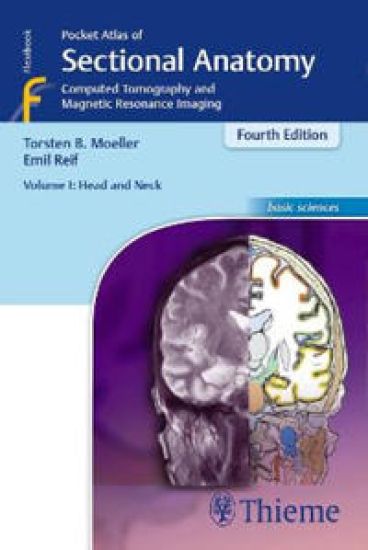
Pocket Atlas of Sectional Anatomy, Volume I: Head and Neck
Torsten Bert Möller; Emil Reif
Thieme Publishing Group
2013
pokkari
This comprehensive, easy-to-consult pocket atlas is renowned for its superb illustrations and ability to depict sectional anatomy in every plane. Together with its two companion volumes, it provides a highly specialized navigational tool for all clinicians who need to master radiologic anatomy and accurately interpret CT and MR images. Special features of Pocket Atlas of Sectional Anatomy:Didactic organization in two-page units, with high-quality radiographs on one side and brilliant, full-color diagrams on the other Hundreds of high-resolution CT and MR images made with the latest generation of scanners (e.g., 3T MRI, 64-slice CT) Consistent color coding, making it easy to identify similar structures across several slices Concise, easy-to-read labeling of all figuresUpdates for the 4th edition of Volume I: New cranial CT imaging sequences of the axial and coronal temporal bone Expanded MR section, with all new 3T MR images of the temporal lobe and hippocampus, basilar artery, cranial nerves, cavernous sinus, and more New arterial MR angiography sequences of the neck and additional larynx images Compact, easy-to-use, highly visual, and designed for quick recall, this book is ideal for use in both the clinical and study settings.
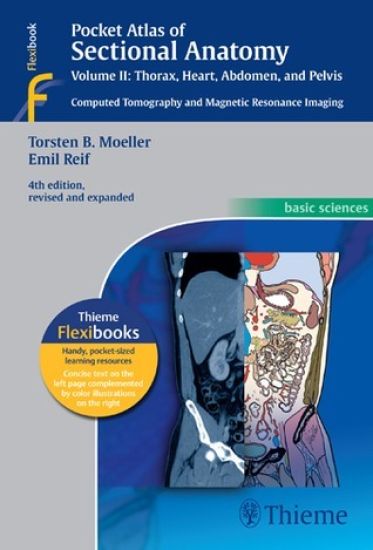
Pocket Atlas of Sectional Anatomy, Vol. II: Thorax, Heart, Abdomen and Pelvis
Torsten Bert Moeller; Emil Reif
Thieme Publishing Group
2013
nidottu
This comprehensive, easy-to-consult pocket atlas is renowned for its superb illustrations and ability to depict sectional anatomy in every plane. Together with its two companion volumes, it provides a highly specialized navigational tool for all clinicians who need to master radiologic anatomy and accurately interpret CT and MR images. Special features of Pocket Atlas of Sectional Anatomy:Didactic organization in two-page units, with high-quality radiographs on one side and brilliant, full-color diagrams on the other Hundreds of high-resolution CT and MR images made with the latest generation of scanners (e.g., 3T MRI, 64-slice CT) Color-coded schematic drawings that indicate the level of each section Consistent color coding, making it easy to identify similar structures across several slicesUpdates for the 4th edition of Volume II: CT imaging of the chest and abdomen in all 3 planes: axial, sagittal, and coronal New back-cover foldout featuring pulmonary and hepatic segments and lymph node stations Follows standard international classifications of the American Heart Association for cardiac vessels and the AJCC/UICC for mediastinal lymph nodes Compact, easy-to-use, highly visual, and designed for quick recall, this book is ideal for use in both the clinical and study settings.


Pocket Atlas of Ophthalmology
Torsten Schlote; Matthias Grueb; Joerg Mielke; Jens Martin Rohrbach
Thieme Publishing Group
2006
pokkari
Portable, practical information at a glance In ophthalmology, visual diagnosis is the most crucial part of an examination. This handy atlas is designed to help busy clinicians identify clinical signs and symptoms, establish differential diagnoses, and work through complex clinical questions - efficiently and accurately. The Pocket Atlas of Ophthalmology features:More than 500 photographs, line drawings, and diagramsPrecise clinical descriptions of all major disordersColor-coded tabs for easy accessEasy-to-follow bulleted lists and flow chartsSide-by-side comparison charts for differential diagnosisSuccinct overviews of ocular anatomy and physiologyValuable tips and techniques for diagnosis and treatmentChapters on drug side effects and eye diseases in developing countries Also useful as a study guide or patient information aid, the atlas also includes a detailed index and numerous cross-references. Compact, durable, and packed with information, this volume slides into any lab coat pocket, making it the ideal clinical companion for all eye care professionals.
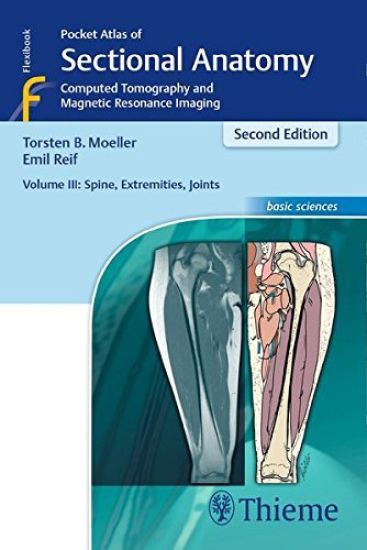
Pocket Atlas of Sectional Anatomy, Volume III: Spine, Extremities, Joints
Torsten Bert Möller; Emil Reif
Thieme Publishing Group
2016
nidottu
Full multiplanar coverage of the spine, extremities, and joints! Renowned for its superb illustrations and highly practical information, the third volume of this classic reference reflects the very latest in state-of-the-art imaging technology. Together with Volumes 1 and 2, this compact and portable book provides a highly specialized navigational tool for clinicians seeking to master the ability to recognize anatomical structures and accurately interpret CT and MR images. Highlights of Volume 3: New CT and MR images of the highest qualityDidactic organization using two-page units, with radiographs on one page and full-color illustrations on the nextConcise, easy-to-read labeling on all figuresColor-coded, schematic diagrams that indicate the level of each sectionSectional enlargements for detailed classification of the anatomical structureComprehensive, compact, and portable, this popular book is ideal for use in both the classroom and clinical setting.
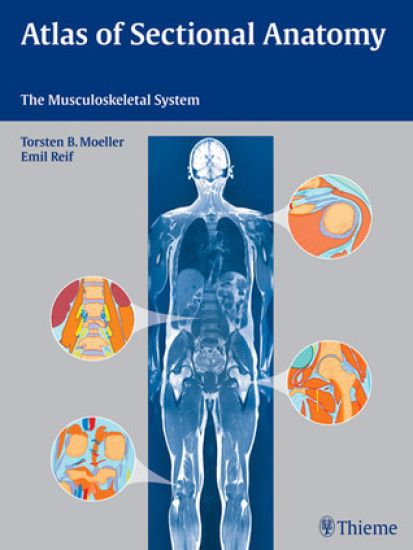
A handy, full-color resource for interpreting musculoskeletal MRI scans with confidence This superbly illustrated atlas provides a comprehensive presentation of the normal sectional anatomy of the musculoskeletal system to aid in the diagnosis of diseases affecting the joints, soft tissues, bones, and bone marrow. A precise, full-color drawing accompanies each high-quality sectional image, helping the reader to gain a solid understanding of the topographic anatomy and to differentiate between normal and pathologic conditions. Following examples of whole-body imaging, the atlas offers complete representations of the spinal column and the upper and lower extremities. The contiguous images of the extremities in transverse sections facilitate the identification of structures extending beyond the joints. Key features: Top-quality MRI scans, including whole-body views, produced with the most current, high-performance equipment Full-color illustrations drawn by the authors for optimal precision and accuracy Easy identification of anatomic structures through a uniform color code in the drawings Contiguous cross-sectional anatomy of the extremities Information on the location and direction of each slice for rapid orientation Atlas of Sectional Anatomy: The Musculoskeletal System is an invaluable reference for the daily practice of radiologists, radiology residents, and radiologic technologists.