

Kirjahaku
Etsi kirjoja tekijän nimen, kirjan nimen tai ISBN:n perusteella.
1000 tulosta hakusanalla WALTER RYE




The Collected Sermons of Walter Brueggemann
Walter Brueggemann
Westminster/John Knox Press,U.S.
2011
nidottu
In addition to being one of the world's leading interpreters of the Old Testament, Walter Brueggemann is a skilled and beloved preacher. This collection of sermons demonstrates Brueggemann's fidelity to biblical texts, which come alive with meaning in our contemporary world. Throughout, Brueggemann also reflects on his preaching.The book features a biblical index as well as a foreword by Samuel Wells of Duke University who writes: "Enjoy this volume from a master exegete, a master theologian, and a master preacher. They really are neat sermons. And they're for you."
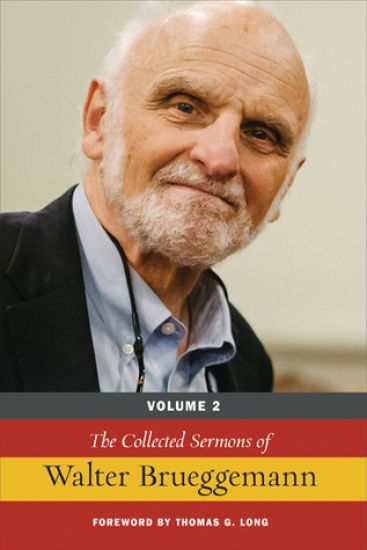
The Collected Sermons of Walter Brueggemann, Volume 2
Walter Brueggemann
Westminster John Knox Press
2015
sidottu
This collection presents over fifty powerful sermons from one of the most trusted preachers today, Walter Brueggemann. In it, Brueggemann continues his task of making the biblical text available to the church. He sees preaching as a performance of God's good rule that, in an act of utterance and receptive listening, mediates the truthful, joyous reality of that rule. The sermons are organized according to the church year, starting with sermons for Advent, Christmas, and Epiphany and followed by sermons for Lent and Easter and then Pentecost and Ordinary Time. Sermons for other occasions, such as ordinations, weddings, and graduations, are also included, along with a Scripture index. Whether a pastor or a person in the pew, the reader will find inspiration, reflection, and wisdom in Brueggemann's powerful words.

The Collected Sermons of Walter Brueggemann, Volume 2
Walter Brueggemann
Westminster/John Knox Press,U.S.
2015
nidottu
This collection presents over fifty powerful sermons from one of the most trusted preachers today, Walter Brueggemann. In it, Brueggemann continues his task of making the biblical text available to the church. He sees preaching as a performance of God's good rule that, in an act of utterance and receptive listening, mediates the truthful, joyous reality of that rule. The sermons are organized according to the church year, starting with sermons for Advent, Christmas, and Epiphany and followed by sermons for Lent and Easter and then Pentecost and Ordinary Time. Sermons for other occasions, such as ordinations, weddings, and graduations, are also included, along with a Scripture index. Whether a pastor or a person in the pew, the reader will find inspiration, reflection, and wisdom in Brueggemann's powerful words.

The Collected Sermons of Walter Brueggemann, Volume 3
Walter Brueggemann; Barbara Brown Taylor
Westminster John Knox Press
2020
sidottu

The Collected Sermons of Walter Brueggemann, Volume 3
Walter Brueggemann; Barbara Brown Taylor
WESTMINSTER/JOHN KNOX PRESS,U.S.
2020
nidottu
This collection features sixty sermons by Walter Brueggemann, preached mostly in the last five years. For his final public appearances, he preached at various churches and the Festival of Homiletics, including his last address there in 2018. Most of these are based on lectionary texts, with numerous sermons on Advent-Christmas and Lent-Easter texts. Preachers will find inspiration in the handful of sermons covering special occasions or themes, including confirmation, evangelism, and funerals.

Walter Benjamin was one of the most original and important critical voices of the twentieth century, but until now only a few of his writings have been available in English. Harvard University Press has now undertaken to publish a significant portion of his work in definitive translation, under the general editorship of Michael W. Jennings. This volume, the first of three, will at last give readers of English a true sense of the man and the many facets of his thought. (The magnum opus of Benjamin’s Paris years, The Arcades Project, has been published in a separate volume.) Walter Benjamin emerged from the head-on collision of an idealistic youth movement and the First World War, which Benjamin and his close friends thought immoral. He walked away from the wreck scarred yet determined “to be considered as the principal critic of German literature.” But the scene, as he found it, was dominated by “talented fakes,” so—to use his words—“only a terrorist campaign would I suffice” to effect radical change. This book offers the record of the first phase of that campaign, culminating with “One Way Street,” one of the most significant products of the German avant-garde of the Twenties. Against conformism, homogeneity, and gentrification of all life into a new world order, Benjamin made the word his sword. Volume I of the Selected Writings brings together essays long and short, academic treatises, reviews, fragments, and privately circulated pronouncements. Fully five-sixths of this material has never before been translated into English. The contents begin in 1913, when Benjamin, as an undergraduate in imperial Germany, was president of a radical youth group, and take us through 1926, when he had already begun, with his explorations of the world of mass culture, to emerge as a critical voice in Weimar Germany’s most influential journals. The volume includes a number of his most important works, including “Two Poems by Friedrich Hölderlin,” “Goethe’s Elective Affinities,” “The Concept of Criticism in German Romanticism,” “The Task of the Translator,” and “One Way Street.” He is as compelling and insightful when musing on riddles or children’s books as he is when dealing with weightier issues such as the philosophy of language, symbolic logic, or epistemology. We meet Benjamin the youthful idealist, the sober moralist, the political theorist, the experimentalist, the translator, and, above all, the virtual king of criticism, with his magisterial exposition of the basic problems of aesthetics. Benjamin’s sentences provoke us to return to them again and again, luring us as though with the promise of some final revelation that is always being postponed. He is by turns fierce and tender, melancholy and ebullient; he is at once classically rooted, even archaic, in his explorations of the human psyche and the world of things, and strikingly progressive in his attitude toward society and what he likes to call the organs of the collective (its architectures, fashions, signboards). Throughout, he displays a far-sighted urgency, judging the present on the basis of possible futures. And he is gifted with a keen sense of humor. Mysterious though he may sometimes be (his Latvian love, Asia Lacis, once described him as a visitor from another planet), Benjamin remains perhaps the most consistently surprising and challenging of critical writers.
In the frenzied final years of the Weimar Republic, amid economic collapse and mounting political catastrophe, Walter Benjamin emerged as the most original practicing literary critic and public intellectual in the German-speaking world. Volume 2 of the Selected Writings is now available in paperback in two parts.In Part 1, Benjamin is represented by two of his greatest literary essays, "Surrealism" and "On the Image of Proust," as well as by a long article on Goethe and a generous selection of his wide-ranging commentary for Weimar Germany's newspapers. Part 2 contains, in addition to the important longer essays, "Franz Kafka," "Karl Kraus," and "The Author as Producer," the extended autobiographical meditation "A Berlin Chronicle," and extended discussions of the history of photography and the social situation of the French writer, previously untranslated shorter pieces on such subjects as language and memory, theological criticism and literary history, astrology and the newspaper, and on such influential figures as Paul Valery, Stefan George, Hitler, and Mickey Mouse.

In the frenzied final years of the Weimar Republic, amid economic collapse and mounting political catastrophe, Walter Benjamin emerged as the most original practicing literary critic and public intellectual in the German-speaking world. Volume 2 of the Selected Writings is now available in paperback in two parts.In Part 1, Benjamin is represented by two of his greatest literary essays, "Surrealism" and "On the Image of Proust," as well as by a long article on Goethe and a generous selection of his wide-ranging commentary for Weimar Germany's newspapers. Part 2 contains, in addition to the important longer essays, "Franz Kafka," "Karl Kraus," and "The Author as Producer," the extended autobiographical meditation "A Berlin Chronicle," and extended discussions of the history of photography and the social situation of the French writer, previously untranslated shorter pieces on such subjects as language and memory, theological criticism and literary history, astrology and the newspaper, and on such influential figures as Paul Valery, Stefan George, Hitler, and Mickey Mouse.
Radical critic of a European civilization plunging into darkness, yet commemorator of the humane traditions of the old bourgeoisie--such was Walter Benjamin in the later 1930s. This volume, the third in a four-volume set, offers twenty-seven brilliant pieces, nineteen of which have never before been translated.The centerpiece, A Berlin Childhood around 1900, marks the first appearance in English of one of the greatest German works of the twentieth century: a profound and beautiful account of the vanished world of Benjamin's privileged boyhood, recollected in exile. No less remarkable are the previously untranslated second version of Benjamin's most famous essay, "The Work of Art in the Age of Its Technological Reproducibility," with its striking insights into the relations between technology and aesthetics, and German Men and Women, a book in which Benjamin collects twenty-six letters by distinguished Germans from 1783 to 1883 in an effort to preserve what he called the true humanity of German tradition from the debasement of fascism.Volume 3 also offers extensively annotated translations of essays that are key to Benjamin's rewriting of the story of modernism and modernity--such as "The Storyteller" and "Paris, the Capital of the Nineteenth Century"--as well as a fascinating diary from 1938 and penetrating studies of Bertolt Brecht, Franz Kafka, and Eduard Fuchs. A narrative chronology details Benjamin's life during these four harrowing years of his exile in France and Denmark. This is an essential collection for anyone interested in his work.

"Every line we succeed in publishing today...is a victory wrested from the powers of darkness." So wrote Walter Benjamin in January 1940. Not long afterward, he himself would fall prey to those powers, a victim of suicide following a failed attempt to flee the Nazis. However insistently the idea of catastrophe hangs over Benjamin's writings in the final years of his life, the "victories wrested" in this period nonetheless constitute some of the most remarkable twentieth-century analyses of the emergence of modern society. The essays on Charles Baudelaire are the distillation of a lifetime of thinking about the nature of modernity. They record the crisis of meaning experienced by a civilization sliding into the abyss, even as they testify to Benjamin's own faith in the written word.This volume ranges from studies of Baudelaire, Brecht, and the historian Carl Jochmann to appraisals of photography, film, and poetry. At their core is the question of how art can survive and thrive in a tumultuous time. Here we see Benjamin laying out an ethic for the critic and artist--a subdued but resilient heroism. At the same time, he was setting forth a sociohistorical account of how art adapts in an age of violence and repression. Working at the height of his powers to the very end, Benjamin refined his theory of the mass media that culminated in the final version of his essay "The Work of Art in the Age of Its Technological Reproducibility." Also included in this volume is his influential piece "On the Concept of History," completed just before his death. The book is remarkable for its inquiry into the nature of "the modern" (especially as revealed in Baudelaire), for its ideas about the transmogrification of art and the radical discontinuities of history, and for its examples of humane life and thought in the midst of barbarism. The entire collection is eloquent testimony to the indomitable spirit of humanity under siege.

Walter Benjamin is often viewed as a cultural critic who produced a vast array of brilliant and idiosyncratic pieces of writing with little more to unify them than the feeling that they all bear the stamp of his "unclassifiable" genius. Eli Friedlander argues that Walter Benjamin's corpus of writings must be recognized as a unique configuration of philosophy with an overarching coherence and a deep-seated commitment to engage the philosophical tradition.Friedlander finds in Benjamin's early works initial formulations of the different dimensions of his philosophical thinking. He leads through them to Benjamin's views on the dialectical image, the nature of language, the relation of beauty and truth, embodiment, dream and historical awakening, myth and history, as well as the afterlife and realization of meaning. Those notions are articulated both in themselves and in relation to central figures of the philosophical tradition. They are further viewed as leading to and coming together in The Arcades Project. Friedlander takes that incomplete work to be the central theater where these earlier philosophical preoccupations were to be played out. Benjamin envisaged in it the possibility of the highest order of thought taking the form of writing whose contents are the concrete time-bound particularities of human experience. Addressing the question of the possibility of such a presentation of philosophical truth provides the guiding thread for constellating the disparate moments of Benjamin's writings.
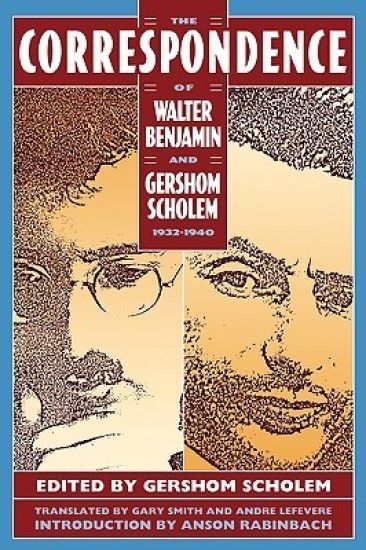
The Correspondence of Walter Benjamin and Gershom Scholem 1932-1940
Walter Benjamin; Gershom Scholem; Gary (TRN) Smith
Harvard University Press
1992
pokkari
The legendary correspondence between the critic Walter Benjamin and the historian Gershom Scholem bears witness to the inner lives of two remarkable and enigmatic personalities. Benjamin, acknowledged as one of the leading literary and social critics of his day, was known during his lifetime by only a small circle of friends and intellectual confreres. Scholem recognized the genius of his friend and mentor during their student days in Berlin, and the two began to correspond after Scholem's emigration to Palestine. Their impassioned exchange draws the reader into the very heart of their complex relationship during the anguished years from 1932 until Benjamin's death in 1940.
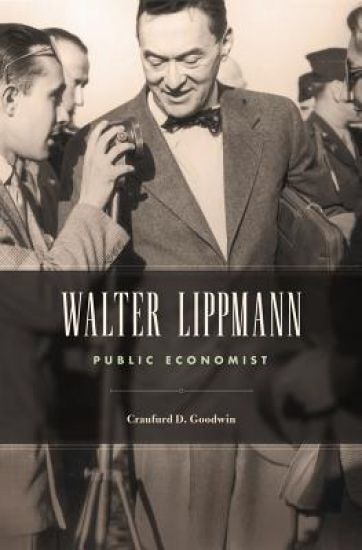
Walter Lippmann was the most distinguished American journalist and public philosopher of the twentieth century. But he was also something more: a public economist who helped millions of ordinary citizens make sense of the most devastating economic depression in history. Craufurd Goodwin offers a new perspective from which to view this celebrated but only partly understood icon of American letters.From 1931 to 1946 Lippmann pursued a far-ranging correspondence with leading economic thinkers: John Maynard Keynes, Lionel Robbins, Friedrich Hayek, Henry Simons, Adolf Berle, Frank Taussig, and others. Sifting through their divergent views, Lippmann formed his own ideas about economic policy during the Great Depression and shared them with a vast readership in his syndicated column, Today and Tomorrow. Unemployment, monetary and fiscal policy, and the merits and drawbacks of free markets were just a few of the issues he helped explain to the public, at a time when professional economists who were also skilled at translating abstract concepts for a lay audience had yet to come on the scene.After World War II Lippmann focused on foreign affairs but revisited economic policy when he saw threats to liberal democracy. In addition to pointing out the significance of the Marshall Plan and the World Bank, he addressed the emerging challenge of inflation and what he called “the riddle of the Sphinx”: whether price stability and full employment could be achieved in an economy with strong unions.
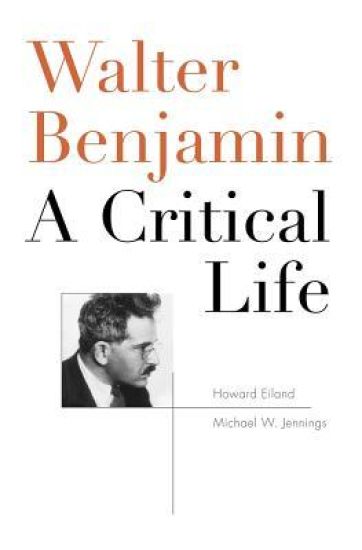
Walter Benjamin is one of the twentieth century's most important intellectuals, and also one of its most elusive. His writings—mosaics incorporating philosophy, literary criticism, Marxist analysis, and a syncretistic theology—defy simple categorization. And his mobile, often improvised existence has proven irresistible to mythologizers. His writing career moved from the brilliant esotericism of his early writings through his emergence as a central voice in Weimar culture and on to the exile years, with its pioneering studies of modern media and the rise of urban commodity capitalism in Paris. That career was played out amid some of the most catastrophic decades of modern European history: the horror of the First World War, the turbulence of the Weimar Republic, and the lengthening shadow of fascism. Now, a major new biography from two of the world's foremost Benjamin scholars reaches beyond the mosaic and the mythical to present this intriguing figure in full.Howard Eiland and Michael Jennings make available for the first time a rich store of information which augments and corrects the record of an extraordinary life. They offer a comprehensive portrait of Benjamin and his times as well as extensive commentaries on his major works, including "The Work of Art in the Age of Its Technological Reproducibility," the essays on Baudelaire, and the great study of the German Trauerspiel. Sure to become the standard reference biography of this seminal thinker, Walter Benjamin: A Critical Life will prove a source of inexhaustible interest for Benjamin scholars and novices alike.

In a lucid, brilliant work of nonfiction -- as close to an autobiography as his readers are likely to get -- Larry McMurtry has written a family portrait that also serves as a larger portrait of Texas itself, as it was and as it has become. Using as a springboard an essay by the German literary critic Walter Benjamin that he first read in Archer City's Dairy Queen, McMurtry examines the small-town way of life that big oil and big ranching have nearly destroyed. He praises the virtues of everything from a lime Dr. Pepper to the lost art of oral storytelling, and describes the brutal effect of the sheer vastness and emptiness of the Texas landscape on Texans, the decline of the cowboy, and the reality and the myth of the frontier. McMurtry writes frankly and with deep feeling about his own experiences as a writer, a parent, and a heart patient, and he deftly lays bare the raw material that helped shape his life's work: the creation of a vast, ambitious, fictional panorama of Texas in the past and the present. Throughout, McMurtry leaves his readers with constant reminders of his all-encompassing, boundless love of literature and books.