Kirjojen hintavertailu. Mukana 11 699 587 kirjaa ja 12 kauppaa.

Kirjahaku

Etsi kirjoja tekijän nimen, kirjan nimen tai ISBN:n perusteella.

1000 tulosta hakusanalla ART WIEDERHOLD

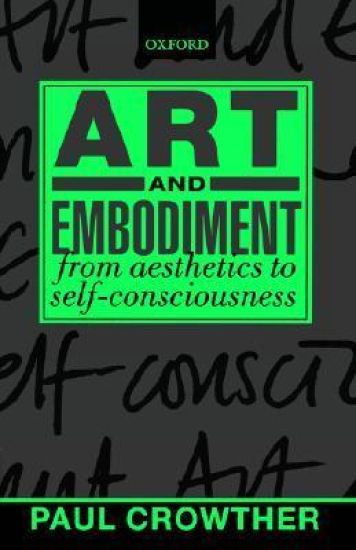
Art and Embodiment

Art and Embodiment

Paul Crowther

Oxford University Press
2001
nidottu
In his Critical Aesthetics and Postmodernism (Clarendon Press, 1993) Paul Crowther argued that art and aesthetic experiences have the capacity to humanize. In Art and Embodiment he develops this theme in much greater depth, arguing that art can bridge the gap between philosophy's traditional striving for generality and completeness, and the concreteness and contingency of humanity's basic relation to the world. As the key element in his theory, he proposes an ecological definition of art. His strategy involves first mapping out and analysing the logical boundaries and ontological structures of the aesthetic domain. He then considers key concepts from this analysis in the light of a tradition in Continental philosophy (notably the work of Kant, Heidegger, Merleau-Ponty, and Hegel) which -- by virtue of the philosophical significance that it assigns to art -- significantly anticipates the ecological conception. On this basis Professor Crowther is able to give a full formulation of his ecological definition. Art, in making sensible or imaginative material into symbolic form, harmonizes and conserves what is unique and what is general in human experience. The aesthetic domain answers basic needs intrinsic to self-consciousness itself, and art is the highest realization of such needs. In the creation and reception of art the embodied subject is fully at home with his or her environment.
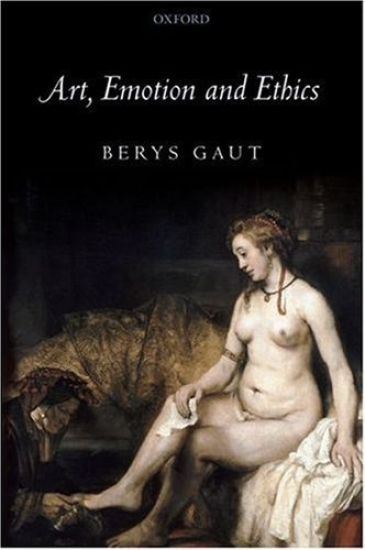
Art, Emotion and Ethics

Art, Emotion and Ethics

Berys Gaut

Clarendon Press
2007
sidottu
Art, Emotion and Ethics is a systematic investigation of the relation of art to morality, a topic that has been of central and recurring interest to the philosophy of art since Plato. Berys Gaut explores the various positions that have been taken in this debate, and argues that an artwork is always aesthetically flawed insofar as it possesses a moral defect that is aesthetically relevant. Three main arguments are developed for this view; these involve showing how moral goodness is itself a kind of beauty, that artworks can teach us about morality and that this is under certain conditions an aesthetic merit in them, and that our emotional responses to works of art are properly guided in part by moral considerations. Art, Emotion and Ethics also contains detailed interpretations of a wide range of artworks, including Rembrandt's Bathsheba and Nabokov's Lolita, which show that ethical criticism can yield rich and plausible accounts of individual works. Gaut develops a new theory of the nature of aesthetic value, explores how art can teach us about the world and what we morally ought to do by guiding our imaginings, and argues that we can have genuine emotions towards people and events that we know are merely fictional. Characterised by its clarity and sustained argument, this book will be of interest to anyone who wants to understand the relation of art to morality.
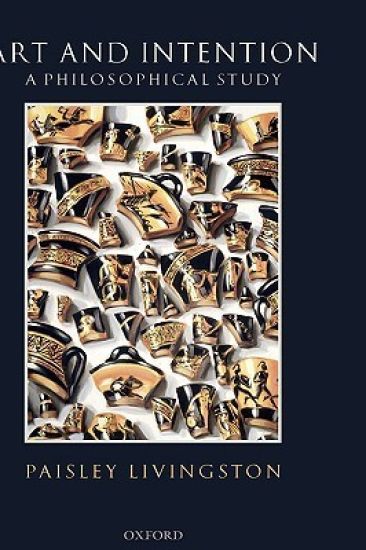
Art and Intention

Art and Intention

Paisley Livingston

Clarendon Press
2005
sidottu
Do the artist's intentions have anything to do with the making and appreciation of works of art? In Art and Intention Paisley Livingston develops a broad and balanced perspective on perennial disputes between intentionalists and anti-intentionalists in philosophical aesthetics and critical theory. He surveys and assesses a wide range of rival assumptions about the nature of intentions and the status of intentionalist psychology. With detailed reference to examples from diverse media, art forms, and traditions, he demonstrates that insights into the multiple functions of intentions have important implications for our understanding of artistic creation and authorship, the ontology of art, conceptions of texts, works, and versions, basic issues pertaining to the nature of fiction and fictional truth, and the theory of art interpretation and appreciation. Livingston argues that neither the inspirationist nor rationalistic conceptions can capture the blending of deliberate and intentional, spontaneous and unintentional processes in the creation of art. Texts, works, and artistic structures and performances cannot be adequately individuated in the absence of a recognition of the relevant makers´ intentions. The distinction between complete and incomplete works receives an action-theoretic analysis that makes possible an elucidation of several different senses of 'fragment' in critical discourse. Livingston develops an account of authorship, contending that the recognition of intentions is in fact crucial to our understanding of diverse forms of collective art-making. An artist's short-term intentions and long-term plans and policies interact in complex ways in the emergence of an artistic oeuvre, and our uptake of such attitudes makes an important difference to our appreciation of the relations between items belonging to a single life-work. The intentionalism Livingston advocates is, however, a partial one, and accomodates a number of important anti-intentionalist contentions. Intentions are fallible, and works of art, like other artefacts, can be put to a bewildering diversity of uses. Yet some important aspects of art´ s meaning and value are linked to the artist´ s aims and activities.
Art of Coercion: The Primitive Accumulation and Management of Coercive Power
In today's dominant discourse of liberal interventionism, the role of coercion and the monopoly of violence have been neglected, argues Antonio Giustozzi, an analyst justly renowned for his research and writing on the Taliban. It is widely assumed that a functional, liberal state can emerge out of a political settlement between warring parties based on political inclusiveness and a social contract, which involves pressuring political actors to reach a deal. But the post-Cold war experience of such deals has been so disappointing that a re-examination of these 'certainties' is warranted. Giustozzi contends that a key source of such flawed analyses is widespread confusion over what state formation and state-building involve. In his view, completely different 'rules of the game' apply to the two. Naked coercion is a key component of state formation, and very few states were formed without recourse to it. In contrast, the history of state consolidation after their initial formation is one of taming violence and creating increasingly sophisticated way of managing it.The Art of Coercion offers a new approach to thinking about the role of security forces, in their broadest sense, in this transition between state formation and state-building. While focussing largely on the nineteenth and twentieth centuries, Giustozzi discusses coercive power throughout history, from the Carolingian empire to the Boer War, from Zapata's Mexico to China's Warring States. He scrutinises the role of armies, guerrilla bands, mercenaries, police forces and intelligence services, analyses why some coups fail and some succeed, and examines the ways in which the monopoly of violence decays.
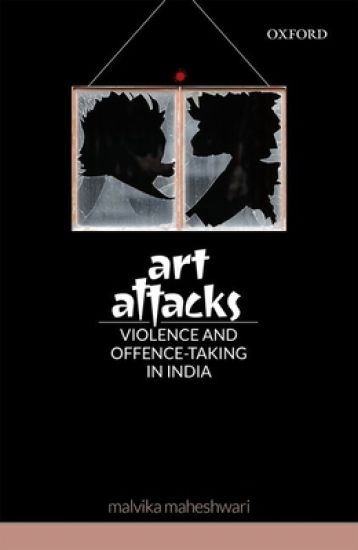
Art Attacks

Art Attacks

Malvika Maheshwari

OUP India
2018
sidottu
Since the end of the 1980s in India, self-styled representatives of a variety of ascriptive groups (religious, caste, regional, and linguistic among others) have come to routinely damage artwork, disrupt their exhibition, and threaten and assault artists and their supporters. Often, these acts are said to be a protest against the allegedly 'hurtful' or 'offensive' artworks. They are even claimed to be a prescient call to save the identity of the community, in a manner that makes the communal identities hinge entirely on that artistic (mis)representation. Yet, at the time of these attacks, many who indulge in this kind of violence have seldom heard of the artist before or even seen, read, watched, let alone engaged with the artwork. Such is the wrench on the right to freedom of speech and expression in general, and on the physical safety and security of artists in particular, that has inspired fear, anger, and discomfort within the art world, marked by ominous declarations of a 'cultural emergency' owing to the loss of lives and property, and without the due processes of law-a consequence that was hardly synonymous with art practice in India, at least until a few decades ago. This book tells the story of violence against artists in India, marked by the intensifying sense of insecurity, fear, frustration and anger within the art world. But to bring out its complexities-to build an analytical account for understanding what such destructive and, even competitive, attacks on artists convey about India's liberal democracy, given that violence in its many avatars has not so much been an aberration to the form of India's liberal democracy as much as its very condition-the book attempts to map the concrete political transformations that have informed its dynamic unfolding. In other words, as opposed to simply adding to the prevalent commentaries on violent regulation of free speech in India, this work focuses on the dynamics of violence in that regulation. Based on extensive interactions with assailants and artists, I argue that these attacks are not simply 'anti-democratic.' But are dependent in perverse ways on the very logics of democracy's functioning, as much they are contained by it, along with the wider material conditions that have prevented both free speech in India, and India at large, from being immutably locked in a downward spiral.
Art in Three Dimensions

Art in Three Dimensions

Noël Carroll

Oxford University Press
2010
sidottu
Art in Three Dimensions is a collection of essays by one of the most eminent figures in philosophy of art. The animating idea behind Noël Carroll's work is that philosophers of art should eschew the sort of aestheticism that often implicitly -- but sometimes explicitly, as in the case of aesthetic theories of art and of their commitments to the notion of the autonomy of art -- governs their methodology. Instead, Carroll argues that philosophers of art need to refocus their attention on the ways in which art enters the life of culture and the lives of individual audience members. The reference to "three dimensions" in the title refers to Carroll's view that philosophers of art should look at art from multiple angles and treat it as a substantial participant not only in society, but also as a significant influence upon the moral and emotional experiences of audiences.
Art, Emotion and Ethics

Art, Emotion and Ethics

Berys Gaut

Oxford University Press
2009
nidottu
Art, Emotion and Ethics is a systematic investigation of the relation of art to morality, a topic that has been of central and recurring interest to the philosophy of art since Plato. Berys Gaut explores the various positions that have been taken in this debate, and argues that an artwork is always aesthetically flawed insofar as it possesses a moral defect that is aesthetically relevant. Three main arguments are developed for this view; these involve showing how moral goodness is itself a kind of beauty, that artworks can teach us about morality and that this is often an aesthetic merit in them, and that our emotional responses to works of art are properly guided in part by moral considerations. Art, Emotion and Ethics also contains detailed interpretations of a wide range of artworks, including Rembrandt's Bathsheba and Nabokov's Lolita, which show that ethical criticism can yield rich and plausible accounts of individual works. Gaut develops a new theory of the nature of aesthetic value, explores how art can teach us about the world and what we morally ought to do by guiding our imaginings, and argues that we can have genuine emotions towards people and events that we know are merely fictional. Characterised by its clarity and sustained argument, this book will be of interest to anyone who wants to understand the relation of art to morality.
Art and Pornography

Art and Pornography

Oxford University Press
2012
sidottu
Art and Pornography presents a series of essays which investigate the artistic status and aesthetic dimension of pornographic pictures, films, and literature, and explores the distinction, if there is any, between pornography and erotic art. Is there any overlap between art and pornography, or are the two mutually exclusive? If they are, why is that? If they are not, how might we characterize pornographic art or artistic pornography, and how might pornographic art be distinguished, if at all, from erotic art? Can there be aesthetic experience of pornography? What are some of the psychological, social, and political consequences of the creation and appreciation of erotic art or artistic pornography? Leading scholars from around the world address these questions, and more, and bring together different aesthetic perspectives and approaches to this widely consumed, increasingly visible, yet aesthetically underexplored cultural domain. The book, the first of its kind in philosophical aesthetics, will contribute to a more accurate and subtle understanding of the many representations that incorporate explicit sexual imagery and themes, in both high art and demotic culture, in Western and non-Western contexts. It is sure to stir debate, and healthy controversy.
Art in Three Dimensions

Art in Three Dimensions

Noël Carroll

Oxford University Press
2012
nidottu
Art in Three Dimensions is a collection of essays by one of the most eminent figures in philosophy of art. The animating idea behind Noël Carroll's work is that philosophers of art should eschew the sort of aestheticism that often implicitly -- but sometimes explicitly, as in the case of aesthetic theories of art and of their commitments to the notion of the autonomy of art -- governs their methodology. Instead, Carroll argues that philosophers of art need to refocus their attention on the ways in which art enters the life of culture and the lives of individual audience members. The reference to "three dimensions" in the title refers to Carroll's view that philosophers of art should look at art from multiple angles and treat it as a substantial participant not only in society, but also as a significant influence upon the moral and emotional experiences of audiences.
Art and Art-Attempts

Art and Art-Attempts

Christy Mag Uidhir

Oxford University Press
2013
sidottu
Although few philosophers agree about what it is for something to be art, most, if not all, agree on one thing: art must be in some sense intention dependent. Art and Art Attempts is about what follows from taking intention dependence seriously as a substantive necessary condition for something's being art. Christy Mag Uidhir argues that from the assumption that art must be the product of intentional action, along with basic action-theoretic account of attempts (goal-oriented intention-directed activity), follows a host of sweeping implications for philosophical enquiry into the nature of art and its principal relata such as authorship, art forms, and art ontology: e.g., · An informative distinction between art, non-art, and failed-art that any viable theory of art must capture. · A far more productive minimal framework for authorship not only capable of systematically addressing issues of collective authorship appropriation, etc. but also one according to which artists just are authors. · A coherent and structurally precise account of art forms based upon the relation between artists, artworks, and the sortal properties thereof. · A unified and far less metaphysically suspect ontology of art according to which if there are such things as artworks, then artworks must be concrete things. Ultimately, Mag Uidhir aims neither to propose nor to defend any particular, precise answer to the question "What is art?" Instead, he shows the ways in which taking intention-dependence seriously as a substantive necessary condition for being art can be profoundly revelatory, and perhaps even radically revisionary, as to the scope and limits of what any particular, precise answer to such a question could viably be.
Art, Aesthetics, and the Brain

Art, Aesthetics, and the Brain

Oxford University Press
2015
sidottu
Humans have engaged in artistic and aesthetic activities since the appearance of our species. Our ancestors have decorated their bodies, tools, and utensils for over 100,000 years. The expression of meaning using color, line, sound, rhythm, or movement, among other means, constitutes a fundamental aspect of our species' biological and cultural heritage. Art and aesthetics, therefore, contribute to our species identity and distinguish it from its living and extinct relatives. Science is faced with the challenge of explaining the natural foundations of such a unique trait, and the way cultural processes nurture it into magnificent expressions, historically and ethnically unique. How does the human brain bring about these sorts of behaviors? What neural processes underlie the appreciation of painting, music, and dance? How does training modulate these processes? How are they impaired by brain lesions and neurodegenerative diseases? How did such neural underpinnings evolve? Are humans the only species capable of aesthetic appreciation, or are other species endowed with the rudiments of this capacity? This volume brings together the work on such questions by leading experts in genetics, psychology, neuroimaging, neuropsychology, art history, and philosophy. It sets the stage for a cognitive neuroscience of art and aesthetics, understood in the broadest possible terms. With sections on visual art, dance, music, neuropsychology, and evolution, the breadth of this volume's scope reflects the richness and variety of topics and methods currently used today by scientists to understand the way our brain endows us with the faculty to produce and appreciate art and aesthetics.
Art and the Senses

Art and the Senses

Oxford University Press
2013
nidottu
In recent years, there has been a re-discovery of the importance of sensory experience in our daily lives. The senses play a vital role in our health, in our social interactions, and in enjoying food, music and the arts. This book provides an introduction to the study of the senses and the arts. It contains over thirty chapters written by artists/practitioners, including, musicians, visual artists, a "sculptor for the blind", a celebrity chef, a choreographer, designers, and architects. It also includes chapters by leading neuroscientists and psychologists who study the senses, as well as chapters from scholars from the humanities, including, art history, anthropology, and cultural studies. The book provides a unique interdisciplinary overview of the senses, ranging from the neuroscience of sensory processing in the body, to cultural influences on how the senses are used in society, to the role of the senses in the arts. The chapters are written by leading academics, artists and scientists, each of whom brings different perspectives and experiences to the book. Together, these chapters form a timely snapshot of research on the human senses which makes clear a number of common themes that run across the arts, humanities, and sciences. The first book of its kind, 'Art and the Senses' will be a valuable tool for anyone interested in how the senses interact with eachother to create meaningful human experience.
Art and Abstract Objects

Art and Abstract Objects

Oxford University Press
2013
sidottu
Art and Abstract Objects presents a lively philosophical exchange between the philosophy of art and the core areas of philosophy. The standard way of thinking about non-repeatable (single-instance) artworks such as paintings, drawings, and non-cast sculpture is that they are concrete (i.e., material, causally efficacious, located in space and time). Da Vinci's Mona Lisa is currently located in Paris. Richard Serra's Tilted Arc is 73 tonnes of solid steel. Johannes Vermeer's The Concert was stolen in 1990 and remains missing. Michaelangelo's David was attacked with a hammer in 1991. By contrast, the standard way of thinking about repeatable (multiple-instance) artworks such as novels, poems, plays, operas, films, symphonies is that they must be abstract (i.e., immaterial, causally inert, outside space-time): consider the current location of Melville's Moby Dick, the weight of Yeats' "Sailing to Byzantium", or how one might go about stealing Puccini's La Bohème or vandalizing Mozart's Piano Concerto No. 9. Although novels, poems, and symphonies may appear radically unlike stock abstract objects such as numbers, sets, and propositions, most philosophers of art think that for the basic intuitions, practices, and conventions surrounding such works to be preserved, repeatable artworks must be abstracta. This volume examines how philosophical enquiry into art might itself productively inform or be productively informed by enquiry into abstracta taking place within not just metaphysics but also the philosophy of mathematics, epistemology, philosophy of science, and philosophy of mind and language. While the contributors chiefly focus on the relationship between philosophy of art and contemporary metaphysics with respect to the overlap issue of abstracta, they provide a methodological blueprint from which scholars working both within and beyond philosophy of art can begin building responsible, mutually informative, and productive relationships between their respective fields.
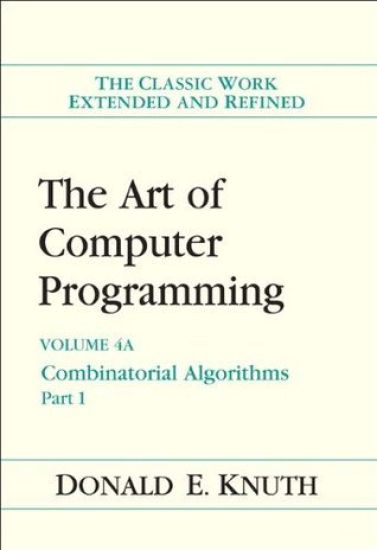
Art of Computer Programming, The

Art of Computer Programming, The

Donald Knuth

Addison Wesley
2011
sidottu
The Art of Computer Programming, Volume 4A: Combinatorial Algorithms, Part 1 Knuth’s multivolume analysis of algorithms is widely recognized as the definitive description of classical computer science. The first three volumes of this work have long comprised a unique and invaluable resource in programming theory and practice. Scientists have marveled at the beauty and elegance of Knuth’s analysis, while practicing programmers have successfully applied his “cookbook” solutions to their day-to-day problems. The level of these first three volumes has remained so high, and they have displayed so wide and deep a familiarity with the art of computer programming, that a sufficient “review” of future volumes could almost be: “Knuth, Volume n has been published.” –Data Processing Digest Knuth, Volume n has been published, where n = 4A. In this long-awaited new volume, the old master turns his attention to some of his favorite topics in broadword computation and combinatorial generation (exhaustively listing fundamental combinatorial objects, such as permutations, partitions, and trees), as well as his more recent interests, such as binary decision diagrams. The hallmark qualities that distinguish his previous volumes are manifest here anew: detailed coverage of the basics, illustrated with well-chosen examples; occasional forays into more esoteric topics and problems at the frontiers of research; impeccable writing peppered with occasional bits of humor; extensive collections of exercises, all with solutions or helpful hints; a careful attention to history; implementations of many of the algorithms in his classic step-by-step form. There is an amazing amount of information on each page. Knuth has obviously thought long and hard about which topics and results are most central and important, and then, what are the most intuitive and succinct ways of presenting that material. Since the areas that he covers in this volume have exploded since he first envisioned writing about them, it is wonderful how he has managed to provide such thorough treatment in so few pages. –Frank Ruskey, Department of Computer Science, University of Victoria The book is Volume 4A, because Volume 4 has itself become a multivolume undertaking. Combinatorial searching is a rich and important topic, and Knuth has too much to say about it that is new, interesting, and useful to fit into a single volume, or two, or maybe even three. This book alone includes approximately 1500 exercises, with answers for self-study, plus hundreds of useful facts that cannot be found in any other publication. Volume 4A surely belongs beside the first three volumes of this classic work in every serious programmer’s library. Finally, after a wait of more than thirty-five years, the first part of Volume 4 is at last ready for publication. Check out the boxed set that brings together Volumes 1 - 4A in one elegant case, and offers the purchaser a $50 discount off the price of buying the four volumes individually.p> The Art of Computer Programming, Volumes 1-4A Boxed Set, 3/e ISBN: 0321751043
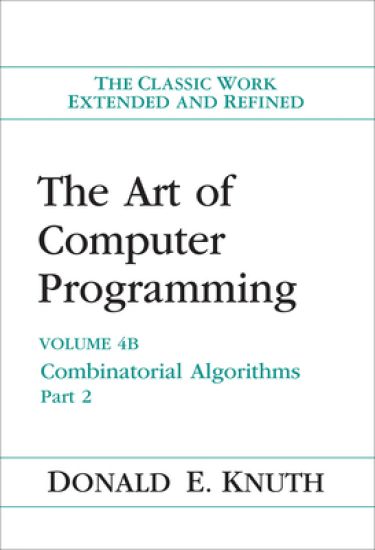
Art of Computer Programming, The

Art of Computer Programming, The

Donald Knuth

Addison Wesley
2022
sidottu
The Art of Computer Programming is Knuth's multivolume analysis of algorithms. With the addition of this new volume, it continues to be the definitive description of classical computer science. Volume 4B, the sequel to Volume 4A, extends Knuth's exploration of combinatorial algorithms. These algorithms are of keen interest to software designers because ". . . a single good idea can save years or even centuries of computer time." The book begins with coverage of Backtrack Programming, together with a set of data structures whose links perform "delightful dances" and are ideally suited to this domain. New techniques for important applications such as optimum partitioning and layout are thereby developed. Knuth's writing is playful, and he includes dozens of puzzles to illustrate the algorithms and techniques, ranging from popular classics like edge-matching to more recent crazes like sudoku. Recreational mathematicians and computer scientists will not be disappointed! In the second half of the book, Knuth addresses Satisfiability, one of the most fundamental problems in all of computer science. Innovative techniques developed at the beginning of the twenty-first century have led to game-changing applications, for such things as optimum scheduling, circuit design, and hardware verification. Thanks to these tools, computers are able to solve practical problems involving millions of variables that only a few years ago were regarded as hopeless. The Mathematical Preliminaries Redux section of the book is a special treat, which presents basic techniques of probability theory that have become prominent since the original "preliminaries" were discussed in Volume 1. As in every volume of this remarkable series, the book includes hundreds of exercises that employ Knuth's ingenious rating system, making it easy for readers of varying degrees of mathematical training to find challenges suitable to them. Detailed answers are provided to facilitate self-study. "Professor Donald E. Knuth has always loved to solve problems. In Volume 4B he now promotes two brand new and practical general problem solvers, namely (0) the Dancing Links Backtracking and (1) the SAT Solver. To use them, a problem is defined declaratively (0) as a set of options, or (1) in Boolean formulae. Today's laptop computers, heavily armoured with very high speed processors and ultra large amounts of memory, are able to run either solver for problems having big input data. Each section of Volume 4B contains a multitudinous number of tough exercises which help make understanding surer. Happy reading!" --Eiiti Wada, an elder computer scientist, UTokyo "Donald Knuth may very well be a great master of the analysis of algorithms, but more than that, he is an incredible and tireless storyteller who always strikes the perfect balance between theory, practice, and fun. [Volume 4B, Combinatorial Algorithms, Part 2] dives deep into the fascinating exploration of search spaces (which is quite like looking for a needle in a haystack or, even harder, to prove the absence of a needle in a haystack), where actions performed while moving forward must be meticulously undone when backtracking. It introduces us to the beauty of dancing links for removing and restoring the cells of a matrix in a dance which is both simple to implement and very efficient." --Christine Solnon, Department of Computer Science, INSA Lyon Register your book for convenient access to downloads, updates, and/or corrections as they become available.
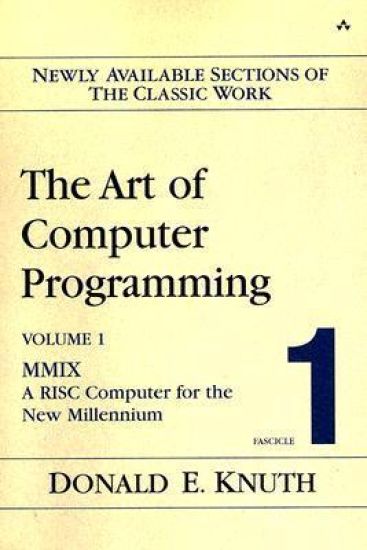
Art of Computer Programming, Volume 1, Fascicle 1, The
Check out the boxed set that brings together Volumes 1 - 4B in one elegant case. The Art of Computer Programming, Volumes 1-4B Boxed Set ISBN: 9780137935109 Art of Computer Programming, Volume 1, Fascicle 1, The: MMIX -- A RISC Computer for the New Millennium This multivolume work on the analysis of algorithms has long been recognized as the definitive description of classical computer science. The three complete volumes published to date already comprise a unique and invaluable resource in programming theory and practice. Countless readers have spoken about the profound personal influence of Knuth's writings. Scientists have marveled at the beauty and elegance of his analysis, while practicing programmers have successfully applied his "cookbook" solutions to their day-to-day problems. All have admired Knuth for the breadth, clarity, accuracy, and good humor found in his books. To begin the fourth and later volumes of the set, and to update parts of the existing three, Knuth has created a series of small books called fascicles, which will be published t regular intervals. Each fascicle will encompass a section or more of wholly new or evised material. Ultimately, the content of these fascicles will be rolled up into the comprehensive, final versions of each volume, and the enormous undertaking that began in 1962 will be complete. Volume 1, Fascicle 1 This first fascicle updates The Art of Computer Programming, Volume 1, Third Edition: Fundamental Algorithms, and ultimately will become part of the fourth edition of that book. Specifically, it provides a programmer's introduction to the long-awaited MMIX, a RISC-based computer that replaces the original MIX, and describes the MMIX assembly language. The fascicle also presents new material on subroutines, coroutines, and interpretive routines. Ebook (PDF version) produced by Mathematical Sciences Publishers (MSP),http://msp.org
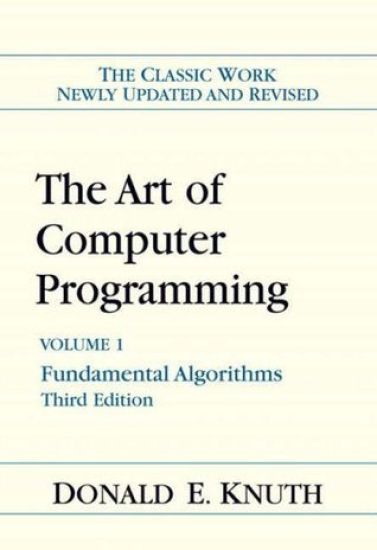
Art of Computer Programming, The

Art of Computer Programming, The

Donald Knuth

Addison Wesley
1997
sidottu
The bible of all fundamental algorithms and the work that taught many of today's software developers most of what they know about computer programming. –Byte, September 1995 I can't begin to tell you how many pleasurable hours of study and recreation they have afforded me! I have pored over them in cars, restaurants, at work, at home... and even at a Little League game when my son wasn't in the line-up. –Charles Long If you think you're a really good programmer... read [Knuth's] Art of Computer Programming... You should definitely send me a resume if you can read the whole thing. –Bill Gates It's always a pleasure when a problem is hard enough that you have to get the Knuths off the shelf. I find that merely opening one has a very useful terrorizing effect on computers. –Jonathan Laventhol This first volume in the series begins with basic programming concepts and techniques, then focuses more particularly on information structures–the representation of information inside a computer, the structural relationships between data elements and how to deal with them efficiently. Elementary applications are given to simulation, numerical methods, symbolic computing, software and system design. Dozens of simple and important algorithms and techniques have been added to those of the previous edition. The section on mathematical preliminaries has been extensively revised to match present trends in research.
Art of Computer Programming, The

Art of Computer Programming, The

Donald Knuth

Addison Wesley
1998
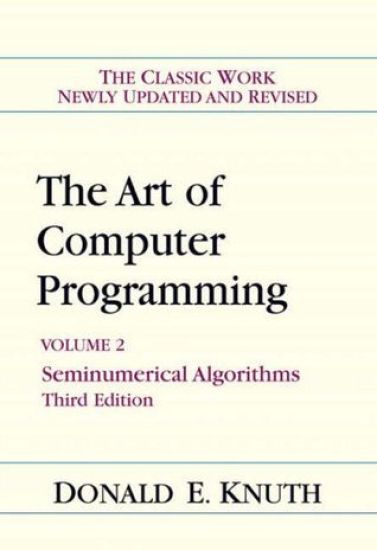
sidottu
The bible of all fundamental algorithms and the work that taught many of today's software developers most of what they know about computer programming. –Byte, September 1995 I can't begin to tell you how many pleasurable hours of study and recreation they have afforded me! I have pored over them in cars, restaurants, at work, at home... and even at a Little League game when my son wasn't in the line-up. –Charles Long If you think you're a really good programmer... read [Knuth's] Art of Computer Programming... You should definitely send me a resume if you can read the whole thing. –Bill Gates It's always a pleasure when a problem is hard enough that you have to get the Knuths off the shelf. I find that merely opening one has a very useful terrorizing effect on computers. –Jonathan Laventhol The second volume offers a complete introduction to the field of seminumerical algorithms, with separate chapters on random numbers and arithmetic. The book summarizes the major paradigms and basic theory of such algorithms, thereby providing a comprehensive interface between computer programming and numerical analysis. Particularly noteworthy in this third edition is Knuth's new treatment of random number generators, and his discussion of calculations with formal power series.
Art of Computer Programming, The

Art of Computer Programming, The

Donald Knuth

Addison Wesley
1998
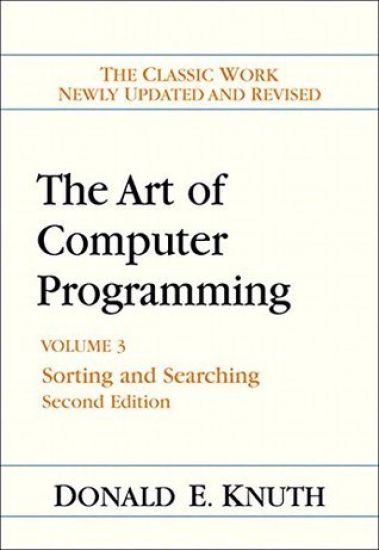
sidottu
The bible of all fundamental algorithms and the work that taught many of today's software developers most of what they know about computer programming. –Byte, September 1995 I can't begin to tell you how many pleasurable hours of study and recreation they have afforded me! I have pored over them in cars, restaurants, at work, at home... and even at a Little League game when my son wasn't in the line-up. –Charles Long If you think you're a really good programmer... read [Knuth's] Art of Computer Programming... You should definitely send me a resume if you can read the whole thing. –Bill Gates It's always a pleasure when a problem is hard enough that you have to get the Knuths off the shelf. I find that merely opening one has a very useful terrorizing effect on computers. –Jonathan Laventhol The first revision of this third volume is the most comprehensive survey of classical computer techniques for sorting and searching. It extends the treatment of data structures in Volume 1 to consider both large and small databases and internal and external memories. The book contains a selection of carefully checked computer methods, with a quantitative analysis of their efficiency. Outstanding features of the second edition include a revised section on optimum sorting and new discussions of the theory of permutations and of universal hashing.