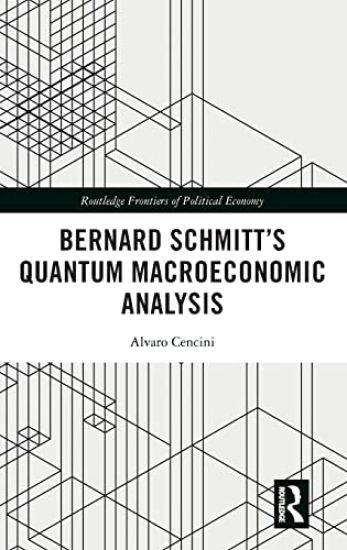
The aim of Bernard Schmitt’s analysis of the monetary economy of production was twofold: to introduce and to explain the logical character of the macroeconomic laws governing our economies and to explain the origin of the pathologies that follow if these laws are not complied with. Schmitt’s main original contributions concern the theories of value, profit, and capital, as well as his explanation of inflation, unemployment and international payments, unified as quantum macroeconomic analysis. This book expounds on the key principles of quantum macroeconomic analysis as he conceived and developed them.Schmitt’s starting point was the analysis of bank money and the way it is associated with produced output. His macroeconomics was not founded on microeconomics nor derived from the aggregation of microeconomic variables. Schmitt’s theory does not rely on mathematics and modelling either; instead, it is based on logical laws derived from the nature of money and monetary payments. Part I of this book deals with the quantum macroeconomic analysis of capitalism and its pathologies developed by Schmitt and provides the elements necessary to understand its ‘structural’ mechanism. Parts II and III deal with the principles of two reforms that enable the passage from capitalism to post-capitalism and from the present non-system of international payments to an orderly system. This book provides essential reading for all those interested in heterodox approaches to macroeconomics, monetary economics, banking, international economics, and the history of economic thought.
This book studies a significant event in US relations with Latin America, shedding light on the role of dependent states and their foreign policy agency in the process by which local concerns become intertwined with the dominant state’s foreign policy. Plan Colombia was a large-scale foreign aid programme through which the US intervened in the internal affairs of Colombia, by invitation. It proved to be one of the major successes of US foreign policy, and has been credited with stemming a potentially catastrophic security failure of the Colombian state. This book discusses the strategies and practices deployed by the Colombian government to influence US foreign policy decision making at the bureaucratic, legislative and executive levels, and is a distinctive contribution to our understanding of the dynamics of small power agency. Giving a clearer insight into the decision making processes in both the US and Colombia, this book founds its argument on solid empirical analysis assembled from interviews of the major players in the events including: Andres Pastrana, President of Colombia; Thomas Pickering, US State Department; Arturo Valenzuela, Senior Director for Inter-American Affairs at the NSA; General Barry McCaffrey, the US ‘Drug Czar’; and Dennis Hastert, Speaker of the US House of Representatives. Approaching the events in question from a bottom-up theoretical perspective that puts the emphasis on the facts of the case, this book will be of great interest to academics, students and policy makers in the field of foreign policy analysis, US foreign policy studies, and Latin American studies.
Problems in Stable Population Theory is a comprehensive book written by Alvaro Lopez. The book deals with the theory of population stability and its applications in demographic analysis. It presents a detailed analysis of the various mathematical models used to study population dynamics and their limitations. The author discusses the basic concepts and principles of stable population theory, including the concept of stable population, age-specific fertility rates, and life tables. The book also covers various issues related to population stability, such as the impact of migration on population growth, the effects of mortality on population dynamics, and the role of population structure in determining stability. The author uses a rigorous mathematical approach to explain the various concepts and models, making the book suitable for students and researchers in the field of demography and population studies. The book also includes numerous examples and case studies that illustrate the practical applications of stable population theory. The author provides detailed explanations of the methods used to estimate population parameters and to analyze population data. The book concludes with a discussion of the future of stable population theory and its potential applications in the study of population dynamics. Overall, Problems in Stable Population Theory is an essential reference for anyone interested in the theory of population stability and its applications in demographic analysis. The book provides a comprehensive overview of the field and is written in a clear and concise manner, making it accessible to both students and researchers.This scarce antiquarian book is a facsimile reprint of the old original and may contain some imperfections such as library marks and notations. Because we believe this work is culturally important, we have made it available as part of our commitment for protecting, preserving, and promoting the world's literature in affordable, high quality, modern editions, that are true to their original work.