Kirjojen hintavertailu. Mukana 12 537 246 kirjaa ja 12 kauppaa.

Kirjahaku

Etsi kirjoja tekijän nimen, kirjan nimen tai ISBN:n perusteella.

1000 tulosta hakusanalla David Grove

Professional Development for Leaders and Managers of Self-Governing Schools
Current Context Currently, self-governing schools (SGS) or school-based/site-based management (SBM) or local management of schools (LMS) identifies the individual school as the primary unit of improvement. It relies on the redistribution of decision-making authority to stimulate and sustain impro- ments in a school. For this purpose, varying degrees of formal authority to make decisions in the domains of school’s mission, goals, priorities, and school policies relating to financial, material and human resources are not simply delegated but transferred by legislation to a representative governing body called the school council or board. Accordingly, it is the position of the principal or the head-teacher, previously at the apex of the hierarchical str- ture of the school which undergoes the most radical reform. Under the new concept, authority is shifted to the corporate body that is to the council or board while the principal becomes an ex-officio member of that body and the chief executive officer (CEO) of the school. Traditionally and legally, the principal or the head-teacher was vested with the full authority for the total management of the school. But, in terms of SGS or SBM, the principal becomes a partner with the representatives of other relevant stakeholders in a democratic structure. When the bureaucratic model of a school gets modified with the school governing body occupying the apex of the school hierarchy, it becomes the key power centre with legal authority.
Professional Development for Leaders and Managers of Self-Governing Schools
Current Context Currently, self-governing schools (SGS) or school-based/site-based management (SBM) or local management of schools (LMS) identifies the individual school as the primary unit of improvement. It relies on the redistribution of decision-making authority to stimulate and sustain impro- ments in a school. For this purpose, varying degrees of formal authority to make decisions in the domains of school’s mission, goals, priorities, and school policies relating to financial, material and human resources are not simply delegated but transferred by legislation to a representative governing body called the school council or board. Accordingly, it is the position of the principal or the head-teacher, previously at the apex of the hierarchical str- ture of the school which undergoes the most radical reform. Under the new concept, authority is shifted to the corporate body that is to the council or board while the principal becomes an ex-officio member of that body and the chief executive officer (CEO) of the school. Traditionally and legally, the principal or the head-teacher was vested with the full authority for the total management of the school. But, in terms of SGS or SBM, the principal becomes a partner with the representatives of other relevant stakeholders in a democratic structure. When the bureaucratic model of a school gets modified with the school governing body occupying the apex of the school hierarchy, it becomes the key power centre with legal authority.
Disrupted Governance

Disrupted Governance

Kris Hartley; Glen David Kuecker

Cambridge University Press
2022
pokkari
This Element explores the uncertain future of public policy practice and scholarship in an age of radical disruption. Building on foundational ideas in policy sciences, we argue that an anachronistic instrumental rationalism underlies contemporary policy logic and limits efforts to understand new policy challenges. We consider whether the policy sciences framework can be reframed to facilitate deeper understandings of this anachronistic epistemic, in anticipation of a research agenda about epistemic destabilization and contestation. The Element applies this theoretical provocation to environmental policy and sustainability, issues about which policymaking proceeds amid unpredictable contexts and rising sociopolitical turbulence that portend a liminal state in the transition from one way of thinking to another. The Element concludes by contemplating the fate of policy's epistemic instability, anticipating what policy understandings will emerge in a new system, and questioning the degree to which either presages a seismic shift in the relationship between policy and society.
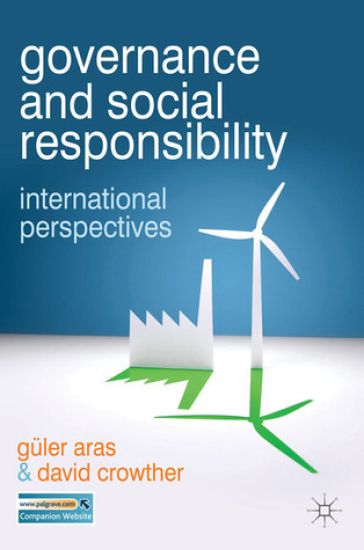
Governance and Social Responsibility

Governance and Social Responsibility

Güler Aras; David Crowther

Red Globe Press
2011
nidottu
Recent corporate failures have attracted the attention of managers, governments and the general public to the role of governance and social responsibility. Ranging from managerial behaviour and reward systems, to environmental protection and human rights, governance and social responsibility encompasses a variety of thought provoking business issues. In Governance and Social Responsibility, Aras and Crowther bring together the considerable debates about what exactly it is, and how it can be applied to business.Key Features:- Written by leading governance and social responsibility experts- International coverage and orientation- Comprehensive coverage of CSR issues and debates- Excellent pedagogy, including case studies, reflective questions and further readingFirmly grounded in academic research, Governance and Social Responsibility is an ideal companion for CSR courses at all levels.
Pro Azure Governance and Security

Pro Azure Governance and Security

Peter De Tender; David Rendon; Samuel Erskine

APress
2019
nidottu
Any IT professional can tell you that managing security is a top priority and even more so when working in the cloud. Access to accurate and timely security information is critical, but governance and control must first be enabled. This guide shows you how to take advantage of Azure's vast and powerful built-in security tools and capabilities for your application workloads.Pro Azure Governance and Security offers a comprehensive look at the governance features available with Microsoft Azure and demonstrates how to integrate them with your hybrid and Azure environments, drawing on the author's experiences from years in the field. Learn about the array of controls implemented within Microsoft Azure from two valuable perspectives: the customer and Microsoft operations. Beginning with the top-level subscription hierarchy, learn about the most important built-in Azure security services and features, as well as how to use Azure Policies and Blueprints as a means for security and governance. A series of hands-on exercises teaches you the concepts of Azure Governance: how to enable and deploy Azure Security Center, integrate RBAC (role-based access control), and set up Azure Operations and Monitoring. Get introduced to the new Azure Sentinel solution that offers SIEM as a service for security incident management and proactive hunting.What You'll Learn Understand different architectural designs for implementing Azure SecurityOperate and monitor an Azure environmentDeploy Azure Governance, Policies, and BlueprintsDiscover key Azure features that enhance securityImplement and confidently access Azure Security CenterGet to know Azure Sentinel Who This Book Is ForTechnical engineers, consultants, solution and cloud architects, IT managers, and SecOps teams who need to understand how to integrate governance, security, and compliance in hybrid and Azure environments. A basic understanding of Azure or other public cloud platforms is beneficial, but not required.
Governing in Scary Times

Governing in Scary Times

Debra L Brown; David a H Brown; Rob Derooy

Author Academy Elite
2021
sidottu
If the global pandemic taught us anything, it's that all organizations need a strategy to manage in a crisis. In Governing in Scary Times, authors Dr. Debra L. Brown, David A.H. Brown, and Rob DeRooy offer a step-by-step plan to prepare your board to provide direction for your company and reinforce your stakeholders' confidence. With a combined 75 years of experience governing companies and boards, the authors guide you through a process that will prepare you to answer key questions: Where are we headed?What obstacles and opportunities might we face along the way?Who will do what?What are the boundaries and guidelines?How will we resource our efforts? Governing in Scary Times is your boardroom roadmap to navigating extreme challenges in your business. From developing a strategic plan to assessing risks and policies to getting and keeping the right people in place, the authors provide practical and proven advice that will equip your company to survive scary times-and come out stronger on the other side. Another crisis is (always) coming. Use the strategies in Governing in Scary Times, to ensure your organization is prepared.
Network Publicy Governance – On Privacy and the Informational Self

Network Publicy Governance – On Privacy and the Informational Self

Andréa Belliger; David Krieger

Transcript Verlag
2021
nidottu
The information age has brought about a growing conflict between proponents of a data-driven society on the one side and demands for protection of individual freedom, autonomy, and dignity by means of privacy on the other. The causes of this conflict are rooted in the modern Western opposition of individual and society and a self-understanding of the human as an autonomous rational subject with an inalienable right to informational self-determination. Andréa Belliger and David J. Krieger propose a theory of information as a common good and redefine the individual as an informational self who exists in networks made up of both humans and nonhumans. Privacy is replaced by publicy and issues of data use and data protection are described in terms of governance instead of government.
David of Cambridge

David of Cambridge

T. R. Glover

Cambridge University Press
2015
pokkari
The Cambridge bookseller Gustave David (1860–1936) was a key feature of the Cambridge landscape from the late nineteenth century until his death. This small volume, first published in 1937, collects together several obituaries written by David's friends in academia, including Sir Arthur Quiller-Couch. This book will be of value to anyone with an interest in the history of one of Cambridge's enduring personalities.
Conflict, Improvisation, Governance

Conflict, Improvisation, Governance

David Laws; John Forester

Routledge
2015
nidottu
Conflict, Improvisation, Governance presents a carefully crafted and edited collection of first hand accounts of diverse public sector and non-profit urban practitioners facing the practical challenges of "doing democracy" in the global/local context of the interconnected major European city of Amsterdam and its region. The book examines street level democratic processes through the experiences of planning and city governance practitioners in community development, youth work, public service delivery, urban public administration, immigration and multi-cultural social policy. These profiles and case studies show widely shared challenges in global and local urban environments, and new, "bottom-up," democratic and improvisational strategies that community members and public officials alike can use to make more inclusive, democratic cities.