Kirjojen hintavertailu. Mukana 12 390 323 kirjaa ja 12 kauppaa.

Kirjahaku

Etsi kirjoja tekijän nimen, kirjan nimen tai ISBN:n perusteella.

1000 tulosta hakusanalla Ebenezer Obiri Addo

A A Christmas Carol: Ebenezer Scrooge and the Three Christmas Spirits Illustrated by Lisa Aisato with a Foreword by Kathi Appelt
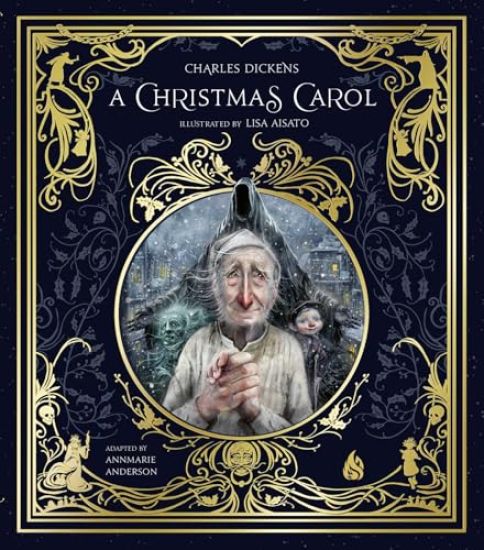
In this lusciously illustrated volume, international bestselling artist Lisa Aisato reimagines Dickens's classic Victorian ghost story. Foreword from National Book Award Finalist and a Newbery Honor Book Winner Kathi Appelt On Christmas Eve in 19th century London, miserly Ebenezer Scrooge is haunted by the ghost of his dead business partner, Jacob Marley, who warns him that three spirits will visit him to show him the future that awaits him if he continues in his ways. He is visited by the ghosts of Christmas Past, Christmas Present, and Christmas Future in order to help him change his ways. Gorgeously designed and illustrated with atmospheric, luscious art, this special edition of A Christmas Carol will become a family treasure. With both a new 2026 film adaptation starring Johnny Depp and now Lisa Aisato's illustrated book releasing, this timeless tale finds fresh, modern, and atmospheric expression.
The Lives and Times of Ebenezer Scrooge

The Lives and Times of Ebenezer Scrooge

Paul R Davis

Yale University Press
1990
sidottu
"Bah! Humbug!" and "God bless us, every one!" are phrases that have resounded through the years, instantly recognizable as exclamations from Scrooge and Tiny Tim in Charles Dickens's beloved Christmas Carol. Told and retold to generations of children and adults, A Christmas Carol has been adapted, revised, condensed, added to, and modernized more than any other work in English literature. In this engaging and delightfully illustrated book, Paul Davis explores the various British and American versions of this work--on stage, film, radio, and television and in literature, cartoons, and comic books--showing how these interpretations have reflected the changing cultural perspectives of successive eras. According to Davis, six periods have shaped this cultural history, each contributing to the evolving culture-text of A Christmas Carol that is what we remember of all its parodies, piracies, and retellings. Dickens's original story, written in 1843, provided proof that urbanization had not destroyed Christmas and that the old country traditions could flourish in the new cities. By the 1870s, A Christmas Carol had become secular scripture, read as a retelling of the biblical Christmas story. The sophisticated decade preceding World War I treated the work for the first time as a story for children. In the Depression era, while the British reaffirmed a traditional Carol, Americans interpreted Scrooge's transformation as the triumph of a new business ethic of service and sharing. The Scrooge of the 1960s became a Freudian figure tormented by his past, who conjured up Marley as a way of calling for help and who turned on to Christmas and tuned into joys he had denied himself. Now, when our focus in on hunger and homelessness rather than joy in the streets, Scrooge is again a social figure placed in the center of unsettling economic realities.
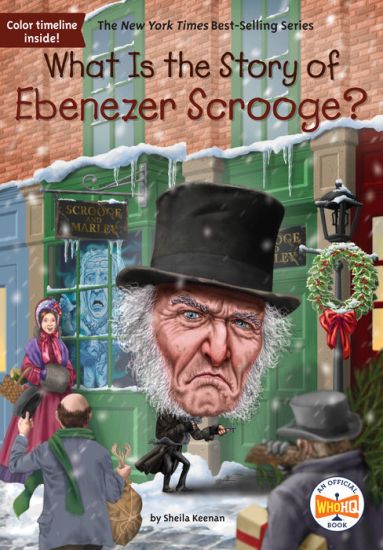
What Is the Story of Ebenezer Scrooge?

What Is the Story of Ebenezer Scrooge?

Sheila Keenan

Penguin Putnam Inc
2022
pokkari
When Charles Dickens wrote A Christmas Carol in 1843, he likely had no idea that the story and its main character, Ebenezer Scrooge, would remain so popular nearly two centuries later. Today, readers still find themselves entertained by the story of a grumpy, selfish man who becomes a holiday hero after he learns generosity through the help of three spirits in Victorian-era England. Whether a Dickens fan or someone in love with all things 'Christmas,' readers will enjoy learning the history of this memorable character and his many appearances on the page, the screen, and the stage in What Is the Story of Ebenezer Scrooge?
What Is the Story of Ebenezer Scrooge?

What Is the Story of Ebenezer Scrooge?

Sheila Keenan; Who Hq

Penguin Workshop
2022
sidottu
Who HQ brings you the stories behind the most beloved characters of our time. Bah humbug Get to know the story of Ebenezer Scrooge and his transformation from miser to hero in this addition to the What Is the Story Of? series. When Charles Dickens wrote A Christmas Carol in 1843, he likely had no idea that the story and its main character, Ebenezer Scrooge, would remain so popular nearly two centuries later. Today, readers still find themselves entertained by the story of a grumpy, selfish man who becomes a holiday hero after he learns generosity through the help of three spirits in Victorian-era England. Whether a Dickens fan or someone in love with all things "Christmas," readers will enjoy learning the history of this memorable character and his many appearances on the page, the screen, and the stage in What Is the Story of Ebenezer Scrooge?
Phinney Genealogy: a Brief History of Ebenezer Phinney, of Cape Cod, and His Descendants, From 1637 to 1947
This work has been selected by scholars as being culturally important and is part of the knowledge base of civilization as we know it.This work is in the public domain in the United States of America, and possibly other nations. Within the United States, you may freely copy and distribute this work, as no entity (individual or corporate) has a copyright on the body of the work.Scholars believe, and we concur, that this work is important enough to be preserved, reproduced, and made generally available to the public. To ensure a quality reading experience, this work has been proofread and republished using a format that seamlessly blends the original graphical elements with text in an easy-to-read typeface.We appreciate your support of the preservation process, and thank you for being an important part of keeping this knowledge alive and relevant.
An Argument in the Case of Ebenezer Smith Platt, now Under Confinement for High Treason. By a Gentleman of the law. To Which is Added, the Opinion of the Court of King's Bench on a Motion to Admit Mr. Platt to Bail, May 1777
The 18th century was a wealth of knowledge, exploration and rapidly growing technology and expanding record-keeping made possible by advances in the printing press. In its determination to preserve the century of revolution, Gale initiated a revolution of its own: digitization of epic proportions to preserve these invaluable works in the largest archive of its kind. Now for the first time these high-quality digital copies of original 18th century manuscripts are available in print, making them highly accessible to libraries, undergraduate students, and independent scholars.Delve into what it was like to live during the eighteenth century by reading the first-hand accounts of everyday people, including city dwellers and farmers, businessmen and bankers, artisans and merchants, artists and their patrons, politicians and their constituents. Original texts make the American, French, and Industrial revolutions vividly contemporary.++++The below data was compiled from various identification fields in the bibliographic record of this title. This data is provided as an additional tool in helping to insure edition identification: ++++British LibraryT103609London: printed for G. Kearsly, 1777. 2], iv,17, 1]p.; 4
The Urban Archetypes of Jane Jacobs and Ebenezer Howard

The Urban Archetypes of Jane Jacobs and Ebenezer Howard

Abraham Akkerman

University of Toronto Press
2020
sidottu
Ebenezer Howard, an Englishman, and Jane Jacobs, a naturalized Canadian, personify the twentieth century’s opposing outlooks on cities. Howard envisaged small towns, newly built from scratch and comprised of single-family homes with small gardens, while Jacobs embraced existing inner-city neighbourhoods that emphasized the verve of the living street. Both figures have had their share of supporters as well as detractors: Howard's conceptualization received criticism for its uniformity and alienation from the city core, while Jacobs’s urban vision came to be recognized as the result of invasive gentrification. Presenting Howard and Jacobs within a psychocultural context, The Urban Archetypes of Jane Jacobs and Ebenezer Howard addresses our urban crisis in its recognition that "city form is a gendered, allegorical medium expressing femininity and masculinity within two founding features of the built environment: void and volume." These founding contrasts represent both tension as well as the opportunity for fusion between pairs of urban polarities: human scale against superscale, gait against speed, and spontaneity against surveillance. In their respective attitudes, Howard and Jacobs have come to embrace the two ancient archetypes of the Garden and the Citadel, leaving it to future generations to blend their two contrarian stances.
The Urban Archetypes of Jane Jacobs and Ebenezer Howard

The Urban Archetypes of Jane Jacobs and Ebenezer Howard

Abraham Akkerman

University of Toronto Press
2020
pokkari
Ebenezer Howard, an Englishman, and Jane Jacobs, a naturalized Canadian, personify the twentieth century’s opposing outlooks on cities. Howard had envisaged small towns, newly built from scratch, fashioned on single family homes with small gardens. Jacobs embraced existing inner-city neighbourhoods emphasizing the verve of the living street. From Howard’s idea, the American Dream of garden suburbs had emerged, yet his conceptualization of a modern city received criticism for being uniform and alienated from the rest of the city. Similarly, at the turn of the new century, Jacobs’ inner-city neighbourhoods came to be recognized as the result of commodification, vacillating between poverty and newly discovered hubs of urban authenticity. Presenting Howard and Jacobs within a psychocultural context, The Urban Archetypes of Jane Jacobs and Ebenezer Howard addresses our urban crisis in the recognition that "city form" is a gendered, allegorical medium expressing femininity and masculinity within two founding features of the built environment: void and volume. Both founding contrasts bring tensions, but also the opportunities of fusion between pairs of urban polarities: human scale against superscale, gait against speed, and spontaneity against surveillance. Jacobs and Howard, in their respective attitudes, have come to embrace the two ancient archetypes, the Garden and the Citadel, leaving it to future generations to blend their two contrarian stances.