Kirjojen hintavertailu. Mukana 11 717 486 kirjaa ja 12 kauppaa.

Kirjahaku

Etsi kirjoja tekijän nimen, kirjan nimen tai ISBN:n perusteella.

1000 tulosta hakusanalla Forest

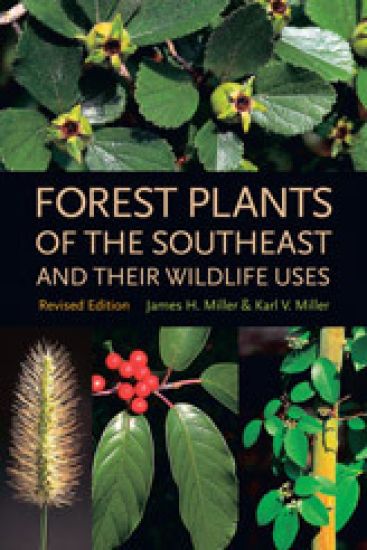
Forest Plants of the Southeast and Their Wildlife Uses

Forest Plants of the Southeast and Their Wildlife Uses

James H. Miller; Karl V. Miller

University of Georgia Press
2005
pokkari
This guide to common and unique plants found in forests of the Southeast thoroughly covers 330 species of forbs (herbaceous plants), grasses, vines, and shrubs, with a special emphasis on the plants’ role in wildlife sustenance. Packed with detailed color photographs, the book is a must-have for forest landowners, game and wildlife managers, biologists, outdoors enthusiasts, students—anyone with an interest in the intricate and often unexpected interrelationships between the flora and fauna of our region’s forests.Features:Descriptions of native and nonnative (exotic or invasive) plants, including 330 species of forbs, in 180 genera: grasses, sedges, and rushes; woody vines and semiwoody plants; shrubs; palms and yucca; cane; cactus; ferns; and ground lichen650 color photosMap of physiographic provinces56 simple black-and-white drawings of flower parts, flower types, and inflorescences, leaf arrangements, leaf divisions, shapes, and margins, and parts of a grass plantGlossaryIndex of genera by family, index by wildlife species, and index of scientific and common names

"Forest Beatniks" and "Urban Thoreaus"

"Forest Beatniks" and "Urban Thoreaus"

Rod Phillips

Peter Lang Publishing Inc
2000
sidottu
The Beat Movement, which first rose to attention in 1955, has often been viewed by critics as an urban phenomenon - the product of a postwar-youth culture with roots in the cities of New York and San Francisco. This study examines another side of the Beat Movement: its strong desire for a reconnection with nature. Although each took a different path in attaining this goal, the writers considered here - Gary Snyder, Jack Kerouac, Lew Welch, and Michael McClure - sought a new and closer connection to the natural world. These four writers, along with many of their counterparts in the Beat era, provided a crucial spark that helped to ignite the environmental movement of the 1970s and provided the foundation for the development of the current -Deep Ecology- worldview."
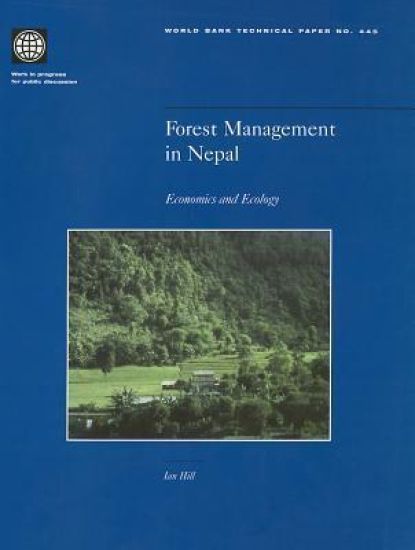
Forest Management in Nepal

Forest Management in Nepal

World Bank Publications
1999
nidottu
Forests play a vital role in maintaining Nepal's impressive biodiversity, which has global significance: With only 0.1 percent of the world's total area, Nepal contains 2 percent of the planet's flowering plants, 8 percent of its birds, and 4 percent of its mammals. As Nepal develops its forest resources, it needs to minimize the biotic pressures affecting the structure and dynamics of forest plant communities and wildlife populations and thereby reverse the current destructive pressures on the country's biodiversity. The study aims to provide a better understanding of the ways in which forest resources are used in Nepal. Its focus is to examine systematically the costs and benefits of present and possible future sustainable and biodiversity-friendly management practices from household, national, and global perspectives. The authors define the analytical framework and the costs of financial and economic alternatives. They also present the economic, social, institutional and legal issues, and recommend strategies for change. The report should be of use to national and donor agencies concerned with the management of natural resources and conservation of biodiversity in Nepal, providing a framework for possible future donor support to the sector. It highlights issues that are of importance in the formulation and implementation of natural resource management programs by government and non-government agencies.
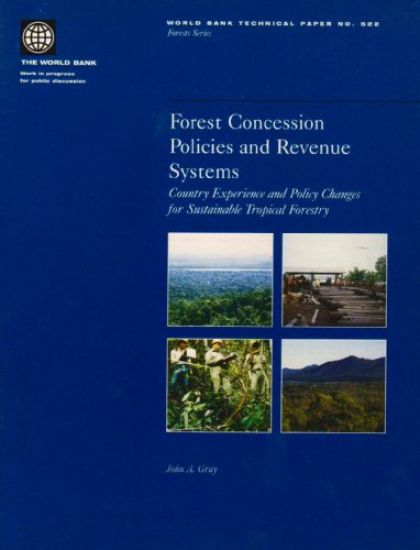
Forest Concession Policies and Revenue Systems

Forest Concession Policies and Revenue Systems

John A. Gray

World Bank Publications
2002
nidottu
If sustainable management of tropical forests is to be accomplished and deforestation brought under control, the on-the-ground performance of existing forest concessions, along with the allocation of new concessions, will have to be strengthened. This study examines the failures of forest concessions and the loss of tropical forests due to mismanagement during the last two decades. It also emphasises the potential gains resulting from strengthening the allocation, management, and supervision of concessions by concentrating on improving procedures, introducing performance incentives, and monitoring key performance elements.
Forest Law and Sustainable Development

Forest Law and Sustainable Development

Lawrence C. Christy; Charles E. Di Leva; Jonathan M. Lindsay; Patrice Talla Takoukam

World Bank Publications
2007
nidottu
This book analyzes the wide range of issues that should be taken into account in forest-related legislation. It stresses that forest law must be understood in the context of the broader legal framework governing land use and land tenure, as well as international obligations related to trade, environmental protection, and human rights. The book also pays significant attention to institutional arrangements and governance practices relevant to forests, including decentralization, transparency, and law enforcement. The authors draw extensively on experience from around the world to provide tools for dealing with various forest management challlenges. The authors are experts in the field of forest law. Lawrence C. Christy is a Former Chief, Development Law Service, Legal Office, Food and Agricultre Organization of the United Nations (FAO). Charles E. Di Leva is Chief Counsel, Environmentally and Socially Sustainable Development and International Law Unit (LEGEN), Legal Vice-Presidency, World Bank. Jonathan M. Lindsay is Senior Counsel with LEGEN, Legal Vice-Presidency, World Bank. Patrice Talla Takoukam is Counsel with LEGEN, Legal Vice-Presidency, World Bank.
Forest Recollections

Forest Recollections

UNIVERSITY OF HAWAI'I PRESS
1997
sidottu
I stayed [in the forest] for two nights. The first night, nothing happened. The second night, at about one or two in the morning, a tiger came--which meant that I didn't get any sleep the whole night. I sat in meditation, scared stiff, while the tiger walked around and around my umbrella tent (klot). My body felt all frozen and numb. I started chanting, and the words came out like running water. All the old chants I had forgotten now came back to me, thanks both to my fear and to my ability to keep my mind under control. I sat like this from 2 until 5 a.m., when the tiger finally left."" --A forest monk During the first half of this century the forests of Thailand were home to wandering ascetic monks. They were Buddhists, but their brand of Buddhism did not copy the practices described in ancient doctrinal texts. Their Buddhism found expression in living day-to-day in the forest and in contending with the mental and physical challenges of hunger, pain, fear, and desire. Combining interviews and biographies with an exhaustive knowledge of archival materials and a wide reading of ephemeral popular literature, Kamala Tiyavanich documents the monastic lives of three generations of forest-dwelling ascetics and challenges the stereotype of state-centric Thai Buddhism. Although the tradition of wandering forest ascetics has disappeared, a victim of Thailand's relentless modernization and rampant deforestation, the lives of the monks presented here are a testament to the rich diversity of regional Buddhist traditions. The study of these monastic lineages and practices enriches our understanding of Buddhism in Thailand and elsewhere.
Forest Recollections

Forest Recollections

Kamala Tiyavanich

University of Hawai'i Press
1997
nidottu
During the first half of this century the forests of Thailand were home to wandering ascetic monks. They were Buddhists, but their brand of Buddhism did not copy the practices described in ancient doctrinal texts. Their Buddhism found expression in living day-to-day in the forest and in contending with the mental and physical challenges of hunger, pain, fear, and desire. Combining interviews and biographies with an exhaustive knowledge of archival materials and a wide reading of ephemeral popular literature, Kamala Tiyavanich documents the monastic lives of three generations of forest-dwelling ascetics and challenges the stereotype of state-centric Thai Buddhism.Although the tradition of wandering forest ascetics has disappeared, a victim of Thailand's relentless modernization and rampant deforestation, the lives of the monks presented here are a testament to the rich diversity of regional Buddhist traditions. The study of these monastic lineages and practices enriches our understanding of Buddhism in Thailand and elsewhere.
Forest of Struggle

Forest of Struggle

Eve Monique Zucker

University of Hawai'i Press
2013
sidottu
In a village community in the highlands of Cambodia’s Southwest, people struggle to rebuild their lives after nearly thirty years of war and genocide. Recovery is a tenuous process as villagers attempt to shape a future while contending with the terrible rupture of the Pol Pot era. Forest of Struggle tracks the fragile progress of restoring the bonds of community in O’Thmaa and its environs, the site of a Khmer Rouge base and battlefield for nearly three decades between 1970 and 1998. Anthropologist Eve Zucker’s ethnographic fieldwork (2001–2003, 2010) uncovers the experiences of the people of O’Thmaa in the early days of the revolution, when some villagers turned on each other with lethal results. She examines memories of violence and considers the means by which relatedness and moral order are re-established, comparing O’Thmaa with villages in a neighbouring commune that suffered similar but not identical trauma. Zucker argues that those differing experiences shape present ways of healing and making the future. Events had a devastating effect on the social and moral order at the time and continue to impair the remaking of sociality and civil society today, impacting villagers’ responses to changes in recent years. More positively, Zucker persuasively illustrates how Cambodians employ indigenous means to reconcile their painful memories of loss and devastation. This point is noteworthy given current debates on recovery surrounding the Khmer Rouge Tribunal. Forest of Struggle offers a compelling case study that is relevant to anyone interested in post-conflict recovery, social memory, the anthropology of morality and violence, and Cambodia studies.
Forest of Struggle

Forest of Struggle

Eve Monique Zucker

University of Hawai'i Press
2013
nidottu
In a village community in the highlands of Cambodia’s Southwest, people struggle to rebuild their lives after nearly thirty years of war and genocide. Recovery is a tenuous process as villagers attempt to shape a future while contending with the terrible rupture of the Pol Pot era. Forest of Struggle tracks the fragile progress of restoring the bonds of community in O’Thmaa and its environs, the site of a Khmer Rouge base and battlefield for nearly three decades between 1970 and 1998. Anthropologist Eve Zucker’s ethnographic fieldwork (2001–2003, 2010) uncovers the experiences of the people of O’Thmaa in the early days of the revolution, when some villagers turned on each other with lethal results. She examines memories of violence and considers the means by which relatedness and moral order are re-established, comparing O’Thmaa with villages in a neighbouring commune that suffered similar but not identical trauma. Zucker argues that those differing experiences shape present ways of healing and making the future. Events had a devastating effect on the social and moral order at the time and continue to impair the remaking of sociality and civil society today, impacting villagers’ responses to changes in recent years. More positively, Zucker persuasively illustrates how Cambodians employ indigenous means to reconcile their painful memories of loss and devastation. This point is noteworthy given current debates on recovery surrounding the Khmer Rouge Tribunal. Forest of Struggle offers a compelling case study that is relevant to anyone interested in post-conflict recovery, social memory, the anthropology of morality and violence, and Cambodia studies.
Forest Sampling Desk Reference

Forest Sampling Desk Reference

Evert W. Johnson

CRC Press Inc
2000
sidottu
Should damaged trees be clear cut and replanted or allowed to recover naturally? Is the deer herd large enough to survive hunting pressure? Managing forest resources entails numerous decisions. Making these decisions intelligently requires sound information about the resource in question. Ideally, assessments should be based on the entire population involved. However, the costs in time and money often prevent this, and evaluations - or sampling - are done on a small portion of the whole. The most complete treatment of systematic sampling in one volume, Forest Sampling Desk Reference explains the uses and limitations of individual sampling designs in forest inventory operations. This text contains detailed derivations of the most commonly used statistical methods in forestry. It provides examples that highlight the statistical methods. The author covers probability and probability distributions and the development of logical regression models. The text discusses systematic sampling, describing its benefits and shortcomings in detail. It provides an in depth examination of the controversial 3-P sampling procedure. The validity and strength of sampling results vary from option to option, along with their costs in terms of money and time. Before selecting a sampling procedure you need to know their strengths and weaknesses in relation to their expense. Forest Sampling Desk Reference supplies the background necessary for making these decisions.
Forest Certification
Forest certification has been widely accepted as a tool that would encourage industrial and non-industrial management of resources in an environmentally acceptable, socially beneficial and economically viable manner. Much has been written on certification yet five issues have been missing, which this book addresses: an analysis of the scientific basis for the certification standards; a formal and mechanistic incorporation of social and natural system sustainability as part of the standards; the rationale for the different sets of standards that are currently being used to certify governmental, industrial and non-industrial organizations; the success of the different sets of standards in assessing the environmental acceptability, social benefits and economic viability of the managed system; and, the difficulty of certifying small landowners with current protocols. Forest Certification examines the historical roots of forest certification, the factors that guide the development of certification protocols, the players involved in certification, the factors determining the customers to be certified, and the benefits of certification. The book also covers the terminology and other issues intrinsic to certification that direct the structure of standards, the similarities between indicators of different human disturbances within the ecosystem/landscape and certification standards, and, finally, a case study evaluating the strengths and weaknesses of existing certification protocols. Forest Certification is unique in its analysis of the scientific basis for the structure of the forest certification protocols. It documents the roles of human values in the development of assessment protocols but demonstrates how elements of existing protocols should be used to produce non-value based standards.
Forest Policy

Forest Policy

CABI Publishing
1998
sidottu
Forest policy involves a complex balance of governmental, social and industrial objectives in an environment where the forests and the institutions are also constantly changing. Across the various forestry jurisdictions there is a wide variety of policy models that have evolved in response to specific societal demands, institutional structures and forest environments. This book is an examination of forest policy in a selection of major forestry jurisdictions, primarily the major competitors in world softwood markets. These include the United States, British Columbia, Alberta, New Zealand, Sweden, Finland, Chile and Russia. These regions represent systems operating with natural forests, plantation forests, initial forest endowments, second/third generation forests, public forestland ownership, private forestland ownership, open markets, highly structured markets, and various responses to sustainability. For each jurisdiction a brief overview to the economy, the contribution of forestry, the resource base, the composition of the forest industry and the major stakeholders is provided. The policy discussions include forest management, timber pricing and export policy, environmental standards, land ownership and use, and the institutional setting relating to government agencies, taxation, labour and capital. Comment is provided on the evolution of the existing policy structure and the chapters finish with an evaluation and prognosis for the jurisdiction. This book is a valuable reference source for forest policy practitioners, students of forestry and political economy and industrial decision-makers seeking to position their business in global forestry.
Forest Genetics

Forest Genetics

Timothy White; W. Adams; David Neale

CABI Publishing
2007
nidottu
Winner of a 2009 Outstanding Academic Title (OAT) award! Trees continue to maintain a unique significance in the social, ecological and economic systems of the world - as large, long-lived perennials covering 30% of land on Earth; their very nature dictates their importance. An understanding of forest genetics is essential for providing insight into the evolution, conservation, management and sustainability of both natural and managed forests. Providing a comprehensive introduction to the principles of genetics as important to forest trees, this text integrates the varied sub-disciplines of genetics and their applications in gene conservation, tree improvement and biotechnology. Topics discussed include genetic variation in natural forest trees, the application of genetics in tree improvement and breeding programs, and genomic sciences and molecular technologies.
Forest Dynamics in Heavily Polluted Regions
Air pollution has been recognised as a potential problem for forests for nearly 150 years. Today, sulphur dioxide, fluorides, heavy metals and ozone are a significant problem, usually from large scale sources in industrial and urban areas. Problems are exacerbated in those regions where there is a poor understanding of the factors involved in forest decline and destruction and no rigorous control over it has been established. This book is the first report from the International Union of Forest Research Organization's (IUFRO) Task Force on Environmental Change and provides an assessment of the extent of air pollution impacts on forests in heavily polluted regions. It includes case studies from Russia, Ontario (Canada), California and the Mediterranean region. It is also the first volume in a new book series covering many areas of forestry research, published by CABI Publishing in association with IUFRO.
Forest Tourism and Recreation
The demand for ecotourism and outdoor recreation is increasing, and the pressures on land use are becoming more obvious. A large part of the experience of ecotourism and recreational landscape depends on the maintenance of forested land. Effective management of tourism and recreation in forests can provide extra income to help offset the costs of sustainable timber production and encourage biodiversity conservation.This multi-author book considers the compatibility between tourism, forestry and conservation, the management of natural resources and the involvement of stakeholders and the community. Issues are presented through case studies from a range of countries and topics covered include National Parks, peri-urban forestry and wilderness management, as well as practitioner-oriented contributions.
Forest History

Forest History

CABI Publishing
2000
sidottu
This book presents edited and revised versions of more than 30 papers selected from those presented at a major conference on History and Forest Resources, held in Florence in 1998. The conference was organised by the Italian Academy of Forestry Science and working group on Forest History of the International Union of Forestry Research Organisations (IUFRO). As a whole the papers present detailed analyses of the interrelationships between forest ecosystems and socioeconomic development from thirteen different countries of the world. Main economic and social factors, techniques and local practices, as well as legal and political aspects related to forest changes are discussed, according to the latest achievements in forest history research. The book is a companion volume to Methods and Approaches in Forest History.
Forest Policy for Private Forestry
There is currently great concern about the sustainability of forestry and the contribution of private forestry towards this aim. The need to better understand the impact of different policy choices on private forestry has never been more important. This book includes a selection of peer-reviewed papers from a conference held in Atlanta in March 2001.
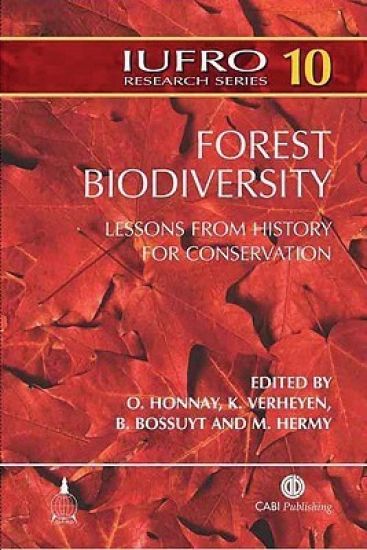
Forest Biodiversity

Forest Biodiversity

CABI Publishing
2004
sidottu
This book focuses on the diverse impact of forest history in general, and of forest continuity, fragmentation and past management in particular, on the diversity and distribution of species. The implications for the conservation of biodiversity in forests are also addressed. Chapters have been developed from papers presented at a conference held in Leuven in January 2003. The emphasis is on temperate forests in Europe and North America, but the information may also be applicable to other regions or biomes. The book will be of significant interest to researchers working within the areas of forestry, ecology, conservation and environmental history.