Kirjojen hintavertailu. Mukana 12 016 292 kirjaa ja 12 kauppaa.

Kirjahaku

Etsi kirjoja tekijän nimen, kirjan nimen tai ISBN:n perusteella.

1000 tulosta hakusanalla Franz Neumann

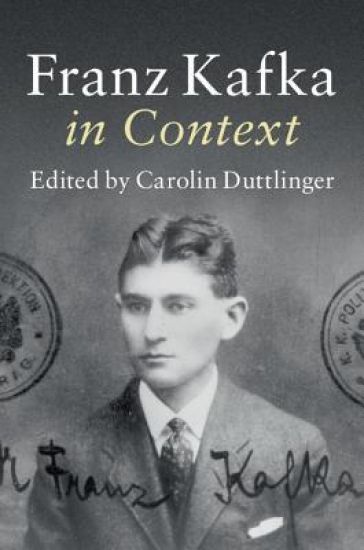
Franz Kafka in Context

Franz Kafka in Context

Cambridge University Press
2017
sidottu
Franz Kafka (1883–1924) lived through one of the most turbulent periods in modern history, witnessing a world war, the dissolution of an empire and the foundation of a new nation state. But the early twentieth century was also a time of social progress and aesthetic experimentation. Kafka's novels and short stories reflect their author's keen but critical engagement with the big questions of his time, and yet often Kafka is still cast as a solitary figure with little or no connection to his age. Franz Kafka in Context aims to redress this perception. In thirty-five short, accessible essays, leading international scholars explore Kafka's personal and working life, his reception of art and culture, his engagement with political and social issues, and his ongoing reception and influence. Together they offer a nuanced and historically grounded image of a writer whose work continues to fascinate readers from all backgrounds.
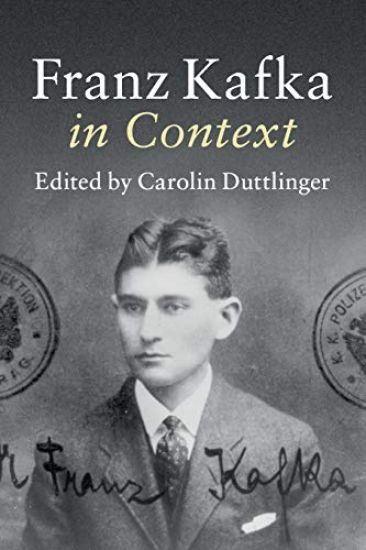
Franz Kafka in Context

Franz Kafka in Context

Cambridge University Press
2019
pokkari
Franz Kafka (1883–1924) lived through one of the most turbulent periods in modern history, witnessing a world war, the dissolution of an empire and the foundation of a new nation state. But the early twentieth century was also a time of social progress and aesthetic experimentation. Kafka's novels and short stories reflect their author's keen but critical engagement with the big questions of his time, and yet often Kafka is still cast as a solitary figure with little or no connection to his age. Franz Kafka in Context aims to redress this perception. In thirty-five short, accessible essays, leading international scholars explore Kafka's personal and working life, his reception of art and culture, his engagement with political and social issues, and his ongoing reception and influence. Together they offer a nuanced and historically grounded image of a writer whose work continues to fascinate readers from all backgrounds.
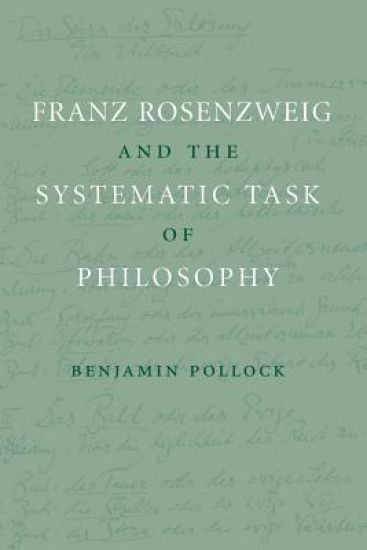
Franz Rosenzweig and the Systematic Task of Philosophy

Franz Rosenzweig and the Systematic Task of Philosophy

Benjamin Pollock

Cambridge University Press
2014
pokkari
Benjamin Pollock argues that Franz Rosenzweig's The Star of Redemption is devoted to a singularly ambitious philosophical task: grasping 'the All' - the whole of what is - in the form of a system. In asserting Rosenzweig's abiding commitment to a systematic conception of philosophy, this book breaks rank with the assumptions about Rosenzweig's thought that have dominated recent scholarship. Indeed, the Star's importance is often claimed to lie precisely in the way it opposes philosophy's traditional drive for systematic knowledge and upholds instead a 'new thinking' attentive to the existential concerns, the alterity, and even the revelatory dimension of concrete human life. Pollock shows that these very innovations in Rosenzweig's thought are in fact to be understood as part and parcel of the Star's systematic program. But this is only the case, Pollock claims, because Rosenzweig approaches philosophy's traditional task of system in a radically original manner.
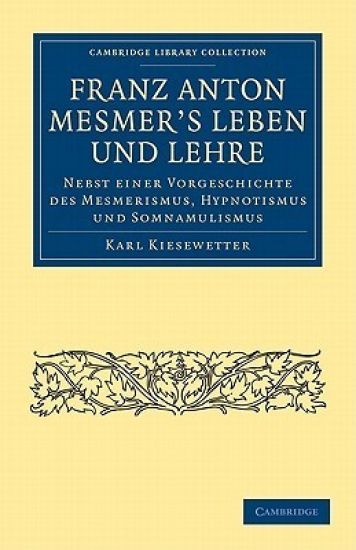
Franz Anton Mesmer's Leben und Lehre

Franz Anton Mesmer's Leben und Lehre

Karl Kiesewetter

Cambridge University Press
2011
pokkari
Karl Kiesewetter (1854–1895) was the most influential German theosophical writer of his time, and wrote several books on the history of esotericism and occultism. This biography of Mesmer (1734–1815) was first published in Leipzig in 1893. It begins with two very substantial historical chapters. The first discusses practitioners of 'animal magnetism' before Mesmer, citing evidence dating back to ancient Egyptian hieroglyphs and Babylonian cuneiform records. The second discusses the history of visions, dreams, trances, soothsaying and divination, referring to the Greeks and the Gnostics. The second half of the book focuses on Mesmer himself. It describes his childhood near Lake Constance, his university education in philosophy and medicine, his medical practice in Vienna and his interest in 'cosmic magnetism'. It documents his treatments and the controversies they caused, his travels, his benefactors and detractors, and ends with a summary of his theories including extracts from his work.
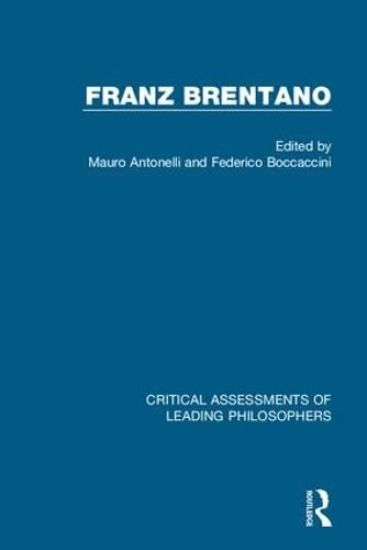
Franz Brentano
Franz Brentano (1838–1917) was a leading philosopher and psychologist of the nineteenth century. Indeed, the impact of his scholarship was so great that he became synonymous with a school of thought and a new approach in scientific philosophy. The Brentano School stood against the Idealistic and post-Kantian German tradition and Brentano played a crucial role in the founding of Austrian philosophy. He had an enormous impact on the work of Husserl and Heidegger, as well as on Moore’s Ethics and Stout and Russell’s analysis of mind. In particular, situated between the phenomenology movement and the analytic tradition, the concept of intentionality was redefined by Brentano and has been—and remains—a key concept of twentieth- and twentieth-first century philosophy of mind. But Brentano not only reshaped philosophy of mind; he was also a remarkable and innovative thinker in several other fields of philosophy, and recent debate in metaethics, metaphysics, and the history of analytic philosophy shows a strong resurgence of interest in Brentano’s thought.Published to coincide with the centenary of Brentano’s death, this four-volume collection, a new title from Routledge Major Works, provides an essential intellectual tool for the exegetical evaluation of all aspects of Brentano’s work. Bringing together early reviews and reactions from his contemporaries—many of which have never before been translated into English—as well as the best critical assessments of Brentano’s work, this ‘mini library’ provides Brentano scholars, historians of philosophy and psychology, and phenomenologists, with a rigorous historical appraisal of Brentano’s thought and influence. Brentano’s relationships with Husserl, Heidegger, and the phenomenological tradition are examined in depth, alongside investigations of key themes from his work on Aristotle, medieval and modern philosophy, philosophy of mind, logic, ontology, ethics, aesthetics, philosophy of religion, and the philosophy of history.