Kirjojen hintavertailu. Mukana 11 342 296 kirjaa ja 12 kauppaa.

Kirjahaku

Etsi kirjoja tekijän nimen, kirjan nimen tai ISBN:n perusteella.

1000 tulosta hakusanalla Goethe

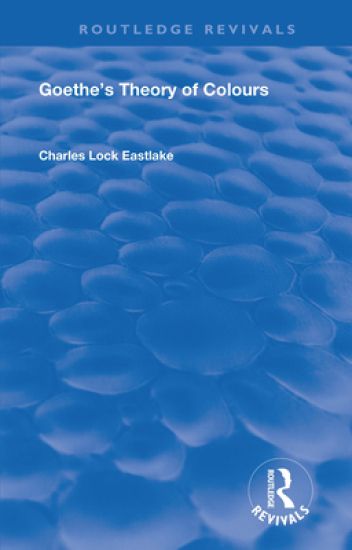
Goethe’s Theory of Colours

Goethe’s Theory of Colours

Johann Wolfgang von Goethe

Routledge
2019
sidottu
First published in German in 1810, this detailed volume was translated from the German by Charles Lock Eastlake and, in six parts, examines every aspect of Goethe’s theory of colours, including psychological colours, chemical colours, the moral effect of colour, minerals, plants, insects, mammals and a multitude of further subjects.
Goethe’s Theory of Colours

Goethe’s Theory of Colours

Johann Wolfgang von Goethe

Routledge
2021
nidottu
First published in German in 1810, this detailed volume was translated from the German by Charles Lock Eastlake and, in six parts, examines every aspect of Goethe’s theory of colours, including psychological colours, chemical colours, the moral effect of colour, minerals, plants, insects, mammals and a multitude of further subjects.
Goethe's Faust

Goethe's Faust

John R. Williams

Routledge
2020
sidottu
Originally published in 1987, this is a thorough and lucid introduction and commentary to the whole of Goethe’s Faust. It gives the student of German and European literature valuable insights into the most important work of Germany’s foremost poet. German quotations are translated or paraphrased in English and a detailed knowledge of German literature is not assumed. The book traces Goethe’s work on the play over 60 years of his creative career and surveys its critical reception over the 200 years since its first appearance. Part One is analysed as a mimetic tragedy, Part Two as an historical and cultural profile of Goethe’s own times. The commentary guides the reader carefully through its subtleties and multi-layered references and provides a broad and coherent structure for the overall understanding of the work. It suggests provocative interpretations of some figures and episodes in Part Two and places renewed emphasis on parts of the work that often receive relatively little attention. An appendix surveys the metres and verse forms of the play.
Goethe's Faust

Goethe's Faust

John R. Williams

TAYLOR FRANCIS LTD
2021
nidottu
Originally published in 1987, this is a thorough and lucid introduction and commentary to the whole of Goethe’s Faust. It gives the student of German and European literature valuable insights into the most important work of Germany’s foremost poet. German quotations are translated or paraphrased in English and a detailed knowledge of German literature is not assumed. The book traces Goethe’s work on the play over 60 years of his creative career and surveys its critical reception over the 200 years since its first appearance. Part One is analysed as a mimetic tragedy, Part Two as an historical and cultural profile of Goethe’s own times. The commentary guides the reader carefully through its subtleties and multi-layered references and provides a broad and coherent structure for the overall understanding of the work. It suggests provocative interpretations of some figures and episodes in Part Two and places renewed emphasis on parts of the work that often receive relatively little attention. An appendix surveys the metres and verse forms of the play.
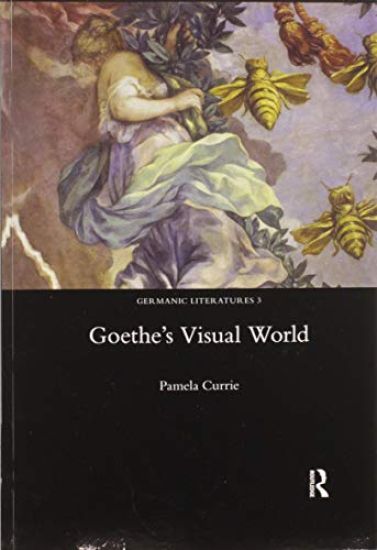
Goethe's Visual World

Goethe's Visual World

Pamela Currie

Routledge
2020
nidottu
Goethe's ideas on colour and imagery crossed many borderlines: those of artistic processes and philosophical aesthetics, art history and colour theory, together with the science of perception. This investigation into his writings ranges across art from Antiquity to Goethe's literary work.
Goethe and the Philosopher’s Stone
Originally published in 1965, this study examines the concealed meanings in the second part of Faust, often considered obscure. It is of value not only to students of literature but also comparative religions, as it deals with Goethe’s knowledge of ancient myths, mysteries and Hellenistic religions. It is of value too, to those interested in alchemy as it traces the many alchemical references in Faust. The book gives a psychological interpretation of elements of Goethe’s personal life and work, which succeeds in making the man and the veiled references in his most profound work accessible to the modern reader.
Goethe and the Philosopher’s Stone

Goethe and the Philosopher’s Stone

Alice Raphael

TAYLOR FRANCIS LTD
2021
nidottu
Originally published in 1965, this study examines the concealed meanings in the second part of Faust, often considered obscure. It is of value not only to students of literature but also comparative religions, as it deals with Goethe’s knowledge of ancient myths, mysteries and Hellenistic religions. It is of value too, to those interested in alchemy as it traces the many alchemical references in Faust. The book gives a psychological interpretation of elements of Goethe’s personal life and work, which succeeds in making the man and the veiled references in his most profound work accessible to the modern reader.
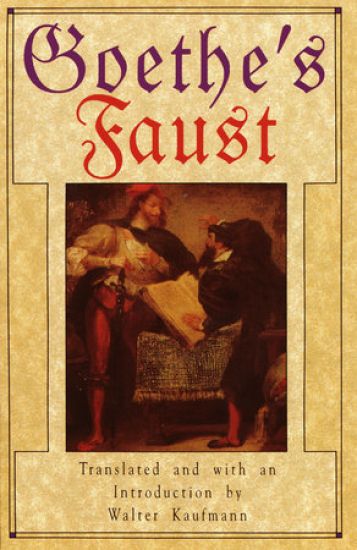
Goethe's Faust

Goethe's Faust

Johann Wolfgang Von Goethe

Anchor Books
1962
pokkari
The best translation of Faust available, this volume provides the original German text and its English counterpart on facing pages. Walter Kaufmann's translation conveys the poetic beauty and rhythm as well as the complex depth of Goethe's language. Includes Part One and selections from Part Two.
Goethe's Faust

Goethe's Faust

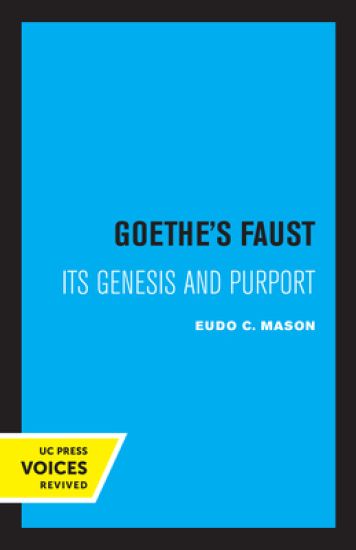
Eudo C. Mason

University of California Press
2022
pokkari
Goethe's Faust: Its Genesis and Purport offers an exploration of one of the most complex and multifaceted works in literary history. The author delves into Faust's intricate layers, examining its genesis, historical context, and Goethe's personal experiences that influenced the play. The work navigates the significant polarities that define Goethe's masterpiece—realism and idealism, the sensual and the spiritual, and the amoral versus ethical dimensions—highlighting the tensions and synthesis that give the drama its enduring power. The study acknowledges that Faust resists definitive interpretation, as each reader is drawn to different aspects of its dualities, and its richness lies in this very tension. This comprehensive review not only addresses Goethe's artistic intentions and thematic depth but also critiques the complexities added by decades of academic analysis. The author challenges the "Higher Critics," suggesting that their overly intricate dissection often obscures the play's accessible elements, creating unnecessary barriers for readers. Instead, the book emphasizes the need to return to the text itself, Goethe's broader oeuvre, and his poetic vision to uncover the "inner fairy tale" that underpins Faust. Drawing inspiration from influential critics like Konrad Burdach and Emil Staiger, the study ultimately seeks to balance scholarly insight with a clear understanding of Goethe's intentions, offering a pathway to appreciating the universal and timeless nature of his work. This title is part of UC Press's Voices Revived program, which commemorates University of California Press’s mission to seek out and cultivate the brightest minds and give them voice, reach, and impact. Drawing on a backlist dating to 1893, Voices Revived makes high-quality, peer-reviewed scholarship accessible once again using print-on-demand technology. This title was originally published in 1967.
Goethe's Faust

Goethe's Faust

Eudo C. Mason

University of California Press
2022
sidottu
Goethe's Faust: Its Genesis and Purport offers an exploration of one of the most complex and multifaceted works in literary history. The author delves into Faust's intricate layers, examining its genesis, historical context, and Goethe's personal experiences that influenced the play. The work navigates the significant polarities that define Goethe's masterpiece—realism and idealism, the sensual and the spiritual, and the amoral versus ethical dimensions—highlighting the tensions and synthesis that give the drama its enduring power. The study acknowledges that Faust resists definitive interpretation, as each reader is drawn to different aspects of its dualities, and its richness lies in this very tension. This comprehensive review not only addresses Goethe's artistic intentions and thematic depth but also critiques the complexities added by decades of academic analysis. The author challenges the "Higher Critics," suggesting that their overly intricate dissection often obscures the play's accessible elements, creating unnecessary barriers for readers. Instead, the book emphasizes the need to return to the text itself, Goethe's broader oeuvre, and his poetic vision to uncover the "inner fairy tale" that underpins Faust. Drawing inspiration from influential critics like Konrad Burdach and Emil Staiger, the study ultimately seeks to balance scholarly insight with a clear understanding of Goethe's intentions, offering a pathway to appreciating the universal and timeless nature of his work. This title is part of UC Press's Voices Revived program, which commemorates University of California Press’s mission to seek out and cultivate the brightest minds and give them voice, reach, and impact. Drawing on a backlist dating to 1893, Voices Revived makes high-quality, peer-reviewed scholarship accessible once again using print-on-demand technology. This title was originally published in 1967.
Goethe's History of Science

Goethe's History of Science

Karl J. Fink

Cambridge University Press
2009
pokkari
Being familiar with Goethe's Faust story, students of Western thought will not be surprised to learn that Goethe was also a scientist, philosopher and historian. This book is about the interdisciplinary activities of his mid-life (1790–1810) when he researched optics, colour theory and plant morphology, and at the same time contributed to the growing literature in the history and philosophy of science. In Goethe's writings, Karl J. Fink finds a scientist examining the junctures of nature, the boundary conditions where growth and change occur. These topics of transition also define his approach to the history of science, where the gaps between visible states challenge the historian to search for metaphors that bridge discontinuities. Fink concludes his study with Goethe's views on the possibility of a teleology of science, looking at those writings in which Goethe explores how the scientist of today projects and directs the science of tomorrow.
Goethe's Boyhood

Goethe's Boyhood

Cambridge University Press
2011
pokkari
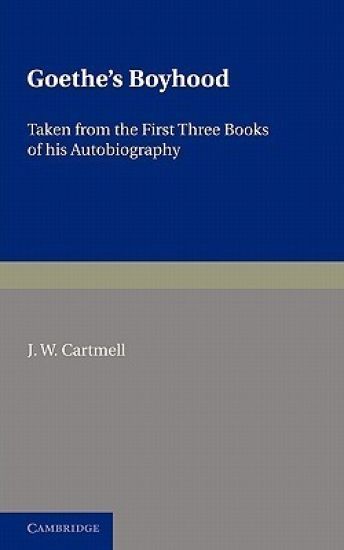
Johann Wolfgang Goethe was a German poet, novelist and philosopher who became an eminent figure in the movement of Weimar Classicism in the late 18th and early 19th centuries. This book, which was first published in 1875, takes its focal text from the first three books of his Knabenjahre (autobiography). It was originally arranged and edited by the late Dr W. Wagner, with this second edition being prepared in 1890 by J. W. Cartmell of Christ's College, Cambridge. Although the text itself appears in its original German, meticulous notes from both editors make Goethe's Boyhood endlessly accessible to students of German language and literature. The editors have also provided a detailed family tree of the writer and thinker to give this rich and engaging text a useful contextual background.
Goethe's Faust

Goethe's Faust

Cambridge University Press
2011
sidottu
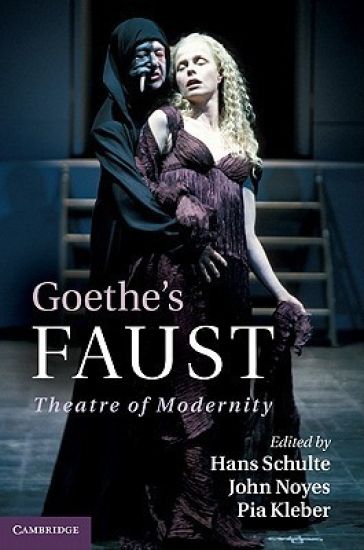
Faust has been called the fundamental icon of Western culture, and Goethe's inexhaustible poetic drama is the centrepiece of its tradition in literature, music and art. In recent years, this play has experienced something of a renaissance, with a surge of studies, theatre productions, press coverage and public discussions. Reflecting this renewed interest, leading Goethe scholars in this volume explore the play's striking modernity within its theatrical framework. The chapters present new aspects such as the virtuality of Faust, the music drama, the modernization of evil, Faust's blindness, the gay Mephistopheles, classic beauty and horror as phantasmagoria, and Goethe's anticipation of modern science, economics and ecology. The book contains an illustrated section on Faust in modern performance, with contributions by renowned directors, critics and dramaturges, and a major interview with Peter Stein, director of the uncut 'millennium production' of Expo 2000.
Goethe and the Greeks

Goethe and the Greeks

Trevelyan Humphry

Cambridge University Press
1981
sidottu
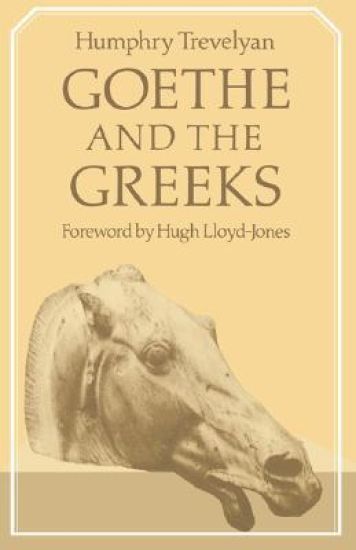
'The revolution that is going on in me is that which has taken place in every artist who has studied Nature long and diligently and now seeks the remains of the great spirit of antiquity; his soul wells up, he feels a transfiguration of himself from within, a feeling of freer life, higher existence, lightness and grace.' It is Mr Trevelyan's purpose, in this profoundly interesting book, to trace the course of this development in Goethe, to determine its extent, to test its sincerity. To this task he brings, not only a complete knowledge of Goethe's life and works and of classical literature, but also a fine critical sense which enables him to direct his detailed knowledge towards a philosophical conclusion.' So wrote Herbert Read in The Spectator in December 1941 on the first publication of Goethe and the Greeks. Trevalyan's account of Goethe's fascination with the Greeks, his striving to master their culture, his vision of Hellenic man, is judged not to have been supplanted by any later work in English. Professor Lloyd-Jones has written a substantial Foreword for this reissue of Trevelyan's book, giving his own assessment of Goethe's search for Hellenism and its influence on his work.
Goethe and the Greeks

Goethe and the Greeks

Humphry Trevelyan; Hugh Lloyd-Jones

Cambridge University Press
1981
pokkari
'The revolution that is going on in me is that which has taken place in every artist who has studied Nature long and diligently and now seeks the remains of the great spirit of antiquity; his soul wells up, he feels a transfiguration of himself from within, a feeling of freer life, higher existence, lightness and grace.' It is Mr Trevelyan's purpose, in this profoundly interesting book, to trace the course of this development in Goethe, to determine its extent, to test its sincerity. To this task he brings, not only a complete knowledge of Goethe's life and works and of classical literature, but also a fine critical sense which enables him to direct his detailed knowledge towards a philosophical conclusion.' So wrote Herbert Read in The Spectator in December 1941 on the first publication of Goethe and the Greeks. Trevalyan's account of Goethe's fascination with the Greeks, his striving to master their culture, his vision of Hellenic man, is judged not to have been supplanted by any later work in English. Professor Lloyd-Jones has written a substantial Foreword for this reissue of Trevelyan's book, giving his own assessment of Goethe's search for Hellenism and its influence on his work.
Goethe: Faust Part One

Goethe: Faust Part One

Nicholas Boyle

Cambridge University Press
1986
pokkari
Nicholas Boyle begins with a fascinating survey of earlier versions of the Faust story. He then offers a detailed reading of Faust Part One, emphasising the poetic and dramatic coherence of the work and tracing its links with the thought and culture of Goethe's time. The play emerges as a tragic poem which may, to a certain extent, be read independently of Faust Part Two.
Goethe: The Sorrows of Young Werther

Goethe: The Sorrows of Young Werther

Martin Swales

Cambridge University Press
1987
pokkari
The tradition of the German novel, before the emergence of its 'classic' writers in the first half of the twentieth century (Thomas Mann, Kafka, Hesse, Musil), does not have an assured place in the canon of European literature. Not that it has wanted for spirited advocates; but, despite all efforts, it has remained firmly on the periphery. The one signal exception is Goethe's novel Die Leiden des jungen Werthers usually rendered as 'The Sorrows of Young Werther'. Werther was an extraordinary and immediate bestseller both in Germany and abroad.
Goethe contra Newton

Goethe contra Newton

Dennis L. Sepper

Cambridge University Press
2003
pokkari
This book explains the background and rationale of the German poet Johann Wolfgang von Goethe’s notorious attack on Isaac Newton’s classic theory of white light and colors. Though the merits of Goethe’s color science, as advanced in his massive Zur Farbenlehre, have often been acknowledged, it has been almost unanimously proclaimed invalid as physics. How could Goethe have been so mistaken? In his book, Dennis Sepper shows that the condemnation of Goethe’s attacks on Newton has been based on erroneous assumptions about the history of Newton’s theory and the methods and goals of Goethe’s color science. By illuminating the historical background and the experimental, methodological, and philosophical aspects of Goethe’s work, the author shows that his color theory is in an important sense genuinely physical and that, as simultaneously poet, scientist, historian, and philosopher, Goethe managed to anticipate important twentieth-century research not only in the history and philosophy of science, but even in color science itself.