Kirjojen hintavertailu. Mukana 12 016 292 kirjaa ja 12 kauppaa.

Kirjahaku

Etsi kirjoja tekijän nimen, kirjan nimen tai ISBN:n perusteella.

1000 tulosta hakusanalla Harold L Doerr

Texas Through Women's Eyes

Texas Through Women's Eyes

Judith N. McArthur; Harold L. Smith

University of Texas Press
2010
pokkari
Winner, Liz Carpenter Award For Research in the History of Women, Texas State Historical Association, 2010Texas women broke barriers throughout the twentieth century, winning the right to vote, expanding their access to higher education, entering new professions, participating fully in civic and political life, and planning their families. Yet these major achievements have hardly been recognized in histories of twentieth-century Texas. By contrast, Texas Through Women's Eyes offers a fascinating overview of women's experiences and achievements in the twentieth century, with an inclusive focus on rural women, working-class women, and women of color.McArthur and Smith trace the history of Texas women through four eras. They discuss how women entered the public sphere to work for social reforms and the right to vote during the Progressive era (1900–1920); how they continued working for reform and social justice and for greater opportunities in education and the workforce during the Great Depression and World War II (1920–1945); how African American and Mexican American women fought for labor and civil rights while Anglo women laid the foundation for two-party politics during the postwar years (1945–1965); and how second-wave feminists (1965–2000) promoted diverse and sometimes competing goals, including passage of the Equal Rights Amendment, reproductive freedom, gender equity in sports, and the rise of the New Right and the Republican party.
Voluntary Agencies in the Welfare State

Voluntary Agencies in the Welfare State

Ralph M. Kramer; Harold L. Wilensky

University of California Press
2020
pokkari
The rise of the welfare state threatens the autonomy and survival of nonprofit voluntary agencies as providers of social services. Or does it? In this cross-national, empirical study of the workings of voluntary agencies, Ralph M. Kramer cuts through the conceptual confusion surrounding voluntarism and the boundaries between the public and private sectors. He draws on a survey of voluntary agencies helping disabled people in four welfare democracies (the United States, England, Israel, and the Netherlands) to explain the virtues and flaws of different patterns of government-voluntary relationships in coping with the growing demand for human services. Kramer concludes that many of the most cherished beliefs about the voluntary sector have little basis in fact. The most innovative agencies, for example, are not the smallest, but rather among the largest, most bureaucratized, and most professionalized. Government funding does not necessarily constrain agency autonomy. And giving voluntary agencies the primary responsibility for social services can reduce, not increase, citizen participation. This comparative analysis of the distinctive competence, vulnerability, and potential of the voluntary agency should replace some of the myths that guide public policy and the day-to-day activities of social service agencies. This title is part of UC Press's Voices Revived program, which commemorates University of California Press’s mission to seek out and cultivate the brightest minds and give them voice, reach, and impact. Drawing on a backlist dating to 1893, Voices Revived makes high-quality, peer-reviewed scholarship accessible once again using print-on-demand technology. This title was originally published in 1981.
Voluntary Agencies in the Welfare State

Voluntary Agencies in the Welfare State

Ralph M. Kramer; Harold L. Wilensky

University of California Press
2021
sidottu
The rise of the welfare state threatens the autonomy and survival of nonprofit voluntary agencies as providers of social services. Or does it? In this cross-national, empirical study of the workings of voluntary agencies, Ralph M. Kramer cuts through the conceptual confusion surrounding voluntarism and the boundaries between the public and private sectors. He draws on a survey of voluntary agencies helping disabled people in four welfare democracies (the United States, England, Israel, and the Netherlands) to explain the virtues and flaws of different patterns of government-voluntary relationships in coping with the growing demand for human services. Kramer concludes that many of the most cherished beliefs about the voluntary sector have little basis in fact. The most innovative agencies, for example, are not the smallest, but rather among the largest, most bureaucratized, and most professionalized. Government funding does not necessarily constrain agency autonomy. And giving voluntary agencies the primary responsibility for social services can reduce, not increase, citizen participation. This comparative analysis of the distinctive competence, vulnerability, and potential of the voluntary agency should replace some of the myths that guide public policy and the day-to-day activities of social service agencies. This title is part of UC Press's Voices Revived program, which commemorates University of California Press’s mission to seek out and cultivate the brightest minds and give them voice, reach, and impact. Drawing on a backlist dating to 1893, Voices Revived makes high-quality, peer-reviewed scholarship accessible once again using print-on-demand technology. This title was originally published in 1981.
The Paleolithic Prehistory of the Zagros–Taurus

The Paleolithic Prehistory of the Zagros–Taurus

Deborah I. Olszewski; Harold L. Dibble

University of Pennsylvania Press
1993
sidottu
Situated between Europe, Asia, and the Levantine corridor to Africa, the Zagros-Taurus region has enormous potential for the study of human adaptation and population movement during the Pleistocene. While archaeological work was done in this area 40 years ago, much of it remains unpublished. The political situation restricts research by archaeologists. This volume includes new data and major syntheses of the Paleolithic prehistory of the region, with reports of key sites and industries. By filling a major gap in our understanding of this area, it represents an essential reference for Near Eastern and Paleolithic specialists.
Chemistry and the Chemical Industry

Chemistry and the Chemical Industry

Robert A. Smiley; Harold L. Jackson

CRC Press
2018
sidottu
As chemical companies strive to be more competitive in the world economy, it is essential that their employees, including sales and marketing personnel, as well as administrative support groups understand the basic concepts of the science upon which the industry is based. The authors, who have over 100 years of combined experience in the chemical industry, developed this easy-to-read book to provide a fundamental understanding of the chemical industry for non-chemists and those poised to enter the chemical profession. Designed specifically for self-study, Chemistry and the Chemical Industry: A Practical Guide for Non-Chemists reviews the important aspects of industrial chemistry in a way that can be easily understood even if you have not taken any formal chemistry courses. The authors provide a clear, concise presentation of the foremost issues behind the chemical discipline along with key definitions and concepts so you can readily obtain an appreciation of the nature of the industry and its contribution to society. Even though you are not at the lab bench, you can still understand, recognize, and partake in discussions about the work being done at your company. Compiled in a straightforward and accessible manner, this book is unique in that it bridges the gap between nonscientific employees and the scientific world in which they operate. The first chapter begins with a description of the chemical industry. It defines the most common terms used in chemistry, drawing on nonscientific analogies whenever possible. In the following chapters, the authors review the concepts and terminology of organic and inorganic chemistry, polymer chemistry, high volume chemicals, and environmental concerns about chemical production with each subject presented as a graphic representation accompanied by a description. Finally, there is a short compilation of general information sources for further study. Chemistry and the Chemical Industry: A Practical Guide for No
Geology of the Ausable Quadrangle: New York State Museum Bulletin No. 261, June, 1925
Geology of the Ausable Quadrangle is a book written by James F. Kemp and published as New York State Museum Bulletin No. 261 in June 1925. The book provides a comprehensive overview of the geological features of the Ausable Quadrangle, located in New York. The author discusses the various rock formations, their origin, and their significance in the region's geological history. Kemp also delves into the geological processes that have shaped the landscape of the Ausable Quadrangle, including glacial activity and erosion. The book is a valuable resource for geologists, students, and anyone interested in the geological history of New York State.This scarce antiquarian book is a facsimile reprint of the old original and may contain some imperfections such as library marks and notations. Because we believe this work is culturally important, we have made it available as part of our commitment for protecting, preserving, and promoting the world's literature in affordable, high quality, modern editions, that are true to their original work.
Payback

Payback

James P. Andrew; Harold L. Sirkin; John Butman

Harvard Business Review Press
2007
sidottu
If you're like most people, you bet your career and company on innovation--because you must. Payback: Reaping the Rewards of Innovation offers you a new way to think about and manage innovation that will dramatically improve the odds of success. Authors James Andrew and Harold Sirkin, senior partners in The Boston Consulting Group, describe an approach to managing innovation based on the concept of a cash curve--which tracks investment against time. They ask the questions you need to ask: How much should you invest in a new product or service? How fast should you push it to market? How quickly can you get to optimal value? How much additional investment should you pour into sustaining and building the product or service? Payback offers you practical and economically sound advice on when to pursue cash flow indirectly by first pursuing other benefits, such as brand and knowledge. It also shows you how to reshape the cash curve by using different business models--integrator, orchestrator, and licenser--each of which balances risk and reward differently. The authors then present a short list of decisions and activities that you must make--not delegate--to achieve a high return on innovation. You won't find facile answers in Payback--but you will find valuable insights and practical guidance for mastering one of the most challenging and critical business activities: innovation.
Chemistry and the Chemical Industry

Chemistry and the Chemical Industry

Robert A. Smiley; Harold L. Jackson

CRC Press Inc
2002
nidottu
As chemical companies strive to be more competitive in the world economy, it is essential that their employees, including sales and marketing personnel, as well as administrative support groups understand the basic concepts of the science upon which the industry is based. The authors, who have over 100 years of combined experience in the chemical industry, developed this easy-to-read book to provide a fundamental understanding of the chemical industry for non-chemists and those poised to enter the chemical profession. Designed specifically for self-study, Chemistry and the Chemical Industry: A Practical Guide for Non-Chemists reviews the important aspects of industrial chemistry in a way that can be easily understood even if you have not taken any formal chemistry courses. The authors provide a clear, concise presentation of the foremost issues behind the chemical discipline along with key definitions and concepts so you can readily obtain an appreciation of the nature of the industry and its contribution to society. Even though you are not at the lab bench, you can still understand, recognize, and partake in discussions about the work being done at your company. Compiled in a straightforward and accessible manner, this book is unique in that it bridges the gap between nonscientific employees and the scientific world in which they operate.The first chapter begins with a description of the chemical industry. It defines the most common terms used in chemistry, drawing on nonscientific analogies whenever possible. In the following chapters, the authors review the concepts and terminology of organic and inorganic chemistry, polymer chemistry, high volume chemicals, and environmental concerns about chemical production with each subject presented as a graphic representation accompanied by a description. Finally, there is a short compilation of general information sources for further study. Chemistry and the Chemical Industry: A Practical Guide for Non-Chemists will allow you to communicate effectively within your organization and become more familiar with this vital industry.
A Life Sketch of D.S. Warner

A Life Sketch of D.S. Warner

John a Morrison; Joseph D Allison; Harold L Phillips

Jordan Publishing (GB)
2019
pokkari
In the nineteenth century, many American Christians yearned to restore the church to the simplicity and vitality of its New Testament origins. These restorationist movements spearheaded American church growth well into the twentieth century. One of these groups, known as the Church of God, was led by a holiness preacher named Daniel Sidney Warner (1842-1895), who preached a radical message of Christian unity and personal holiness.Warner challenged believers to leave their rival denominations because they were all one in Christ. These "come outers" held no formal church membership, no governing church officials, and recognized no ministerial credentials. Instead of having an ecclesiastical hierarchy, they emphasized the priesthood of all believers. They began several innovative ministries--rescuing young women caught in sex trafficking, distributing food and teaching children in crowded cities, and lobbying for the pardon of prisoners on death row. Now headquartered in Anderson, Indiana, the Church of God has nearly a million adherents worldwide.This narrative of D.S. Warner's life and ministry reveals that not all Christians of the Gilded Age stood aloof from the human needs of their day. The sacrificial, courageous work of this frontier evangelist still challenges Christians today.
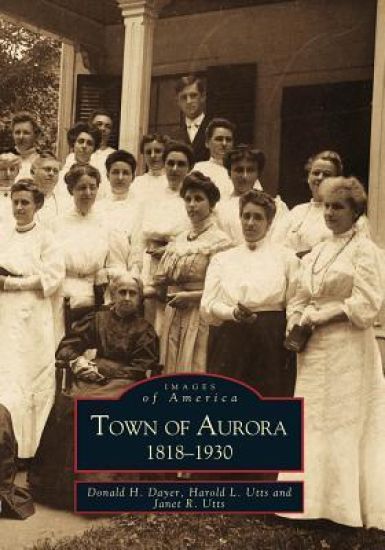
Town of Aurora, 1818-1930

Town of Aurora, 1818-1930

Donald H. Dayer; Harold L. Utts; Janet R. Utts

Arcadia Publishing (SC)
2000
nidottu
At the dawn of the nineteenth century, resourceful pioneers carved a small community out of the wilderness in far western New York State. An agent of the Holland Company opened the way by surveying a road from Big Tree Indian Reservation to Lake Erie in 1803. One mile section of that road today is Main Street, East Aurora. A year later, a man named Jabez Warren obtained a contract for 1,443 acres of land, which makes up a large part of the Town of Aurora. The earliest settlers arrived, cleared the forests, farmed the land, harnessed the waterpower, and built mills. Their efforts and the richness of the land formed the foundation of a town that in years to come provided food and materials for the the city of Buffalo and nearby areas. Town of Aurora: 1818-1930, presents more than a century of the history of this vibrant community. It includes some notable people and places. In the spring of 1823, young attorney Millard Fillmore opened the first law office in town--twenty-seven years before he became the nation's thirteenth president. In 1832, Aurora Academy, the most celebrated institution of learning in western New York, was incorporated. By the 1890s, Hamlin Village Farm, and Jewett's Stock Farm were world famous for the breeding of harness race horses. In 1895, Elbert Hubbard established the arts and crafts community of the Roycrofters, which flourished into the 1930s.
The Cave of Fontéchevade

The Cave of Fontéchevade

Philip G. Chase; André Debénath; Harold L. Dibble; Shannon P. McPherron

Cambridge University Press
2008
sidottu
Summary of the discoveries made during the course of excavations at the Paleolithic cave site of Fontéchevade, France, between 1994 and 1998. The excavation team address major problems raised by earlier excavations at the site from 1937 to 1954. These earlier excavations produced two sets of problematic data : first, the Lower Paleolithic stone tool industry, the Tayacian, that differs in fundamental ways from other contemporary industries, second, the human skull fragment that has been interpreted as modern in nature but that apparently dates from the last interglacial, long before there is any evidence for humans from any other site in Europe. By applying modern stratigraphic, lithic, faunal, geological, geophysical, and radiometric analyses, the interdisciplinary team demonstrates that the Tayacian 'industry' is a product of site formation processes and that the actual age of the Fontéchevade I fossil is compatible with other evidence for the arrival of modern humans in Europe.
Work Decisions in the 1980s

Work Decisions in the 1980s

Eli Ginzberg; Daniel Mills; John Owen; Harold L. Sheppard; Michael L. Wachter

Praeger Publishers Inc
1981
sidottu
What kinds of work will be available in the 1980s? For whom? When should a person retire? Should a retiree find a part-time job? The authors answer such questions by examining a multitude of factors that will affect work decisions in the coming decade. Their findings will alert decision-makers in both private organizations and the government to the employment issues that dominate the 1980s.
The Cave of Fontéchevade

The Cave of Fontéchevade

Philip G. Chase; André Debénath; Harold L. Dibble; Shannon P. McPherron

Cambridge University Press
2014
pokkari
Summary of the discoveries made during the course of excavations at the Paleolithic cave site of Fontéchevade, France, between 1994 and 1998. The excavation team address major problems raised by earlier excavations at the site from 1937 to 1954. These earlier excavations produced two sets of problematic data : first, the Lower Paleolithic stone tool industry, the Tayacian, that differs in fundamental ways from other contemporary industries, second, the human skull fragment that has been interpreted as modern in nature but that apparently dates from the last interglacial, long before there is any evidence for humans from any other site in Europe. By applying modern stratigraphic, lithic, faunal, geological, geophysical, and radiometric analyses, the interdisciplinary team demonstrates that the Tayacian 'industry' is a product of site formation processes and that the actual age of the Fontéchevade I fossil is compatible with other evidence for the arrival of modern humans in Europe.
Strategic And Critical Materials

Strategic And Critical Materials

L. Harold Bullis; James E Mielke; L Harold Bullis

Routledge
2020
sidottu
Much attention has been focused on U.S. dependency on imports for supplies of strategic minerals and materials. There is alarm about the extent of that dependency and about the possibility that U.S. economic, political, and strategic decisions might be unduly influenced by arbitrary actions of foreign suppliers. In addition, there is concern that t
Strategic And Critical Materials

Strategic And Critical Materials

L. Harold Bullis; James E Mielke; L Harold Bullis

TAYLOR FRANCIS LTD
2024
nidottu
Much attention has been focused on U.S. dependency on imports for supplies of strategic minerals and materials. There is alarm about the extent of that dependency and about the possibility that U.S. economic, political, and strategic decisions might be unduly influenced by arbitrary actions of foreign suppliers. In addition, there is concern that t