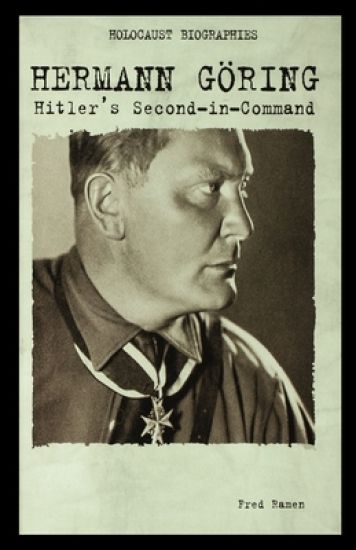
Hermann Goring was with Hitler from the beginning of his career as a minor politician in Munich to his ruthless domination of Europe. Soldier, politician, and general, Goring was an important and influential member of the Nazi Party. In this biography the author deftly chronicles the shocking life and times of this key member of the Third Reich.
Hermann Hesses Geschichte des Brahmanensohns Siddhartha, der sich aufmacht, sich selbst zu finden, ist ein Klassiker der modernen spirituellen Literatur. Erschienen 1922, bezaubert das Buch bis heute seine zahlreichen Leser, die es immer wieder aufs Neue f r sich entdecken. Worauf beruht die Faszination dieser einfachen und doch so tiefgr ndigen Erz hlung? In seinem ausf hrlichen Kommentar erl utert Eberhard Ostermann alle wichtigen Aspekte des Textes: von den biografischen Hintergr nden seiner Entstehung ber die Fragen des Stils und Aufbaus bis hin zu seinem religi sen und philosophischen Gehalt. Zur Sprache kommt auch der geistes- und sozialgeschichtliche Kontext, in den das Werk eingeflochten ist. Dabei werden die Ergebnisse der Forschung auf behutsame und allgemein verst ndliche Weise eingearbeitet. Dem Leser steht somit ein klar gegliedertes und gut lesbares Handbuch zur Verf gung, das auf nahezu alle Fragen zu Hesses "Siddhartha" eine Antwort gibt. Das Buch wendet sich ebenso an den Anf nger, der neugierig ist auf ein viel gelesenes und viel ger hmtes, teils auch geschm htes Werk der Literatur, wie an den Fortgeschrittenen, der sich, sei es in der Schule, sei es im Studium, mit Hesses Erz hlung besch ftigt, und nicht zuletzt berrascht es den Kenner, der schon alles ber einen altbekannten Text zu wissen meint, mit neuen Einsichten und Perspektiven.
Johann Karl Wezel: Hermann und Ulrike Edition Holzinger. Taschenbuch Berliner Ausgabe, 2013, 2. Auflage Vollst ndiger, durchgesehener Neusatz mit einer Biographie des Autors bearbeitet und eingerichtet von Michael Holzinger Erstdruck: Frankfurt und Leipzig (Johann Gottfried Dyck) 1780. Textgrundlage ist die Ausgabe: Johann Karl Wezel: Hermann und Ulrike. Ein komischer Roman. Mit einem Nachwort herausgegeben und erl utert von Gerhard Steiner, Leipzig: Insel, 1980. Herausgeber der Reihe: Michael Holzinger Reihengestaltung: Viktor Harvion Umschlaggestaltung unter Verwendung des Bildes: Johann Karl Wezel (Kupferstich von Christian Gottlieb Geyser, 1780) Gesetzt aus Minion Pro, 10 pt.
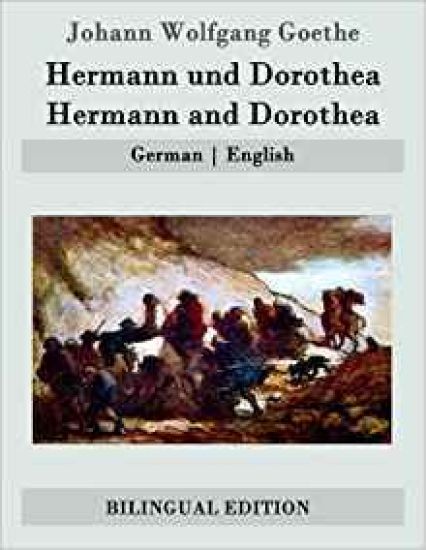
Johann Wolfgang Goethe: Hermann und Dorothea / Hermann and Dorothea. German - English Zweisprachige Ausgabe. bersetzt von Ellen Frothingham Gro format, 216 x 279 mm Berliner bilinguale Ausgabe, 2015 Absatzgenau synchronisierter Parallelsatz in zwei Spalten, bearbeitet und eingerichtet von Thomas A. Martin. Erstdruck: In: Taschenbuch f r 1798, Berlin 1797. Textgrundlage ist die Ausgabe: Johann Wolfgang von Goethe: Berliner Ausgabe. Herausgegeben von Siegfried Seidel: Poetische Werke Band 1-16]; Kunsttheoretische Schriften und bersetzungen Band 17-22], Berlin: Aufbau, 1960 ff. Herausgeber der Reihe: Michael Holzinger Reihengestaltung: Viktor Harvion Umschlaggestaltung unter Verwendung des Bildes: Honor -Victorin Daumier, Fl chtlinge, um 1850 Gesetzt aus Minion Pro, 11 pt.
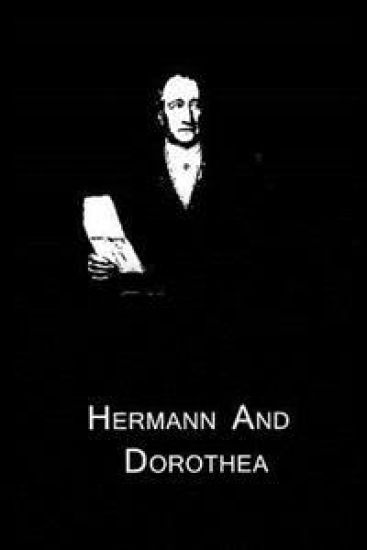
Hermann and Dorothea is an epic poem, an idyll, written by German writer Johann Wolfgang von Goethe between 1796 and 1797, and was to some extent suggested by Johann Heinrich Voss's Luise, an idyll in hexameters, which was first published in 1782-84. Goethe's work is set around 1792 at the beginning of the French Revolutionary Wars, when French forces under General Custine invaded and briefly occupied parts of the Palatinate. The story of the well-settled burgher's son marrying a poor fugitive was contained in an account of the Salzburg Protestants who, for their religion, in 1731 fled from their old homes into Germany. The inhabitants and conditions of the little town which is the scene of Hermann and Dorothea are pictured in contrast to the turmoil of the French Revolution, for they stand for the foundations on which civilization will always rest. The leading characters represent the standard callings of men - the farmer, the merchant, the apothecary-doctor, the minister, the judge. The hero is the true son of mother earth, given to tilling the soil and harvesting his crops. The life both in family and community is depicted as the fundamental social forms, with some hints of national life. The love story of the young couple is free from wild romance, indeed their love makes them look to the future not with any anticipation of pleasure or extravagance, but with the instinctive conviction that the true blessings of life flow from the performance of necessary tasks. The public spirit of Hermann's father germinates also in the son's character as his burning patriotism protests against the French invasion. But the spirit that permeates the poem as a whole is that of trust in the future and sympathy with mankind. Ewald Eiserhardt, who reviews this work for Encyclopedia Americana, cites the serene flow of presentation, the masterly descriptions of landscape and home, the plastic vigor of the main figures, the balance of color, all as rendering Hermann and Dorothea a great work of literary art.